A tiny stone and a fluffy sponge can both fit in your hand, but they do not feel the same at all. One is hard, one is soft. One may sink, one may float. When children look closely at objects, they begin to act like young scientists. They collect information, talk about what they notice, and keep a record so they can remember it later.
When we study objects, we look at their physical properties. A physical property is something we can notice with our senses. We may see color, feel texture, or notice shape and size. Scientists use careful observation, as [Figure 1] shows, to learn how objects are alike and different.
An object can be hard or soft, smooth or rough, big or small. A red ball, a brown stick, and a shiny spoon do not look or feel the same. These differences help us describe each object. If a cup is made of glass, it may feel smooth. If a towel is made of cloth, it may feel soft.
Observe means to look, touch, listen, or notice carefully. Record means to save information so we can look at it again. Predict means to make a smart guess using what we already know.
We can also sort objects into groups. For example, we can put all the round objects together, all the soft objects together, or all the things that are blue together. Grouping helps us see patterns. A pattern is something that repeats or goes together in a useful way.
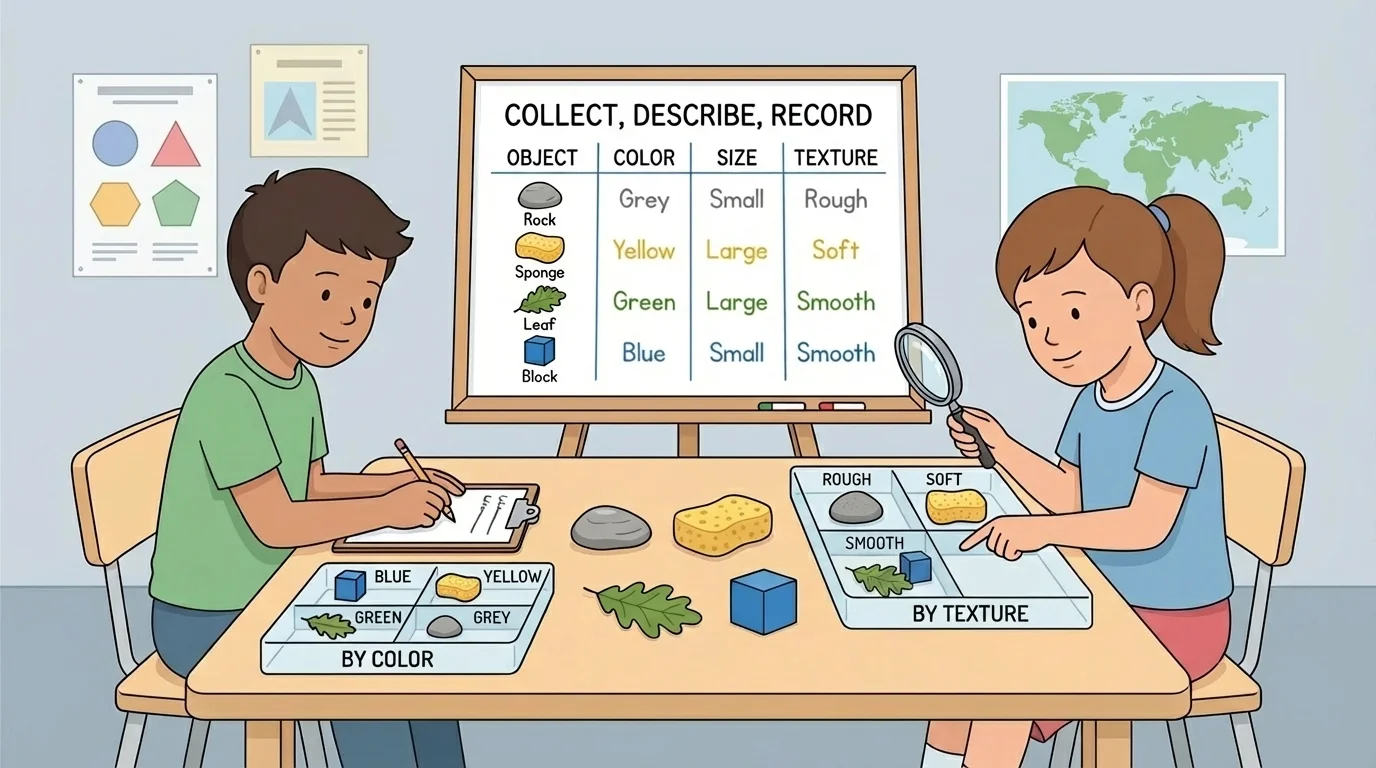
Sometimes we learn by comparing two objects. A rock may be heavier than a leaf. A sponge may feel softer than a wooden block. Even very young learners can say, "This one is rough," or "That one is bigger." These words help turn noticing into science talk.
Information can be kept in many forms, and the same ideas can be shown with pictures, maps, graphs, and charts. Recording is important because our eyes and hands notice many things, and a record helps us remember them.
[Figure 2] One way to record information is with words. We can say or write simple descriptions such as "The shell is white," "The block is hard," or "The ball is round." Words tell what an object is like.
Another way is with a drawing. A drawing can show shape, color, and parts of an object. If we draw a leaf, we may add its pointed tip and green color. If we draw a toy car, we may show its wheels and windows.
A simple map can show where things are. In a room, a map might show that the books are on one shelf and the blocks are in one bin. A map helps us record place. It answers the question, "Where is it?"
A graph can show which group has more and which has fewer. If we count red blocks and blue blocks, a graph can help us see the difference quickly. A chart can help us sort information into spaces, such as soft things in one part and hard things in another part.
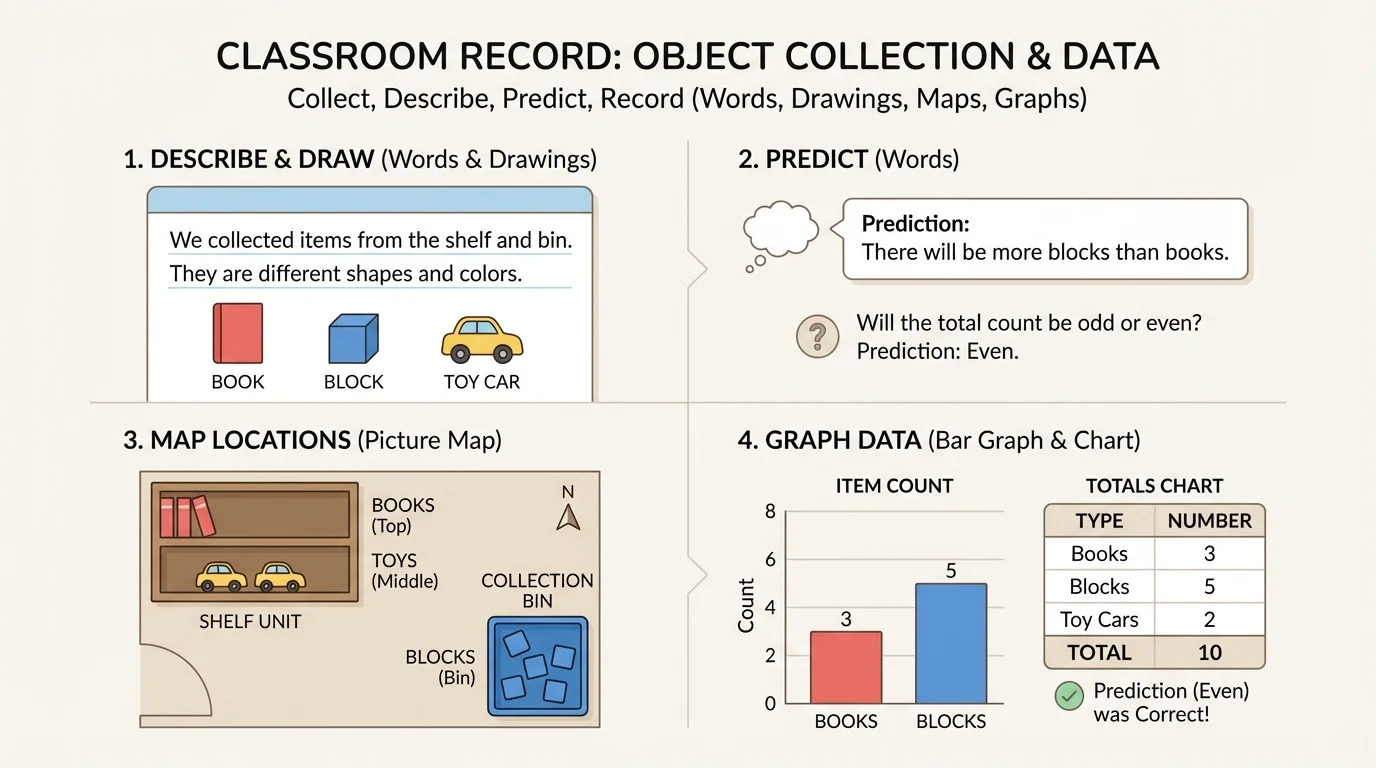
When children use more than one kind of record, they understand information in more than one way. A drawing shows what something looks like. A map shows where it is. A graph shows how many. A chart shows how things are grouped.
After we collect and record information, we describe it. Describing means telling what we found. We may say, "Most of the blocks are blue," or "The shells are smoother than the rocks." Describing helps us explain our observations clearly.
We can look for simple patterns. For example, many metal spoons feel hard and smooth. Many cotton balls feel soft and light. When we notice a pattern, we begin to understand how properties help us know an object better.
Why properties matter
Physical properties help people choose and use materials. A raincoat needs to keep water out, so it must be made from a material that does not soak up water easily. A pillow should feel soft, so people choose soft materials. Looking at properties helps us solve simple problems.
Describing information can also include comparing groups. If we have leaves, stones, and buttons, we may notice that the stones are often harder than the leaves. We may also notice that buttons can come in many colors. These descriptions come from careful looking and touching.
Later, when we look back at our records, we can talk about them again. That is why recording is so useful. As we saw earlier in [Figure 2], a chart or graph lets us return to the information and discuss it clearly.
A prediction is a smart guess based on information we already have. It is not just any guess. We use what we observed first. As [Figure 3] illustrates, a child can look at a record of objects that sink or float and then make a guess about a new object.
For example, if we notice that many heavy rocks sink in water, we may predict that another heavy rock will sink too. If we notice that many light cork pieces float, we may predict that a new cork piece will float. We use the pattern to help us think ahead.
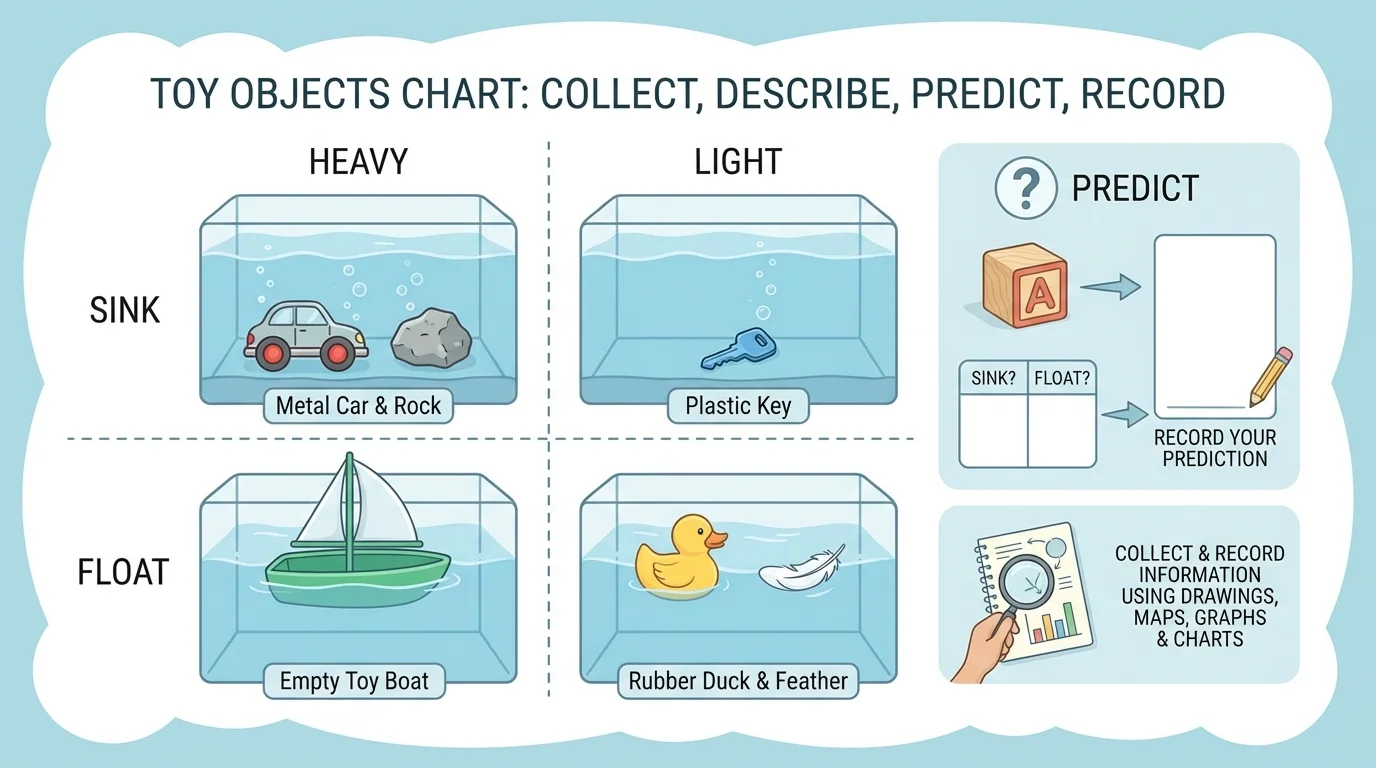
Predictions can also be about sorting. If several objects that feel soft are all cloth or sponge, we may predict that a new soft object belongs in the soft group. We make the best prediction we can, and then we can test it by looking, touching, or trying it safely.
Real-world example: choosing the right cup
Step 1: Observe two cups.
One cup is plastic and light. One cup is paper and soft when wet.
Step 2: Describe the properties.
The plastic cup is smooth and keeps its shape. The paper cup may become weak after getting wet.
Step 3: Predict.
If water stays in the cups for a long time, the plastic cup will likely hold up better.
The prediction comes from observed properties of the materials.
Good predictions do not need to be perfect every time. They need to be based on what we know. If the prediction is wrong, that still teaches us something new.
People use collecting and recording every day. A cook looks at ingredients and chooses soft fruit for a smoothie. A builder chooses hard materials for a wall. A parent may sort toys by size or shape to put them away. These are simple uses of observation and recording.
In a classroom, children may collect leaves from outside and make a chart of colors: green, yellow, and brown. They may draw the leaves, place them on a map of the playground, and make a graph to show which color appeared most often. This turns noticing into organized information.
Maps, drawings, graphs, and charts are helpful because they make thinking visible. They let us share our ideas with other people. They also help us remember details. A child may forget where a shell was found, but a map can preserve that information.
Some scientists spend years collecting information about rocks, plants, or weather. They often begin with the same basic skills young learners use: observe carefully, record clearly, and look for patterns.
When we look back to the sorting in [Figure 1], we can see that grouping by properties is one of the first big ideas in science. The same skill helps scientists study materials, animals, and places.
Every careful word, drawing, map, graph, and chart tells part of a story about the world. When we collect information, describe it, predict from it, and record it, we learn how objects and materials help us understand our surroundings.
