Have you ever seen a ball sit very still and then zoom away? Something made that happen. When we touch or move things, we can make them start moving, stop moving, or move in a new way. Science helps us notice what we do and what happens next.
A cause is something that makes something happen. An effect is what happens after. If you push a toy car, the push is the cause. The car moving is the effect.
Cause means the action or event that makes something happen. Effect means the result that happens after the cause.
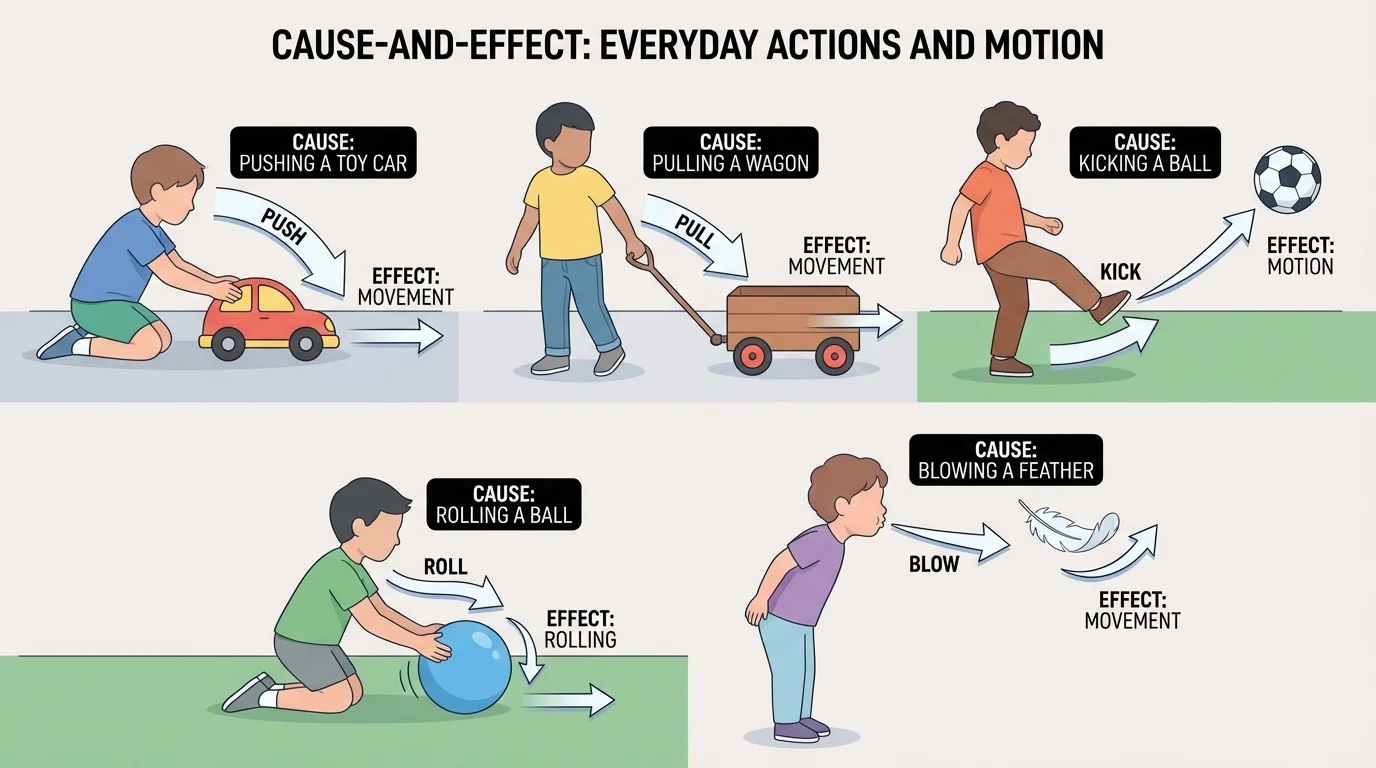
We can find cause and effect in many little moments each day. A hand pushes a door, and the door opens. Feet kick a ball, and the ball rolls away. Air from your mouth blows a feather, and the feather moves.
Objects move in different ways because of different actions, as [Figure 1] shows. A push moves something away. A pull brings something closer. A kick uses your foot to move something. To roll is to turn and move along a surface. To blow is to move air so a light object can move.
When you push a stroller, it goes forward. When you pull a wagon, it follows you. When you kick a playground ball, it can travel across the grass. When you roll a round orange on a table, it turns as it moves. When you blow on a tissue or feather, the air can make it slide or flutter.
Some objects are easy to move. A feather is light, so blowing can move it. A big box is harder to move, so it may need a stronger push or pull. Round objects, like balls, often roll more easily than flat objects.
A tiny puff of air can move some objects. That is why bubbles drift and feathers flutter when moving air touches them.
Sometimes the same object can move in more than one way. A ball can be pushed, kicked, or rolled. The action is the cause, and the way the ball moves is the effect.
Actions can change motion in several ways, and [Figure 2] illustrates these changes with one ball. An object can start moving if it was still. It can stop if something blocks it. It can go faster with a bigger push. It can also change direction if it is hit or kicked from the side.
A soft push may make a toy car move slowly. A stronger push may make the same car move faster. If a rolling ball bumps into a wall, the wall can stop it or make it bounce another way. If you pull a toy on a string, the toy follows your path.
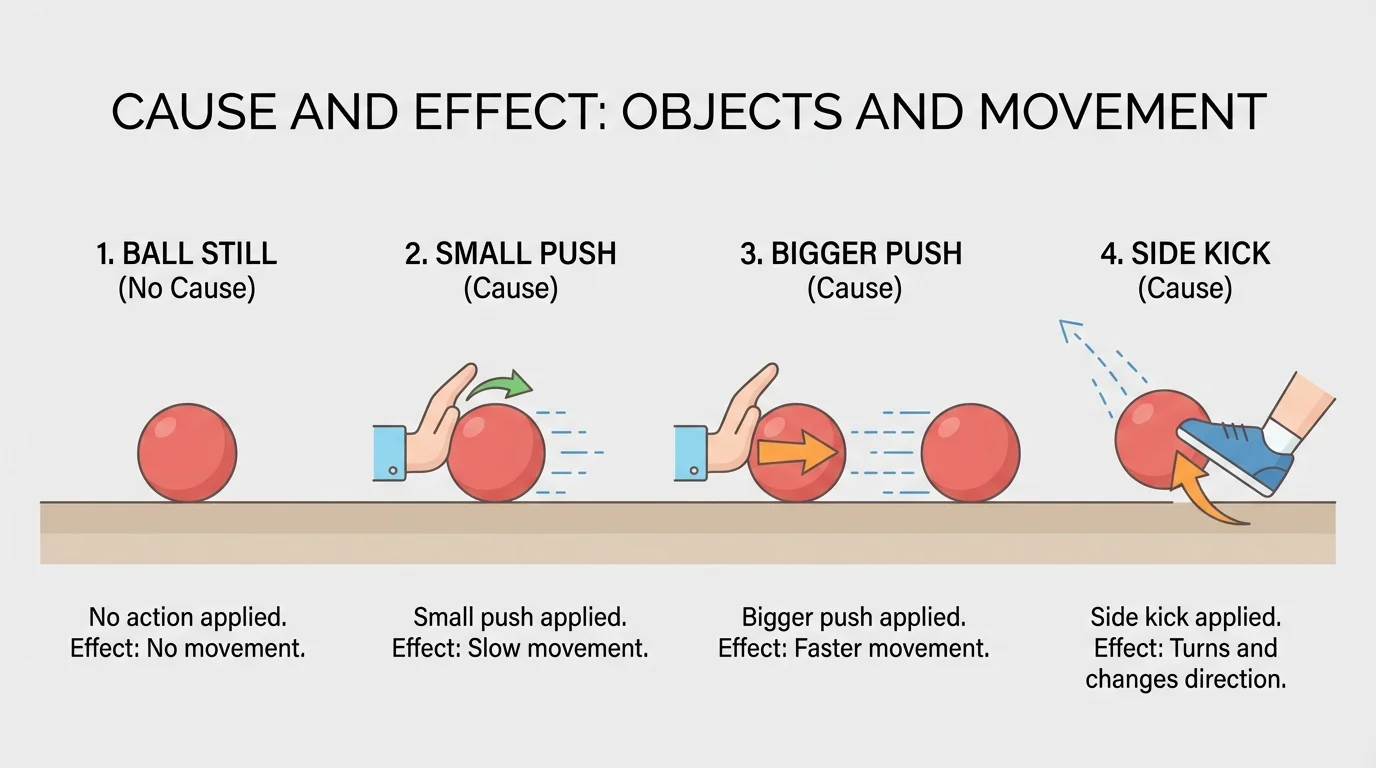
We can use simple describing words. We can say started, stopped, faster, slower, or changed direction. These words help us tell the effect clearly.
Actions change motion. When a person or moving air acts on an object, the object may begin to move, move in a different direction, or move with a different speed. Not every action makes the same effect, because objects are different sizes, shapes, and weights.
A leaf on the ground may move when wind blows. A heavy chair usually does not move from a tiny puff of air. This tells us that the kind of object matters too. The same cause does not always make the same effect for every object.
Scientists watch carefully. They notice what happened first and what happened next. If a child pulls a ribbon tied to a toy, the pull happens first. Then the toy slides. That order matters.
You can investigate by looking at one action and one result. For example, if a ball is still and then someone kicks it, the kick is the cause and the ball moving is the effect. If a pinwheel is still and then air blows on it, the moving air is the cause and the spinning is the effect.
Everyday investigation examples
Step 1: Look at the object before the action.
The toy car is still.
Step 2: Notice the action.
A hand pushes the toy car.
Step 3: Notice the effect.
The toy car moves forward.
We can say, "The push made the car move."
Good science descriptions are simple and accurate. "I pushed the ball, and it rolled." "I blew on the feather, and it moved." "I pulled the wagon, and it came with me."
At the playground, children use cause and effect all the time. A child kicks a ball, and the ball travels. A child pulls a swing, and the swing moves back. A child pushes a toy truck, and the truck rolls across the floor.
At home, a person can pull a drawer open, push a chair in, or blow bubbles through a wand. In each case, an action comes first. Then we can see the result. As we saw in [Figure 1], different actions can move different objects in different ways.
Outside, wind can act like a push from moving air. Wind blows leaves, paper, and pinwheels. The wind is the cause. The moving leaves or spinning pinwheel are the effects. This is like blowing with your mouth, but the air is moving outdoors.
We can also compare what happens. A ball usually rolls farther than a block because a ball is round. A feather moves more easily than a book because it is much lighter. The picture in [Figure 2] reminds us that the same object can move differently when the action changes.
When we explore movement, we use safe objects and gentle actions. Soft balls, toy cars, feathers, and paper are good choices. We keep people safe by not kicking objects near others and by not blowing small things toward anyone's face.
Science begins with noticing. When you see something move, ask: What caused it? Then ask: What happened because of that action? Those two questions help us understand cause and effect everywhere around us.
