Why does ice turn into water? Why does a ball move when we push it? Young scientists learn by wondering, testing, and watching closely. A simple experiment helps us find answers to questions. When we test an idea, we can see that one thing happens because of another thing. That is called cause and effect.
Science often begins with a question. A question can be very simple: "Will this leaf float?" "What happens if I shake the bell?" "Will the ice stay hard in a warm place?" Good science questions are about things we can see, touch, hear, or watch happen.
Science questions can help us learn about matter and energy. Matter is the "stuff" things are made of, like water, wood, rock, and air. Energy is what can make things move, warm up, light up, or make sound. A push can move a toy car. Warm sunlight can melt ice. A shake can make a rattle sound.
Prediction is a smart guess about what may happen.
Observation is what we notice by using our senses.
Experiment is a test we do to answer a question.
Questions help us focus. Instead of asking many things at once, we try one question. That makes it easier to see the answer clearly.
Before we test, we make a prediction. A prediction is not just any guess. It is a guess based on what we already know. A child may say, "I think the rock will sink because it feels heavy." Another child may say, "I think the bell will make sound when I tap it."
Predictions can be right or wrong, and that is okay. Science is about finding out. Sometimes a prediction matches what happens. Sometimes the experiment surprises us. Both results help us learn.
Cause and effect means one thing makes another thing happen. If you push a toy, it moves. The push is the cause. The movement is the effect. If ice gets warm, it melts. The warmth is the cause. The melting is the effect.
When children talk about their predictions, they begin to connect ideas: heavy things may sink, warmth may melt ice, and shaking may make sound. These are early science patterns.
[Figure 1] A simple experiment is a careful test. In a fair test, we try to change just one thing and keep the other parts the same. If we want to know whether a rock or a leaf sinks, we can put both into cups with the same kind of water. Then we watch what happens.
Simple experiments use easy steps. First, ask the question. Next, make a prediction. Then test it. Last, look carefully at what happened. We do not need big machines. Cups, water, ice, paper, blocks, balls, or spoons can be useful science tools.
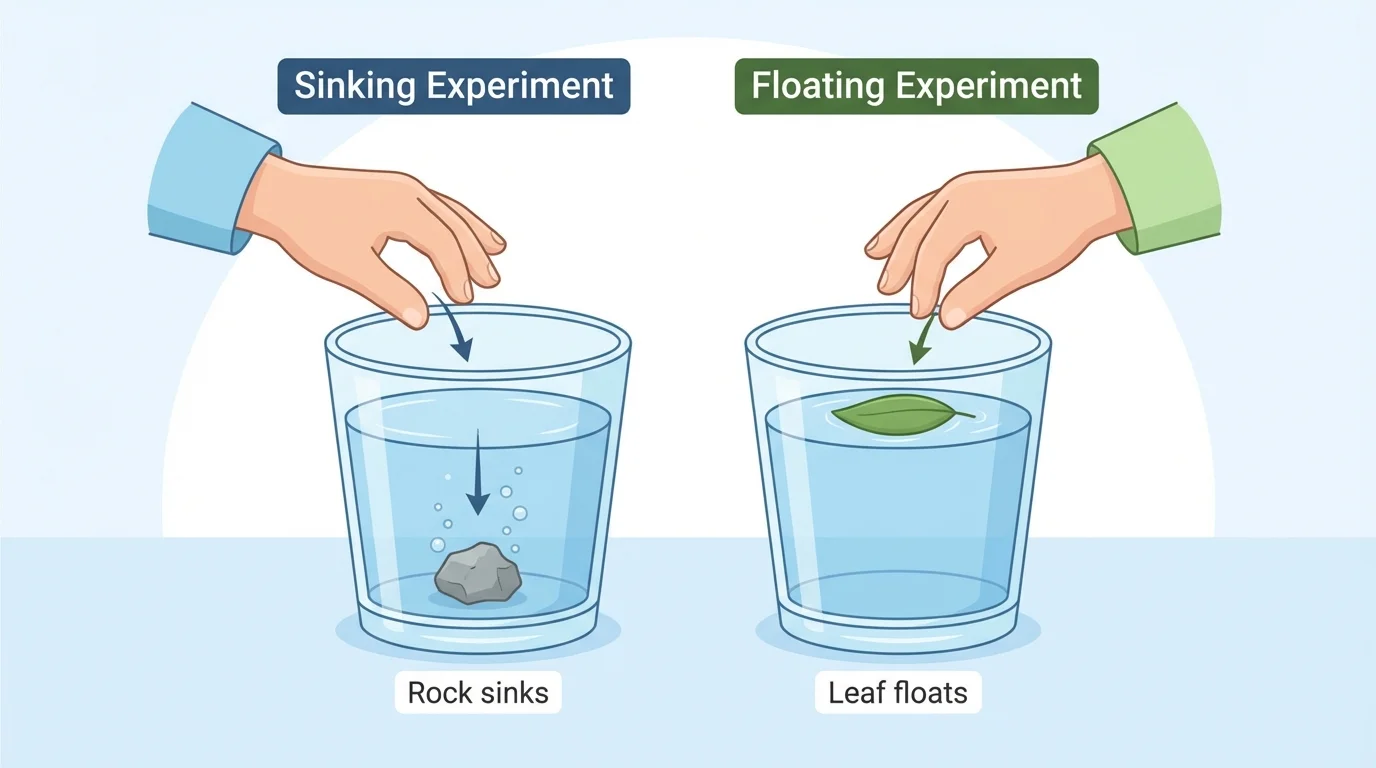
When we test, we use our senses safely. We look for movement, color, size, shape, floating, sinking, melting, or sound. We can listen for a quiet bell or feel whether something is warm or cool with an adult helping.
It helps to test one idea at a time. If we change too many things, we may not know what caused the result. Using the same water in both cups makes comparing easier.
Example: Testing what floats
Step 1: Ask a question
"Will a leaf float and will a rock sink?"
Step 2: Make a prediction
"I think the leaf will float. I think the rock will sink."
Step 3: Test it
Put the leaf in water. Put the rock in water.
Step 4: Observe
The leaf stays on top. The rock goes down.
The test helps answer the question.
Some experiments happen quickly, like tapping a drum to hear sound. Some take more time, like watching ice melt. In both cases, careful watching matters.
After testing, we talk about our observations. An observation can be simple: "The block did not move until I pushed harder." "The ice got smaller." "The spoon made a louder sound when I hit the pan." Observations tell what really happened.
Sometimes we compare. One object floats, and another sinks. One ice cube melts faster than another. One push makes a ball roll a little, and a stronger push makes it roll farther. These comparisons help us understand the result.
| Question | Prediction | Observation |
|---|---|---|
| Will the leaf float? | The leaf will float. | The leaf stayed on top of the water. |
| Will the rock sink? | The rock will sink. | The rock went to the bottom. |
| Will ice melt in warmth? | The ice will melt. | The ice turned into water. |
Table 1. Simple examples of questions, predictions, and observations in early science experiments.
Observations help us decide whether our prediction matched the result. If it did, that is useful. If it did not, that is useful too. The important part is that we tested and learned from what we saw.
Some very small changes can make a big difference. A tiny push can start a toy car moving, and a little warmth from sunlight can slowly change hard ice into liquid water.
[Figure 2] Scientists often repeat experiments. Doing the test again helps us see if the same thing happens each time. Repeating builds confidence in the answer.
The world is full of matter and energy changes. Thermal energy can change materials. Warmth can melt ice into water. A push can make an object move. A shake can make sound. These are physical science ideas we can notice every day.
When ice melts, the matter is still there. It changes from solid ice to liquid water. When a child pushes a ball, energy from the push helps the ball move. When someone taps a drum, the movement makes sound energy we can hear.
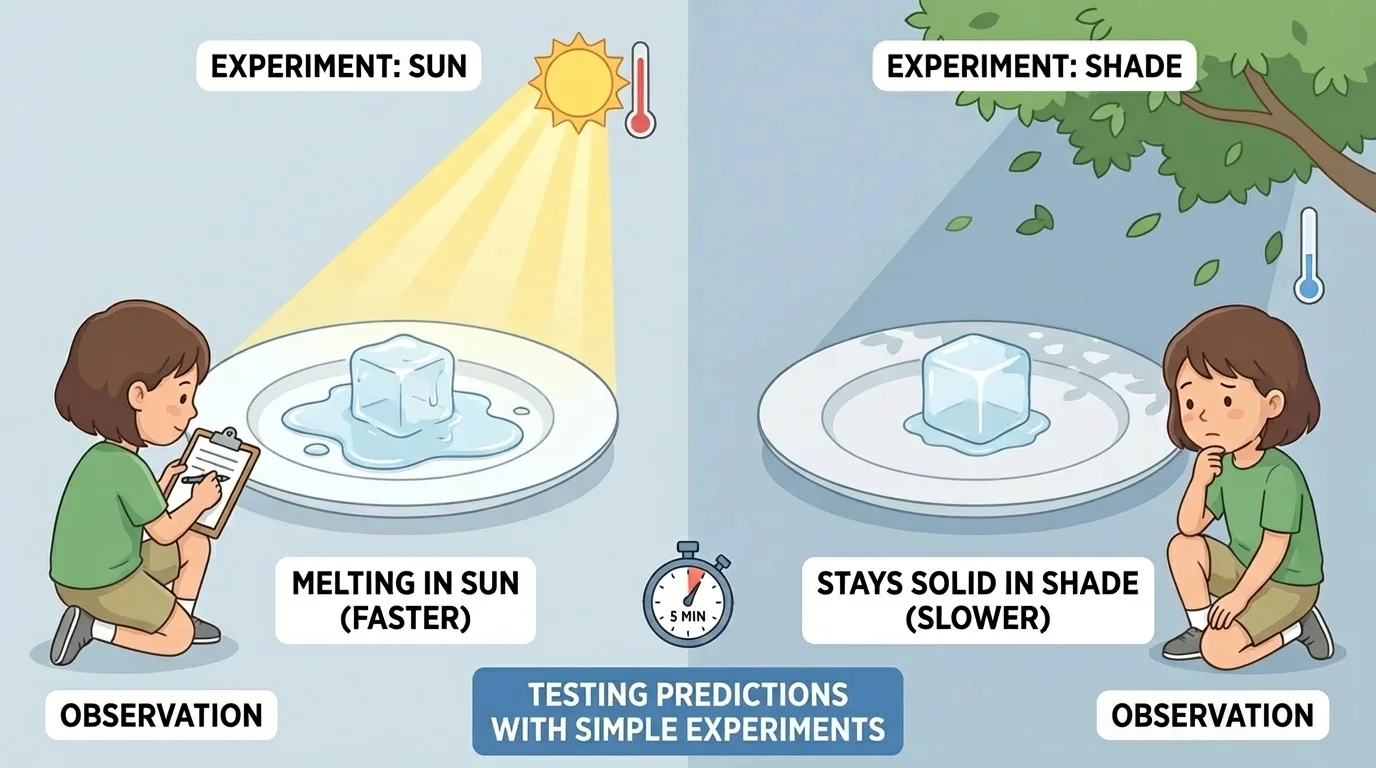
These examples show simple cause-and-effect relationships. Heat causes melting. A push causes movement. A shake causes sound. Children begin to understand that materials can change and that energy helps cause those changes.
Thinking back to melting helps us notice that the warmer place changes the ice faster than the cooler place. That comparison helps us answer the question, "Does warmth change ice?"
Example: Watching ice melt
Step 1: Ask a question
"Will ice melt faster in a warm place?"
Step 2: Make a prediction
"I think the ice in the warm place will melt first."
Step 3: Test it
Put one ice cube in a sunny place and one in a shady place.
Step 4: Observe
The sunny ice cube melts faster.
This shows that warmth can cause a change in matter.
Not every material changes in the same way. A wooden block does not melt like ice. A feather does not sink like a rock. Testing helps us learn the special properties of different materials.
People use simple testing in real life all the time. A cook checks how heat cooks batter into a pancake. A builder tests which block shape stacks best. A gardener watches whether a plant grows better with water and sunlight. These are all ways of asking questions, making predictions, and observing results.
Children do this naturally in play. They roll cars down ramps, splash in water, build towers, and listen to sounds. With guidance, these playful tests become science learning. They show that careful watching can lead to answers.
We learn best when we slow down, change one thing at a time, and notice what happens next. That is how experiments help answer questions.
When we seek answers using simple experiments, we become careful thinkers. We ask, "What happened?" We also ask, "What made it happen?" That is the heart of cause and effect in science.
