A tiny seed can turn into a plant, a puppy can grow bigger, and a bird can flap away when it hears a sound. Living things are all around us, and they are full of clues. We can learn about them by watching carefully, talking about what we see, making pictures, and saving information in simple ways.
A living thing has needs and changes over time. We can recognize living things by what they do and what they need, as [Figure 1] shows. A flower needs water and light. A bird needs food, water, and air. A fish needs water and food. Living things can grow, move in some way, and respond to the world around them.
Living things are plants and animals that need food, water, air, and space to live and grow. They can be observed and studied.
Some living things are big, like trees. Some are small, like ants. Some have fur, some have feathers, and some have leaves. Even though they look different, they all have basic needs. When we study living things, we look for those needs and the body parts that help them live.
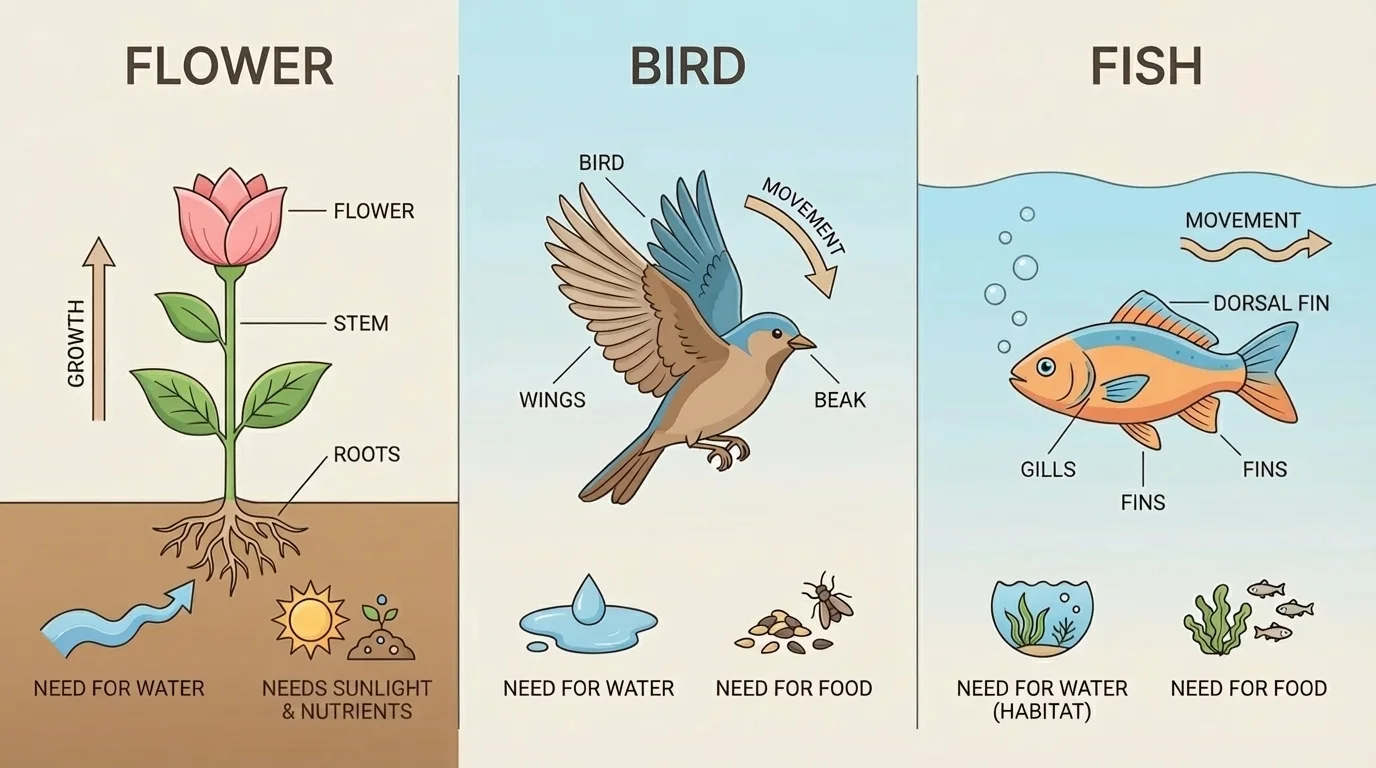
A plant has roots, a stem, and leaves. Roots help take in water. Leaves help the plant use light. An animal may have legs to walk, wings to fly, or fins to swim. These parts help the living thing stay alive. Later, when we compare living things, we can think back to [Figure 1] and notice that different parts do different jobs.
Scientists learn by observing, and young scientists do too. As [Figure 2] illustrates, we can collect information with our eyes, ears, hands, words, drawings, and simple tools. We might look at a leaf and notice its color. We might listen to a bird chirp. We might touch tree bark and feel that it is rough.
We can also talk with others about what we notice. A discussion helps us share ideas such as, "The snail moves slowly," or "The flower is yellow." When we say what we see, we are describing the living thing. Careful discussion helps us remember details.
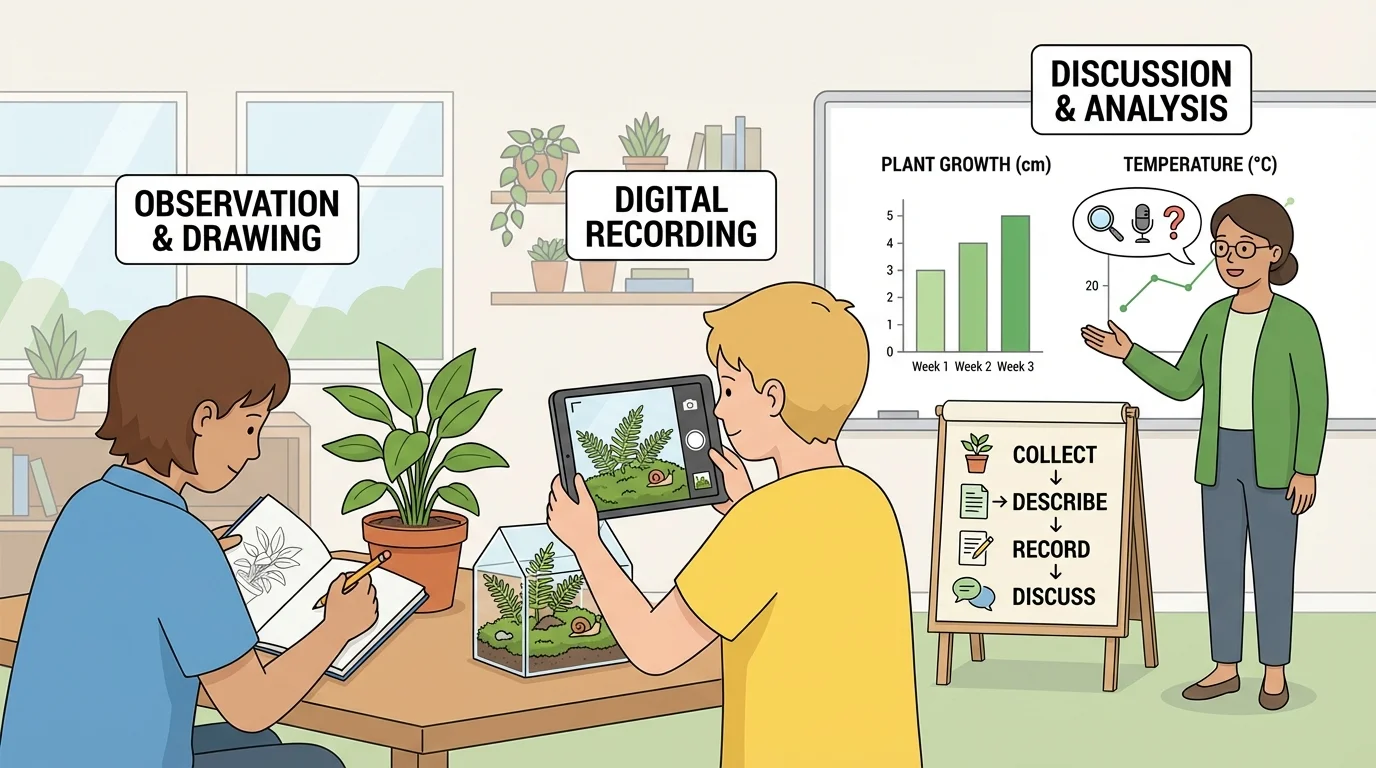
Another way to collect information is to make a drawing. A drawing can show the shape of a leaf, the long neck of a giraffe, or the round body of a ladybug. A picture helps us remember what we saw. We can also use technology, such as a tablet or camera, to take a photo. Photos help us look again later.
Some scientists watch the same animal or plant again and again over many days. This helps them notice changes, such as a bud opening into a flower or a caterpillar becoming a butterfly.
When we collect information, we try to be careful and kind. We look closely, but we do not pull petals off flowers or scare small animals. Studying living things means noticing them respectfully.
When we describe a living thing, we use words that tell about its color, size, shape, body parts, movement, and needs. A rabbit may be soft, small, brown, and fast. A tree may be tall, green, rough, and still. Good describing words help other people understand exactly what we observed.
Describing with details means saying more than just a name. Instead of saying "bird," we can say "a small black bird with a short beak." Instead of saying "plant," we can say "a green plant with three wide leaves."
We can also describe what a living thing needs. A cat drinks water. A plant needs sunlight. A fish lives in water. These details help us understand how living things survive. A habitat is the place where a living thing lives, such as a pond, garden, tree, or home.
Sometimes we compare two living things. A dog and a cat both need food and water, but a dog may bark and a cat may meow. A flower and a tree are both plants, but one may be small and one may be tall. Comparing helps us notice what is the same and what is different.
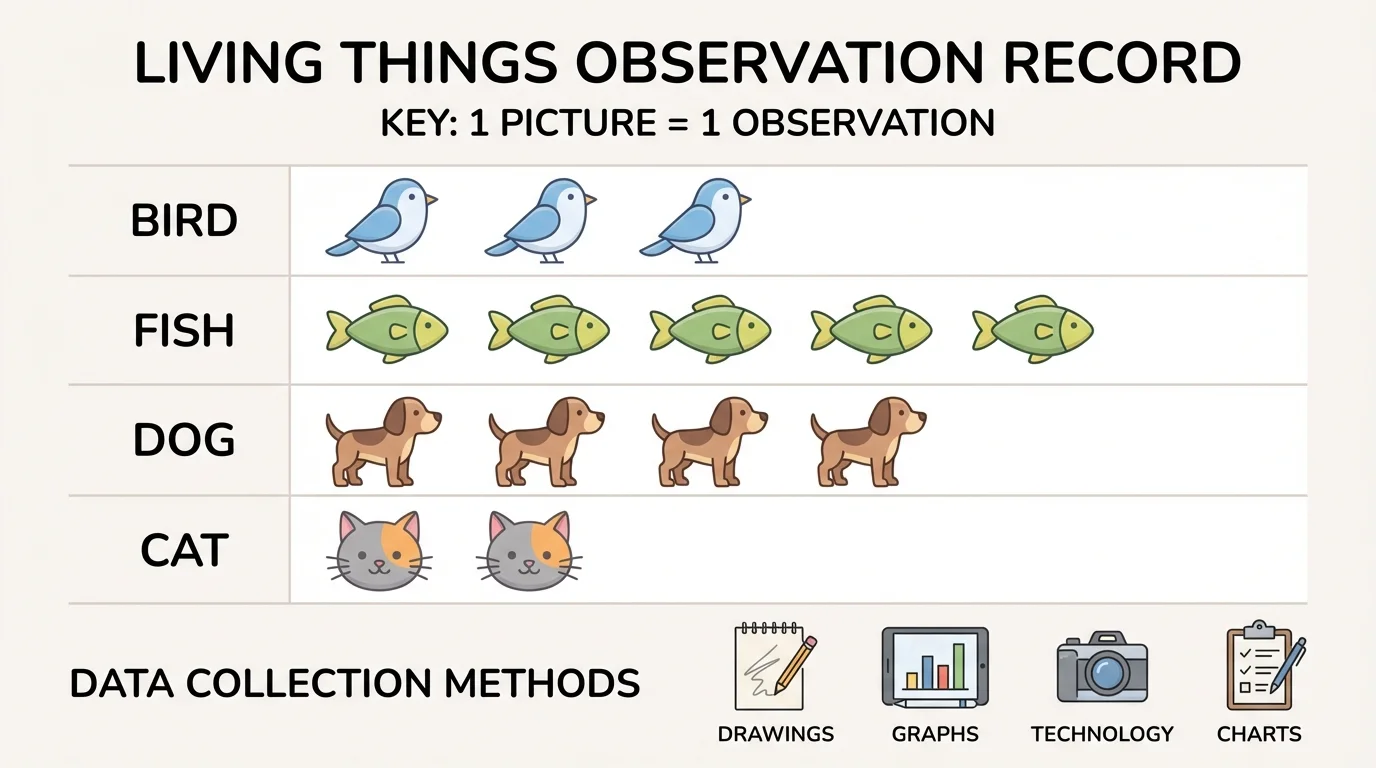
After we collect information, we can record it so it is easy to see again. A chart can help us list what we observed. As [Figure 3] shows, a graph can help us compare how many of each living thing we found.
For example, a class might look outside and notice birds, butterflies, and squirrels. The class can put that information in a simple chart.
| Living thing | What we noticed |
|---|---|
| Bird | Has feathers and flies |
| Butterfly | Has wings and drinks nectar |
| Squirrel | Has fur and climbs trees |
Table 1. A simple observation chart showing living things and what was noticed about them.
A picture graph uses pictures to show how many observations there are. If we saw one bird, two butterflies, and one squirrel, we could record the amounts with pictures. In a simple graph, one picture can stand for one observation. This makes comparing easy for young learners.
Recording a class observation
A class looks at pets in photos brought from home.
Step 1: Collect information
The class notices a dog, a cat, a fish, and another dog.
Step 2: Sort the information
Dogs go together, cats go together, and fish go together.
Step 3: Record the information
The chart says: dogs = \(2\), cats = \(1\), fish = \(1\).
Step 4: Talk about the graph
The class can say, "We saw more dogs than cats," because \(2 > 1\).
Charts and graphs help us save information and talk about it clearly.
Recording information helps us answer questions. Which living thing did we see most? Which one did we see least? What colors did we notice most often? Good records help us remember and compare.
People use observation and records every day. An observation note helps a gardener remember which plant is growing well. A veterinarian watches an animal's behavior, body, and eating habits. A zookeeper records what an animal eats and how it moves. These records help people care for living things in safe ways.
When we use our senses to learn about the world, we gather information. Science uses that information to answer questions.
Technology also helps in real life. A camera can save a photo of a plant each week to show growth. A computer can store class pictures and sort them into groups. A tablet can help children look closely at a photo again. These tools make studying living things easier.
Just as in [Figure 2], people often work together while collecting information. One person may watch, another may draw, and another may record. Science is often a team effort.
When we know what a living thing needs, we can help care for it. A classroom plant needs water and light. A pet needs food, water, shelter, and gentle care. If we do not meet those needs, the living thing may not stay healthy.
"Look closely, and nature tells a story."
Learning to collect, describe, and record information helps us become careful thinkers. It also helps us become caring people who understand that living things are special and need respect.
