Have you ever seen a puppy run, a flower grow, and a rock stay exactly the same? The world is full of things around us, but not all things are alive. Some things are living, and some things are nonliving. Learning the difference helps us look at nature like young scientists.
A living thing is something that is alive. A dog is alive. A bird is alive. A tree is alive. A person is alive. Even a tiny bug is alive. These examples are easy to see in the world around us, and [Figure 1] shows familiar things children may notice at home or outside.
Living things do special things. They grow. They need food and water. Many living things need air. They can change over time. A baby grows into a child. A small plant grows taller. A kitten becomes a cat.
Nonliving things are not alive. A rock is not alive. A ball is not alive. A chair is not alive. A toy is not alive. These things do not grow by themselves, and they do not need food or water to stay alive.
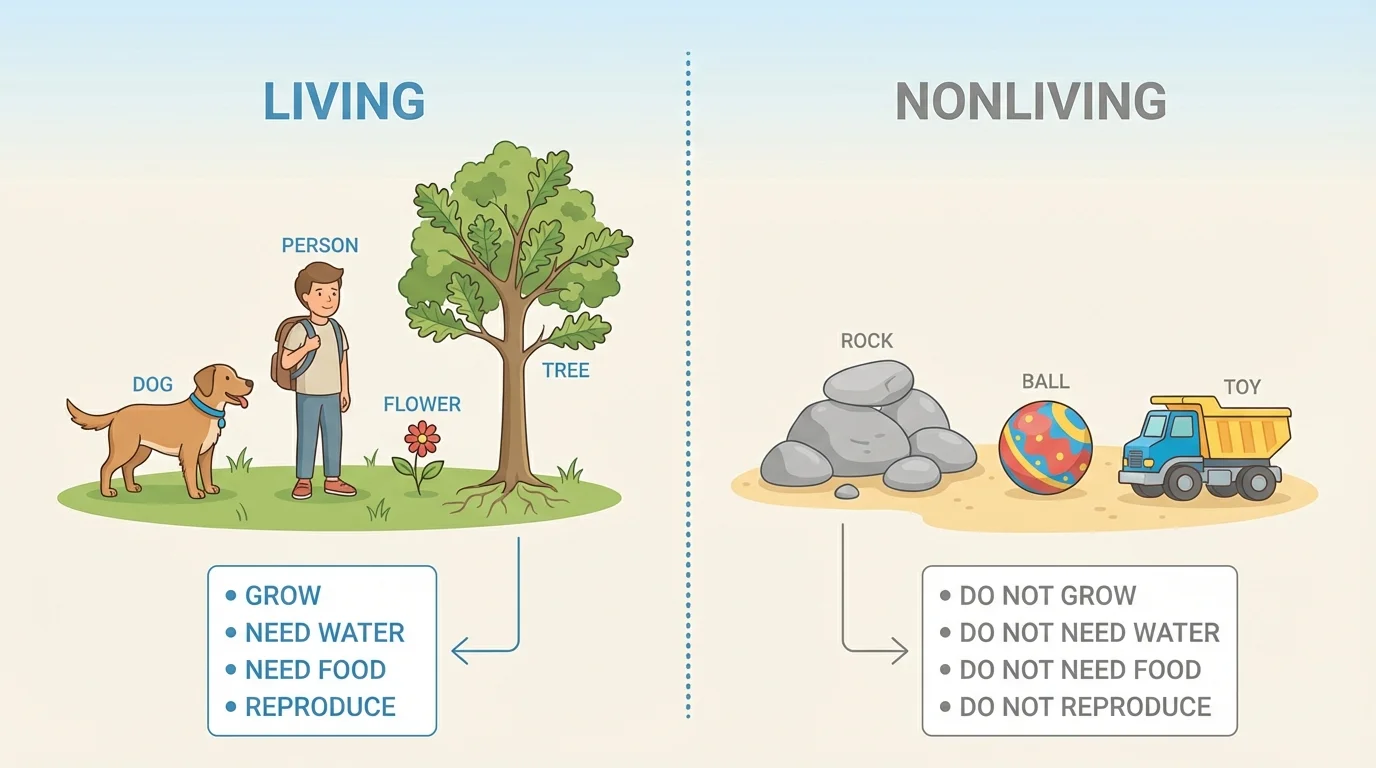
Living things are things that are alive. They grow, need basic things like water and food, and change over time.
Nonliving things are things that are not alive. They do not grow, eat, or need water to stay alive.
Some living things are animals, and some living things are plants. Animals and plants may look very different, but both are alive. A fish swims, and a flower stays in one place, yet both are living things.
All living things have basic needs. Basic needs are things living things must have to live. People need food, water, air, and shelter. Dogs need food, water, air, and a safe place too. Plants need water, air, sunlight, and space to grow.
When a plant does not get water, it can droop and die. When a pet does not get food or water, it becomes weak. This is one big clue that something is living: it needs things from its environment.
Growing and changing
Living things do not stay exactly the same forever. A seed can grow into a plant. A baby bird can grow feathers. A child can grow taller. Growing is one important sign of life.
Nonliving things do not have basic needs. A toy truck does not need lunch. A spoon does not need water. A rock can sit outside in the rain, but it is still not alive because it does not use the water to live and grow.
The differences are easier to notice when we compare things, and [Figure 2] shows this clearly. Living things usually grow, need food or water, and can make more living things like themselves. Nonliving things do not do these things.
Some living things move on their own. A cat walks. A bird flies. A worm wiggles. Plants do not walk, but they still move in small ways. A sunflower turns toward sunlight. This reminds us that movement is not the only sign of life.
Some nonliving things can move, but only when something makes them move. A ball rolls when someone kicks it. A car moves when a person drives it. A kite flies when the wind blows. That does not mean they are alive.
| Thing | Living or Nonliving | Why? |
|---|---|---|
| Dog | Living | Needs food and water, grows, moves on its own |
| Tree | Living | Grows, needs water and sunlight |
| Rock | Nonliving | Does not grow or need food |
| Ball | Nonliving | Can move, but not by itself |
Table 1. A simple comparison of living and nonliving examples.
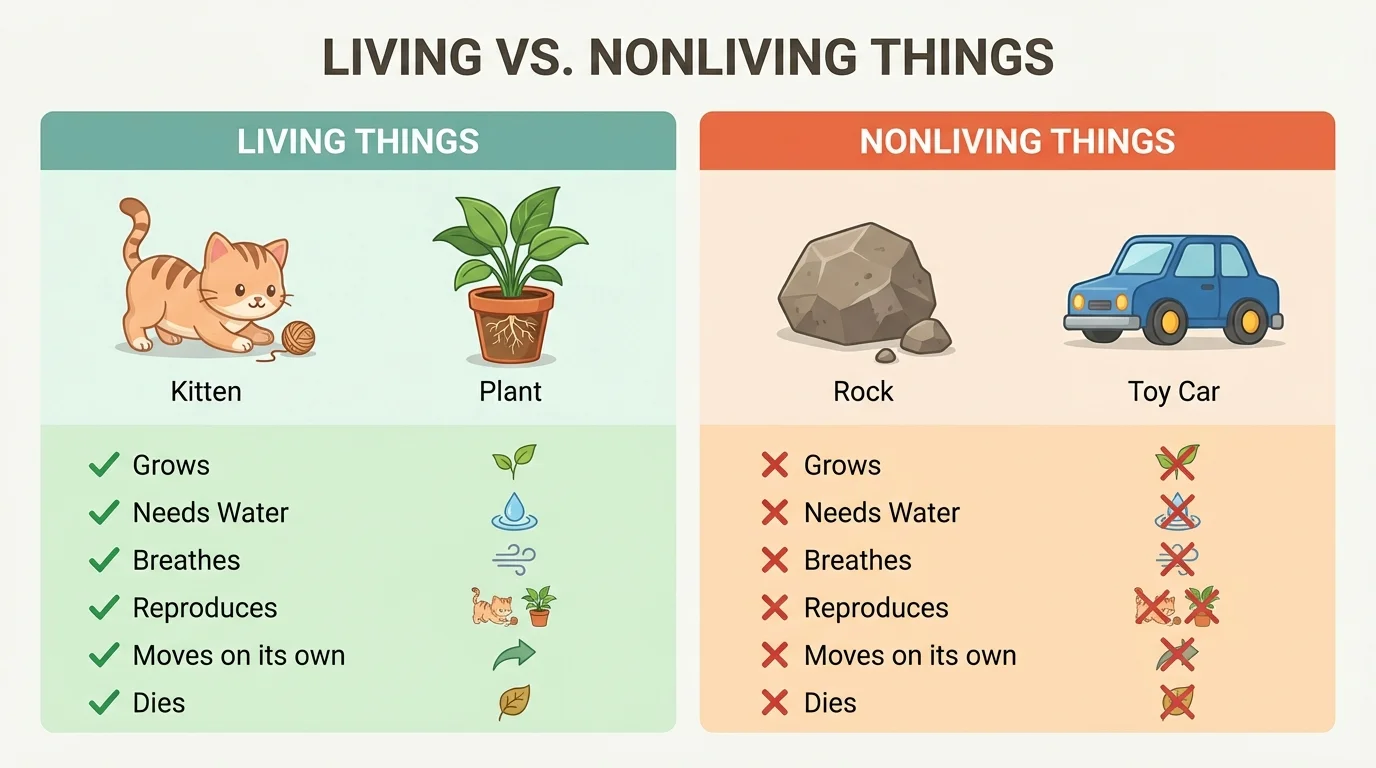
Another difference is reproduction. A living thing can make more of its own kind. Cats have kittens. Birds lay eggs. Plants make seeds. A nonliving thing cannot make new rocks or new chairs. The idea of needing food, water, and growth helps us decide more carefully.
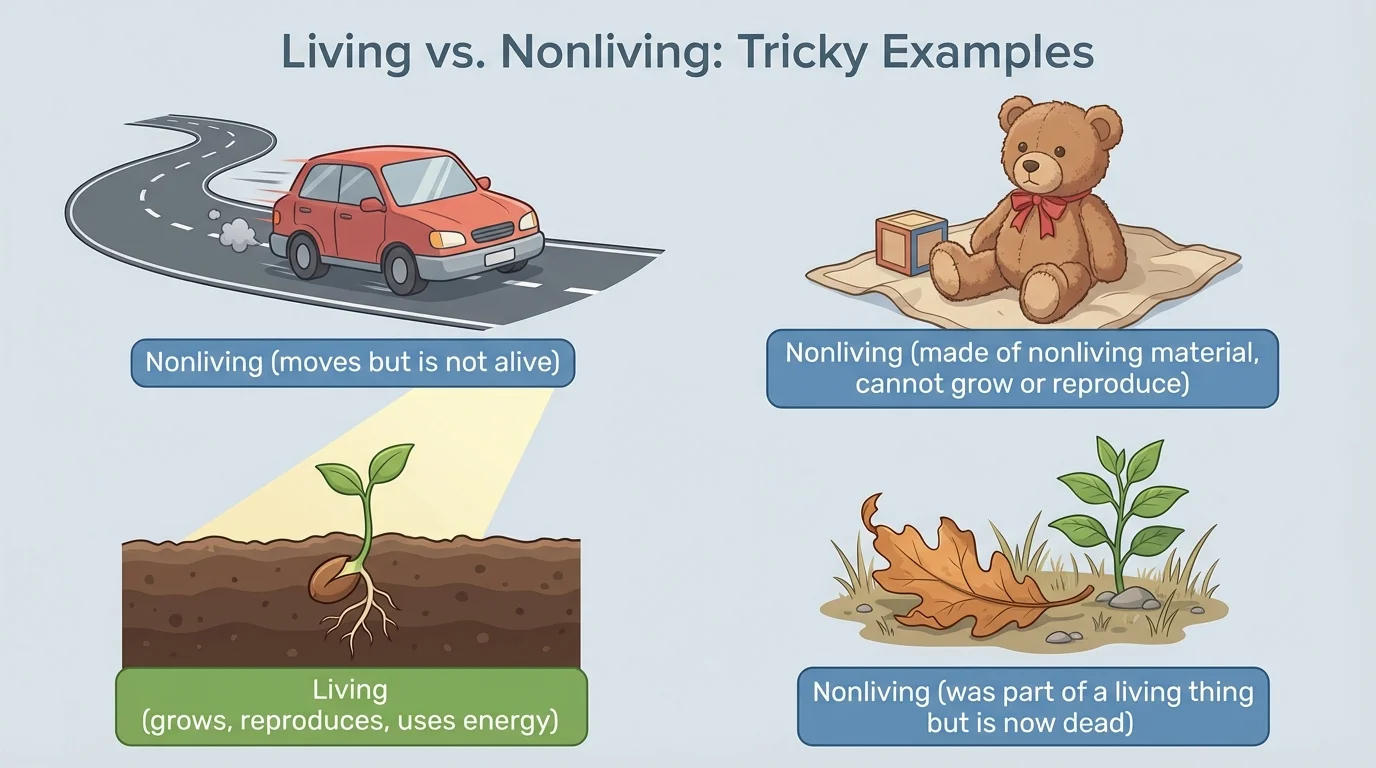
Sometimes it is hard to tell if something is living or nonliving. This is why scientists use careful observation. Some confusing examples are shown in [Figure 3], where movement and appearance can trick us.
A car moves fast, but it is nonliving. It needs gas or electricity, but it does not eat, grow, or have babies. A stuffed bear looks like an animal, but it is nonliving. It does not breathe, grow, or need water.
A seed can seem nonliving because it is small and still. But a seed is part of a living plant. When it has water, air, and the right place, it can grow. A leaf that has fallen off a tree is no longer living, even though it came from a living tree.
Some of the biggest living things on Earth are trees. They may not run or roar, but they are alive and can live for many years.
These tricky examples teach an important idea: we should not decide only by looking at one thing. We ask several questions. Does it grow? Does it need water? Is it alive now? Can it make more of its kind? Those clues help us classify objects correctly.
Scientists look carefully at the world. To classify means to sort things into groups. We can classify objects into a living group and a nonliving group. This helps us understand nature and care for living things properly.
At home, in a park, or on a walk, you can notice many examples. A worm in the dirt is living. Grass is living. A puddle is nonliving. A slide is nonliving. Looking carefully helps us learn more about our world.
Real-world example
A child sees a rabbit, a stick, and a toy car in the yard.
Step 1: Look at the rabbit.
The rabbit eats, drinks, grows, and moves on its own. It is living.
Step 2: Look at the stick.
The stick does not grow by itself anymore and does not need food or water. It is nonliving.
Step 3: Look at the toy car.
The toy car can roll, but only if someone pushes it. It is nonliving.
When we know what is living and nonliving, we also learn how to care for things. A plant needs water and light. A pet needs food, water, air, and kindness. A rock does not need care in the same way because it is nonliving.
