A puddle can sparkle, a rock can feel bumpy, and sand can slip through your fingers. The world is full of materials to explore. When we look closely at things around us, we are doing science. We learn by noticing, comparing, and talking about what we find.
Our senses help us investigate the world. A material is what something is made of. We can look at a leaf, touch a shell, listen to pebbles shake in a cup, or smell wet soil after rain. Senses help us gather information about materials, as [Figure 1] shows with children observing nature carefully and safely.
Some materials are easy to tell apart with our senses. A rock may feel hard. Mud may feel squishy. Water may feel wet and cool. Paper may tear easily. Wood may feel firm and look grainy. We use words to describe what we notice.
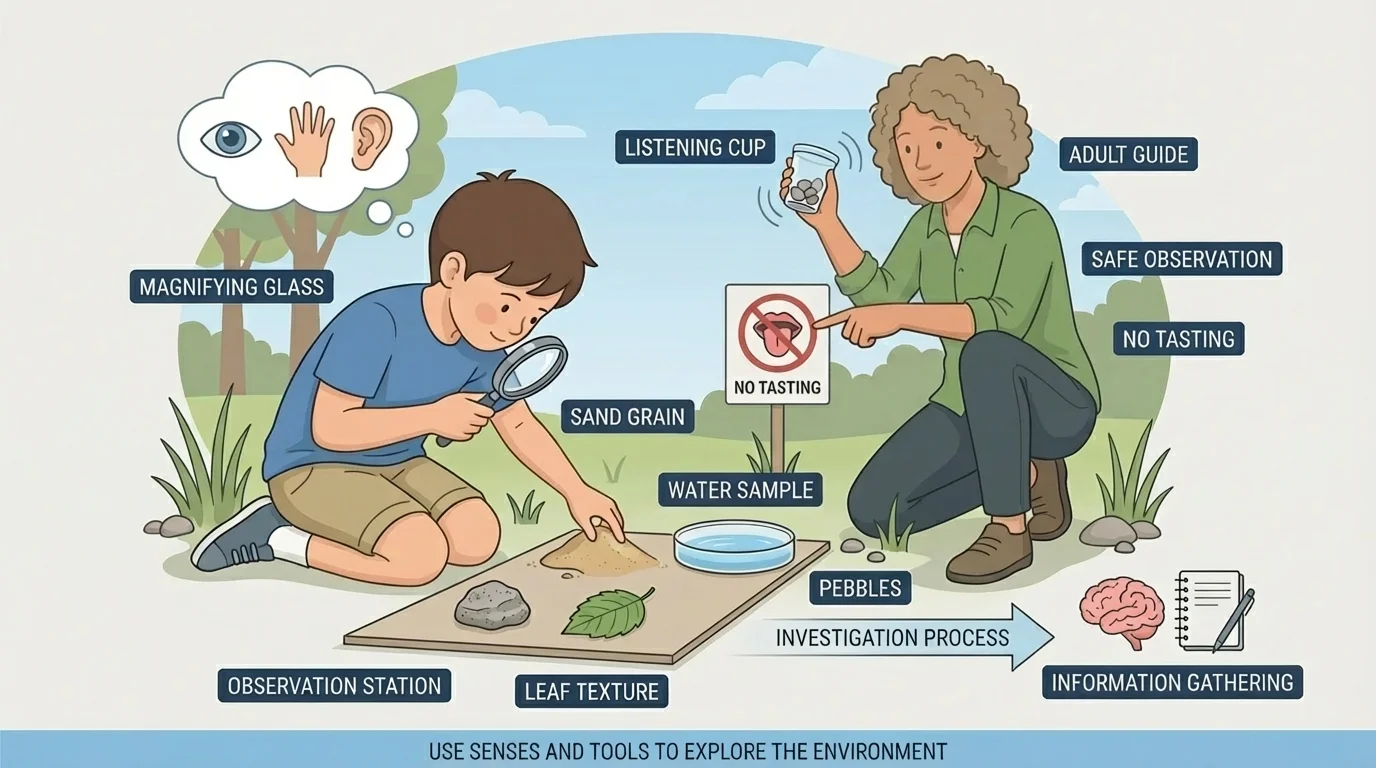
We do not taste unknown materials. We do not smell things too close to our noses unless an adult says it is safe. Safe science means using our bodies carefully and paying attention.
Observe means to notice carefully with your senses or with tools. Property means something you can notice about a material, like its color, shape, texture, or whether it is hard or soft.
When we observe, we can compare things. A leaf and a rock may both be brown, but the leaf is bendy and the rock is hard. Sand and soil can both come from the ground, but sand often feels grainier while soil may hold more tiny bits of plants.
Materials have different properties. Some are smooth, and some are rough. Some are hard, and some are soft. Some are dry, and some are wet. Some are bendy, and some are stiff. These properties help us tell one material from another.
Many materials we explore come from Earth. Rocks, soil, sand, and water are Earth materials. People use them in many ways. Sand can help make glass. Rocks can be used in buildings. Soil helps plants grow. Water is needed by people, animals, and plants.
A material can also be chosen for a job because of its properties. A cup should hold water, so it needs to be strong enough and not leak. A blanket feels soft because soft materials are good for keeping us cozy. A shovel is hard and strong so it can move soil.
Some rocks are very smooth because water moves them and rubs their edges over time. Nature can change the shape and feel of Earth materials.
When we talk about materials, we can sort them. We may put all rough things together or all smooth things together. We may group things that sink or float, or things that bend and things that do not. Sorting helps us see relationships between objects.
Our senses are important, but tools help us learn even more. A tool is something we use to help us do a job. In science, tools can help us see, compare, or record. A magnifying glass can make tiny details look bigger, as [Figure 2] illustrates. A clear cup can help us watch water and sand move. A simple balance can help us compare which object feels heavier or lighter.
Technology is also a tool. A camera can take a picture of a leaf today and another picture next week. A tablet or computer can help a teacher save photos, play a close-up video, or show how snow, rain, and wind change the ground. Technology helps us remember what we observed.
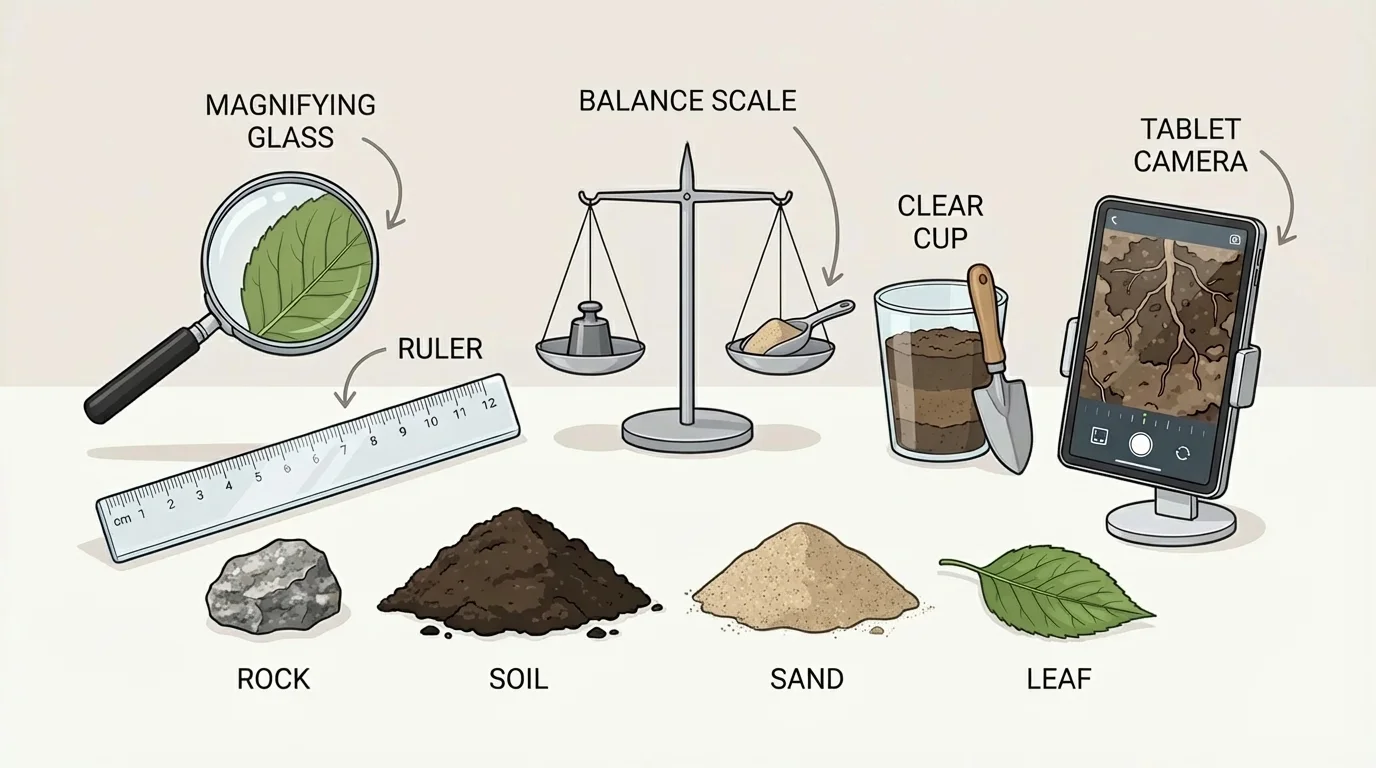
With a magnifier, we may notice lines on a leaf or tiny grains in sand. With a ruler, an adult can help compare long and short objects. With a thermometer, an adult can check if something is warmer or cooler. Tools help make observations more careful.
Why tools matter
Sometimes our eyes alone cannot notice enough detail. Tools and technology extend what we can do. They help us see small parts, compare objects, and keep records so we can look back and notice change.
Later, when we compare a dry sponge and a wet sponge, or a large rock and a small rock, we are using information gathered with senses and tools. The tool does not replace observing; it helps us observe better, just as we saw with the magnifier and camera in [Figure 2].
Science is not only about objects. It is also about processes, which are things that happen over time. Materials can change, and careful observers notice the order of change. An ice cube can melt into water, as [Figure 3] shows. A puddle can get smaller in sunshine. Dry soil can become muddy when water is added.
We can also observe movement and relationships. Water can carry sand. Wind can move leaves. Rain can wash soil from one place to another. Plant roots grow in soil, so soil and plants are connected. The ground, water, air, plants, animals, and people affect one another.
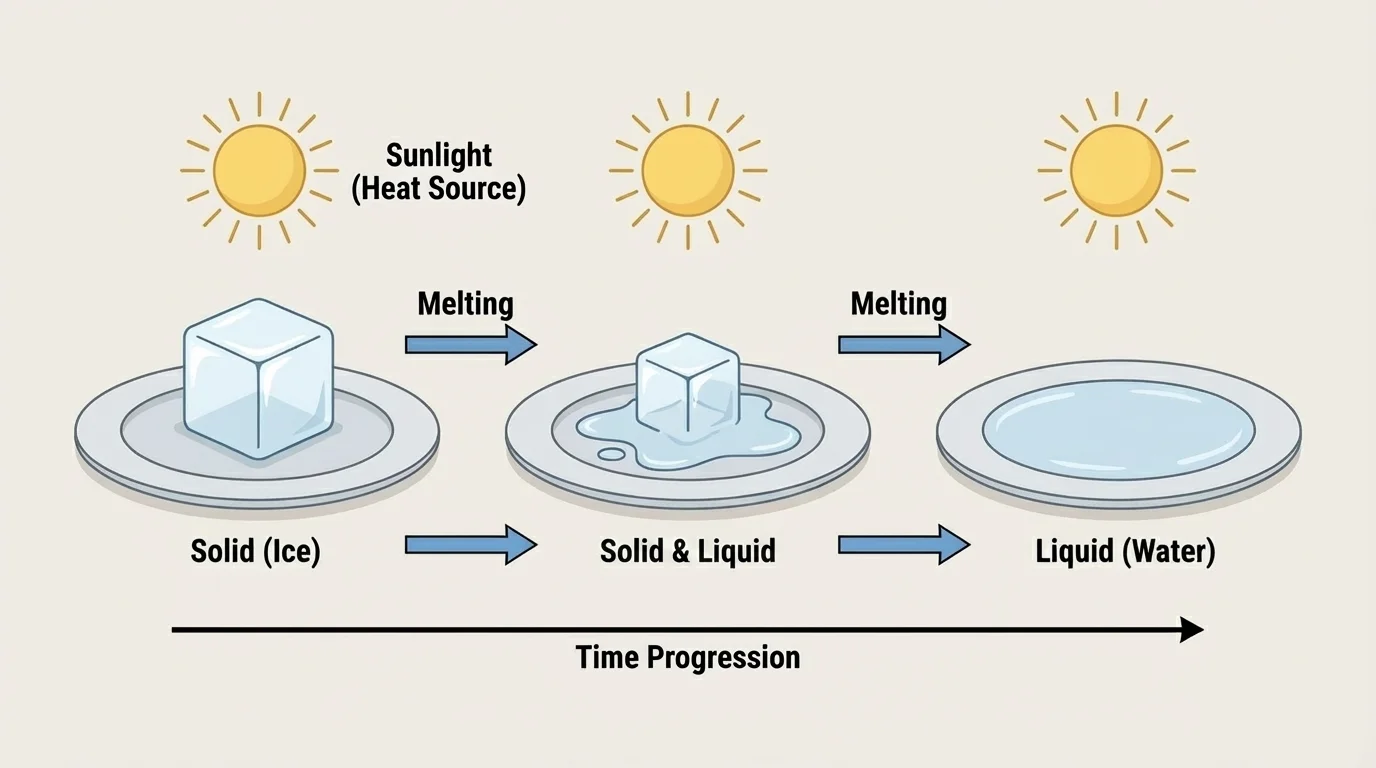
When we watch a change, we can say what happened first, next, and last. First the ice is hard and cold. Next it gets smaller. Last there is liquid water. This helps us understand how materials behave in different places and conditions.
Real-world observation example
Step 1: Look at dry sand.
Dry sand may feel loose and pour easily.
Step 2: Add a little water.
The sand begins to stick together.
Step 3: Compare again.
Wet sand can hold its shape better than dry sand.
This shows that adding water changes a material's behavior.
Changes like these matter in real life. Builders care if soil is dry or wet. Gardeners watch how water soaks into the ground. Families notice that ice melts on a warm day. Earth materials are always part of daily life.
People use Earth materials because of their properties. Soil grows food. Sand can be used as a building material. Rocks can make strong walls and roads. Water is used for drinking, washing, and growing plants. Wood from trees is used to make furniture, paper, and homes.
Choosing the right material is a simple kind of engineering. If something needs to be strong, people choose a strong material. If something needs to be soft, people choose a soft one. Scientists and engineers look at properties before they decide what to use.
| Material | What it is like | One use |
|---|---|---|
| Rock | Hard, strong | Buildings or paths |
| Soil | Loose, holds water | Growing plants |
| Sand | Grainy, loose | Building or play areas |
| Water | Wet, flows | Drinking and watering plants |
| Wood | Strong, can be shaped | Furniture and houses |
Table 1. Common materials, simple properties, and everyday uses.
When we notice that wet soil feels different from dry soil, or that some rocks are smoother than others, we learn about how Earth and people are connected. The melting change in [Figure 3] also reminds us that heat from the Sun can change materials we use every day.
A technology tool, such as a camera or tablet, helps us save what we find. We can take a picture, make a voice note, or draw what we saw. These records help us remember and share information.
Careful observers slow down. They look closely. They compare. They use words such as rough, smooth, wet, dry, hard, soft, heavy, and light. They watch for change and relationships, like water moving soil or roots growing in dirt.
You already know how to use your eyes, ears, nose, and hands to learn. Science adds careful noticing, safe habits, and simple tools so your observations become clearer and more useful.
Exploring the environment means paying attention to the ground, weather, plants, water, and objects around us. Every careful observation helps us understand materials and how the world works.
