Have you ever picked up a rock, a leaf, and a toy block and noticed that each one feels different in your hand? Some things are hard. Some are soft. Some are smooth, and some are bumpy. When we look closely at objects, we become careful observers of the world.
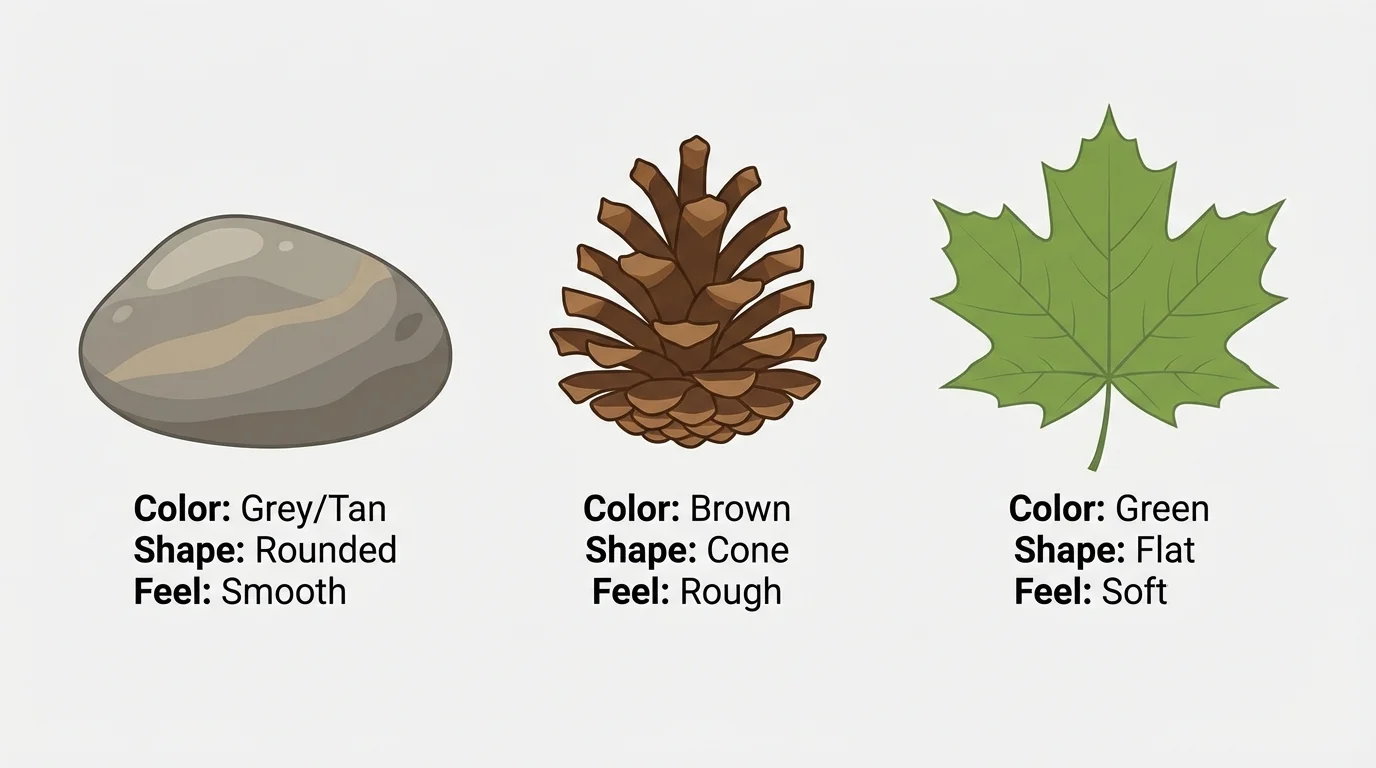
To observe means to look very carefully. We can use our eyes and our hands to learn about objects. As [Figure 1] shows, we can notice a rock, a pinecone, and a leaf by looking at their color, shape, and how they feel.
An object may be red, green, brown, or gray. It may be big or small. It may be round, long, flat, or pointy. It may feel smooth, rough, soft, or hard. These are called properties. A property is something we can notice about an object.
We can also notice if something is heavy or light. A big rock may feel heavy. A feather may feel light. A sponge may feel soft, but a block may feel hard. When we talk about these properties, we are comparing objects.
Compare means to look at how objects are the same and how they are different. Property means a feature of an object, such as color, size, shape, or texture.
Scientists begin by observing. Even very young learners can be scientists when they notice details and talk about what they see.
Some objects share one property but not another. Two leaves may both be green, but one may be bigger. Two rocks may both be hard, but one may be smooth while the other is rough. Two cups may both hold water, but one may be made of plastic and one may be made of glass.
When we compare, we can say, "These are the same color," or "This one is bigger." We can also say, "Both are round," or "This one is rougher." These words help us explain what we notice.
Objects from nature are great for comparing. A shell and a pebble can both be small. A leaf and a flower can both come from plants. Sand and soil may both be on the ground, but they do not feel the same. Sand often feels gritty, and soil may feel softer or clump together.
Many things on Earth can look almost the same at first, but close observation helps us tell them apart. Two brown rocks may seem identical until you touch them and find that one is smooth and the other is rough.
People compare objects every day. We compare shoes to see which fit. We compare spoons to find the big one for cooking. Builders compare materials to choose the right rock, wood, or sand for different jobs.
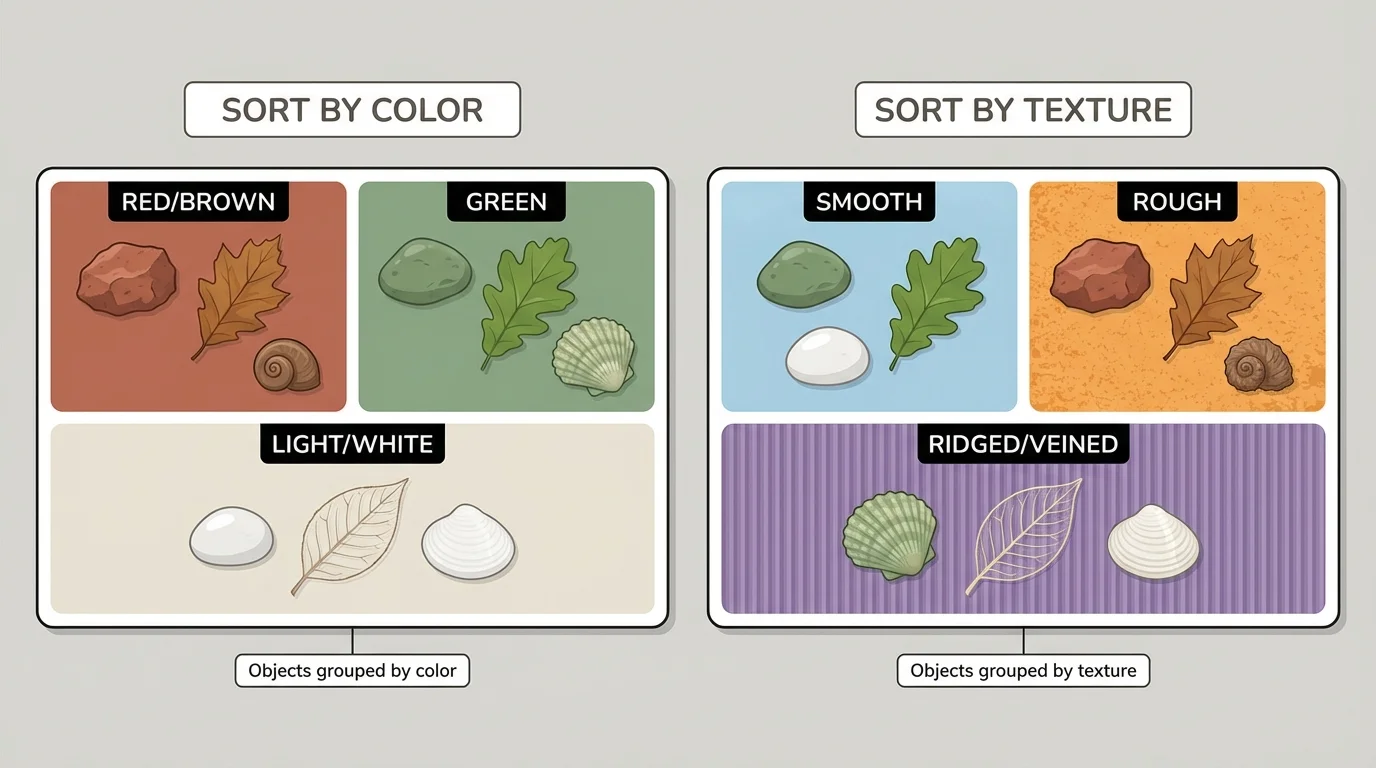
To sort means to put things into groups. We can sort by one property at a time. As [Figure 2] illustrates, the same set of natural objects can be grouped by color, by shape, or by how they feel.
For example, we can put all the smooth rocks in one group and all the rough rocks in another group. We can put big leaves in one pile and small leaves in another pile. We can group shells by color, such as white shells together and brown shells together.
The same objects can be sorted in different ways. A rock can be in the gray group when we sort by color, but it can also be in the smooth group when we sort by texture. That helps us understand that one object can have many properties.
Sorting helps us stay organized. It also helps us notice patterns. If many objects in one group are hard, we begin to see what they have in common. If another group is soft, we notice that difference too.
Real-world example: Sorting natural objects
Step 1: Look at three objects: a rock, a leaf, and a shell.
Step 2: Sort them by hardness. The rock and shell may go together if they feel hard. The leaf goes in a different group because it feels softer.
Step 3: Sort the same objects again by shape. The leaf may be long, the shell may be curved, and the rock may be round.
The objects stay the same, but the groups change when the property changes.
Later, when we look back at [Figure 2], we can see why sorting is useful: one collection can tell us many different things depending on which property we choose.
Many objects around us come from Earth materials. [Figure 3] Earth materials include rock, soil, sand, and water. These materials are part of the ground, beaches, rivers, and many places where people live and play.
Rocks can be used to build walls or paths. Soil helps plants grow. Sand can be used in a sandbox or in building materials. Water is used for drinking, washing, and helping living things survive. When we compare Earth materials, we notice that they do not all look or feel alike.
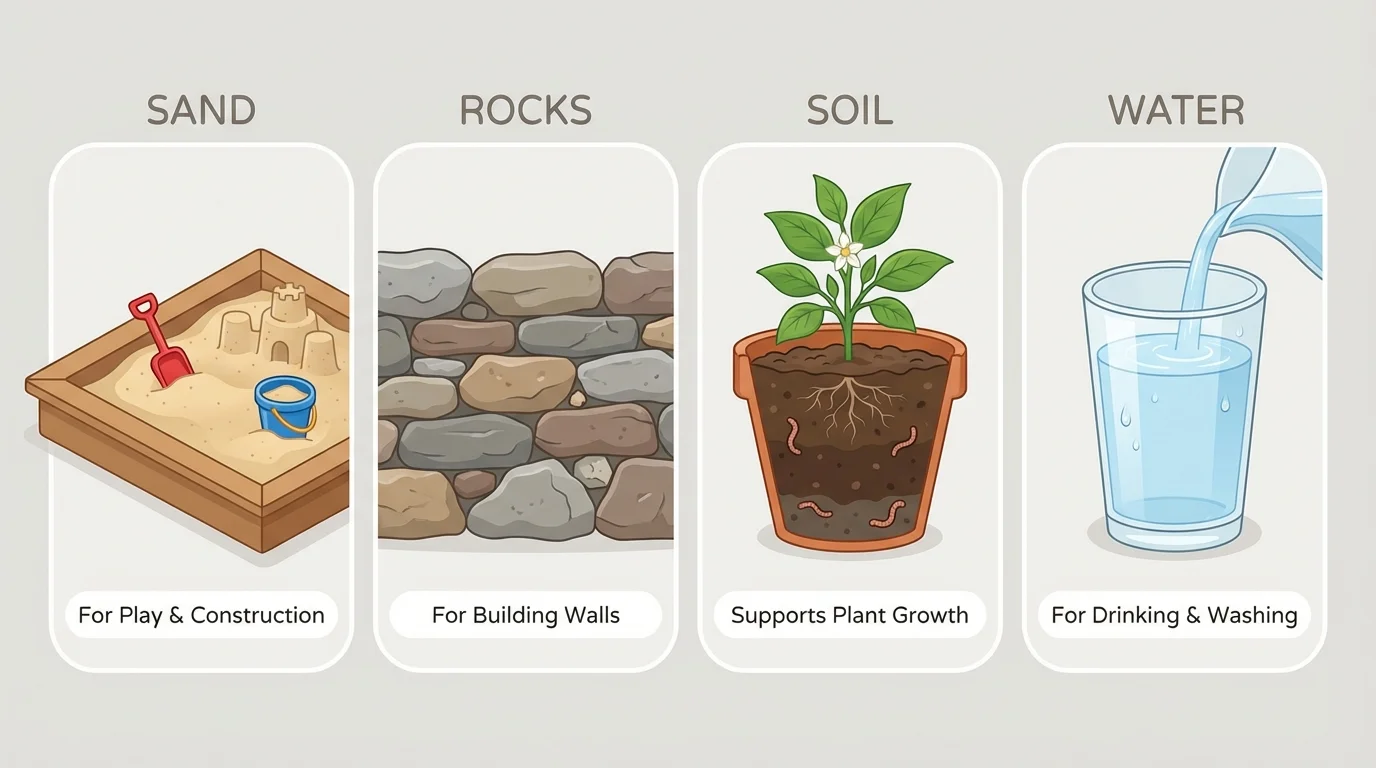
A rock is usually hard. Soil may be loose and crumbly. Sand is made of tiny grains. Water is wet and flows. These differences help people decide how to use each material. Hard rocks can support heavy things. Soft soil can hold roots. Sand can be poured. Water can move through spaces and fill containers.
Materials and uses are connected. People choose materials because of their properties. A strong stone may be good for building. Soft soil is better for planting. A cup holds water because water takes the shape of the cup while the cup stays firm.
When rain falls, water can move soil or sand from one place to another. People need to understand these materials so they can grow food, build safely, and care for the land.
Objects are not only different in how they look. They are also different in how they feel and what they do. A towel and a rock may both be gray, but the towel is soft and can soak up water, while the rock is hard and does not soak up water in the same way.
A wooden spoon and a metal spoon may have the same shape, but they can feel different. One may feel warmer or lighter. One may be smoother. People choose objects for a job by comparing their properties.
We can compare natural things and human-made things too. A stick and a pencil are both long. But a stick comes from a tree, and a pencil is made by people from materials such as wood and other materials. Looking closely helps us notice where things come from and how they are used.
As we saw with Earth materials in [Figure 3], the way something feels and behaves helps explain why it is useful. Hard stones are good for some jobs, while soft soil is better for others.
Scientists use clear words when they describe objects. You can say: same, different, big, small, long, short, heavy, light, smooth, rough, hard, soft, wet, and dry. These words help us share observations clearly.
You can also use simple comparison sentences: "The shell is smoother than the rock." "The leaf is softer than the block." "The sand is finer than the gravel." These ideas help us explain the world in a careful way.
Careful observation helps us learn about nature, about materials from Earth, and about the objects people make and use every day. When we notice properties and compare objects, we begin to understand why the world is full of different materials and shapes.
