Have you ever noticed that the sky gets bright, then dark, then bright again? That is not random. The world is full of clues. Scientists look closely, notice what happens again and again, and use those clues to think about what comes next. Even very young learners can do this by watching clouds, shadows, plants, and the Moon.
A careful look is called an observation. When we observe, we use our eyes, ears, hands, and other senses to notice what is happening. We might see a puddle after rain, feel warm sunlight, or hear wind blowing in trees.
Observation means noticing with our senses. Evidence means the clues or information we use. Pattern means something happens in a way we can notice again and again.
Evidence helps us think like scientists. If the ground is wet and clouds are gray, those are clues. If a plant leans toward a window, that is a clue too. We do not just guess wildly. We look for what we can notice.
A pattern is something that happens in an order we can notice, as [Figure 1] shows with the sky changing from morning to night. Some patterns repeat every day. Some happen over many days.
Day comes, then night comes, then day comes again. Shadows may look long in the morning, shorter at midday, and long again later. These are patterns because they happen in a way we can watch and remember.
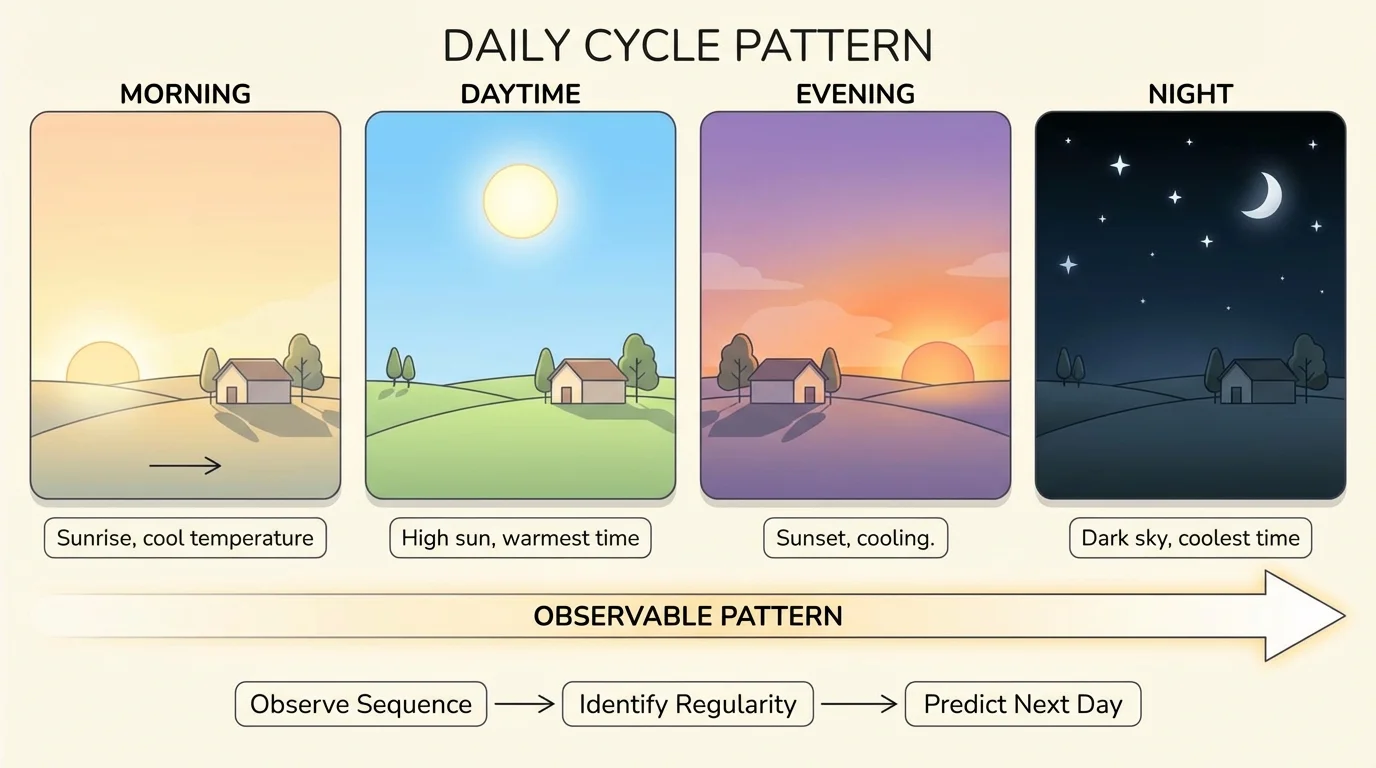
Patterns help us make sense of Earth and space. The Sun appears to move across the sky during the day. The Moon can look different on different nights. Leaves may fall in one season and grow again in another.
The same place can look very different at different times of day. A playground may be cool and shady in the morning but bright and warm later when the Sun is higher.
When we notice a pattern, we can start asking science questions: What is happening again? When does it happen? What clues tell us that?
To predict means to say what may happen next by using clues we already have, as [Figure 2] illustrates with dark clouds and wet ground. A prediction is stronger when it is based on a pattern or on evidence.
If we see dark clouds and feel cool wind, we may predict rain. If we watch the sky getting darker in the evening, we may predict that night is coming. If a seed gets water each day, we may predict it will begin to grow.
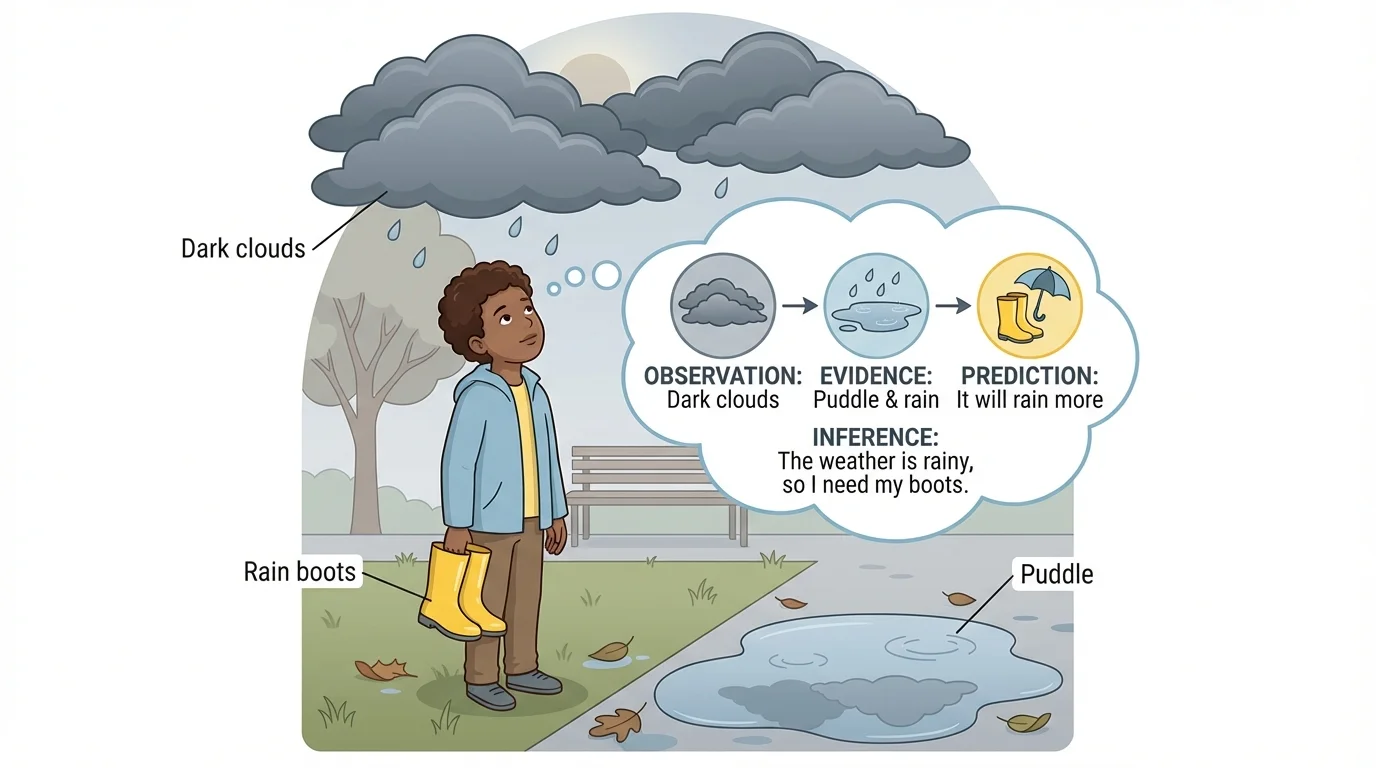
Predictions are not magic. They come from what we observe. We may not always be right, but we should always have a reason. Saying "It may rain because I see dark clouds" uses evidence. Saying "It may rain because I want it to" does not use evidence.
Real-world example: Getting ready for outside play
Step 1: Observe the clues
The sky is gray, the wind is strong, and small drops are on the slide.
Step 2: Notice the pattern
Gray clouds and drops often come before or during rain.
Step 3: Make a prediction
It will probably rain more soon, so a coat or umbrella may be needed.
This prediction is based on observation and evidence.
Later, when children look for weather changes again, the process of using clues still matters, just as it does in [Figure 2]. Scientists use clues again and again to improve their predictions.
To explain means to tell why something happens using evidence. An explanation should connect the clues to a cause in a simple, sensible way.
If ice left in the Sun melts, we can explain that the Sun warmed it. If a puddle gets smaller on a hot day, we can explain that the water is evaporating into the air. If a plant by the window bends toward the light, we can explain that plants grow toward light.
Good explanations use evidence
A good explanation starts with what we notice. Then it connects those observations to a reason. "The sidewalk is wet because it rained" is an explanation based on evidence if we also saw clouds, rain, or puddles. Explanations should match the clues we have.
Sometimes more than one clue helps. We might see a shadow move and also notice the Sun's place changing in the sky. Together, those observations help explain why the shadow changes during the day.
To infer means to figure out something we cannot see directly by using clues we can see, as [Figure 3] shows with footprints. An inference is like careful detective thinking.
If we see muddy footprints on the floor, we may infer someone came in from outside. If we find a cracked shell near a nest, we may infer a baby bird hatched. If we see paw prints in mud but no animal, we may infer an animal walked there earlier.
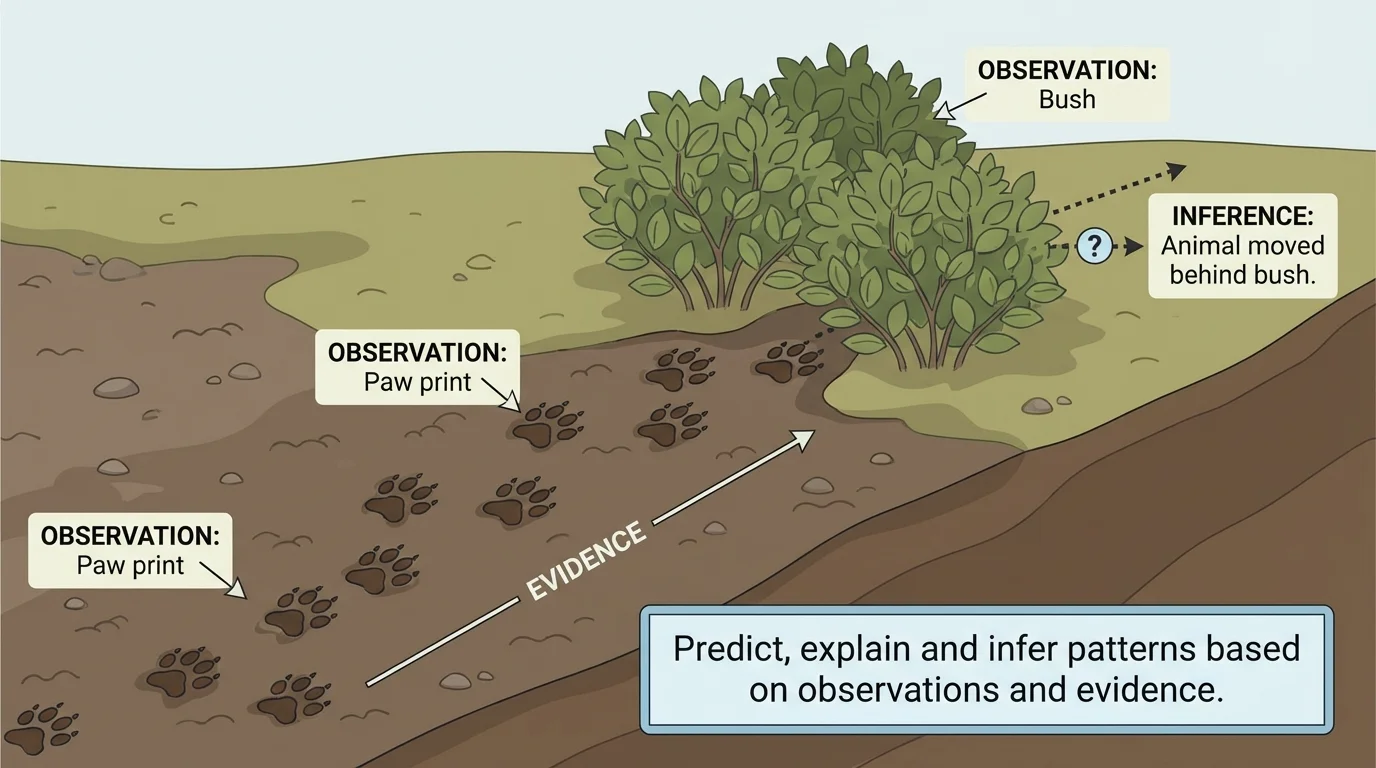
An inference is different from a prediction. A prediction is about what may happen next. An inference is about something we think happened, is happening, or is true, even if we cannot see it directly.
Real-world example: Clues after a windy night
Step 1: Observe what is there
Leaves are all over the ground, and small branches are under the tree.
Step 2: Think about the evidence
Leaves and branches often fall when wind blows hard.
Step 3: Make the inference
It was probably very windy, even if we were asleep and did not watch it happen.
The clues help us understand something we did not directly see.
Later, if we notice tracks in sand or snow, the same kind of reasoning helps us, just like in [Figure 3]. We use visible clues to learn about hidden events.
Earth and space science gives us many patterns to watch. The sky changes from light to dark. The Sun appears during the day. The Moon may look round on one night and thinner on another. Weather can change from sunny to cloudy to rainy.
These patterns help us predict, explain, and infer. If the sky is getting darker and the Sun is low, we predict that night is coming soon. If the ground is wet in the morning, we may infer that rain fell earlier. If we wake up to bent tree branches, we infer that strong wind came through.
The repeating sky pattern from [Figure 1] also helps children understand that many natural events happen in order. Watching these changes over time builds strong science habits.
When scientists work, they look carefully, talk about what they notice, and use evidence. They do not need to know everything at once. They start with clues.
Young children can do real science by observing slowly and talking clearly: "I see," "I notice," "I think," and "My clue is..." These simple sentence starters build strong thinking.
We can keep our ideas clear by using the right word. If we notice something with our senses, that is an observation. If we use clues to say what comes next, that is a prediction. If we tell why something happens, that is an explanation. If we use clues to figure out something hidden, that is an inference.
Patterns make all of this easier. When something happens again and again, we become better at seeing it, describing it, and learning from it. That is how science begins: by noticing the world and thinking carefully about the evidence.
