[Figure 1] Have you ever looked up and seen a big cloud that looked dark and heavy, then felt rain a little later? That can lead to a science finding. When we notice something about the world, we can share it. Scientists do this all the time. Even very young children can be scientists by looking carefully and telling what they find.
Science begins when we observe the world. In Earth and space science, we look at things around us and above us. We may notice the bright Sun, a gray cloud, a windy tree, a puddle after rain, a rock on the ground, or a long shadow in the afternoon.
When we look closely, we can make a simple finding. A finding is something we learned by looking, listening, touching, or comparing. For example, "The cloud is moving," "The rock feels rough," or "The shadow is long" are all findings.
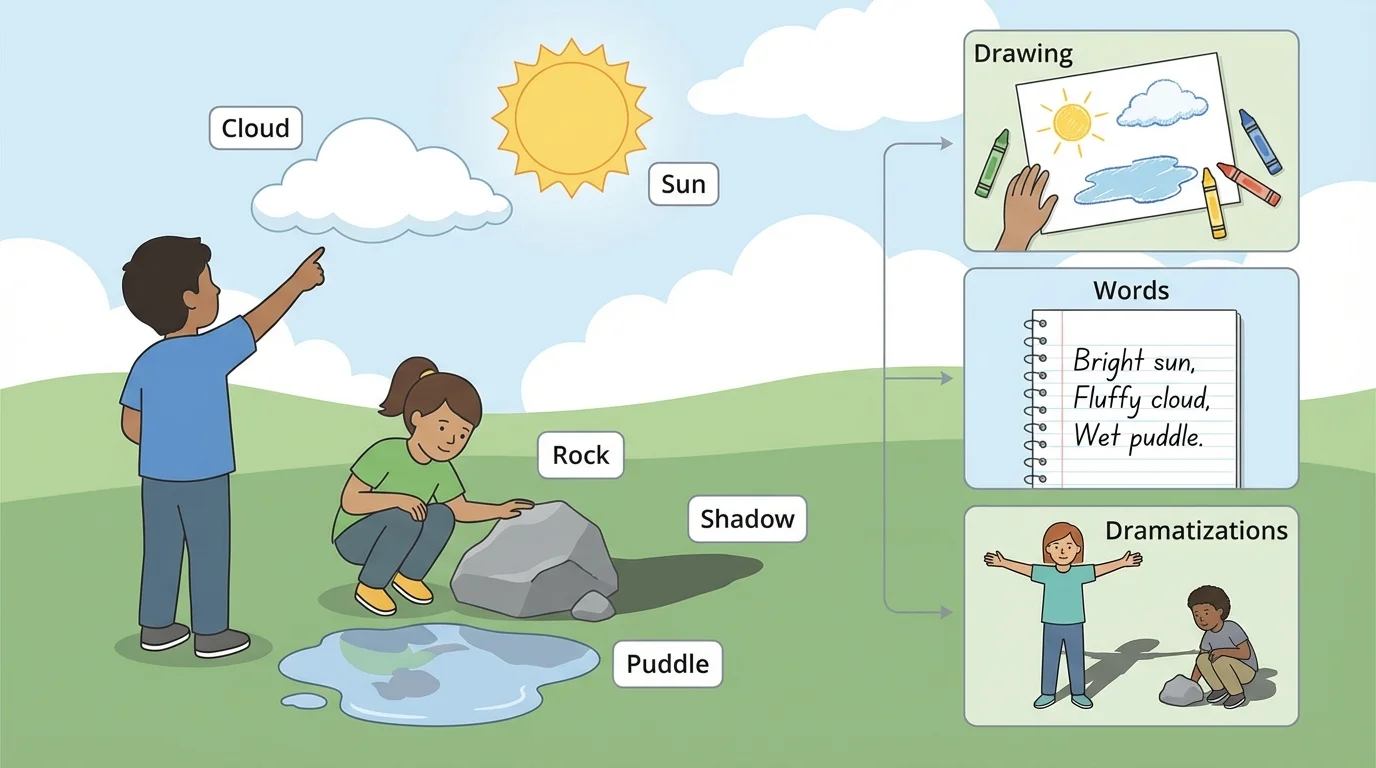
These findings help us make sense of nature. We learn that rain comes from clouds, sunlight makes shadows, and wind can move leaves. Careful noticing is the first step before we share our ideas with others.
Observe means to look, listen, or notice carefully.
Finding means something you discover by observing.
Sometimes two children notice the same thing in different ways. One may say, "The moon is bright." Another may point up and draw a circle. Both are sharing the same idea. Science sharing does not have to look only one way.
[Figure 2] A science idea can be shared in more than one way. We can use more than one modality in science communication. A modality is a way to show or tell something. For young learners, important modalities are drawings, spoken words, gestures, songs, sounds, and dramatizations.
If a child notices rain, the child might draw falling lines under a cloud, say "Rain is falling," tap fingers softly to sound like rain, or act by wiggling arms downward. Each one shares the same finding. The message stays the same, but the form changes.
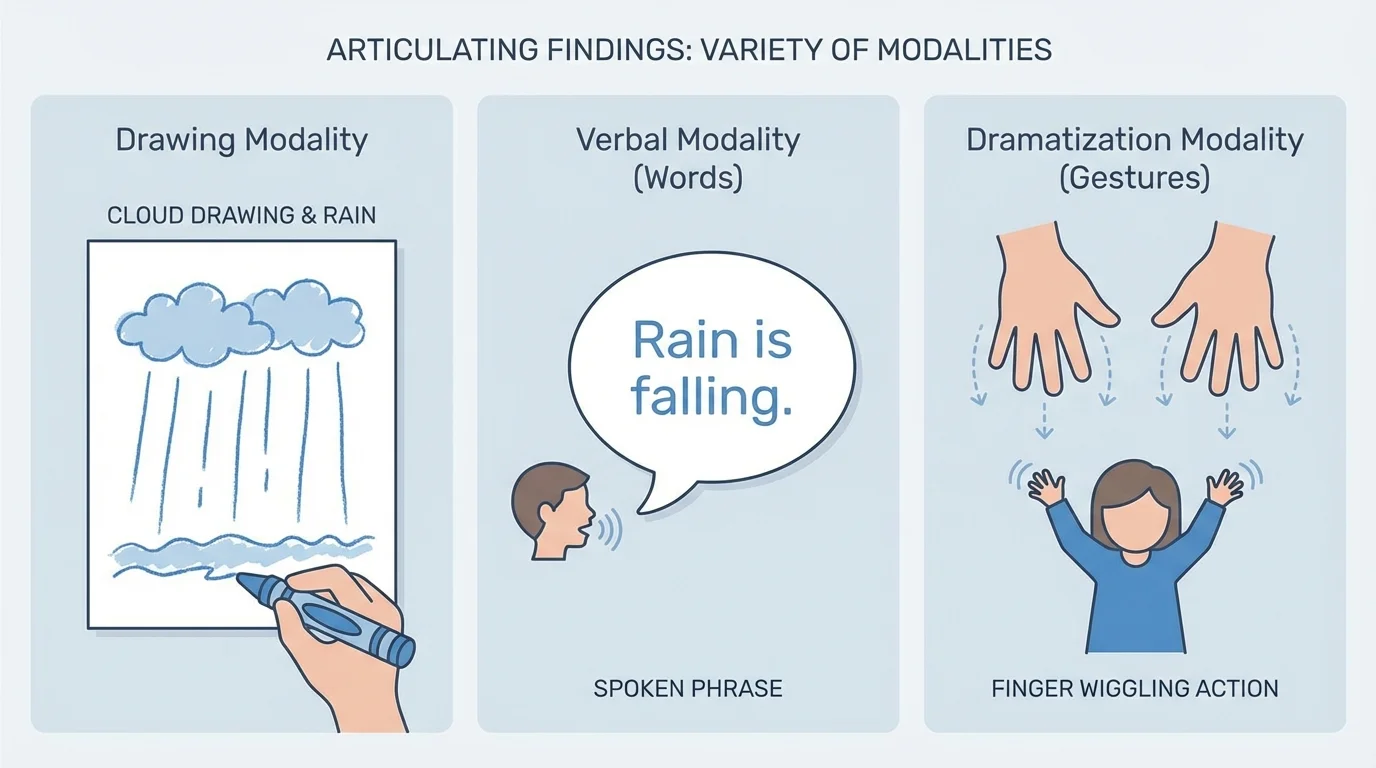
Using many modalities helps more people understand. Some people learn best by seeing. Some understand by hearing. Some understand by moving and acting. In science, it is helpful to use more than one way to communicate what we found.
One finding, many forms
A single science finding can stay true even when it is shown in different ways. "The Sun is up," a yellow circle drawing, and a child pointing to the sky can all express the same observation. The important part is that the message matches what was really observed.
When we use drawings, we can show color, shape, and place. A drawing of a gray cloud over a blue sky tells us something about weather. When we use words, we can name what we saw: sun, moon, rock, cloud, rain. When we act it out, we can show movement, like wind blowing or the Earth turning from day to night.
Different findings work well with different kinds of sharing. A drawing is great for showing that the Moon looks round tonight. Words are great for saying, "The ground is wet." Acting is great for showing how rain falls down or how the Sun rises and sets in the sky from our point of view.
A child might see that a puddle is small in the morning and even smaller later in the day. The child can draw the puddle two times, use words like "big" and "small," or act with arms wide and then close together. These are all strong ways to communicate the change.
Example: Sharing one sky finding in three ways
Finding: the wind is moving the tree branches.
Step 1: Draw it.
Make a picture of a tree with branches leaning to one side.
Step 2: Say it.
Use words such as "The wind is blowing the branches."
Step 3: Act it.
Sway your body and arms to show branches moving in the wind.
All three ways communicate the same finding clearly.
Scientists often use models too. A model is something that stands for a real thing. A ball can help show Earth. A flashlight can help show the Sun. A child turning with a ball and a light can dramatize day and night in a simple way.
That is why science communication is creative and careful at the same time. We can be expressive, but we also want our message to stay true to nature.
Good science sharing uses simple, clear words. Instead of saying only "Look!", we can say "I see a dark cloud," or "The rock is smooth." These words help another person understand the exact finding.
It is also important to separate what we see from what we guess. If we see drops falling from a cloud, we can say, "It is raining." If we have not seen rain yet, but the cloud is dark, we might say, "I think rain may come." Science becomes stronger when we tell what we really observed.
Weather helpers on television and in classrooms use pictures, maps, words, and pointing gestures together. They do this because one kind of message is often not enough to explain the sky clearly.
We can also compare kinds of sharing.
| Way to share | What it helps show | Example |
|---|---|---|
| Drawing | Shape, color, place | A yellow Sun over green grass |
| Words | Name and describe | "The cloud is gray." |
| Action | Movement and change | Arms moving like wind |
| Sound | What something is like | Soft taps for rain |
Table 1. Different modalities for sharing simple science findings.
As we saw earlier in [Figure 2], one rainy-day idea can be shown in several forms. This helps classmates, teachers, and families understand the same science message in ways that fit how they learn.
[Figure 3] People also share science ideas in everyday settings, including with simple weather charts.
People share science ideas every day. Weather reports use symbols for sun, clouds, and rain. Gardeners look at soil and sky and talk about what plants need. Families notice if the day is hot, cold, windy, or wet and choose clothes from those findings.
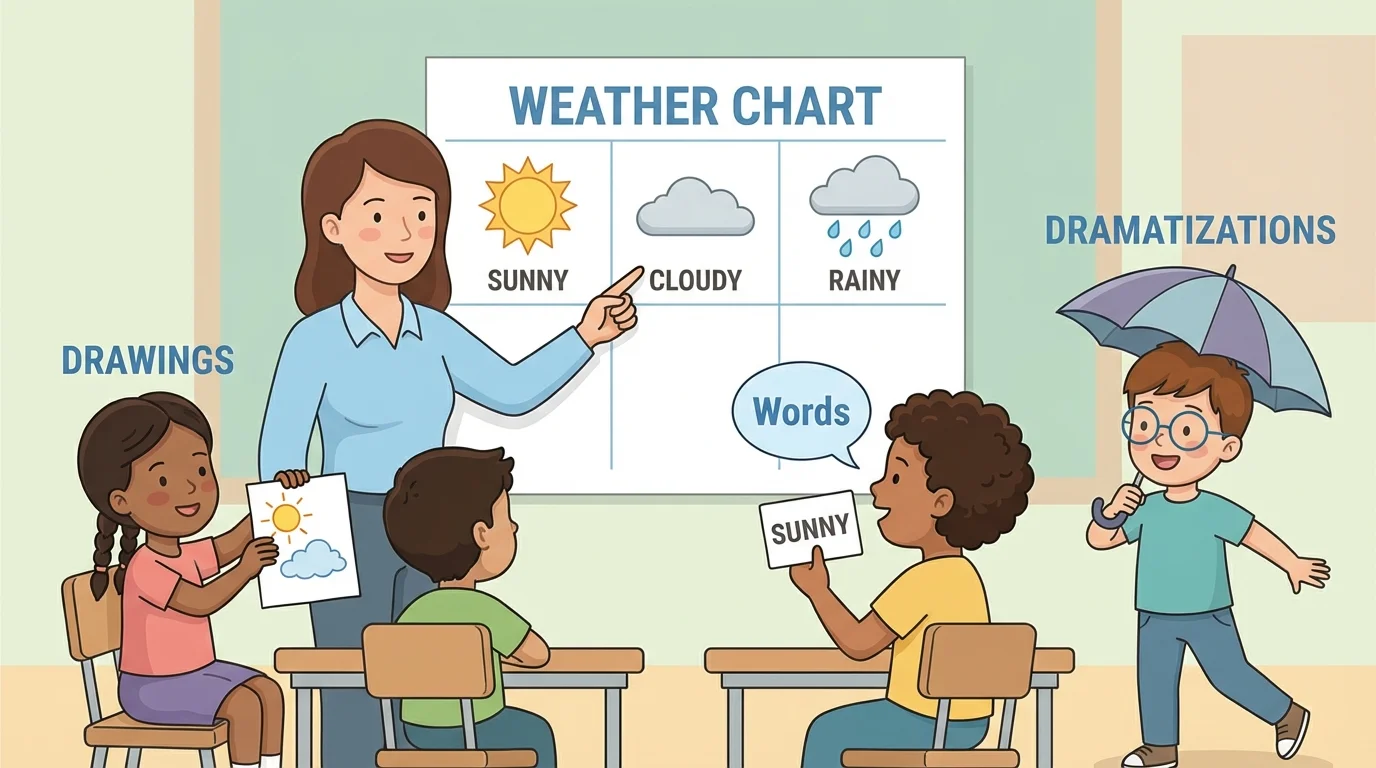
In a classroom, children may talk about whether the day is sunny or cloudy. They may point to a chart, place a weather symbol, or act like falling snow. These are real ways of communicating science. The ideas come from observing Earth and sky conditions around us.
Later, when children learn more science, they will use the same communication skills in bigger ways. They may make labeled pictures of the Moon, describe seasons, or explain how water moves as rain and puddles. The early skill is the same: notice carefully, then share clearly.
Science is not only about knowing facts. It is also about telling others what you noticed. Clear sharing helps people learn together.
The weather chart in [Figure 3] uses simple visual symbols because they are quick and easy to understand. But words still matter. Saying "It is windy today" adds meaning that a picture alone may not fully explain.
Sometimes one way is enough. Sometimes two or three ways work better together. If you want to show the shape of the Moon, a drawing is helpful. If you want to tell how a rock feels, words like "smooth" or "bumpy" help. If you want to show how rain falls or how wind moves, acting can make the idea easy to understand.
Scientists choose communication tools carefully. Young students can do this too. The best choice depends on the finding. A strong science message is clear, true, and easy for others to understand.
When children draw, speak, sing, point, and act out their observations, they are doing real science communication. They are showing what they know about Earth and space in ways that other people can see, hear, and understand.
