When you unlock your phone with your face, auto-complete a line of code in an IDE, or see a perfectly timed video recommendation on a platform, invisible programs are quietly making decisions about you. Those decisions are not neutral. They affect your privacy, your friendships, your opportunities, and even how you see yourself and other people.
Behind almost every digital experience is a set of algorithms written by programmers. These algorithms decide what data to collect, how to store it, and what to do with it. Understanding how computing affects personal, ethical, social, economic, and cultural practices helps you see that programming is not just about getting code to "work" — it is about shaping the world.
This lesson focuses on computer programming as the engine behind modern computing systems. We will look at how programming choices create impacts in five areas:
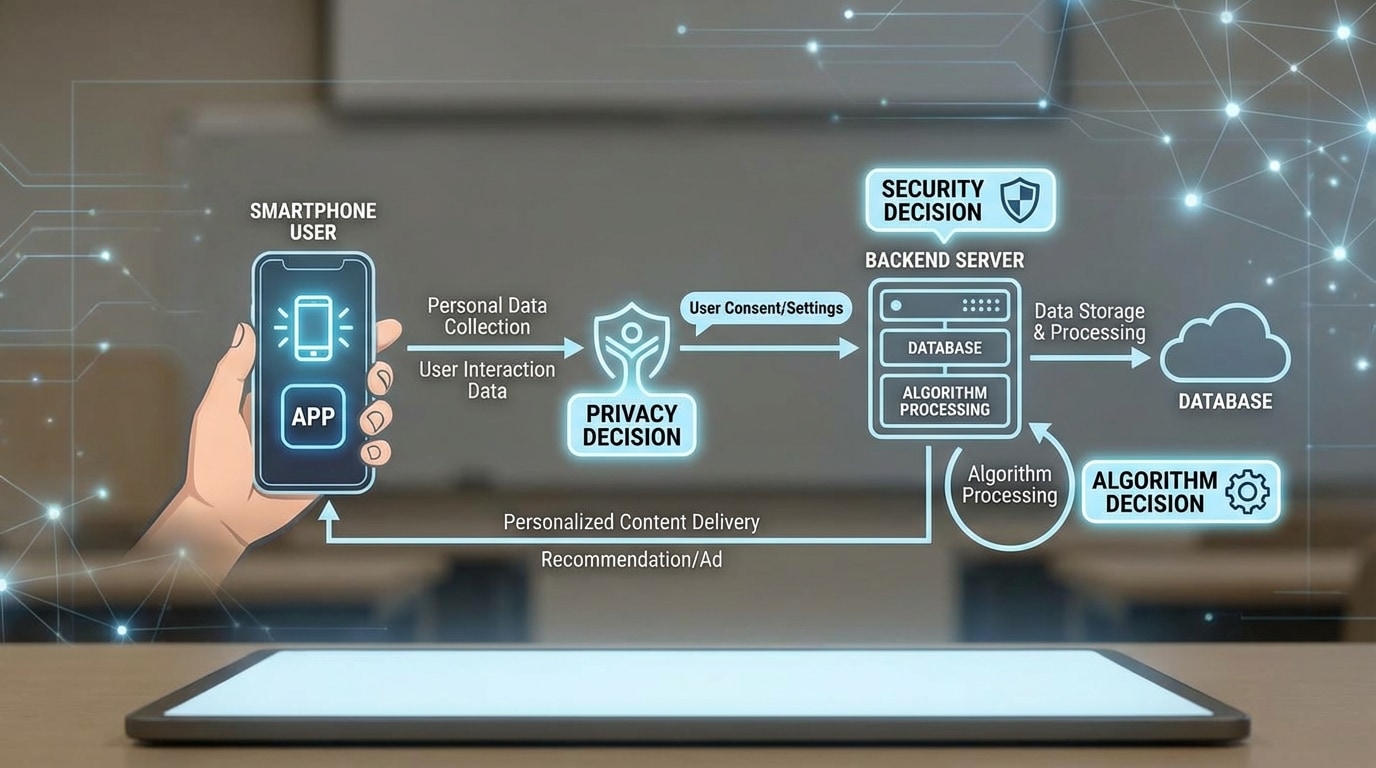
Every time you interact with software, code is interacting back with you. Data about you often travels from your device to servers and back. This data flow, as highlighted in [Figure 1], is where many personal impacts begin.
2.1 Privacy and Data Collection
Many apps collect information such as your location, contacts, search history, or what you click. Programmers decide:
Personal impacts of these decisions include:
2.2 Security and Safety
Programmers also choose security measures: using secure communication protocols, validating input, and handling authentication. Bugs like buffer overflows or poor password handling can let attackers into systems. Personal impacts include:
2.3 Personalization and Autonomy
Recommendation algorithms suggest what to watch, read, buy, or listen to. These programs use techniques from machine learning to predict your interests based on patterns in your behavior.
Programmers choose objective functions, such as maximizing watch time or click-through rate. That choice directly affects your personal autonomy, because the system is optimized to keep you engaged, not necessarily to keep you healthy or informed.
2.4 Mental Health and Well-being
Features like infinite scroll, streak counters, and push notifications are implemented through code. They can:
Design and programming choices about timing, frequency, and rewards have deep personal impacts on how people feel daily.
When programmers write code, they often embed ethical decisions into software behavior, even if they do not call it "ethics."
3.1 Algorithmic Bias and Fairness
Many systems use machine learning models trained on large datasets. If these datasets reflect historical inequalities, the resulting model can treat different groups unfairly. Examples include:
Programmers make ethical choices when they:
3.2 Transparency and Explainability
Some algorithms are "black boxes," especially deep learning models. If users are affected by decisions (getting or not getting a loan, being flagged by a fraud system), they may reasonably ask: Why?
Programmers and organizations choose whether to include logs, reasons, and user-friendly explanations, which are critical for ethical accountability.
3.3 Consent and Dark Patterns
Programmers design interfaces that can respect or undermine user consent:
Even small choices like default settings for data sharing have ethical consequences, because many users never change defaults.
3.4 Safety-Critical Systems
In self-driving cars, medical devices, aviation software, and nuclear control systems, programming mistakes can put lives at risk. Ethical responsibilities here include:
Professional codes of ethics from organizations like ACM or IEEE emphasize these responsibilities, guiding programmers to prioritize human safety and dignity over speed or profit.
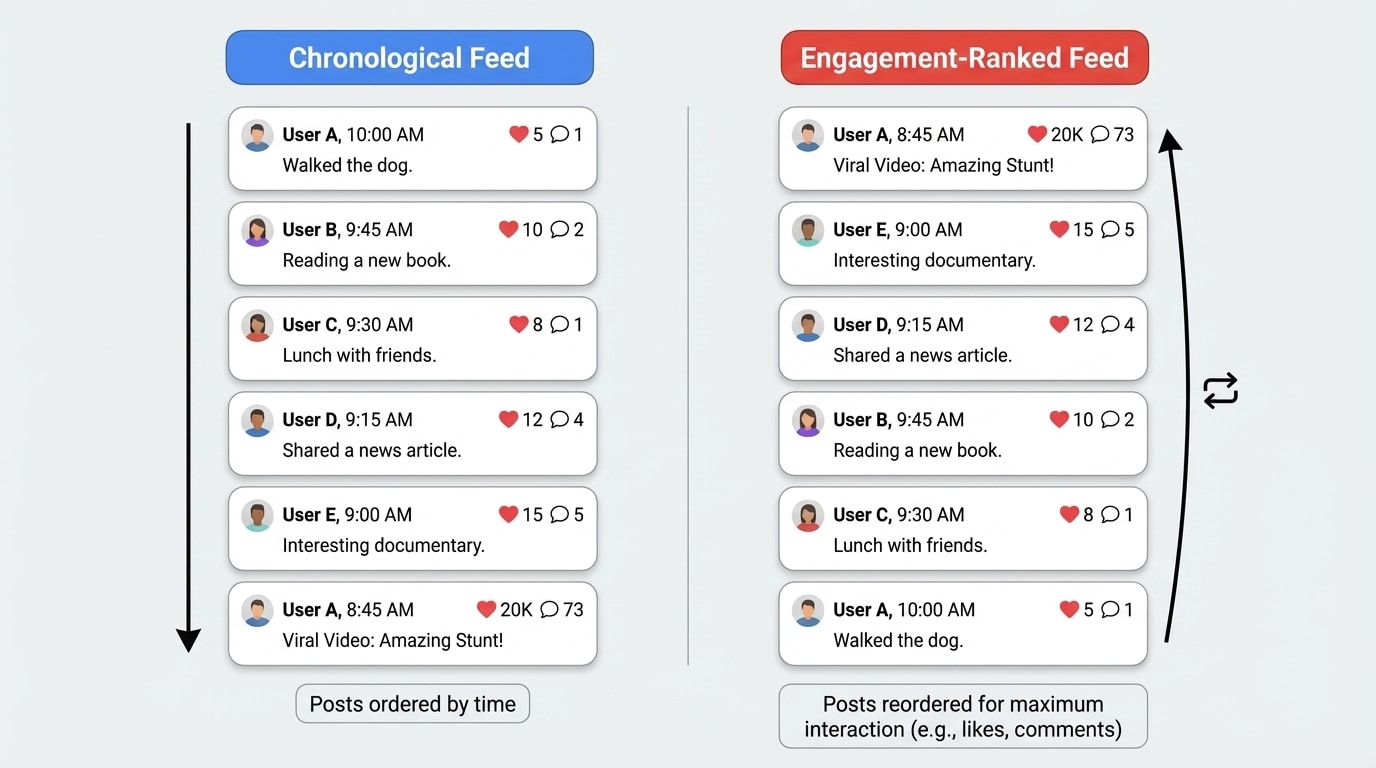
Computing affects how societies communicate, organize, and distribute power. Ranking algorithms that structure content feeds, as seen in [Figure 2], have major influence over what people actually see and discuss.
4.1 Social Media, Feeds, and Echo Chambers
Two different programming choices can create very different social outcomes:
Engagement-optimized feeds can lead to:
Programmers implement ranking functions and choose which signals (likes, comments, watch time, reports) matter most.
4.2 Online Communities and Social Support
On the positive side, software platforms enable support groups, open-source communities, and global collaborations. Design features like moderators' tools, block and report functions, and community guidelines strongly influence:
4.3 Digital Divide and Access
Not everyone has equal access to computing devices, reliable internet, or programming education. This creates a digital divide:
Programming can either reduce or widen these gaps, depending on whether systems are designed to run on low-cost devices, support offline modes, or use low bandwidth.
4.4 Surveillance and Power
Governments and companies can use computing systems for large-scale surveillance: tracking locations, messages, and behaviors. Code that logs events, stores them, and analyzes them at scale can change the relationship between individuals and institutions. Social impacts include:
Computing has transformed economies. Programmers write the code that automates processes, powers platforms, and creates new digital products. These changes affect who gains and who loses economically.
5.1 Automation and Jobs
Automation means using software-controlled systems to perform tasks previously done by humans. Examples include:
Economic impacts include:
Programmers decide what tasks to automate and how to integrate human workers into the system (for example, humans handling exceptions that the algorithm flags as uncertain).
5.2 The Gig Economy and Platforms
Apps for ride-sharing, food delivery, and freelance work are built through platform software that matches workers with customers. Programming choices affect:
Economic impacts include flexible work opportunities for some, but also instability and lack of traditional job protections for many workers.
5.3 New Industries and Innovation
Entire industries — such as app development, streaming services, virtual reality, and fintech — exist because of computing and programming. Economic impacts include:
5.4 Inequality and Concentration of Power
Wealth and control can concentrate in a few powerful tech companies with large user bases and data resources. Programmers inside those companies wield significant influence over global economic flows, sometimes more than governments. This raises questions about competition, regulation, and fair access to digital markets.
Computing also shapes culture — what stories are told, which languages are supported, and whose identities are represented.
6.1 Global Platforms and Local Cultures
Streaming platforms, social media, and game distribution networks make it easy for cultural products (music, shows, memes, games) to spread worldwide. Programming decisions about recommendation algorithms, subtitles, and localization affect:
6.2 Language Support and Inclusion
Software needs to support different character sets, input methods, and fonts to handle multiple languages. If a language is not supported, its speakers may struggle to participate fully online. Programmers influence cultural inclusion when they:
6.3 Representation in Games and Media
In video games, animations, and virtual worlds, programmers and designers work together to build characters, storylines, and environments. Cultural impacts include:
Code-level decisions about character customization, voice chat moderation, and content filters all influence how safe and seen different groups feel.
6.4 Digital Preservation of Culture
Computing can help preserve endangered languages and cultural artifacts through digital archives, scanned documents, or interactive story apps. Programmers who work with museums, libraries, or cultural organizations can create tools to keep traditions alive in digital form.
Looking at concrete programming-related scenarios helps connect all five impact areas.
7.1 Case Study: Biased Facial Recognition System
A company deploys facial recognition to unlock phones and for law-enforcement purposes. The system was trained mostly on images of lighter-skinned faces.
Programmers and data scientists could mitigate this by diversifying training data, measuring performance across groups, and setting strict rules on acceptable error rates.
7.2 Case Study: Ride-Sharing Surge Pricing Algorithm
A ride-sharing app increases prices when demand is high. The algorithm adjusts prices in real time based on the ratio of ride requests to available drivers.
Programmers can encode safeguards, such as caps on prices during emergencies, or special policies for certain regions.
7.3 Case Study: Video Recommendation Algorithm
A video platform uses an algorithm to recommend what to watch next, based on watch history, likes, and similar users.
Programmers can tune the algorithm to balance engagement with other goals, such as diversity of content, quality, or verified accuracy for news topics.
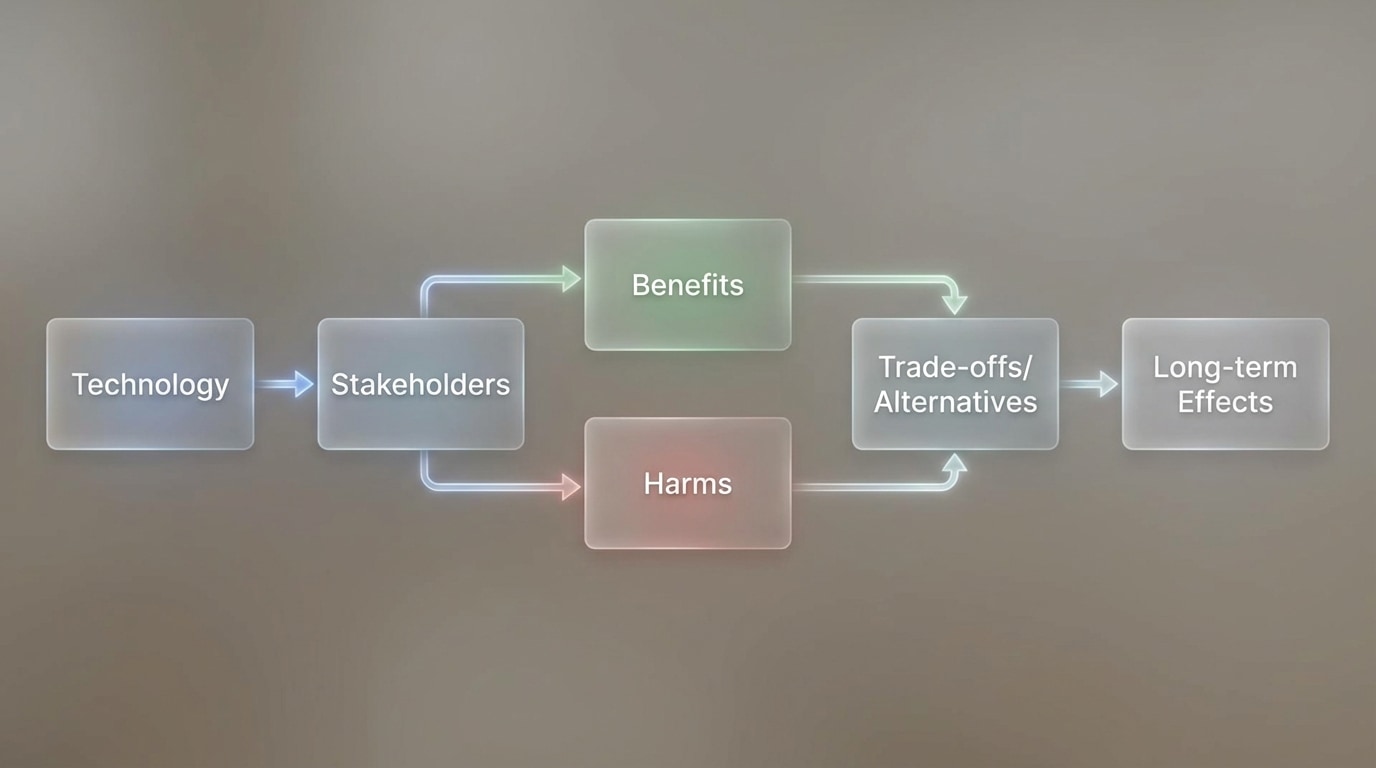
When you encounter a new app, device, or algorithm, you can use a simple mental framework to evaluate its impacts, similar to the structured view in [Figure 3].
Step 1: Identify the Technology Clearly
Describe what the system does in concrete terms. For example: "A mobile app that tracks users' locations to provide targeted ads."
Step 2: List Stakeholders
Stakeholders are people or groups affected by the technology. They usually include:
Step 3: Analyze Benefits and Harms in Each Category
| Category | Possible Benefits | Possible Harms |
|---|---|---|
| Personal | Convenience, safety, entertainment | Privacy loss, addiction, stress |
| Ethical | More consistent decisions, reduced human bias | New forms of bias, lack of accountability |
| Social | Connection, organizing, information sharing | Polarization, harassment, exclusion |
| Economic | New jobs, lower costs, innovation | Job loss, inequality, monopolies |
| Cultural | Cultural exchange, preservation | Homogenization, stereotypes, language loss |
Step 4: Consider Trade-offs and Alternatives
Ask questions like:
Step 5: Long-Term and Systemic Effects
Impacts are not just about what happens today. Think about:
Computing and computer programming deeply influence modern life across five major dimensions. On a personal level, code shapes privacy, security, and mental health through data collection, recommendation systems, and interface design. In the ethical domain, programmers face decisions about fairness, transparency, consent, and safety, especially when algorithms affect opportunities, rights, or physical safety.
Socially, software reorganizes how people communicate, form communities, and experience power, from social media feeds and online support networks to surveillance systems and the digital divide. Economic impacts include automation of jobs, creation of new industries, growth of platform-based work, and possible increases in inequality and market concentration. Culturally, computing reshapes which stories, languages, and identities are visible, influencing both global exchange and local traditions.
Programmers are central actors in all these changes. Their choices about data, algorithms, defaults, and interfaces embed values into technology and distribute benefits and harms among different people. By using a structured framework — identifying technologies and stakeholders, weighing benefits and harms across personal, ethical, social, economic, and cultural dimensions, and thinking about trade-offs and long-term effects — you can critically evaluate how computing systems impact the world and make more informed decisions about how you build and use technology.
