Have you ever seen a cool feature in an app and thought, “I could just copy that into my project”? Or wanted to grab a code snippet from an online repository and drop it straight into your game? In the real world, programmers cannot do “anything they want” with code. They must follow security rules that protect users, and they must obey software licenses that protect creators’ rights. These rules shape what software can do, how it is built, and even whether it can be shared at all. 🔒
This lesson explores how security requirements and software licensing create constraints and restrictions in computational design and development. Understanding these limits is just as important as knowing how to write a loop or a function, especially if you ever want to release your code to the public, work for a company, or contribute to open-source projects.
When we talk about security in computer programming, we are talking about how well a system protects information and services from being stolen, changed, or broken by attackers or accidents.
Security is often described using three main goals, sometimes called the “CIA triad” (not the intelligence agency!):
Programmers face many security threats, such as:
Because of these threats, security becomes a major design requirement. That means certain designs or features are not acceptable, even if they seem easier or faster to code, because they are too risky. Security requirements limit how you store data, which libraries you use, how users interact with the system, and how information flows through your code.
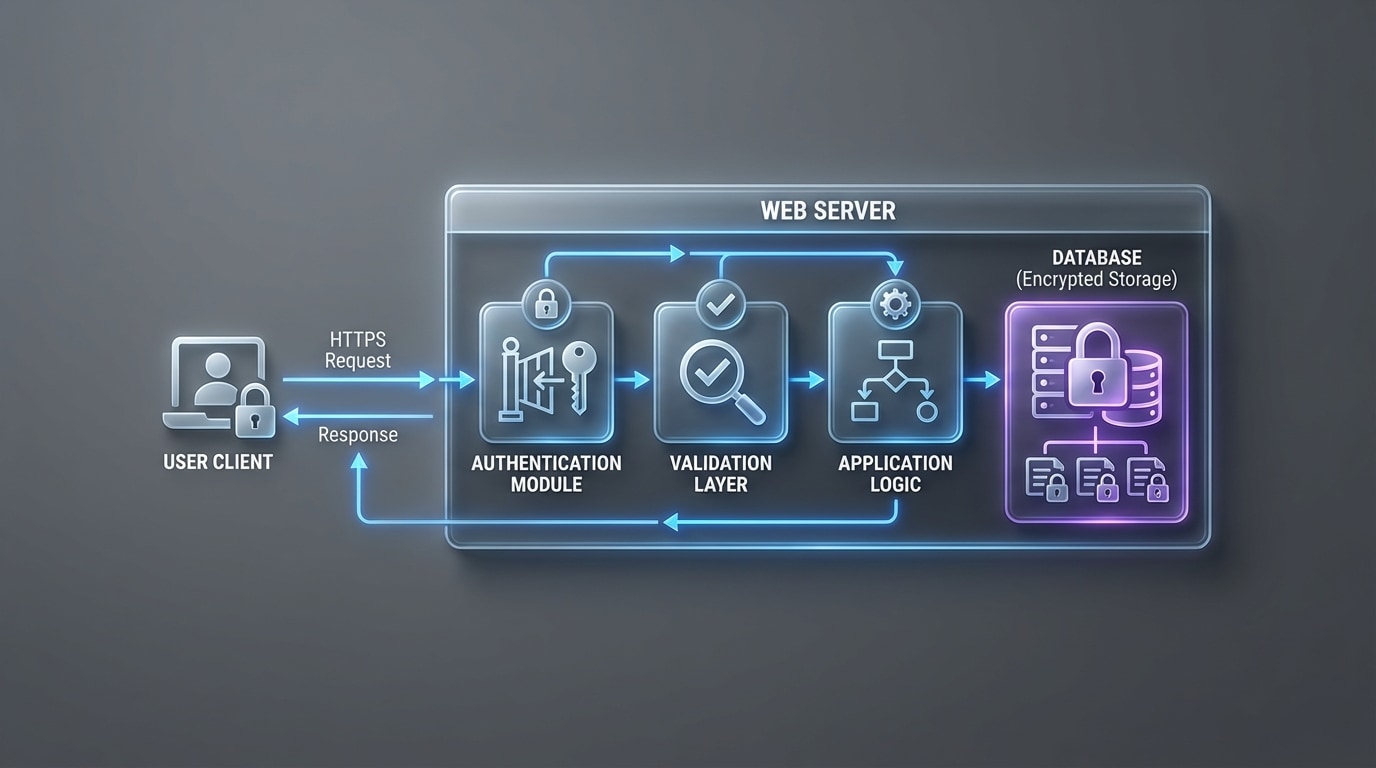
Security is not something you “add at the end.” It affects the structure of your program from the beginning. The way data travels from user to server, is checked, processed, and stored, must follow secure patterns, as shown in [Figure 1]. This changes what your code looks like and what is allowed.
Here are key ways security requirements impose constraints on computational design and development.
1. Authentication and Authorization
Authentication is verifying who a user is (for example, logging in with a username and password, or using multifactor authentication). Authorization is checking what that user is allowed to do (for example, can they edit someone else’s profile?).
Security requirements might force you to:
These constraints mean you cannot just write a quick “everyone can do everything” design, even if that would be simpler.
2. Input Validation and Sanitization
Any time a program accepts input (text boxes, file uploads, API requests), security requires that you validate and sanitize that input. You must check that it is the right type, length, and format, and remove or block dangerous content.
This leads to constraints such as:
For example, if you are designing a comment system, you might want to let users post any text. Security forces you to restrict scripts or certain HTML tags to stop cross-site scripting attacks.
3. Encryption and Secure Storage
Encryption scrambles data so that only people with the correct key can read it. Security requirements may require you to use encryption for:
This introduces constraints such as:
Sometimes a design that is fast but unencrypted must be replaced with a slower but secure design.
4. Logging, Monitoring, and Auditing
Secure systems usually keep logs of important events: logins, password changes, failed access attempts, and admin actions. This allows developers and security teams to detect attacks and investigate incidents.
This creates design requirements like:
5. Trade-Offs: Security vs. Convenience and Performance 🙂
Security is full of trade-offs. Stronger security can mean:
Programmers must design systems that are secure enough for their purpose, without being unusable. These trade-offs are a big part of why security is a constraint on design, not just an optional extra.
Security is not the only limit on how we build software. There is also the law. When someone writes code, that code is usually protected by copyright. This means the author owns it by default, and others cannot legally use, copy, or modify it without permission.
A software license is a legal agreement that tells you what you are allowed to do with code:
When you download a game, use an app, or install a library in your project, you almost always agree to a license, even if you just clicked “I Agree” without reading it. For developers, especially, licenses are very important. Using a library incorrectly can mean you are breaking the law, even if your code “works.”
Owning vs. Licensing Software
You rarely “own” software the way you own a bike. You usually get a license to use it under specific conditions. For example:
Developers must read and respect these terms. Just like security rules, license terms constrain what you can do in your computational projects.
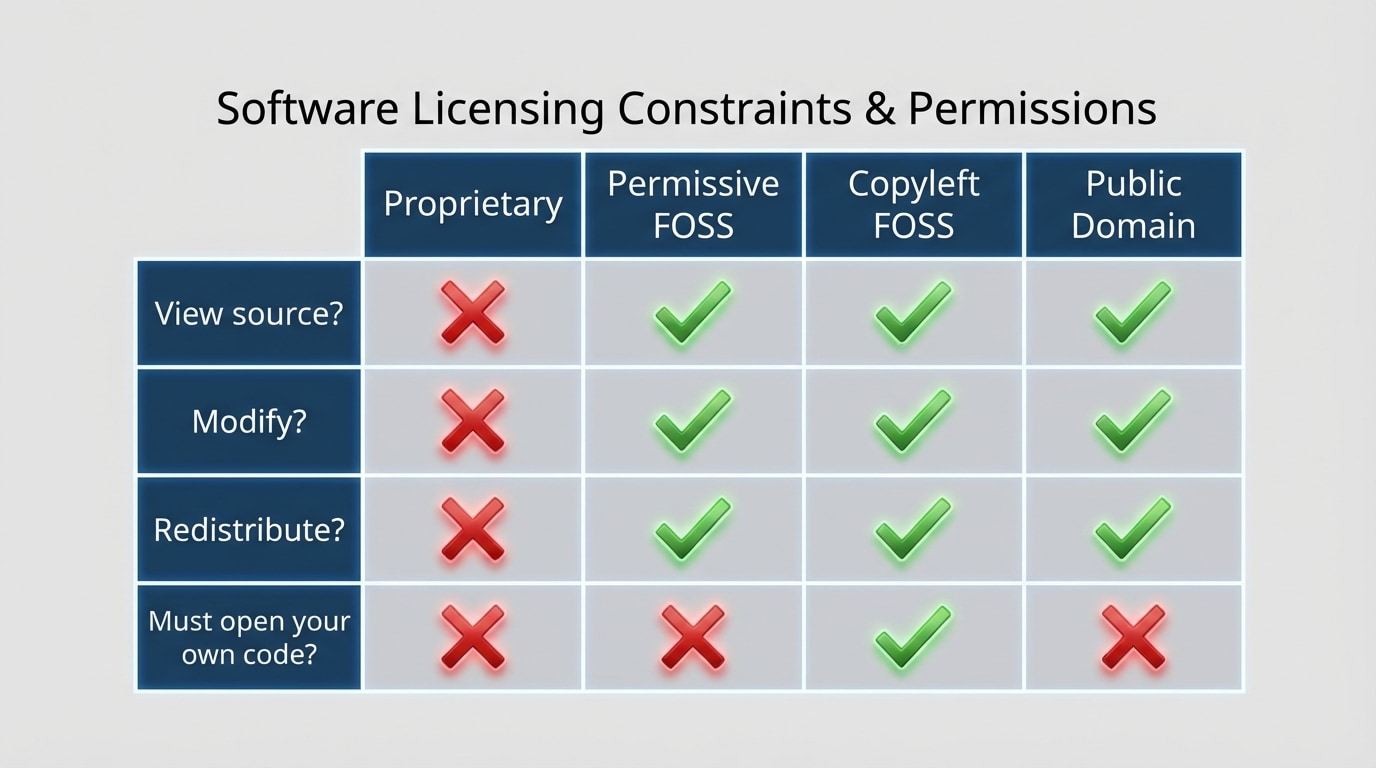
There are many software licenses, but most fall into a few broad categories. It helps to know the main ideas so you can predict what constraints they might place on your project. The main categories listed here are compared visually in [Figure 2].
1. Proprietary (Closed-Source) Licenses
Proprietary software is usually closed-source. You get to use the program, but you do not get the source code, and you cannot freely modify or redistribute it.
Characteristics:
Examples include many commercial apps, big desktop operating systems, and professional-grade creative tools.
2. Free and Open-Source Software (FOSS)
Free and open-source software lets you view, modify, and share the source code under certain conditions. “Free” here means “freedom,” not necessarily price.
Within FOSS, there are two major groups:
a. Permissive Licenses (for example, MIT, Apache 2.0)
Permissive licenses are relatively relaxed. They usually allow you to:
The main requirement is often that you keep the original copyright notice and license text. For example, if you use an MIT-licensed library in your app, you typically just need to credit the authors and include the license.
b. Copyleft Licenses (for example, GPL)
Copyleft licenses like GPL are stricter. They allow you to view, modify, and distribute the code, but with an important condition:
This is sometimes called a “viral” effect, because it spreads the GPL requirements to the larger project. It creates a strong constraint on how GPL code can be used, especially in commercial or closed-source software.
3. Public Domain and CC0
Some authors release their code into the public domain or under a license like CC0 (Creative Commons Zero). This means they give up almost all rights and allow anyone to use, modify, and redistribute the code with basically no restrictions.
Public domain code is the least restrictive in terms of licensing constraints. However, it is less common for large, complex projects.
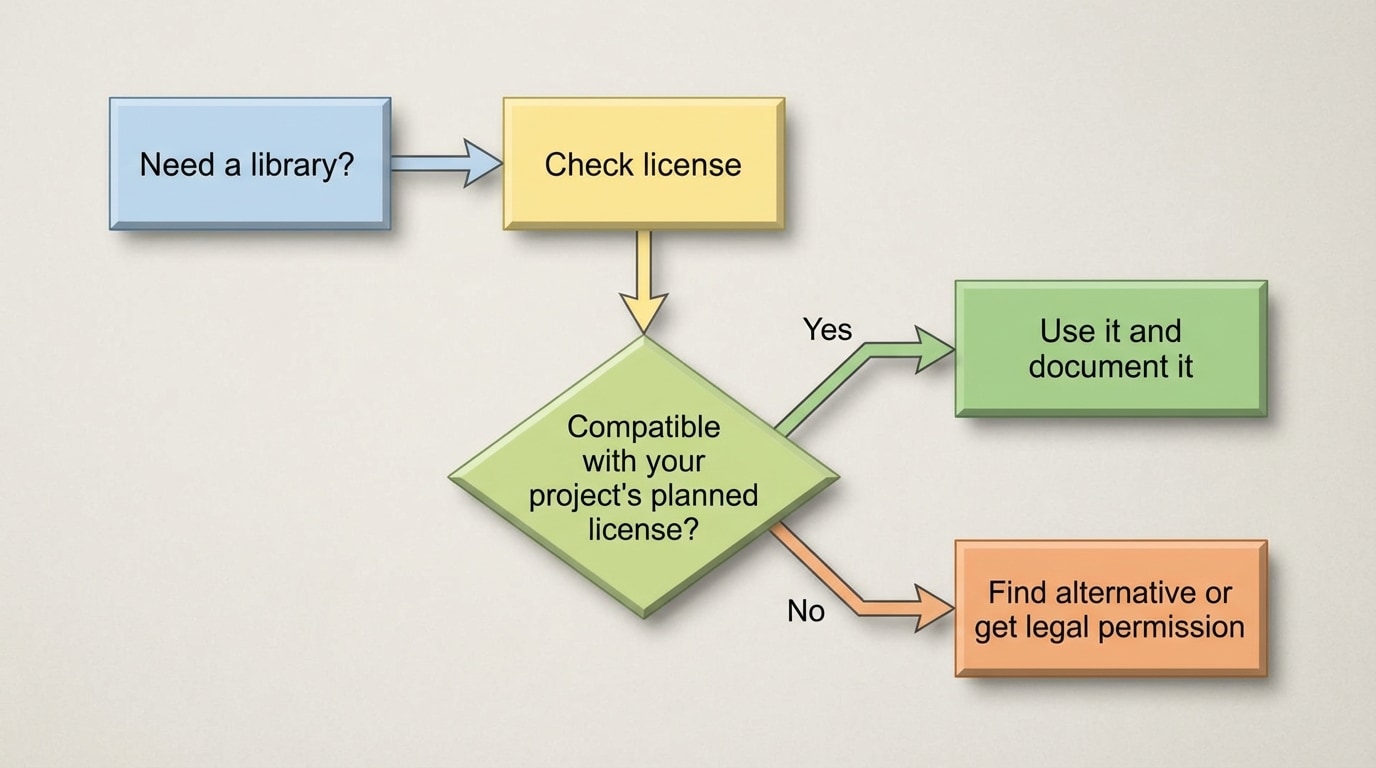
Licenses directly affect what you can combine in a project. You cannot just mix any two code libraries and release the result however you want. You must check whether their licenses are compatible, as the flow in [Figure 3] makes clear.
1. License Compatibility
Suppose you are building a mobile app. You want to use:
If you link the GPL library into your app and distribute the app, GPL may require that your entire app be released under GPL and that you share your source code. If you or your organization want to keep the app closed-source, this is a serious problem.
In contrast, if both libraries are MIT-licensed (or other permissive licenses), you usually have far more freedom: you can keep your code closed-source or open-source it as you choose, as long as you respect attribution rules.
2. Using Libraries vs. Using APIs
There is a difference between:
Licenses often mostly control the code itself. Calling an API is more about terms of service than software licenses. For example, a social media platform’s API might let you read public posts, but forbid you from storing or reselling that data. That is still a constraint on your design: you might not be allowed to build a “download everything and save forever” feature.
3. School and Company Policies
Beyond the actual license text, schools and companies often have additional rules:
These policies limit your choices when designing software, even if the code itself is technically free to use under its license.
Security and licensing sometimes push in different directions, and sometimes they support each other.
1. Open Source: Transparency vs. Exposure
With open-source licenses, anyone can see the code. This can:
In practice, open-source security often works well because active communities fix issues quickly. However, if a project is abandoned, its open code can become a roadmap for attackers. Programmers must design with the assumption that attackers can see the code, whether it is open-source or not.
2. Security Updates and Patching
Licensing affects how security updates happen:
This changes how you design maintenance and update strategies. For example, if you depend on an open-source library that is no longer maintained, you might legally fork it and maintain your own secure version, depending on the license.
3. Illegal Copies and Security Risks
Using unlicensed or “pirated” software is not just a legal issue; it is also a security risk. Cracked versions of expensive software often contain malware. For example:
This is why many schools and companies have strict rules about only using properly licensed software. They want to avoid both legal problems and security compromises.
To see how all of this affects computational design, consider some real-world-style situations you might encounter.
Scenario 1: A School Web App Project
You and your classmates are building a simple web app for a school club to track events and members. You plan to host it publicly so other students can use it.
Security constraints:
Licensing constraints:
These choices change which technologies you can select and how you implement them, even though your main goal is just “build a useful web app.”
Scenario 2: A Startup Mobile App
Imagine you are part of a small startup building a mobile app that collects health data to give users personalized recommendations.
Security constraints:
Licensing constraints:
Security and licensing together heavily influence your tech stack and architecture, not just what features you dream up.
Scenario 3: A Game Mod
You want to write a mod for a popular game that adds new levels and mechanics.
Security constraints:
Licensing constraints:
So, even though you can code, you must play by both security and licensing rules set by the original game creator.
Best Practices for Students and New Developers 💡
Security and software licensing are two major forces that constrain and guide computational design and development.
