Have you ever said something you thought was harmless, and a friend suddenly got really upset? Or sent a text that was meant as a joke, but the other person thought you were being mean? Those moments are not just awkward—they can affect your stress level, your friendships, and even how safe and supported you feel. That is why understanding how you communicate is a huge part of staying mentally, emotionally, and socially healthy.
Communication is how you share ideas, feelings, and needs with other people. It includes the words you say, the way you say them, your body language, and even your silence.
Good communication can:
Poor communication can do the opposite. It can:
Social and emotional wellness is about feeling good about yourself, managing your emotions, and having healthy relationships. The way you communicate every day can either protect that wellness or damage it.
Communication is usually divided into two main types: verbal and nonverbal. Both strongly affect mental, emotional, and social health. As you read the comparison of these two, imagine a simple conversation between two students, where speech bubbles show their words and arrows point to their posture, facial expressions, and distance apart, as in [Figure 1].
Verbal communication is all about words. It includes:
Nonverbal communication is everything you communicate without words, such as:
Even silence can send a message. Standing quietly with your arms crossed and your jaw tight can say, "I am angry," even if you do not speak.
Here is a simple comparison:
| Type | What it includes | Example in school |
|---|---|---|
| Verbal | Spoken or written words | Saying, "I feel nervous about the test." |
| Nonverbal | Body language, facial expression, eye contact, posture, gestures, space | Looking down, fidgeting, and biting your lip during the test. |
Verbal and nonverbal messages work together. When they match, people usually understand you clearly. When they do not match, people often believe your nonverbal message more than your words. For example, if you say, "I am fine," but your eyes are tearing up and your shoulders are slumped, your friend will probably think you are not really fine.
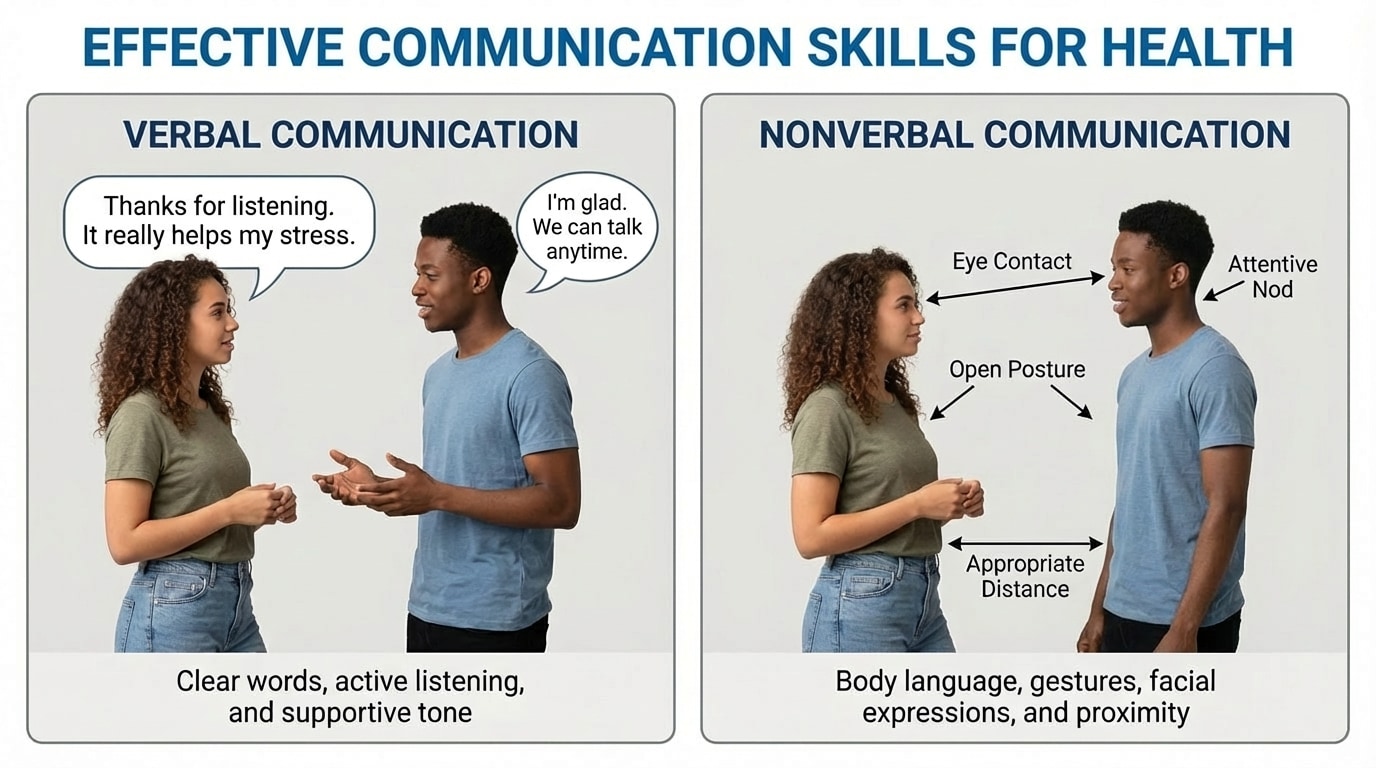
Using words wisely can protect your emotional health and your relationships. Here are some important verbal skills.
1. Speaking clearly and respectfully
Clear, respectful speech helps people feel safe around you. It reduces drama and misunderstandings.
2. Using "I" statements instead of "you" attacks
"You" statements often sound like blame: "You never listen." This can make the other person defensive or angry, increasing stress for both of you.
"I" statements focus on your own feelings and needs. They are more respectful and usually lead to better results. A helpful pattern is:
I feel <emotion> when <what happened> because <why>. I need/would like <your request>.
Example:
This kind of statement can lower anger, protect the relationship, and reduce your own stress because you are expressing yourself clearly and fairly.
3. Asking questions and checking understanding
Good communication is not just talking—it is also checking that you understood the other person correctly.
This skill prevents small misunderstandings from turning into big arguments.
4. Expressing feelings with words instead of actions
When people do not have words to explain how they feel, they may show it in unhealthy ways—slamming doors, snapping at others, or shutting down. Learning emotional vocabulary supports mental health because it helps you notice and share what is really going on inside.
Useful feeling words include: calm, excited, nervous, lonely, jealous, embarrassed, disappointed, overwhelmed, peaceful, hopeful.
Instead of yelling or storming off, you might say:
Naming your feelings can actually lower their intensity and help your brain think more clearly, which supports emotional wellness.
Words matter, but your body often speaks even louder. Your nonverbal communication can either help people feel safe and cared for, or make them feel judged or ignored.
1. Eye contact
Looking at someone's face (without staring aggressively) usually shows that you are paying attention and that you respect them.
Different cultures have different rules about eye contact, so it is important to be respectful and notice what is comfortable for the other person.
2. Facial expressions
Your face can show if you are interested, confused, angry, or caring.
3. Posture and gestures
The way you sit or stand sends signals:
4. Personal space
Everyone has an invisible "bubble" of space around them. Standing too close without permission can make people feel uncomfortable or threatened. Standing too far away can sometimes feel cold or distant.
Respecting space is important for emotional and physical safety.
5. Nonverbal signs of active listening
When a friend is sharing something personal, your nonverbal choices can make a huge difference for their mental health. Helpful signals include:
These signals tell the other person, "You matter. I am here." Feeling heard like this can reduce anxiety and loneliness.
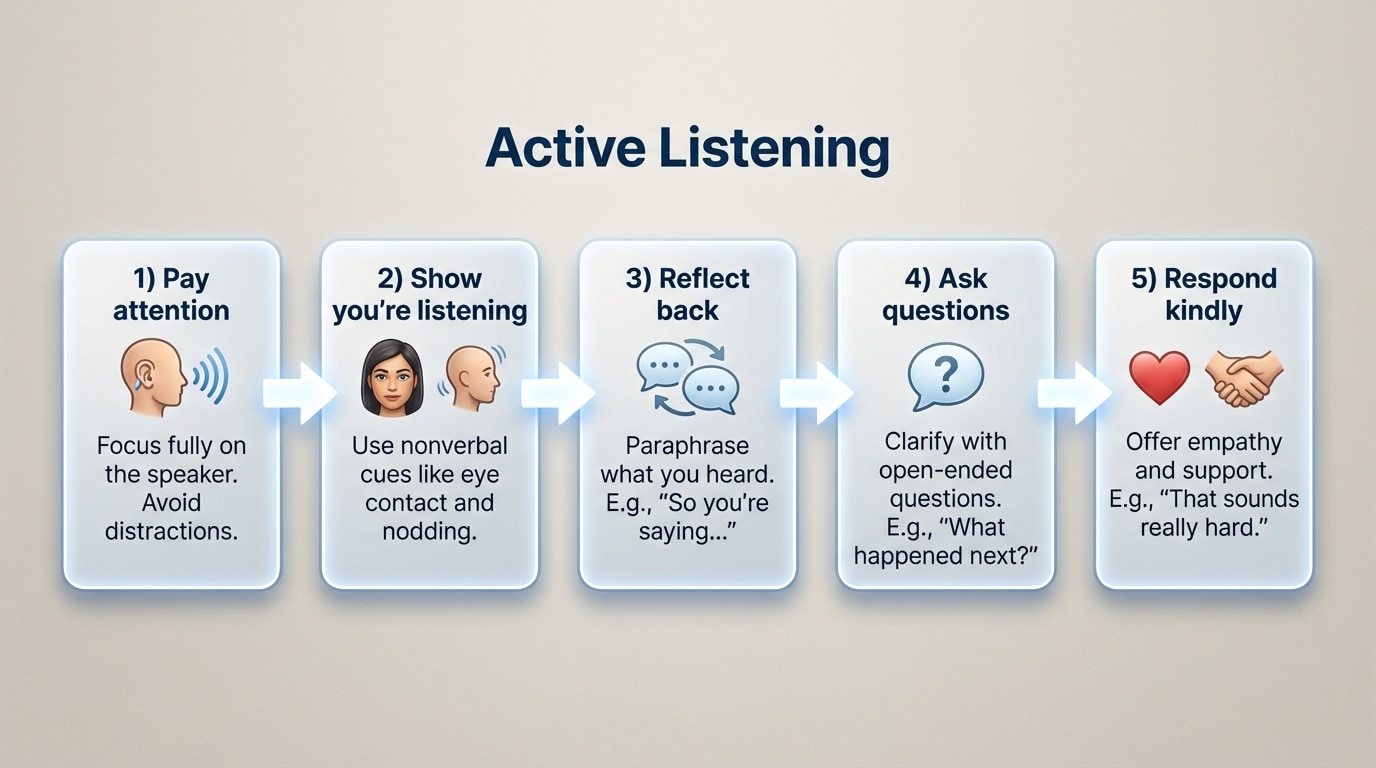
Active listening is more than just hearing sounds. It means choosing to really focus on the other person and trying to understand both their words and feelings. It is one of the most powerful ways you can support someone's mental and emotional health. A clear way to remember this process is to picture it as a simple flowchart that moves from paying attention to responding kindly, as shown in [Figure 2].
Active listening has several key steps:
1. Pay full attention
2. Show you are listening
3. Reflect back what you heard
This means briefly saying what you think they are telling you, in your own words:
4. Ask gentle questions
Ask open questions that let them share more:
5. Respond kindly, not by taking over
Sometimes people just want to be heard, not "fixed." You can say:
When someone feels truly listened to, their stress often drops, and they feel less alone. Practicing the steps in active listening can make you a strong, supportive friend and can also help in conflicts, as you will see when we connect back to [Figure 2] in the conflict section.
Talking about emotions and mental health can feel scary, but it is an important way to protect your wellness. Keeping everything inside can increase anxiety, sadness, or anger over time.
1. How to share your own feelings
You can use both verbal and nonverbal skills to share what is going on:
2. Asking for help when you are struggling
Reaching out is a sign of strength, not weakness. You might say:
Your tone of voice and posture can help show that you are serious and truly asking for support.
3. Checking on a friend who seems different
If a friend suddenly seems withdrawn, angry, or not like themselves, using kind communication can really help their mental health.
4. Respecting boundaries
Sometimes someone is not ready to talk. You can still show you care:
Knowing how to communicate about mental health topics helps build a caring support network where everyone feels safer and less alone.
Conflict is a normal part of life. Friends, siblings, classmates, and even adults disagree. The way you communicate during conflict has a huge impact on your stress, your relationships, and your sense of safety.
1. How unhealthy communication harms wellness
Patterns like yelling, insults, ignoring, or gossiping can lead to:
2. Aggressive, passive, and assertive communication
There are three common styles:
Example:
3. Steps for healthy conflict communication
You can use the same active listening steps from [Figure 2], but both people take turns talking and listening. Here is a simple approach:
Handling conflicts with respectful verbal and nonverbal communication reduces stress and makes your relationships stronger, which supports both your emotional and social health.
Today, a lot of communication happens through screens—texts, group chats, social media, online games. This changes how verbal and nonverbal communication work.
1. What is missing online?
When you are texting or chatting, people cannot see your face, hear your tone of voice, or notice your body language. That means:
2. Using emojis and punctuation wisely
Online, people often use emojis, punctuation, and formatting to replace some nonverbal cues:
Even with emojis, remember they are not perfect. If a conversation is serious or emotional, it is often better to talk in person or at least by voice or video, where more nonverbal signals are available.
3. Healthy digital communication habits
Using technology with kindness and care helps create an online environment that supports, rather than harms, emotional wellness.
Verbal and nonverbal communication are powerful tools that can protect or harm your mental, emotional, and social health.
Key points to remember:
By practicing these skills every day—in the classroom, at home, with friends, and online—you build habits that support your mental and emotional balance, strengthen your social connections, and create a healthier environment for yourself and the people around you.
