Have you ever heard one person say that a certain snack is "super healthy," and then someone else says, "Actually, that's really bad for you"? 🤔 With so many websites, videos, and ads telling you what to eat, it can be confusing. Learning how to judge which information, products, and services you can trust helps you build strong, lifelong healthy eating habits.
Every day, you make food choices: what to eat for breakfast, what to buy at the store with your family, what to grab as a snack after school. Those choices are influenced by many things: friends, family, ads, and what you read or watch online.
Healthy eating behaviors include things like:
To keep up these habits through your whole life, you need to know which information is worth following and which should be ignored. That means checking the validity (Is it true?) and the reliability (Can I trust it every time?) of what you see and hear about food, diets, and health services.
Validity is about truth and accuracy. When information is valid, it matches reality. It is based on good facts and solid evidence, not just opinions or guesses.
Think of it like this: if someone says, "This drink will make you grow 10 cm taller in one week," that claim is almost certainly not valid. It sounds extreme, and there is no strong scientific proof that a normal drink can do that.
Here are signs that information about food has good validity:
Here are some common types of sources and how valid they usually are:
| Source Type | Example | Typical Validity |
|---|---|---|
| Government health site | National nutrition guidelines page | Usually high (based on research and experts) |
| Major health organization | Heart or diabetes foundations | Usually high (scientific evidence) |
| Personal blog or influencer | "My miracle diet story" | Can be low (mostly opinion or one person's experience) |
| Food company advertisement | Commercials, sponsored posts | Mixed (they may share some facts, but their goal is to sell) |
To check validity, ask questions like:
For example, if you see a website saying, "Eat only this special soup and you will lose weight fast with zero risk," that is a warning sign. Real, valid health advice usually explains that any diet has pros and cons, and that sudden, extreme changes can be unhealthy.
Reliability is about being able to trust something again and again. If information is reliable, it stays the same when you check it at different times or in different places.
Think of a clock. If the clock shows the correct time now, and again tomorrow, and again next week, it is reliable. If it jumps from one time to another randomly, you cannot rely on it.
For nutrition information, reliability means:
To check reliability, you can:
Sometimes information can be partly valid (some facts are correct) but still not reliable (it leaves out important details or changes its story all the time). That is why you need to check both validity and reliability.
Ads and social media posts about food are designed to grab your attention and make you feel something. They might use tricks that look exciting but do not always lead to valid or reliable information. 🎯
Common tricks include:
When you see a post that says something like, "I drank this tea and lost 5 kg in one week—no exercise!" stop and test it:
If the answers are unclear, do not let that post control your food choices. You can still enjoy social media, but you do not have to believe everything it tells you about health.
Every time you pick up a food package at the store, you are looking at a mini information system. The front of the package is like an advertisement. The back or side has the Nutrition Facts and ingredients list, which are more scientific and checked by rules and laws.
The front and back of a box can send very different messages, as you can see in [Figure 1]. The front might say "Natural," "Made with fruit," or "Low fat," while the Nutrition Facts may show that it is actually high in added sugar or salt.
Here are some things to pay attention to when you evaluate a product:
To judge validity and reliability:
This kind of simple math helps you see whether a product really matches the healthy image it is trying to sell.
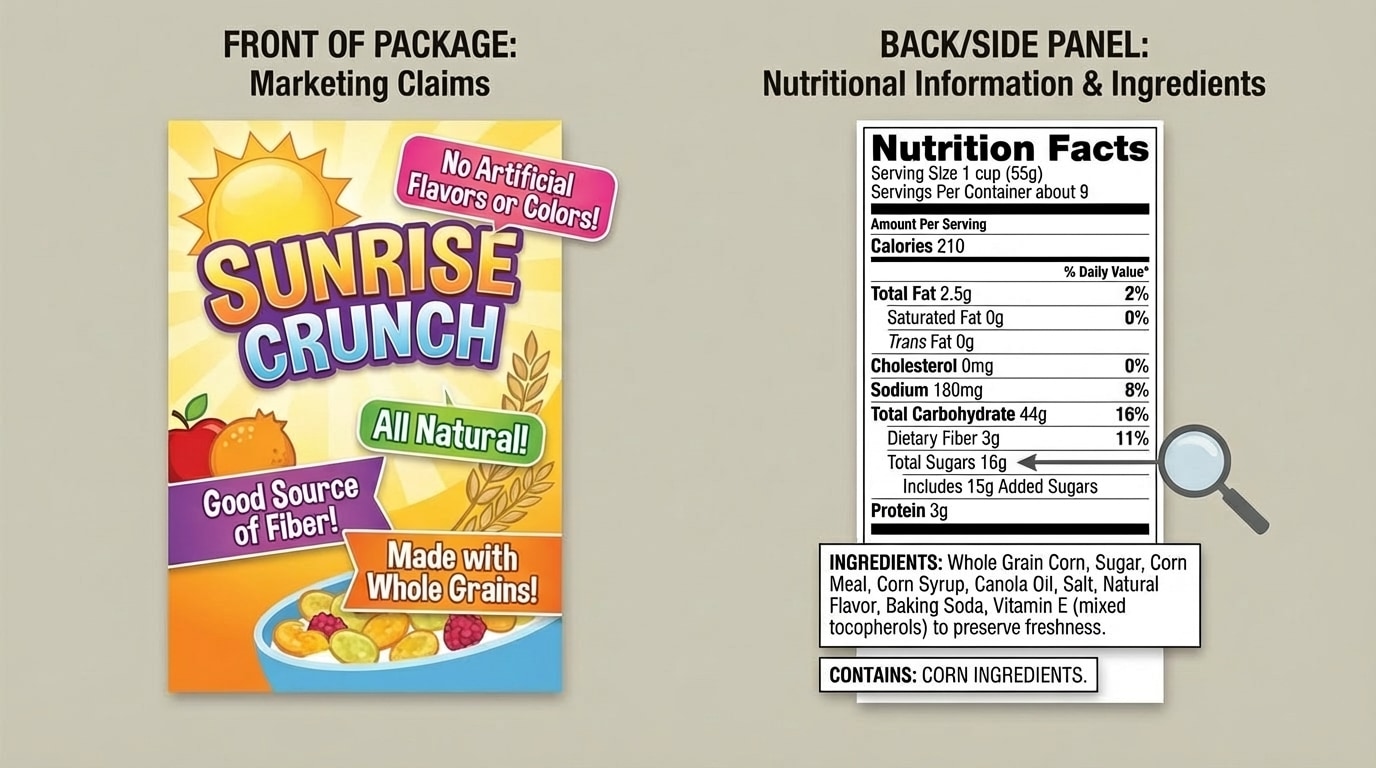
Later, when you compare different products, remember how in the cereal box example the bright, exciting front did not always match the more serious information on the back. Your goal is to base decisions mostly on the solid facts, not only on the fancy words and pictures.
Healthy eating is not just about products; it is also about services and advice, like apps, diet programs, or "nutrition coaches." Some of these are helpful, and some are not. 🩺
Here are examples of services that give eating advice:
To evaluate their validity and reliability, ask:
Warning signs of a possibly unsafe or unreliable service:
Safe services usually:
For younger people your age, it is especially important to talk with parents, guardians, or school health staff before following major eating advice from an app or online program.
There is a lot to remember, so it helps to have a simple mental checklist you can run through whenever you see new nutrition information, a new product, or a health service. Think of it as a little decision path in your mind, like the one shown in [Figure 2]. 🧭
Here is a step-by-step process you can practice using:
At the end of this checklist, ask yourself:
If you can answer "yes" to these questions and it passes the checklist, it is more likely to be valid and reliable—and a good guide for your choices.
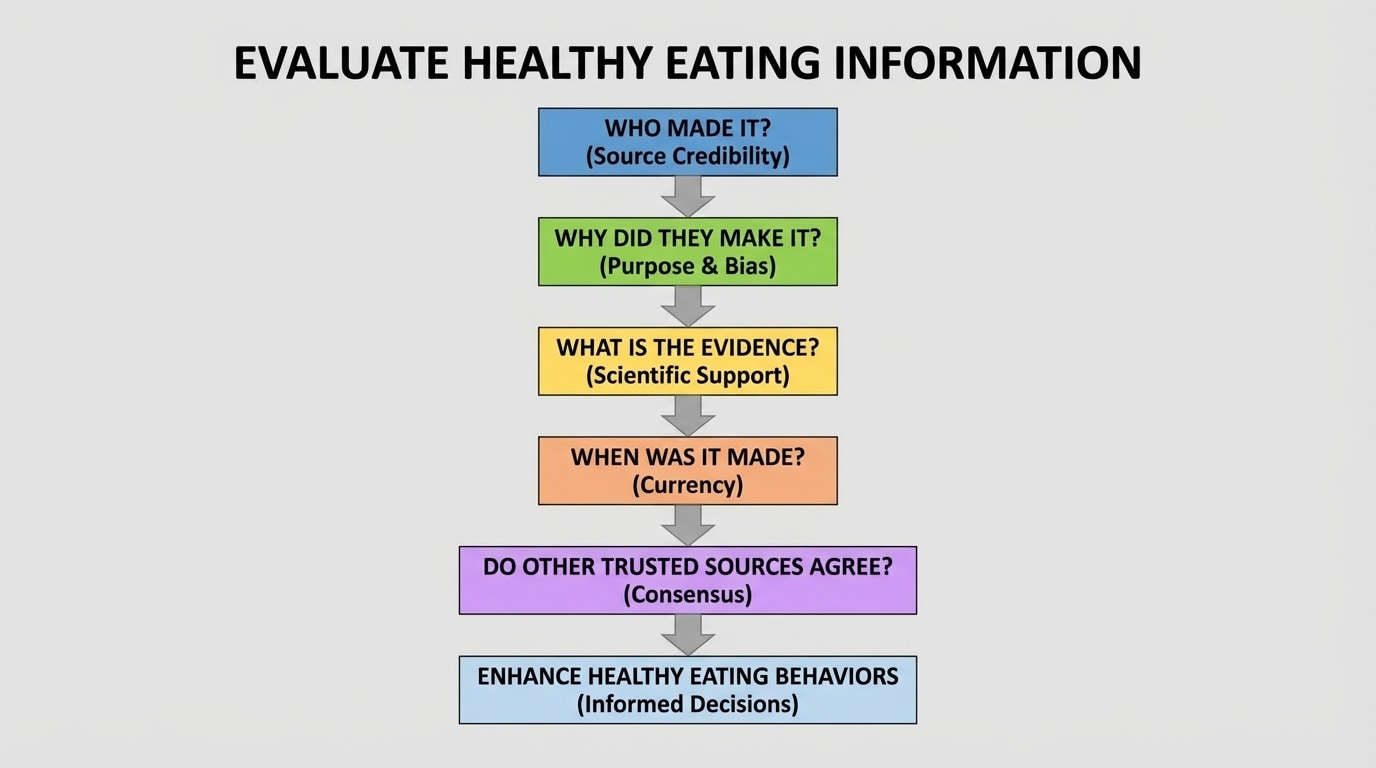
Later, when you are older and faced with bigger health decisions, you can still use the same step-by-step flowchart you practiced here. Learning this now helps you become an independent, thoughtful decision-maker about your health for life. 🌟
Healthy eating behaviors—like eating a variety of foods, watching portions, and limiting added sugar—depend on the information, products, and services you choose to trust.
Validity means the information is true and accurate. Valid information usually comes from experts and is based on scientific evidence, explains the reasons behind advice, and does not make wild promises. Reliability means you can trust the information over time and across different sources. Reliable information is consistent, up-to-date, and supported by more than one trustworthy source.
You learned how to question ads and social media posts that use tricks like emotional language, celebrity influence, and dramatic "before-and-after" photos. You also practiced judging products by looking closely at Nutrition Facts labels, serving sizes, and ingredients, instead of believing only front-of-package claims.
For health services and eating advice, it is important to know who created the program, what their goals are, whether the advice is safe and balanced for someone your age, and if it encourages you to talk with real health professionals and trusted adults.
Finally, a simple checklist—Who made it? Why did they make it? What is the evidence? When was it made? Do other trusted sources agree?—helps you decide whether to accept or question food and health information. Using this process now builds habits that will support your physical and personal wellness for your whole life. 🍽️
