Have you ever said or texted something in the heat of the moment and then thought, “Why did I do that?” later on? During adolescence, this happens a lot, not because you are a “bad” person, but because your feelings are getting stronger and your brain is still learning how to handle them.
Learning how feelings and actions are connected can help you protect your health, build strong friendships, and treat yourself and others with respect.
This lesson explores how your emotions influence what you do, especially in your relationships with friends, family, and people you may feel attracted to.
When you understand this connection, you can make healthier choices, both now and as you grow older.
Adolescence is the time in life when you are no longer a little kid, but not yet an adult. For most people, it starts somewhere between ages 9 and 12 and continues into the late teen years. During this time, your body, brain, and feelings change quickly.
Some changes are physical: you grow taller, your body shape changes, and you may start puberty. Other changes are emotional and social: you may care more about what friends think, feel stronger crushes, or get angry or sad more quickly than before.
Scientists have found that the part of the brain that feels emotions grows very active during adolescence, while the part that helps with planning and self-control is still developing. That means your feelings can feel like a loud speaker and your self-control can still be learning how to turn the volume down.
Because of these changes, your feelings can strongly push your actions. You might slam a door, send a mean text, agree to something you do not really want, or say hurtful words without planning to. The good news is that you can learn skills to pause, think, and choose actions that match your values and keep your relationships healthy.
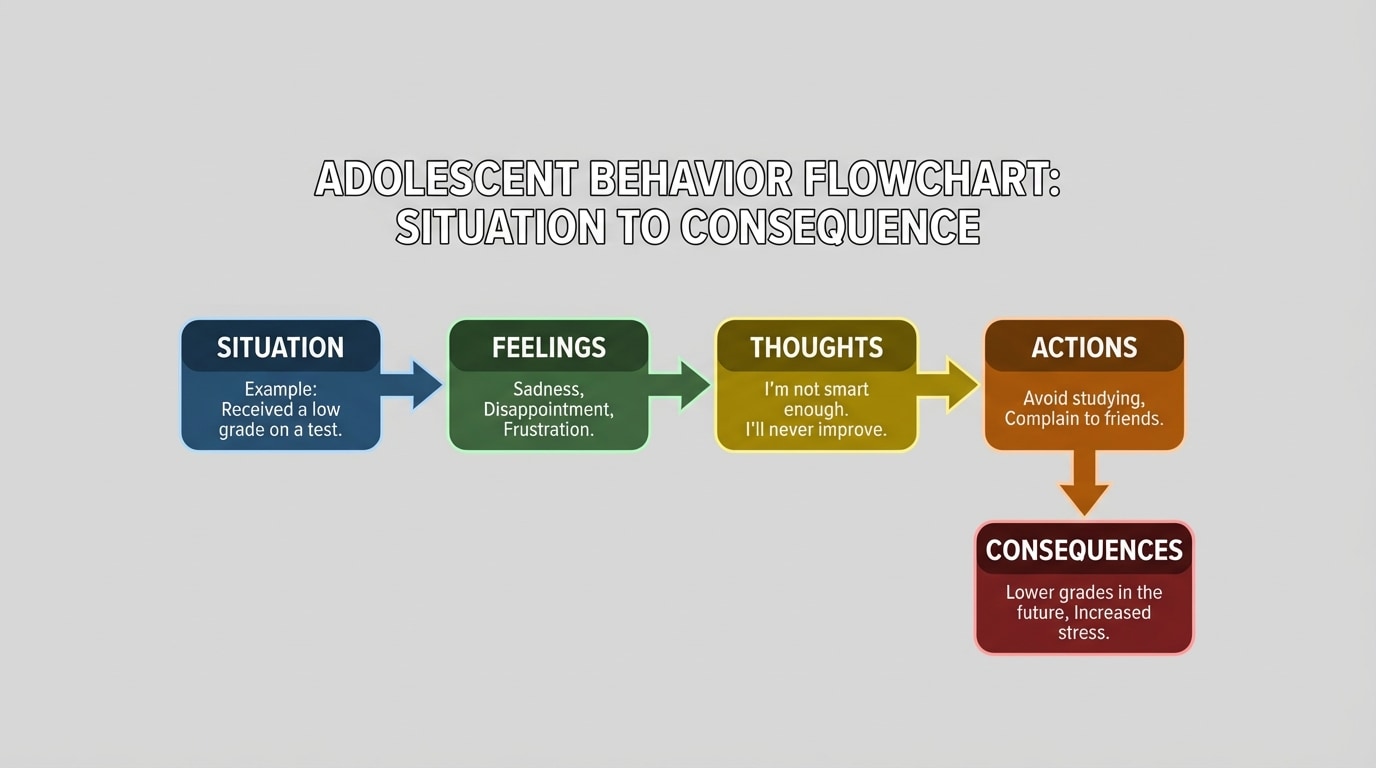
Your behavior does not come only from your feelings. There is a chain that usually looks like this, as shown in [Figure 1]: a situation happens, you have a feeling about it, you think something in your mind, and then you choose an action. The action leads to a result or consequence.
Here is an example: Situation: Your friend sits with someone else at lunch. Feeling: You feel hurt and maybe jealous. Thought: You might think, “They don’t like me anymore.” Action: You decide not to talk to them after school and maybe send a cold text: “Whatever.” Result: Your friend feels confused or upset, and your friendship feels weaker.
But notice that there is another possible chain. Same situation and feeling, different thought and action: Situation: Friend sits with someone else. Feeling: You feel hurt and left out. Thought: “Maybe they just wanted to sit with someone different today. I can talk to them.” Action: You calmly ask later, “Hey, I missed sitting with you today. Everything ok?” Result: You understand each other better and your friendship stays strong.
In both cases, the feeling is similar, but the thought is different, and that changes the action and the result. This is important for your health and relationships: you cannot always control what feelings pop up, but you can learn to notice your thoughts and choose actions that are respectful to yourself and others.
The same chain shows up online. Imagine someone leaves you on “read” after you share something personal. You might feel ignored. If your thought is “They don’t care about me,” your action might be to spam them with angry messages. If your thought is “Maybe they’re busy; I’ll wait,” your action might be to give them time or send a gentle follow-up later. The feeling is real in both cases, but your choice of action can either damage or protect the relationship.
Understanding this chain also helps with health decisions, including sexual and reproductive health as you get older. Strong attraction or curiosity can lead to thoughts like “Everyone else is doing this” or “I have to do this to keep them.” Those thoughts can push you toward actions you are not ready for or do not truly want. Learning to pause and check your thoughts makes it easier to choose safe, respectful, and healthy behaviors.
Adolescence comes with many powerful feelings. None of these feelings are “wrong,” but they can lead to actions that are either helpful or harmful.
1. Anger
Anger can show up when you feel treated unfairly, embarrassed, or hurt. Common unhelpful actions include yelling, hitting, slamming doors, spreading rumors, or sending rude texts. Helpful actions might be taking a break, talking calmly about what bothered you, or asking an adult to help solve a conflict.
2. Embarrassment
Maybe you tripped in the hallway, your voice cracked, or someone made a joke about your changing body. You might want to hide, lash out, or make fun of someone else to distract. But you could also choose actions like laughing it off, reminding yourself that everyone goes through awkward moments, or talking to a trusted friend.
3. Attraction or Having a Crush
You may start to feel strong interest in certain people. This is normal. Unhelpful actions might be pushing someone to share personal photos, touching someone without asking, or agreeing to private situations you do not feel ready for. Helpful actions include respecting boundaries, asking permission before physical contact, and taking your time—remember, you always have the right to say “no,” and so does the other person.
4. Jealousy
You may feel jealous if your friend gets close to someone else, or if someone you like pays attention to another person. This feeling might push you to gossip, be controlling, or try to make the other person jealous too. Healthier actions include talking honestly about how you feel, reminding yourself that people can have more than one friend, and focusing on your own interests and strengths.
5. Loneliness and Sadness
Sometimes you might feel left out, especially if groups form or people are dating. This might lead to actions like isolating yourself, posting risky photos for attention, or agreeing to things just to feel included. Healthier actions can be reaching out to a trusted adult, joining a club or activity you enjoy, or talking kindly to yourself instead of thinking you are “not good enough.”
6. Excitement
Excitement feels good, but it can still lead to risky actions. When you are very excited—about a party, a big game, or someone you like—you might forget to think through safety, rules, or your own boundaries. Practicing a quick pause to think, even when you are really happy, helps you stay safe and respectful.
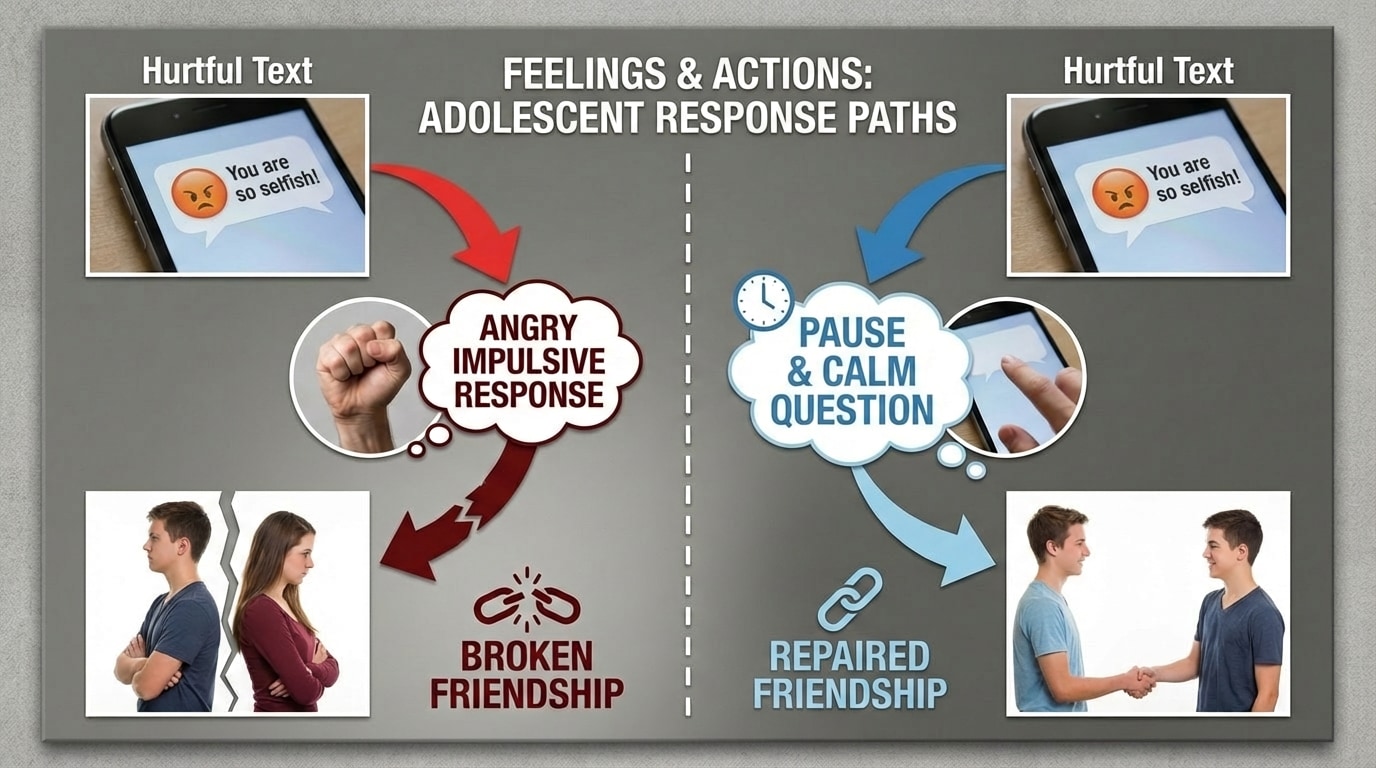
Because your brain is still developing, it is easy to act on impulse—doing something quickly, without thinking about the results. You can see the difference between impulsive and thoughtful actions in [Figure 2]. Learning to pause before acting is a powerful skill that protects your health and relationships.
Imagine this situation: you text a friend something personal, and they reply with a short message that sounds rude to you. You instantly feel hurt and angry.
Impulsive path: Feeling: Angry. Thought: “They are being mean on purpose.” Action: You fire back, “You’re such a jerk. I’m done with you,” and then post something about them online. Result: Your friend feels attacked, the conflict grows, and you may hurt your reputation and your friendship.
Thoughtful path: Feeling: Angry. Thought: “This message hurt. I should find out what they meant before I react.” Action: You wait until you calm down, then ask, “Hey, that message sounded a little harsh to me. Did you mean it that way?” Result: Maybe your friend explains they were tired or distracted, or you both clear up a misunderstanding. The relationship has a better chance of staying strong.
Impulsive actions are not only about texts. They also show up when you feel pressure to do something with your body or in romantic or sexual situations. You might feel nervous, flattered, or afraid of losing someone’s attention, and quickly agree to something you do not want. A thoughtful action would be to pause, check in with your own feelings, and remember your right to say “no” or “not yet,” even if the other person is disappointed.
Thinking about the two paths in [Figure 2] can help you remember that you almost always have a choice, even when your feelings are very strong.
Relationships—whether with family, friends, or people you are interested in romantically—are built on respect, kindness, honesty, and safety. Your feelings strongly influence how you act in these relationships.
1. Respect and Boundaries
Everyone has boundaries—limits about what feels comfortable. This includes how close someone stands, what they talk about, what they touch, and what they share online. You might feel curious or attracted and want to get closer. You might also feel shy or uncomfortable and want more space. Healthy actions include:
Your own feelings matter too. If you feel uneasy, pressured, or unsure, that is a signal to slow down, talk to someone you trust, or say “no.”
2. Consent in Simple Terms
Consent means that everyone involved clearly agrees to what is happening, freely and without pressure. Even at your age, consent matters—for hugs, photos, sharing secrets, and later in life for any sexual or romantic behavior. Feelings like excitement or fear of losing someone can push you to ignore consent. Healthy actions are:
3. Empathy: Imagining the Other Person’s Feelings
Empathy means trying to understand how someone else feels. When you practice empathy, your actions become kinder. For example, if you feel annoyed with a sibling, empathy might help you remember they had a hard day. You may choose to talk calmly instead of yelling.
The chain from [Figure 1] is useful here too. Situation: Your friend cancels plans. Feeling: Disappointed. Thought with empathy: “They might have a lot going on; I’ll ask what’s up.” Action: You send a kind message instead of an angry one, which supports the relationship.
As you move through adolescence, you may notice more thoughts and questions about bodies, privacy, attraction, and eventually sexual and reproductive health. You do not need to rush into anything. Understanding your feelings and actions now can help keep you safer in the future.
1. Strong Feelings of Attraction and Curiosity
Crushes and curiosity are normal. But they can sometimes lead to risky actions, like sending or asking for private pictures, sneaking around, or doing things you do not fully understand yet. Emotions that might push those actions include wanting attention, fearing rejection, or trying to “prove” maturity.
Healthy actions include:
2. Pressure from Others
Sometimes friends, older peers, or people you like may pressure you: “If you loved me, you would …” or “Everyone else is doing this.” These words are trying to pull on your feelings of love, friendship, or belonging to get you to act a certain way.
Healthy responses include:
3. Protecting Future Health
Your choices now help protect your future sexual and reproductive health. This includes staying safe from infections, unwanted pregnancies in the future, and emotional harm. When you feel pressured or very excited, remember the two paths from [Figure 2]: an impulsive path and a thoughtful path. The thoughtful path gives you the space to ask, “Is this safe? Is this respectful? Is this what I really want?”
You cannot stop feelings from showing up, but you can choose how to respond. These strategies help you slow down and pick healthy actions.
1. Pause and Breathe
When a strong feeling hits, try to take a short pause—just a few seconds can help. Take a slow breath in through your nose, hold it for a count of three, and breathe out slowly through your mouth. Doing this a few times can calm your body so your thinking brain can catch up.
2. Name the Feeling
Simply putting your feeling into words—“I feel angry,” “I feel embarrassed,” “I feel jealous”—can make it feel less overwhelming. Once you name it, you can ask yourself, “What action will actually help me here?”
3. Check Your Thoughts
Remember the chain in [Figure 1]. Ask yourself, “What am I telling myself right now? Is it 100% true?” If your thought is “Nobody likes me,” you can challenge it with facts: “Actually, I do have people who care about me.” This helps prevent actions that hurt you or others.
4. Use “I” Statements
When you talk about your feelings, using “I” statements can make conflicts smaller instead of bigger. For example, instead of “You are so annoying,” you might say, “I feel frustrated when I’m interrupted, because I’m trying to finish my homework.” This invites problem solving instead of a fight.
5. Delay Digital Actions
Online posts, texts, and photos can spread quickly and be hard to erase. If you are emotional, wait before you respond. You might decide to:
6. Talk to a Trusted Adult
Grown-ups you trust—parents, guardians, counselors, teachers, coaches, or relatives—can help you sort out feelings and think through actions, especially about relationships and health. Asking for help is a strong and smart action, not a weakness.
Sometimes feelings become very strong or last a long time, such as ongoing sadness, anxiety, anger, or confusion about relationships or your body. You might notice changes in sleep, eating, or schoolwork, or feel like hurting yourself or others. These are signs that you deserve extra support.
When to Ask for Help
In these situations, taking action by asking for help is one of the healthiest choices you can make. Talk to a trusted adult right away. If one person does not listen, keep going until someone does.
Supporting Friends
Friends might come to you with their strong feelings. You cannot fix everything, but you can:
Caring actions like these help create a community where people feel safe and respected, which supports everyone’s physical, emotional, and reproductive health.
Adolescence is a time when feelings become stronger and your brain is still learning self-control. A situation leads to feelings, then thoughts, then actions, and finally results. You often cannot choose your first feeling, but you can learn to notice your thoughts and choose actions that are safe, respectful, and healthy.
Common emotions like anger, embarrassment, attraction, jealousy, and loneliness can pull you toward impulsive actions—like yelling, gossiping, risky online behavior, or agreeing to things you do not want. By pausing, breathing, naming your feeling, checking your thoughts, and sometimes talking to a trusted adult, you can move from the impulsive path to the thoughtful path.
In relationships, including friendships, family, and early crushes, your actions matter. Healthy relationships depend on respect, boundaries, empathy, and consent. Your feelings of curiosity or attraction are normal, but they should never lead you to ignore someone else’s “no,” or your own. Choosing to wait for sexual behaviors until you are older and better informed is a powerful way to protect your sexual and reproductive health.
When feelings get very strong or last a long time, asking for help is a wise and brave action. Supporting others with kindness and encouraging them to get help also makes your community safer. By understanding how feelings and actions are connected, you build the skills to make thoughtful decisions that support your health and your relationships, now and in the future.
