Have you ever noticed that when you are exhausted from staying up late, you are more irritable with friends and it is harder to focus in class? Or that when you have a conflict with someone you care about, your appetite and sleep can suddenly change? These are everyday examples of how different parts of your health are deeply connected, not separate boxes.
Health is more than the absence of disease. It includes how you feel emotionally, how you think and learn, how your body functions, and how you connect with other people. These are often described as four major dimensions of health: emotional, intellectual, physical, and social. Together they form a single, constantly changing system. A change in one dimension almost always affects the others.
Understanding these interrelationships helps you make smarter choices. Instead of seeing sleep, stress, friendships, and grades as separate problems, you can see the patterns that link them—and use that knowledge to improve your mental, emotional, and social well-being. 🙂
Emotional health is your ability to notice, understand, and manage your feelings in healthy ways. It is not about being happy all the time. Instead, it is about being able to experience the full range of human emotions—sadness, anger, fear, joy, excitement—without becoming overwhelmed or losing control of your behavior.
Key elements of emotional health include:
Example: A student feels nervous before a presentation. With strong emotional health skills, they recognize, "I am anxious, but that is normal," take some deep breaths, review their notes, and ask a friend for encouragement. Their feelings are still there, but they can function and even perform well.
Emotional health closely affects and is affected by the other dimensions. Intense, unmanaged stress can lead to headaches, stomachaches, and sleep problems (physical health), make it hard to think clearly (intellectual health), and cause arguments or withdrawal from friends and family (social health).
Intellectual health refers to how you use your mind: your curiosity, your ability to think critically, solve problems, learn from experience, and make decisions. It is not just about grades or IQ. It is about how you approach learning and mental challenges in every part of life.
Key elements of intellectual health include:
Example: You get a lower grade than you expected on a test. With strong intellectual health, you reflect on what happened, identify which study strategies did not work, ask questions in class, and try a new method for the next test—rather than just giving up.
Intellectual health is intertwined with emotional health. For example, if you feel hopeless ("I am just stupid"), that emotional state shuts down curiosity and effort. On the other hand, learning effective study and time-management strategies can reduce stress and boost confidence, supporting emotional well-being.
Physical health involves how well your body functions: your energy level, strength, endurance, sleep, nutrition, and whether you engage in risky behaviors like substance use. Your brain is part of your body, so physical health directly influences how you think and feel.
Important aspects of physical health include:
Example: A student who regularly exercises, eats balanced meals, and protects their sleep is more likely to feel alert in class, stay emotionally stable, and handle stress effectively.
Physical health and emotional health strongly influence each other. Stress and anxiety can trigger physical symptoms like muscle tension, rapid heartbeat, or stomach pain. Over time, chronic stress can affect the immune system and increase risk for illness. At the same time, physical illness or pain can lower mood, increase irritability, and make social interaction or concentrating on school harder.
Social health is about the quality of your relationships and your sense of connection and belonging. It includes how you communicate, resolve conflicts, respect boundaries, and support others.
Key elements of social health include:
Example: After a stressful day, a student texts a trusted friend and talks through what happened. Feeling heard and supported helps them calm down emotionally, sleep better, and return to school the next day with more focus and energy.
Social health is deeply connected to emotional health. Feeling isolated or bullied can lead to sadness, anger, or anxiety. Strong, supportive relationships, on the other hand, protect mental health and can even improve physical health by lowering stress hormones in the body.
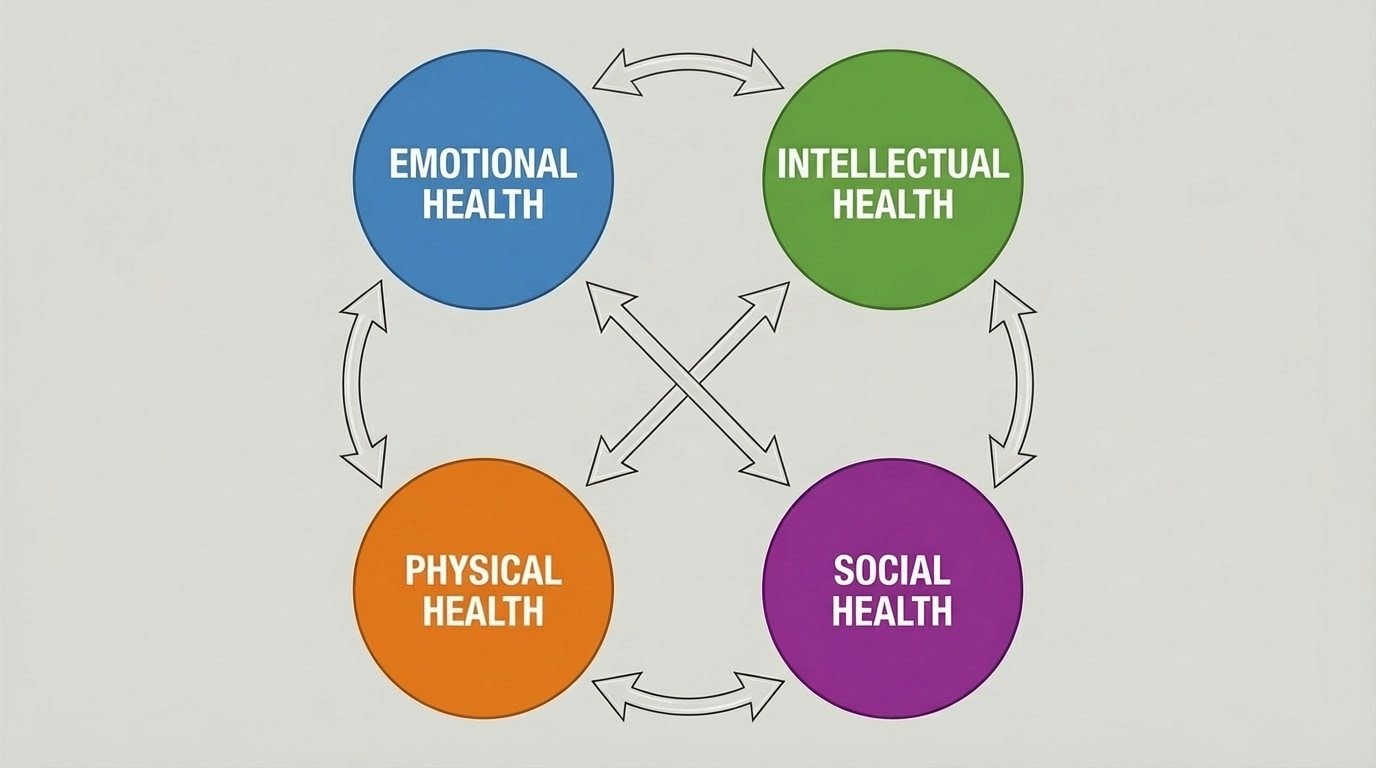
The four dimensions of health—emotional, intellectual, physical, and social—are not separate boxes. They form a connected system in which each part influences the others, as shown in [Figure 1]. When one dimension changes, it often sets off a chain reaction.
Example chain: You stay up late scrolling on your phone (physical). The next day you feel tired and moody (emotional), have trouble paying attention in class (intellectual), and snap at a friend during lunch (social). That argument then makes you feel even worse emotionally, which might lead you to stay up late again, continuing the cycle.
It helps to think of these dimensions as four closely linked gears. If one gear speeds up, slows down, or jams, the others are affected. Improving one dimension can also pull the others in a positive direction.
| Dimension | Short Description | Example of How It Affects Another Dimension |
|---|---|---|
| Emotional | Feelings and mood; coping with stress | Ongoing anxiety makes it hard to sleep (physical) and concentrate on homework (intellectual). |
| Intellectual | Thinking, learning, decision-making | Good study skills reduce stress before tests (emotional) and leave more time for friends (social). |
| Physical | Body functioning: sleep, nutrition, exercise, illness | Regular exercise improves mood (emotional) and attention in class (intellectual). |
| Social | Relationships and sense of belonging | Supportive friends listen when you are upset (emotional) and encourage you to get help or study together (intellectual). |
Because these dimensions are so interconnected, small positive changes can have large ripple effects. Eating a better breakfast might improve your energy, which boosts your mood, which makes it easier to participate in class and talk with others. Likewise, negative cycles can build quickly if they are not interrupted.
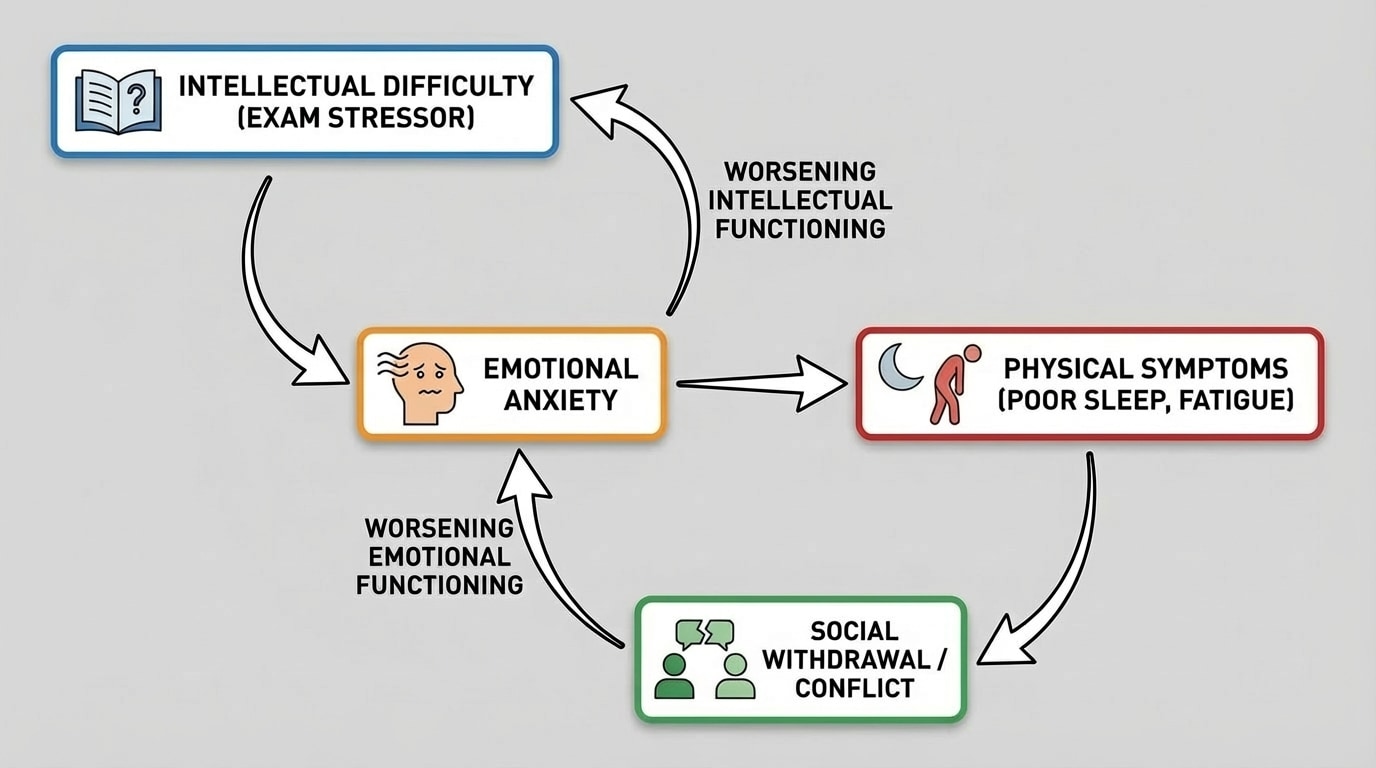
Stress is one of the clearest examples of how the four dimensions of health interact. Stress is not always bad; a certain amount can motivate you. But when stress is intense or long-lasting, it can disrupt emotional, intellectual, physical, and social health all at once. This chain reaction, summarized in [Figure 2], shows how one stressor can ripple through every part of health.
Scenario: Exam Stress
1. Intellectual starting point: You realize you have a major exam in a subject you find difficult. You are not sure how to study effectively.
2. Emotional response: You start to feel anxious and overwhelmed. Thoughts like "I am going to fail" or "I am not smart enough" increase your stress.
3. Physical effects: The stress response activates your body: heart rate increases, muscles tense, and you might have trouble falling asleep. You stay up late trying to cram, which adds sleep deprivation to the mix.
4. Social impact: You might cancel plans with friends or be short-tempered with family. You withdraw from others or argue more easily.
5. Feedback to intellectual and emotional health: Because you are tired and distracted, it is harder to study or remember what you read. The exam feels even more impossible, which increases your anxiety. This becomes a negative feedback loop.
Understanding this pattern gives you power. If you can interrupt the cycle at any point—by using a relaxation strategy (emotional), planning a realistic study schedule (intellectual), going to bed earlier (physical), or asking a friend or teacher for help (social)—you can prevent the stress from spreading across all dimensions.
You cannot control everything that happens in life, but you can build habits that support all four dimensions of health and keep them in better balance. Many strategies help more than one dimension at the same time, creating positive cycles that work in your favor. 💡
Strategies to Support Emotional and Intellectual Health Together
Strategies to Support Physical and Emotional Health Together
Strategies to Support Social Health and Emotional Health Together
When you think back to the exam-stress example described earlier and mapped in [Figure 2], any one of these strategies could help break the negative chain. For instance, a clear plan (intellectual) plus a consistent bedtime (physical) plus asking a friend to quiz you (social) can all reduce anxiety (emotional) and help you perform better.
Taking care of your health does not mean handling everything alone. Sometimes, the best way to protect your emotional, intellectual, physical, and social health is to reach out for help.
Warning signs that the system is under strain:
Sources of support include:
Asking for help is a sign of strength and self-awareness, not weakness. When you get support, you protect every dimension of health at once. Talking with a counselor about anxiety (emotional) may lead to learning new study strategies (intellectual), better sleep (physical), and improved communication with family or friends (social).
1. Health has multiple dimensions that form one system. Emotional, intellectual, physical, and social health are constantly interacting. A change in one dimension almost always affects the others, for better or worse, as the interconnected model in [Figure 1] highlights.
2. Emotional and intellectual health strongly influence each other. How you think affects how you feel, and how you feel affects how well you can think, learn, and make decisions.
3. Physical health shapes your mood and thinking. Sleep, nutrition, exercise, and substance use all influence your energy, focus, and emotional stability.
4. Social connections can protect or harm health. Supportive relationships buffer stress and boost well-being, while toxic or isolating relationships can increase emotional distress and even physical symptoms.
5. Stress reveals the links across all dimensions. A single stressor, like a big exam, can affect emotional, physical, intellectual, and social health, but positive actions in any area can interrupt negative cycles and start positive ones.
6. Skills and choices matter. Strategies like effective planning, healthy coping skills, regular sleep, physical activity, and clear communication help you use the interrelationships between dimensions to your advantage.
7. Seeking help is part of staying healthy. Reaching out to trusted people and professionals supports the whole system of your health and can prevent small problems from becoming crises. 🌟
