Analyze how family, culture, media, peers, and personal beliefs affect a health-related decision.
How Influences Shape Health Decisions About Food and Wellness
Have you ever wondered why two people with the same health information make completely different choices—one grabs water and a sandwich, the other skips lunch and downs an energy drink? Those choices are not random or purely "personal." They are the result of a network of influences shaping every health decision you make, especially around eating and physical wellness.
Why Health Decisions Are Rarely Just "Personal"
When someone says, "It's my body, it's my choice," they are right—but that choice is built from years of experiences, messages, and pressures. You do make the final decision, but you make it inside a world filled with family routines, cultural traditions, social media feeds, group chats, and your own values and beliefs.
In this lesson, a "health-related decision" means any choice that affects your physical or personal wellness. We will focus especially on food and eating, but the same ideas apply to sleep, substance use, physical activity, and stress management.
Five major forces often shape a single decision about food or wellness:
Family – what is bought, cooked, encouraged, or criticized at home.
Culture – traditions, holidays, and beliefs about body and health.
Media – ads, influencers, movies, and health "tips" online.
Peers – friends, teammates, classmates, and their opinions.
Personal beliefs – what you value, fear, hope for, and believe is right.
Understanding these influences does not take away your freedom. Instead, it gives you more power to recognize what is affecting you and to make decisions that actually match your goals for lifelong wellness.
Understanding Health-Related Decisions in Everyday Life
Health decisions are often small and repetitive, not dramatic. For example:
What you choose for breakfast before school.
Whether you drink water, soda, or an energy drink during the day.
How often you eat fast food vs meals at home.
Whether you try a new "detox" or extreme diet you see online.
How you eat before and after sports or workouts.
Each choice affects your body over time—your energy levels, mood, focus, and long-term risk for conditions like diabetes or heart disease. A single decision may seem minor, but repeated daily choices add up. For example, if someone adds one extra sugary drink per day, the added energy intake might be around 150 calories per drink. Over 30 days, that is roughly the same as consuming the energy equivalent of 4,500 extra calories, or approximately the energy in a little more than 1 pound of body fat, because health professionals often estimate that about 3,500 extra calories are associated with adding 1 pound of body weight.
The key idea: your daily wellness is built from patterns. Those patterns are shaped by influences you can learn to recognize and evaluate.
Family Influence on Eating and Wellness Decisions
Your family or household is usually your first "health classroom." Before you ever read a label or watch a fitness video, you learn:
Which foods are "normal" or "weird."
What counts as "enough" or "too much."
How people talk about bodies, weight, and appearance.
What happens when someone is sick, stressed, or tired.
Family influence can be direct or indirect:
Direct messages: "You have to finish everything on your plate," or "We don't eat snacks after 8 p.m."
Indirect modeling: Watching a parent skip breakfast, always diet, overeat while stressed, or regularly cook balanced meals.
Family routines strongly shape your options:
If your family eats late-night fast food several times a week, it becomes your default.
If your household keeps fruits, vegetables, and water visible and easy to grab, that becomes your normal.
If money is tight, cheaper, ultra-processed options might be more available than fresh produce.
Consider two different homes making decisions about dinner:
Home A: Little time and money, a tradition of fried foods, and no one likes cooking. Fast food is seen as convenient and comforting after a long day.
Home B: A routine of cooking together, basic nutrition knowledge, and effort to stretch a food budget with beans, rice, and frozen vegetables.
Both families may care about health, but what is realistic and normal in each home is different. When you make your own choices, you are starting from those norms.
Analyzing family influence on a specific food decision, you can ask:
What foods are usually available at home?
What messages have I heard about weight, dieting, or appearance?
Who makes the food decisions, and what do they believe about health?
Am I copying a habit that does not actually match my goals?
You do not have to reject your family's ways to think critically. You can respect their effort and culture while also adapting your own habits as you gain more knowledge and independence.
Culture, Traditions, and Identity
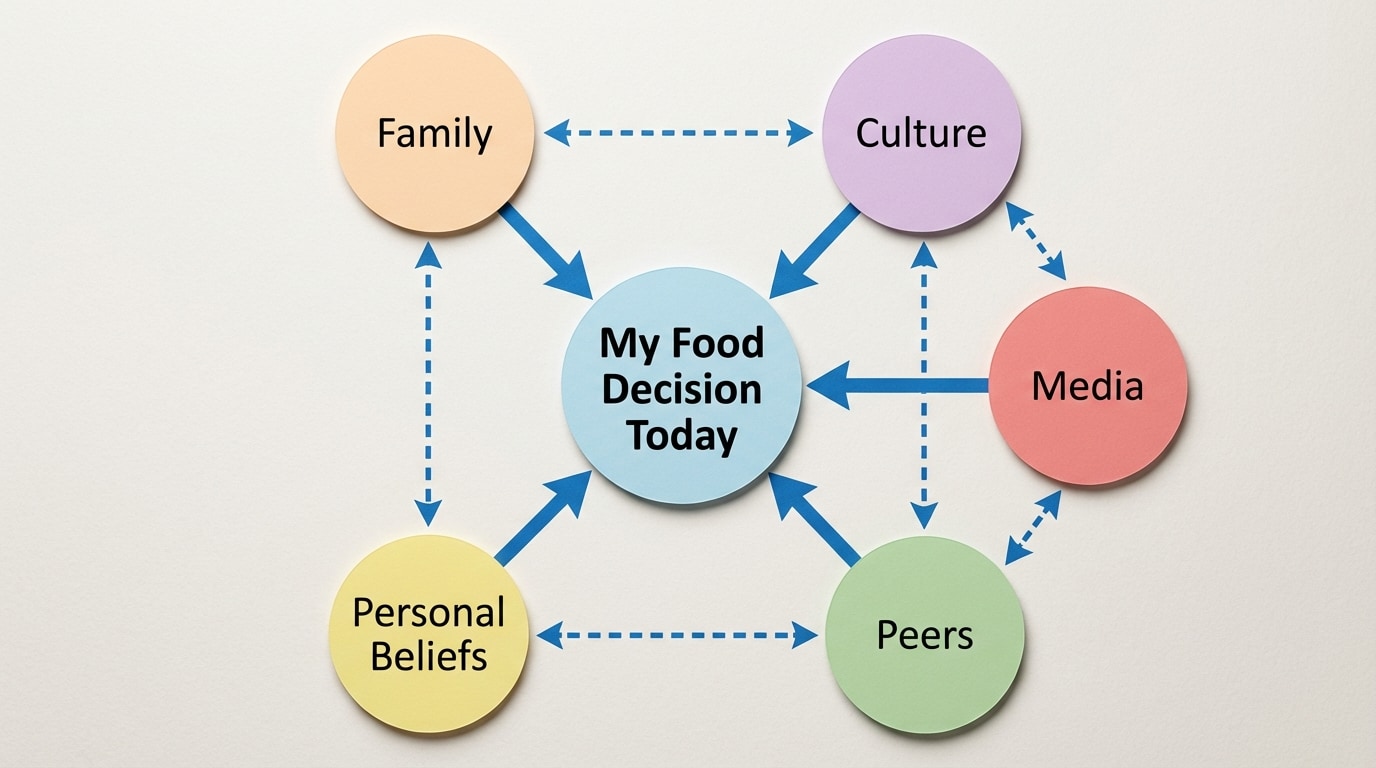
Culture is more than nationality or ethnicity. It includes religion, region, family history, language, and the community values that shape how you see food, body, and health. These overlapping influences form a web of identity and expectations, as shown in [Figure 1].
Positive roles of culture in healthy eating can include:
Traditional meals based on whole foods like grains, beans, vegetables, and lean proteins.
Rituals of eating together that build social connection and mental wellness.
Cultural respect for elders' knowledge about foods and healing practices.
For example, many traditional food patterns—such as Mediterranean, Japanese, or some Indigenous and Latin American diets—feature vegetables, legumes, and minimally processed foods that support long-term heart and metabolic health.
However, culture can also create tensions or risks:
Expectations to overeat at celebrations "to show love" or "not be rude."
Messages that a certain body type is the only acceptable or attractive one.
Norms that discourage talking openly about mental health, eating disorders, or body image struggles.
For example, in some cultures being thinner is heavily praised, leading to pressure to diet aggressively. In others, being larger may be praised as a sign of prosperity, which can create a different kind of pressure. Both can affect how you feel about changing your eating patterns.
Faith and religious traditions can shape eating too—through fasting periods, avoiding certain foods, or rituals tied to specific meals. These practices can support self-discipline, gratitude, and community, but they may also be misused to hide disordered eating or extreme restriction if not guided carefully.
To analyze cultural influence on a food decision, you might ask:
Is this choice connected to a tradition or celebration?
What does my community say a "good" or "beautiful" body looks like?
Which cultural food practices support my health, and which might I need to adjust?
Honoring your culture while also using nutrition and health knowledge is a powerful combination. You do not have to choose between identity and wellness; you can adapt recipes, portion sizes, and frequency while keeping traditions alive.
Figure 1: Concept map with a central circle labeled "My Food Decision Today" and five surrounding circles labeled "Family," "Culture," "Media," "Peers," and "Personal Beliefs," with arrows connecting each outer circle to the center and some arrows connecting the outer circles to each other.
Media and Technology: Advertising, Algorithms, and Misinformation
Every time you scroll, watch a video, or stream a show, you are entering an environment designed to influence you. Media does not just inform you—it tries to shape your choices.
Common media influences on food and wellness decisions include:
Advertising: Fast food, sugary drinks, "protein" snacks, supplements, and weight-loss products.
Social media influencers: Fitness creators, beauty influencers, or even classmates sharing "what I eat in a day."
Entertainment media: TV shows, movies, and music videos that portray certain bodies or lifestyles as desirable or normal.
Media uses specific tactics:
Emotional appeals: Linking products to happiness, friendship, success, or confidence.
"Health halo" words: Using words like "natural," "light," "clean," or "high protein" without clear evidence.
Before-and-after photos: Suggesting dramatic transformations from products or extreme diets.
Targets and algorithms: Showing you more of what you already watch or like, which can trap you in one type of health message (e.g., only extreme dieting or only muscle-building content).
For example, you might see an influencer promoting a "detox tea" and claiming they lost weight quickly. The video has upbeat music, filters, and a discount code. None of that proves the product is safe or effective.
To analyze media influence on a decision—like whether to buy that tea—you can ask:
Who is paying for this message? Is it sponsored?
Does the person have relevant training or credentials, or just a big following?
Are there specific facts, or just vibes, aesthetics, and personal anecdotes?
Is there any mention of risks, side effects, or people for whom this might not be safe?
Notice how media can also affect body image. Constant exposure to edited, filtered, or surgically altered bodies may push you toward unhealthy restriction, over-exercising, or supplements in pursuit of an unrealistic standard. This can lead to anxiety, depression, or disordered eating.
Being aware of these patterns lets you use media intentionally instead of being controlled by it. You can follow credible sources, diversify what you see, and take breaks when needed.
Peer Influence and Social Situations
Peers—friends, teammates, classmates, and online communities—are powerful, especially in high school. Their influence is not always negative. Friends can encourage you to drink more water, join a sport, or try a new healthy recipe. But peer norms can also push risky behaviors.
There are two broad types of peer influence:
Direct pressure: Someone comments on your choices (e.g., "Come on, don't be boring, have some more," or "You're not really going to eat that, are you?").
Indirect pressure: You notice what everyone else does and silently feel you should match it to fit in.
Consider some typical situations:
After practice, your team always hits a fast-food place. You might want a balanced meal but feel awkward being "different."
Your friend group is suddenly obsessed with a new diet or "cutting season," and you feel like you must join in to stay part of conversations.
You are at a party with mostly sugary drinks and snacks; drinking water might make you feel like the odd one out.
To analyze peer influence on a decision, ask:
What do I think my friends expect me to do?
Am I worried they will judge me if I choose differently?
Have I clearly shared my own goals or boundaries about my body and health?
Which friends support my health-related goals, and which regularly pull me away from them?
Healthy relationships respect your autonomy. You can stay connected and still say things like, "I'm good with water tonight," or "I'm focusing on fueling better for my sport." Often, people adjust once they hear your reasons.
Personal Beliefs, Values, and Goals
Even when family, culture, media, and peers pull you in different directions, your personal beliefs and values are the final filter. These include:
What you believe about your body's worth and purpose.
How much you value performance (sports, dance, academics) vs appearance.
Your beliefs about ethics (e.g., animal welfare, environmental impact of food choices).
Your faith or spiritual beliefs about caring for your body.
These beliefs can lead to choices like:
Becoming vegetarian or vegan for ethical or environmental reasons.
Choosing not to drink energy drinks or alcohol because of health or religious beliefs.
Focusing on "strong and energized" rather than "thin at any cost."
But personal beliefs can also become rigid rules that harm health if they are based on misinformation or fear. For example:
Believing that all carbohydrates are "bad" and cutting them almost entirely, even though your body and brain need them for energy.
Deciding that eating after a certain time is always unhealthy, regardless of your schedule or energy needs.
Equating self-worth with a specific weight or clothing size.
Healthy beliefs are usually flexible and evidence-informed. They allow you to adjust based on new information, your body's signals, and life changes.
To analyze your personal beliefs and values in a food decision, you can ask:
Why does this choice feel "right" or "wrong" to me?
Is this belief based on reliable evidence, or mostly on fear, shame, or social pressure?
Does this belief support my long-term physical and mental wellness?
If a friend said this belief about themselves, would I consider it healthy or extreme?
Aligning your decisions with values like respect for your body, long-term health, and self-compassion usually leads to more sustainable and balanced habits.
Putting It Together: Analyzing a Single Health Decision from Multiple Angles
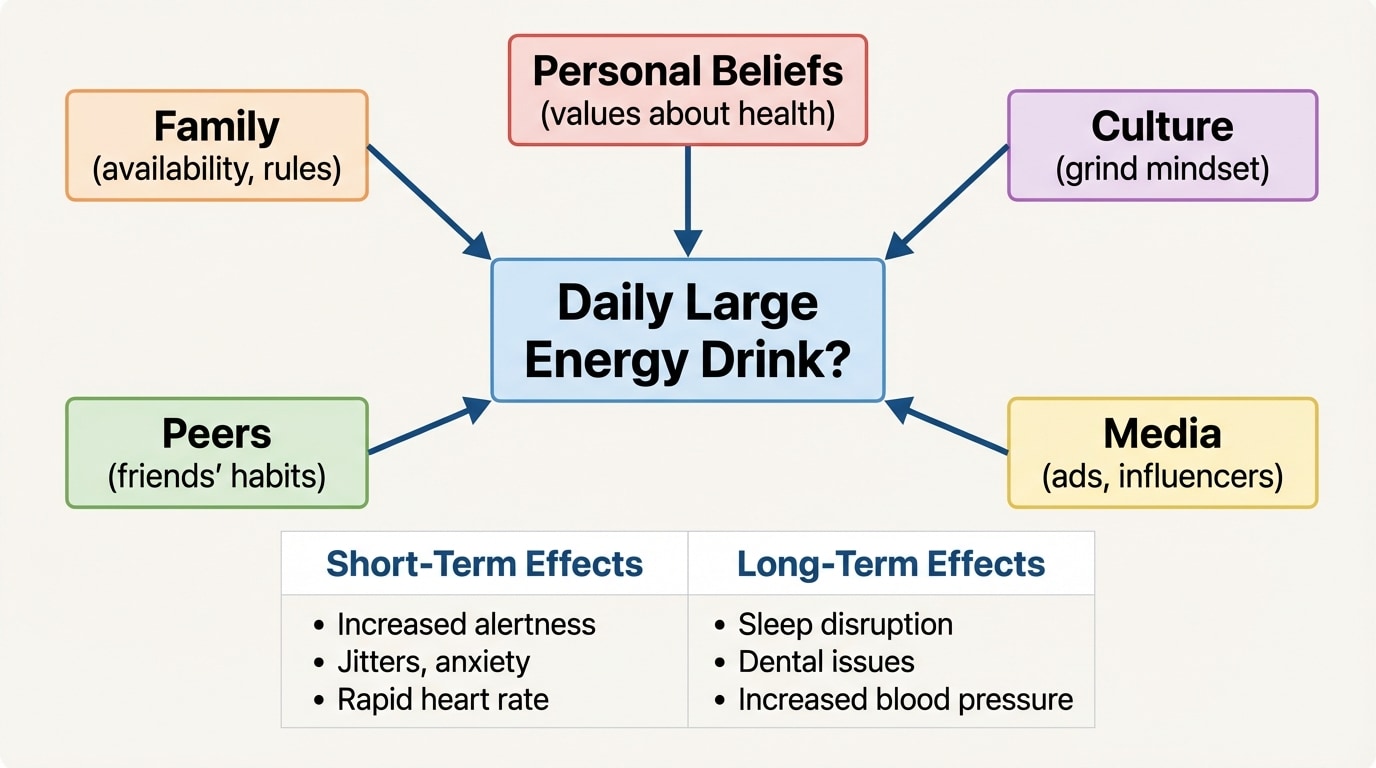
Now let's see how all these influences interact around one specific decision. Think about the choice: "Should I drink a large energy drink every school day?" You can think of this as a decision map for wellness, similar to the structure in [Figure 2].
1. Family
Maybe your parent buys energy drinks by the case at a warehouse store, so they are always available.
Maybe no one at home talks about caffeine or sugar, or someone says, "You're young, you'll be fine."
Or maybe a family member had heart problems, and your parents strongly warn you about stimulants.
These messages affect whether the drink feels normal, risky, or rebellious.
2. Culture
In some environments, staying up late to work or study is praised, so using energy drinks to push through feels like dedication.
Your community might celebrate "grinding" and hustling, where sleeping less and doing more is seen as a badge of honor.
Alternatively, your cultural or religious background might emphasize treating the body gently and avoiding stimulants.
3. Media
You see ads showing athletes, gamers, or musicians using energy drinks and looking powerful, focused, and cool.
Influencers might casually drink them in vlogs without showing any negative side effects.
The packaging might highlight "zero sugar" or "vitamins," focusing your attention away from high caffeine content.
4. Peers
Friends might offer you a can or tease you if you say no: "You can't handle it?"
Your friend group might rely on energy drinks during exams or late-night online gaming.
On the other hand, you might have a teammate who avoids them and talks about feeling better with good sleep and water.
5. Personal beliefs and goals
If you believe productivity is more important than sleep, daily energy drinks may feel justified.
If you value athletic performance and mental focus, you might worry about how caffeine, sugar, and poor sleep affect your body.
If you are concerned about becoming dependent on stimulants, you may set a rule for yourself (e.g., "Only on exam weeks," or "Not larger than a small size").
Now evaluate short-term vs long-term effects:
Short-term positives: Feeling more awake, able to stay up studying or socializing, social bonding with friends who also drink them.
Short-term negatives: Jitters, anxiety, racing heart, difficulty sleeping, energy crash later.
Long-term risks: Habitual high caffeine intake, potential blood pressure issues, dependence on drinks instead of healthy sleep, possible weight gain or dental issues if drinks are sugary.
Considering this full picture, a more informed decision might be:
"I will not drink a large energy drink every day. I might occasionally use a small one, but I will focus on sleep, hydration, and balanced meals for daily energy."
This decision respects your autonomy while recognizing the web of influences around you, similar to the concept connections seen earlier in [Figure 1].
Figure 2: A two-dimensional table or flowchart. The central box is "Daily Large Energy Drink?" Around it are labeled boxes: "Family" (availability, rules), "Culture" (grind mindset), "Media" (ads, influencers), "Peers" (friends' habits), "Personal Beliefs" (values about health). Another section of the diagram shows "Short-Term Effects" vs "Long-Term Effects" in separate columns.
Skills for Making Independent, Healthy Decisions
Recognizing influences is only useful if it changes how you decide. Here is a practical framework you can apply to any health-related decision about food and wellness. Think of it as your internal "decision map," a structure you can apply to many situations, not just energy drinks.
1. Pause
Before acting, take a brief pause—even a few seconds—to notice that you are about to make a health decision.
2. Identify the decision clearly
State it in simple terms: "Should I skip breakfast?" "Should I try this crash diet?" "Should I eat something before practice?"
3. Scan for influences
Ask yourself: How are my family, culture, media, peers, and personal beliefs showing up right now?
Which influences are helping my health, and which are pushing me toward choices that clash with my goals?
4. Check the facts
Look for reliable sources—health organizations, registered dietitians, or trusted healthcare providers.
Be extra cautious if a product promises quick, dramatic results or if the only evidence is personal stories.
5. Consider consequences
What are the likely short-term and long-term effects on your physical health, mood, energy, and relationships?
Would you be comfortable explaining this choice and its reasons to someone you respect?
6. Align with your values
Does this decision respect your body and mental health?
Does it match who you want to be in the future?
7. Set boundaries and communicate
Be prepared to say "no" or "not today" when someone pressures you away from a healthy decision.
You can share your reasons briefly, but you do not owe anyone full justification for taking care of your health.
8. Reflect and adjust
Afterward, notice how the decision affected you. If it did not go well, use that information next time instead of giving up.
Using this process repeatedly helps you build confidence and clarity. Over time, you become less reactive to pressure and more able to choose what truly supports lifelong healthy eating and wellness.
Summary of Key Ideas
Health-related decisions—especially those about food and eating—are not made in a vacuum. They are shaped by at least five major influences: family, culture, media, peers, and personal beliefs. Family sets early patterns for what foods are available, how people talk about bodies, and what eating routines are normal. Culture and traditions connect food to identity, celebrations, and deeply held values, offering both protective habits and potential pressures around body image and portions.
Media and technology use powerful strategies to influence behavior, from targeted ads to influencer content, often emphasizing appearance, speed, or convenience instead of long-term wellness. Peers create norms through both direct and indirect pressure, affecting what feels socially acceptable to eat or drink. Personal beliefs and values act as the final filter, helping you either resist or reinforce these outside forces, depending on how flexible and evidence-based those beliefs are.
By actively analyzing how each influence affects a single decision—such as whether to use energy drinks daily or follow an extreme diet—you can see short-term and long-term consequences more clearly. Building skills like pausing, scanning for influences, checking facts, considering outcomes, aligning choices with your values, and setting boundaries empowers you to make independent, health-supporting decisions. Developing these skills now lays the foundation for lifelong healthy eating and overall physical and personal wellness. 🌍