Some of the choices you make in your teen years can affect the rest of your life: who you trust, how you handle pressure, whether you protect yourself from pregnancy and sexually transmitted infections, and how you respond when something does not feel right. You already make decisions every day—what to wear, what to post, who to spend time with—but decisions about relationships and sexual health carry much higher stakes, emotionally and physically.
This lesson focuses on how to use a clear, step-by-step decision-making process so you can make choices that match your values, protect your health, and respect both yourself and others. Instead of acting in the moment or being pushed by someone else, you will see how to slow things down, analyze your options, and choose what is healthiest for you.
Relationships and sexual health decisions are different from small daily choices because they can have long-term consequences. These may include:
A key idea is that “not deciding” is still a decision. If you avoid thinking about contraception, for example, and then become sexually active, you are still making a choice—just without preparation. A structured decision-making process helps you act intentionally, rather than accidentally.
Before looking at the steps in a decision-making model, it helps to know what a healthy relationship looks like. This includes romantic relationships, close friendships, and any situation where intimacy or sexual behavior might come up.
Key principles include:
In unhealthy or abusive relationships, you may see patterns such as jealousy, controlling behavior, threats, manipulation (“If you loved me, you would …”), ignoring consent, or pressuring someone to send sexual photos or videos. Recognizing these red flags will matter when you apply a decision-making process later.
Healthy relationships also extend into the digital world. The same principles—respect, consent, and boundaries—apply to texting, DMs, video calls, and social media. For example, sharing someone’s photo without permission violates their boundaries and trust, even if you never touch them in person.
Having strong values and good intentions is important, but in the moment, emotions, attraction, or pressure can make it hard to think clearly. A step-by-step decision-making model, as shown in [Figure 1], gives you a structure you can use in almost any situation involving relationships and sexual health.
One useful model includes six steps:
Step 1: Notice the situation clearly
You identify what is really happening, not just how you feel. For example: “My partner is asking if I want to have sex for the first time” or “My friends are pressuring me to send a nude photo.” Naming the situation helps you pause instead of reacting automatically.
Step 2: Clarify your values and goals
You ask yourself: “What matters most to me here?” Examples of values and goals might be: protecting your health, respecting your family or cultural beliefs, waiting until you feel fully ready, maintaining your education goals, or choosing partners who treat you with respect. Your values act as your internal compass.
Step 3: Gather accurate information
You check what you know—and what you might be assuming incorrectly. For sexual health decisions, this could include facts about pregnancy risk, how contraception works, STI transmission, and the laws around sharing images. You might talk to a trusted adult, look up credible health websites, or speak with a healthcare provider.
Step 4: List your options
Many people feel trapped because they only see two choices, like “go along with it” or “end the relationship.” In reality there are usually more options. Listing several possibilities helps you see that you have power. You are not stuck.
Step 5: Evaluate consequences and choose
For each option, you think about short-term and long-term effects on your physical, emotional, and social health. You also consider how each option lines up with your values. You then choose the option that best protects your health and respects everyone’s boundaries—even if it is not the easiest in the moment.
Step 6: Reflect and adjust
After you act, you check in with yourself: “Am I comfortable with the choice I made? Did anything surprise me? What did I learn about myself or this relationship?” Reflection helps you improve your future decisions and spot patterns—like people who respect your boundaries versus people who do not.
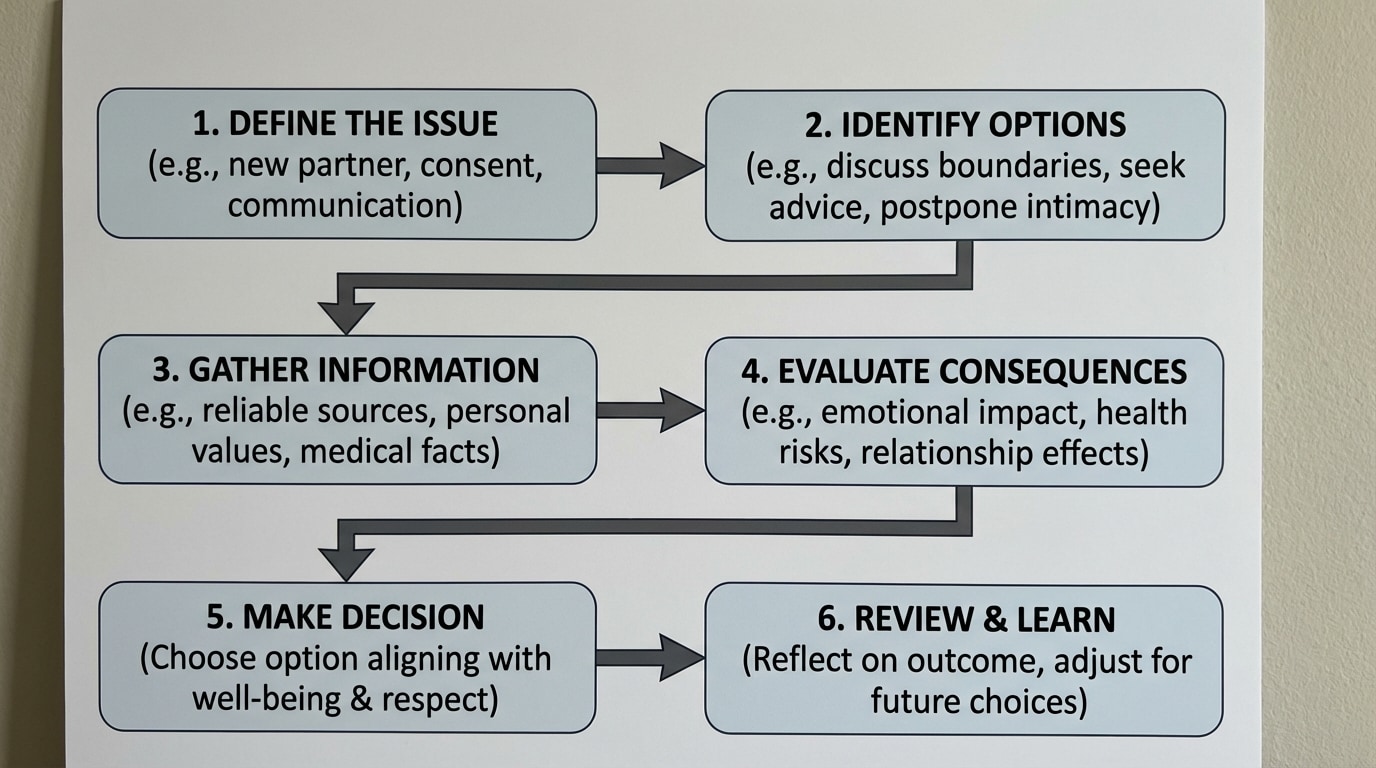
This model is flexible. You may move back and forth between steps—for example, getting more information and then revisiting your list of options. The point is not to follow it perfectly, but to avoid rushed, impulsive decisions that you might regret later.
Let’s apply the decision-making model to a common situation. Imagine you are in a relationship, you care about each other, and your partner says they feel ready to have sex. You are not sure.
The model helps you think through this, including the choices of abstaining or delaying sex, using protection if you decide to be sexually active, and talking with a trusted adult or healthcare provider. When you weigh different routes, a structured comparison, like the one seen in [Figure 2], makes the trade-offs easier to see.
Step 1: Notice
Situation: “My partner wants to have sex. I feel pressured and also curious, but also nervous about pregnancy, STIs, and whether I am really ready.”
Step 2: Values and goals
You might identify values such as: wanting to wait until you are absolutely sure, protecting yourself from pregnancy and STIs, finishing high school before parenting, and only having sex in relationships where you feel completely safe and respected.
Step 3: Information
Accurate information includes:
Step 4: Options
Possible options include:
Step 5: Evaluate consequences and choose
You weigh short- and long-term consequences of each option. For example, waiting may cause tension if your partner hoped to have sex, but it strongly supports your value of only having sex when you are fully ready. Having sex without protection might please your partner in the moment but could lead to unplanned pregnancy or STIs, as well as stress and regret.
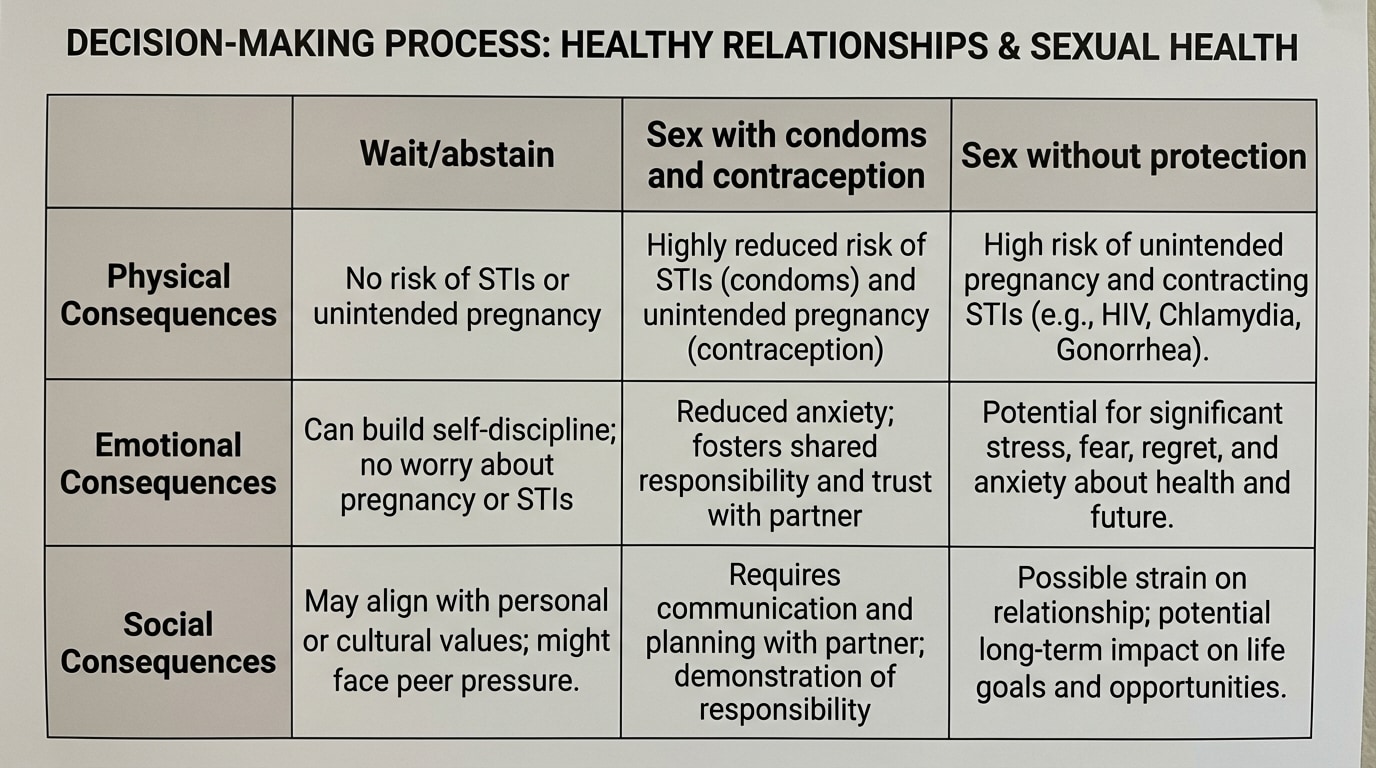
Looking at the options side by side, as in [Figure 2], often makes the healthiest choice clearer. For many teens, the safest decision is to wait until they feel completely ready and have a plan in place for protection if and when they do choose to be sexually active.
Step 6: Reflect
After you act, you notice how your partner responds. If they respect your decision to wait, that is a sign of a healthier relationship. If they pressure, threaten to break up, or guilt-trip you, that is a red flag that this relationship might not be good for your well-being.
Consent is at the center of every healthy sexual decision. It is not a one-time question; it is an ongoing, enthusiastic agreement to what is happening. Thinking of consent as a continuum from clear “yes” to clear “no,” as shown in [Figure 3], can help you pay attention to your own and others’ comfort levels.
What consent is:
What consent is not:
Pressuring someone—by begging, threatening, repeatedly asking after they say no, or using substances to lower their resistance—is not respectful and is not consent.
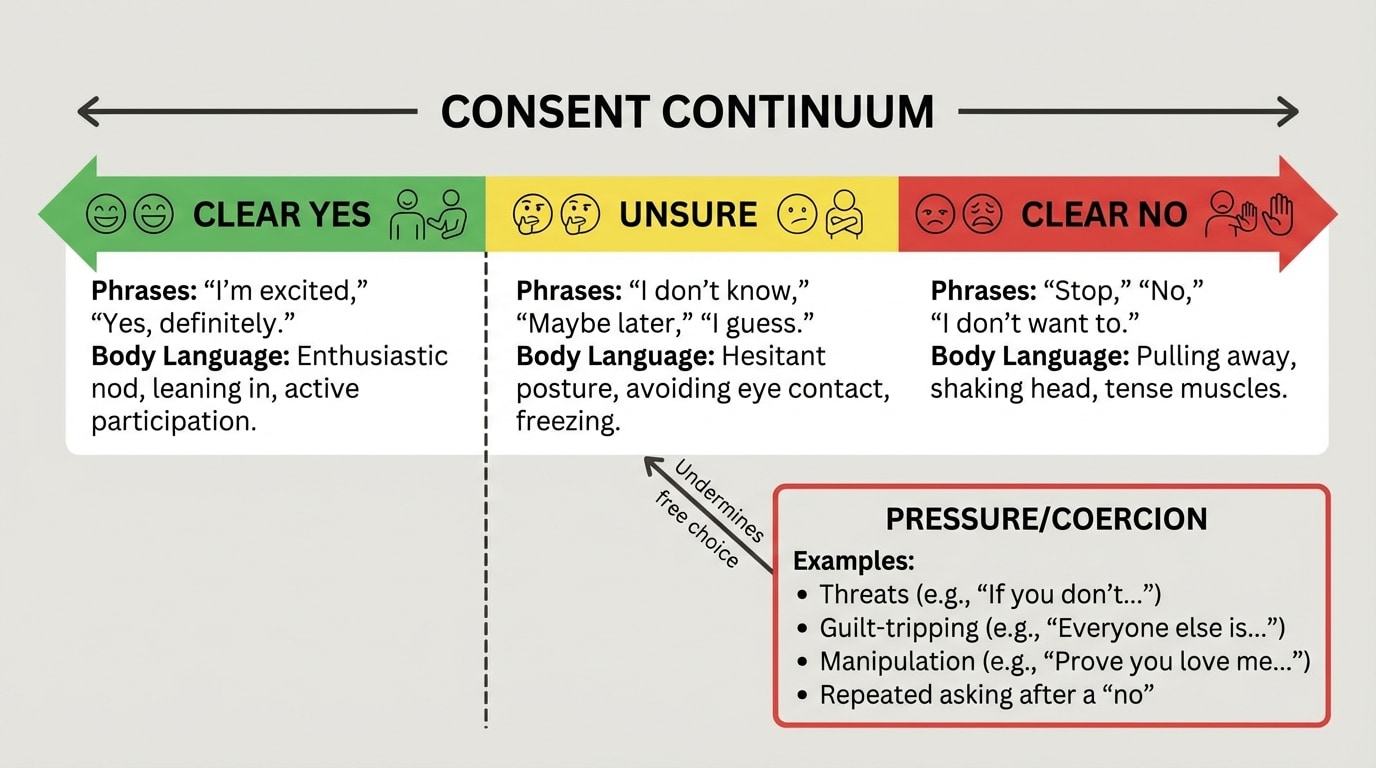
When you face pressure, the decision-making process still applies. For example:
Having a few phrases ready can help you follow through with your decision, such as: “No, I am not comfortable with that,” “I already said no, and I need you to respect that,” or “If you keep pressuring me, I am going to leave.” 🎯
Many important relationship decisions now happen through screens: texting, DMs, snaps, video calls, and social media. The same decision-making process and consent rules apply online.
Common digital situations include:
Using the decision-making steps for a sexting example might look like this:
The healthiest digital decisions usually involve stronger privacy settings, fewer intimate images, and more face-to-face communication in safe, respectful relationships.
When people do choose to be sexually active, the decision-making process can guide them in protecting their health. This includes decisions about contraception, condom use, and STI testing.
Contraception and pregnancy prevention
If you are considering sexual intercourse that could lead to pregnancy, your decisions may include:
The decision-making model might involve:
STI prevention and testing
Sexually transmitted infections can be passed through various kinds of sexual contact. Decisions about STI prevention include:
Using the model, you might:
Talking with healthcare providers can feel intimidating, but they are trained to support your health, not judge your choices. Practicing how you might explain your situation or ask questions can make these conversations easier.
Sometimes the healthiest decision is not about a single choice (like whether to have sex), but about whether to stay in a relationship at all. A decision-making process can help you recognize when a relationship is becoming unsafe or harmful.
Warning signs (red flags) of unhealthy or abusive dynamics include:
In these situations, the decision-making process emphasizes getting help:
Supporting friends also calls for thoughtful decisions. If a friend confides in you about pressure, assault, or abuse, your choices might include:
Using a calm, structured approach can help you avoid reacting out of panic or gossiping, and instead act in ways that truly support your friend’s safety and healing.
Using a clear decision-making process gives you more control over your relationships and sexual health. You learned that healthy relationships are based on respect, equality, communication, and true consent—offline and online. A six-step model (notice the situation, clarify your values, gather accurate information, list options, evaluate consequences, and reflect) helps you slow down and make intentional choices rather than reacting under pressure.
Applied to real situations, the model supports decisions about whether or not to become sexually active, how to respond to pressure around sex or sexting, and how to protect yourself with contraception and STI prevention if you do choose to be sexually active. Visual tools like the decision flowchart in [Figure 1], the options comparison in [Figure 2], and the consent continuum in [Figure 3] reinforce that you have more than two choices in most situations.
You also examined how to recognize red flags in relationships, when to seek help from trusted adults or professionals, and how to support friends facing pressure or abuse. Ultimately, making healthy decisions about relationships and sexual health means aligning your actions with your values, protecting your body and mind, respecting others’ boundaries, and using accurate information and support systems to guide your choices. 🌱
