Demonstrate beginning skills for a variety of activities, games, and sports.
Building Beginning Skills for Activities, Games, and Sports
Have you ever played a game in P.E. and thought, “Wow, this is way easier now than it used to be”? That feeling usually means your movement skills are growing.
You are not just “running around” anymore; you are beginning to control how your body moves, how you use equipment, and how you work with others. These are the kinds of abilities that make up beginning skills for activities, games, and sports.
In this lesson, you will explore the main types of movement skills that help you join in lots of different games and sports: how you travel, how you balance, and how you control objects like balls and bats. You will also see how these skills fit together in real games, how to stay safe, and how to keep improving over time.
Understanding Movement Competence
Movement competence means being able to use your body in a controlled and effective way during physical activities. It does not mean you have to be the best player on the team. It means you:
Can perform basic movements with control (not just randomly moving).
Know simple movement patterns and when to use them.
Can join in games and activities safely and confidently.
We can group movement skills into three big categories:
Locomotor skills – moving your body from one place to another.
Non-locomotor skills – moving parts of your body while staying mostly in one spot.
Manipulative skills – controlling objects, like throwing, catching, or kicking a ball.
These skills show up in daily life too—walking to class, climbing stairs, reaching for a shelf, tossing your backpack, or playing a quick game at recess. The better your skills, the easier and safer these things feel.
Locomotor Skills: How You Move from Place to Place
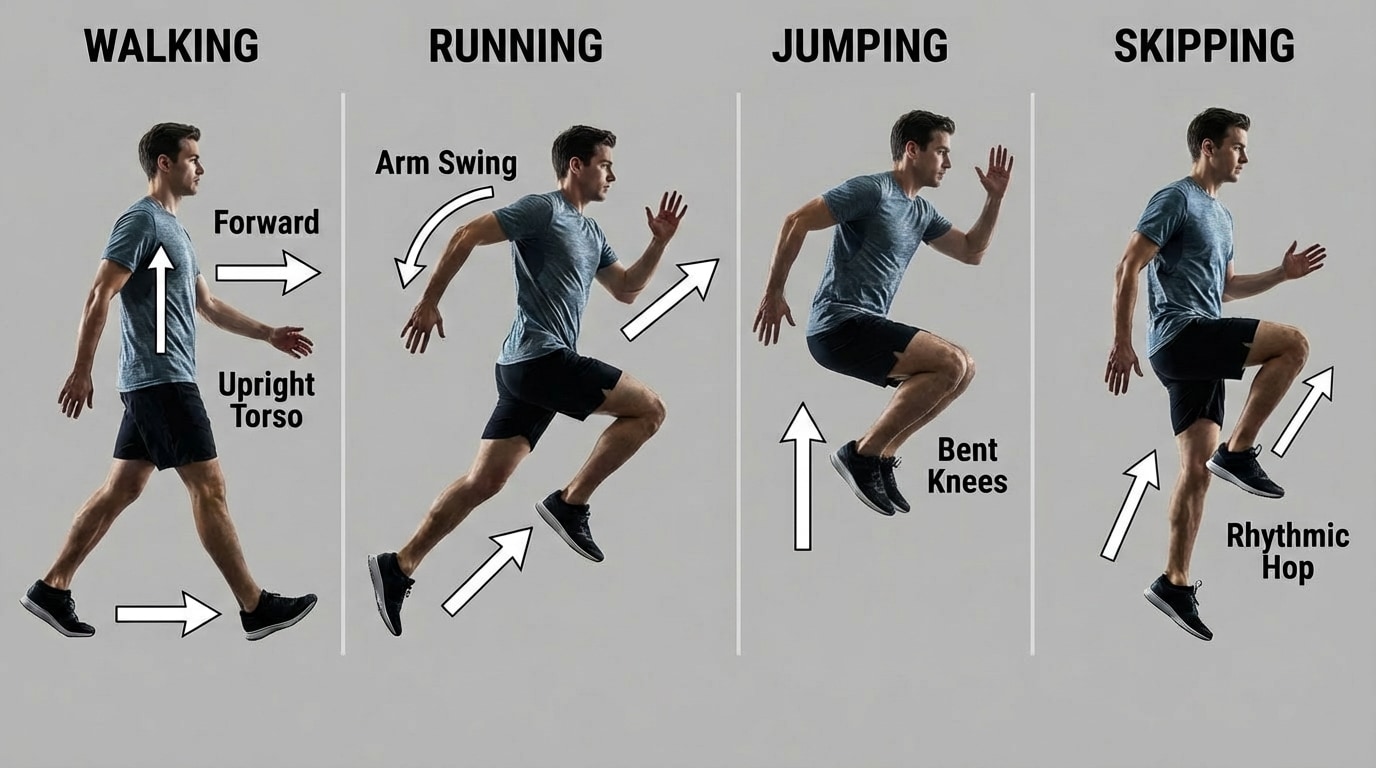
Locomotor skills are the basic ways you travel around a space. As shown in [Figure 1], they include movements like walking, running, jumping, and skipping, each with its own body position and rhythm.
Some important locomotor skills are:
Walking – One foot is always on the ground. Your steps are even and controlled. Arms swing gently at your sides.
Jogging and running – In running, there is a short time when both feet are off the ground. Begin with jogging (slower running) and focus on:
Leaning your body slightly forward, not backward.
Landing softly on the middle of your foot, not pounding your heels.
Letting your arms bend at about a right angle, swinging forward and back (not across your body).
Jumping – You push off with both feet and land with both feet. Key points:
Bend your knees and swing your arms back before takeoff.
Jump up and forward, then land with bent knees to absorb the force.
Keep your eyes up, not staring at your feet.
Hopping – Like jumping, but on one foot. Start with small hops before trying higher or longer hops.
Skipping – A pattern of step-hop, step-hop, switching legs each time. Skipping has a light, bouncy rhythm.
Galloping – One foot always leads and the other follows. For example, the right foot steps forward, and the left foot quickly closes behind it.
Sliding – Sideways galloping. Your body faces forward while you move sideways, stepping to the side and bringing your other foot in.
These locomotor skills are used in many activities:
Tag games – You speed up, slow down, change direction, and slide or dodge to avoid being tagged.
Soccer – You run, stop, and start again quickly, sometimes galloping or sliding to stay with an opponent.
Basketball – You sprint on a fast break, slide your feet on defense, and jump for rebounds.
At a beginning level, your goal is to move with control and safety, not maximum speed. You are learning to feel how your body moves and to change that movement when needed.
Figure 1: Side-by-side sketches of a student walking, running, jumping, and skipping, with arrows showing directions and posture cues like upright torso, bent knees, and arm swing.
Non-Locomotor Skills: Staying in One Place with Control
Non-locomotor skills happen mostly in one spot, but your body still moves and changes shape. These skills build balance, core strength, and body control, which you need in almost every sport.
Common non-locomotor skills include:
Bending and stretching – Bending your knees, hips, elbows, or back, then straightening them. Example: Bending your knees before a jump shot, or stretching your arms high to catch a throw.
Twisting and turning – Rotating your body around your spine. Example: Twisting your upper body to look behind you while your feet stay in place, or turning your shoulders during a swing in softball.
Balancing – Holding your body steady. This might be:
On one foot.
On two feet with your arms out.
In a low crouch or lunge.
Swaying and rocking – Shifting your weight from side to side or front to back in a controlled way.
You use non-locomotor skills in activities like:
Gymnastics or yoga – Holding a balance pose on one leg or in a plank position.
Defending in basketball – Staying low with knees bent, chest up, and arms out while sliding your feet.
Volleyball – Getting into a strong, steady stance before bumping or setting the ball.
Beginning skills here focus on being able to hold a position without wobbling too much, and changing levels (high, medium, low) without losing balance.
Manipulative Skills: Sending, Receiving, and Controlling Objects
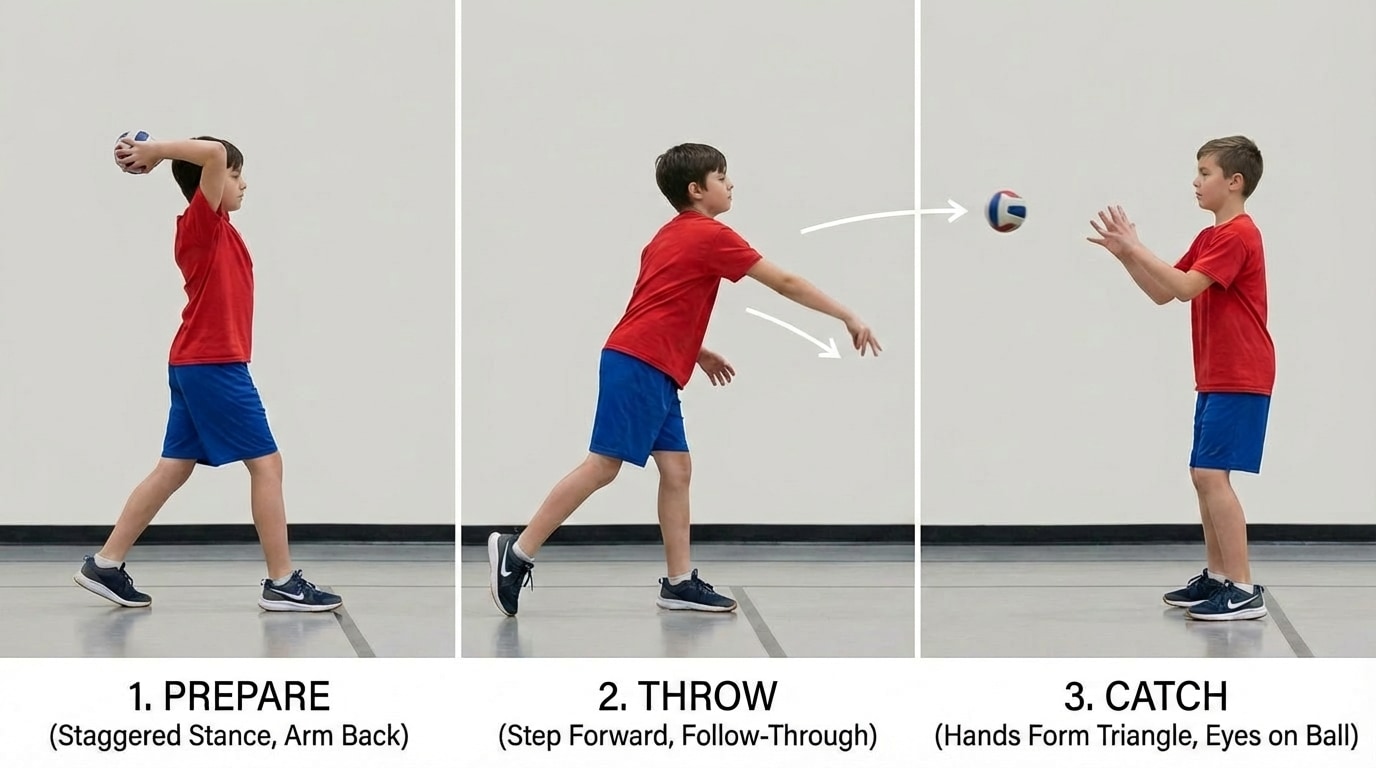
Manipulative skills involve using your hands, feet, or other body parts (or equipment) to control an object. These are the skills people often think of first when they hear “sports.” As shown in [Figure 2], even a simple overhand throw has several parts that your body must coordinate.
Some key manipulative skills are:
Throwing
In an overhand throw, you send the ball with one hand from above your shoulder. Beginning-level cues:
Stance – Stand with your non-throwing side facing your target (like “side to target”). Feet are apart with a slight bend in the knees.
Arm preparation – Bring your throwing arm back, elbow bent, with the ball roughly behind your head.
Step and rotate – Step toward your target with your front foot while your hips and shoulders turn toward the target.
Release – Let go of the ball as your arm comes forward, roughly when your hand is in front of your head.
Follow-through – Your throwing arm continues across your body after release, helping with power and control.
In an underhand throw or toss (like for a soft underhand serve or an easy toss to a partner), your hand swings from behind your body forward and up, releasing the ball in front of you.
Catching
Basic cues for catching:
Watch the ball – Keep your eyes on the ball as it moves toward you.
Move to the ball – Step to where the ball is going, instead of waiting for it to hit you.
Hand shape – For a ball above your waist, hold your hands with thumbs together, fingers spread (like a triangle). For a ball below your waist, pinkies together, fingers up.
Give with the ball – As you catch, bend your elbows and bring the ball slightly toward your body to absorb the force.
Kicking
When you kick a ball:
Take a step or two toward the ball.
Place your non-kicking foot next to the ball, pointing toward your target.
Use the laces of your shoe for a strong kick or the inside of your foot for a more accurate pass.
Follow through by swinging your kicking leg toward your target.
Striking with the hands (like volleyball)
Examples include serving or hitting a volleyball. Focus on:
Contacting the ball with a flat, firm hand or forearms.
Keeping your eyes on the ball.
Using your whole body (legs and core) for power, not just your arms.
Striking with implements (like bats or rackets)
Beginning-level points:
Hold the bat or racket with both hands (if required), using a comfortable, correct grip.
Stand sideways to your target or where the ball is coming from.
Watch the ball and swing smoothly, not wildly.
Follow through in the direction you want the ball to go.
Figure 2: Sequence of three frames showing a student performing an overhand throw toward a partner who is catching: side view with staggered stance, arm back, step forward, follow-through, and hands forming a triangle to catch.
Applying Skills in Small-Sided Games and Sports
Most real games use all three types of skills at the same time. In a small-sided game (for example, 3 vs. 3 instead of 5 vs. 5), you get more chances to try your beginning skills.
Here is how skills combine in different activities:
In soccer
Locomotor: Running, sprinting, and changing direction to get open.
Non-locomotor: Balancing on one leg while you trap or pass the ball.
Manipulative: Kicking, passing with the inside of your foot, and shooting with your laces.
In basketball
Locomotor: Sliding to stay with your player on defense; running on a fast break.
Non-locomotor: Keeping a low, balanced stance when you are guarding.
Manipulative: Dribbling, passing, and shooting the ball with control.
In volleyball-style games
Locomotor: Shuffling to get under the ball.
Non-locomotor: Holding a strong, stable platform with your arms when you bump.
Manipulative: Serving and hitting the ball over a net.
In striking/fielding games (like softball or modified baseball)
Locomotor: Running bases and moving to field a ball.
Non-locomotor: Staying balanced while you swing a bat.
Manipulative: Throwing, catching, and striking the ball.
At a beginning level, you are learning to choose the right skill for the situation. For example, you might decide whether to pass or dribble in basketball, or whether to jog or sprint in a game of tag. Simple decisions like these are the start of game strategy.
Body and Spatial Awareness in Activities
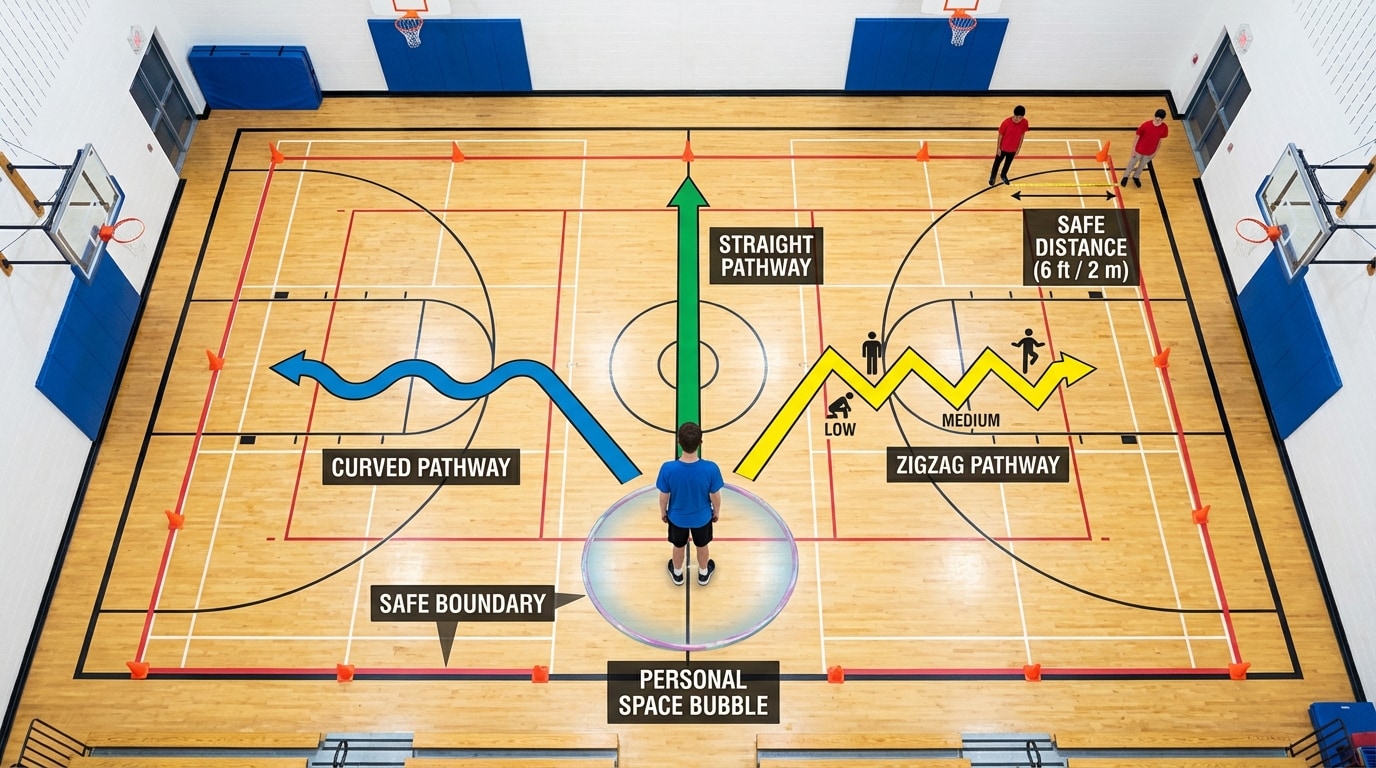
Being skilled is not only about how your body moves. It is also about where you move and how you share the space with others. This is called spatial awareness. When you are playing in a gym or on a field, you must think about your space, as in [Figure 3], so you stay safe and play effectively.
Important ideas in spatial awareness include:
Personal space – The space right around your body, like an invisible bubble. You use personal space when you are stretching, balancing, or doing individual movements so you do not bump into anyone.
General space – The space you share with others (the whole gym or field). You move through general space during games, making sure you do not crash into people or objects.
Levels
High level – Reaching or jumping with arms up.
Medium level – Standing or walking in a normal upright position.
Low level – Crouching, squatting, or moving close to the ground.
Pathways
Straight – Running directly from one point to another.
Curved – Arcing around a defender or obstacle.
Zigzag – Quickly changing directions to dodge someone in tag.
Directions – Forward, backward, sideways, and diagonal moves.
In games, you must constantly notice:
Where the boundaries are (so you do not go out of bounds).
Where your teammates and opponents are (so you avoid collisions).
Where open spaces are (so you can move to a good spot to receive a pass or make a play).
Figure 3: Top-down diagram of a gym with several students: one in a personal “bubble” circle, arrows showing straight, curved, and zigzag pathways at different levels, plus boundaries and safe distances.
Spatial awareness is also a big part of safety. When you remember your personal space bubble and look where you are going, you help protect yourself and others from trips, falls, and hits.
Movement Quality: Balance, Coordination, Speed, and Agility
As you practice, you do not just learn “how” to move, but also how well you move. Four important qualities of movement are:
Balance – Keeping your body stable, whether you are still or moving. Example: Holding a one-leg balance for a few seconds before taking a shot.
Coordination – Using different body parts together smoothly. Example: Stepping, swinging your arms, and rotating your body all at once during a throw, as shown earlier in [Figure 2].
Speed – How fast you move. Example: Sprinting to chase down an opponent in a flag game.
Agility – How quickly you can change direction without losing control. Example: Dodging defenders using zigzag pathways, similar to the movement lines in [Figure 3].
At the beginning stage, your main targets are:
Keeping your balance most of the time.
Coordinating simple patterns (like step-throw or step-kick).
Moving at a speed that still feels controlled.
Changing direction without slipping or bumping others.
As these qualities improve, all your activities and sports feel smoother and more fun.
Safety, Rules, and Respect in Physical Activities
Being competent in movement also means you can participate safely and respectfully. Skills and safety go together.
Key safety and respect habits include:
Warm-up and cool-down
Warm-up: light movement and simple stretches that prepare your muscles and joints for activity.
Cool-down: slower movement and stretching to help your body recover.
Listening to signals
Stopping quickly and safely when you hear a whistle or teacher’s signal.
Freezing your movement when asked, without bumping others.
Using equipment correctly
Carrying bats, sticks, and other equipment with care.
Only throwing or kicking balls in the direction you are supposed to.
Checking your space before you swing or throw.
Following rules
Understanding basic rules of the game (like which direction to move, where the boundaries are, and how to score).
Respecting calls made by the teacher or referee.
Respecting others
Encouraging teammates and not making fun of mistakes.
Taking turns with equipment.
Playing with self-control, not roughness.
When everyone uses beginning skills safely and respectfully, games and activities are much more enjoyable for the whole group.
Building Good Practice Habits and a Growth Mindset
Improving at activities, games, and sports is a process. Even top athletes were beginners once. What makes the difference is how you practice and how you think about learning.
Good practice habits include:
Breaking skills into parts – For example, in an overhand throw, you might practice the stance, then the arm motion, then combining them.
Repeating skills correctly – Doing a movement the right way many times helps your body remember it (this is called “muscle memory”).
Starting slow, then adding speed – Begin with slow, careful movements, then increase your speed as you gain control.
Using both sides – Practice with your right and left hands or feet when possible to improve balance and coordination.
A growth mindset means believing that your skills can improve with effort, practice, and feedback. This looks like:
Seeing mistakes as chances to learn (“What can I change next time?”).
Accepting feedback from teachers and classmates.
Setting simple goals, like “Today I will catch the ball cleanly 5 times in a row” or “I will hold my balance for 10 seconds.”
When you combine good practice habits with a growth mindset, you build strong beginning skills that can grow into advanced skills later on.
Key Points to Remember
To build beginning skills for a variety of activities, games, and sports, remember these main ideas:
Movement competence means using your body with control, safety, and confidence.
Locomotor skills (like walking, running, jumping, and skipping) help you travel through space.
Non-locomotor skills (like bending, stretching, twisting, and balancing) help you control your body while mostly staying in one spot.
Manipulative skills (like throwing, catching, kicking, and striking) let you control objects and equipment in games.
Real games combine all these skills with spatial awareness—knowing about personal space, general space, levels, directions, and pathways, as seen in the gym layout in [Figure 3].
Movement quality (balance, coordination, speed, and agility) makes your skills smoother and more effective.
Safety, rules, and respect are part of being a competent mover and a good teammate.
Good practice habits and a growth mindset help your beginning skills improve over time so you can enjoy more activities and sports throughout your life.