Did you know that two people can both be “in shape,” but for totally different reasons? One person might be able to run a mile without stopping, while another can do a cartwheel, hit a baseball, and balance on one foot with no problem. Both are physically fit—but in different ways that help their health and their skills. Today you will learn how different parts of fitness work together to help you build a strong, active lifestyle that keeps your body healthy now and as you grow. 💪
Physical fitness is not only about winning races or being the best on a team. It is about how your body works during everyday activities—walking to school, climbing stairs, playing on the playground, doing chores at home, or dancing with friends. When your body can do these things without getting too tired, and without getting hurt easily, it is a sign that you have a good level of fitness.
A health-enhancing lifestyle means making choices every day that help your body stay strong, safe, and energetic. This includes being active regularly, eating nutritious foods, drinking water, sleeping enough, and avoiding harmful habits. Regular physical activity is one of the most important parts of a health-enhancing lifestyle because it helps many parts of your body at the same time—your heart, lungs, muscles, bones, and even your brain.
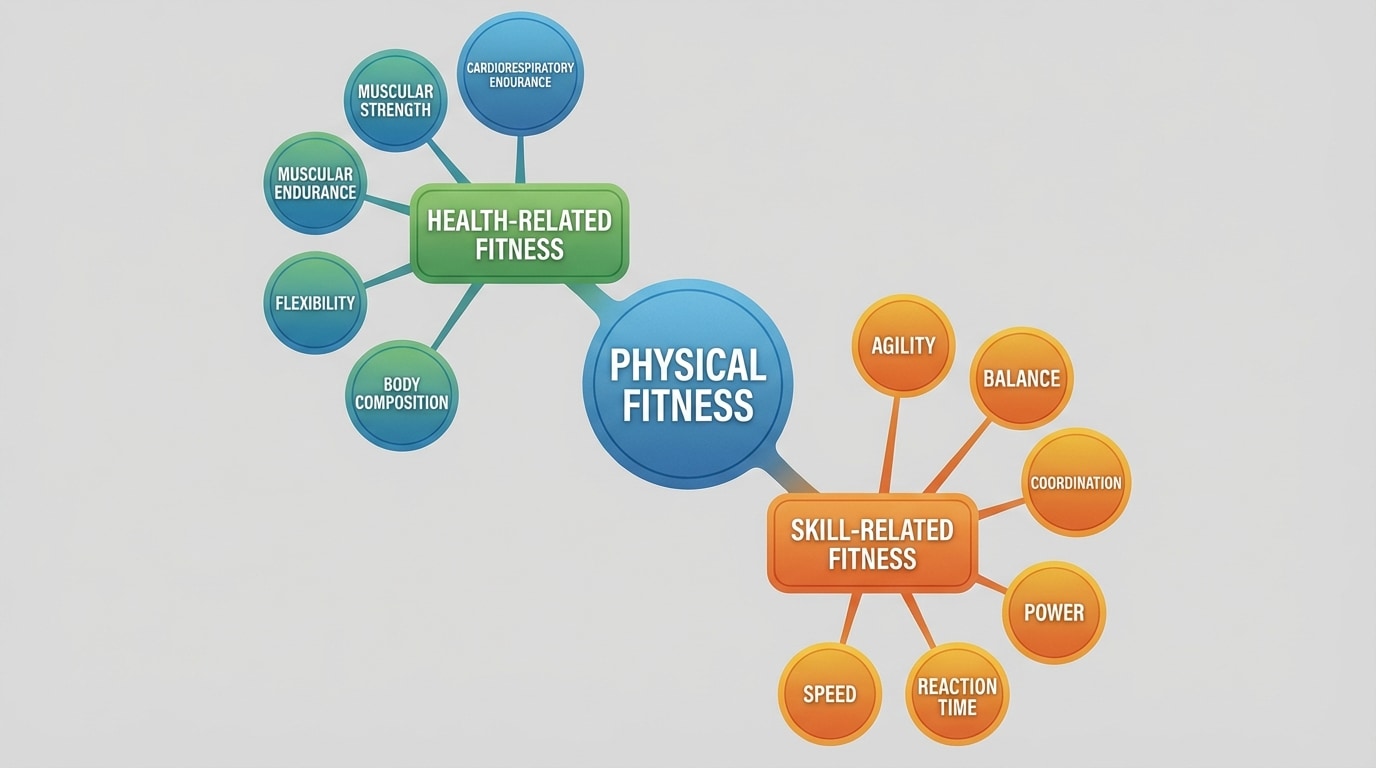
To understand how physical activity helps you, it is useful to separate fitness into two big groups of components: health-related fitness and skill-related fitness. Both groups are important and both can be improved with practice and healthy habits. 🎯
Physical fitness can be divided into two main categories: health-related fitness components and skill-related fitness components. Health-related components are the parts of fitness that connect the most strongly to your overall health and how long your body stays healthy. Skill-related components help you perform better in sports and physical activities that need quick and accurate body movements.
These two groups can be shown as branches from one big idea, physical fitness, as in [Figure 1]. Health-related fitness includes: cardiorespiratory endurance, muscular strength, muscular endurance, flexibility, and body composition. Skill-related fitness includes: agility, balance, coordination, power, speed, and reaction time. Even though they are in separate groups, they work together whenever you move.
For example, when you are playing soccer, you need health-related fitness to run up and down the field without getting too tired. At the same time, you need skill-related fitness to change directions quickly, control the ball, and react fast when your teammate passes to you.
As you learn about each component, think about your own life: which parts are already strong for you, and which could grow stronger with practice?
Health-related fitness components are closely connected to your body’s systems and your ability to stay healthy over many years. They also help reduce your risk of sickness as you get older.
These components are shown in [Figure 2] and include:
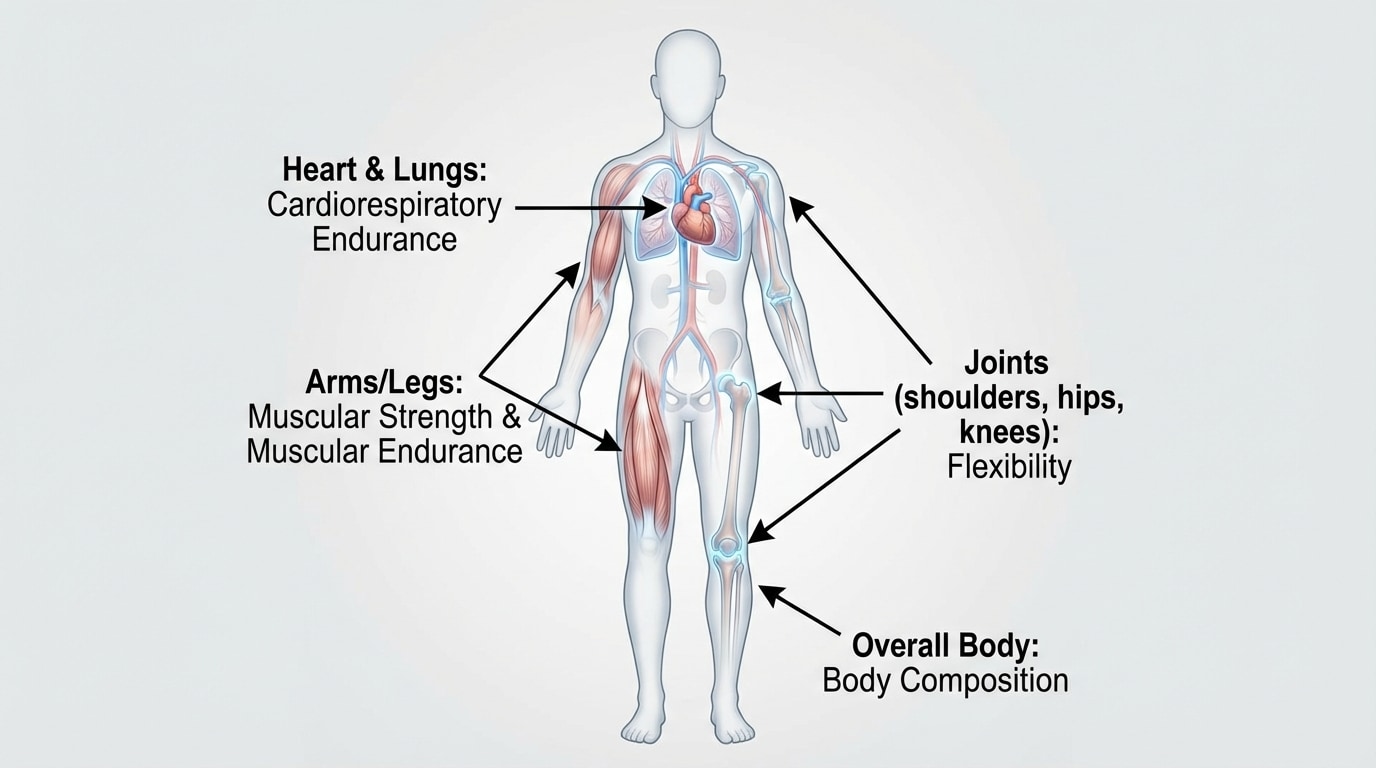
Cardiorespiratory endurance is how well your heart and lungs work together to provide oxygen to your body during activities that last longer, like brisk walking, running, swimming, or biking. When you can keep moving without having to stop and rest right away, your cardiorespiratory endurance is probably good.
Activities that help cardiorespiratory endurance include jogging, jump rope, playing tag, or riding a bike. These activities help your heart become stronger and your lungs work better. Over time, this can lower your risk of heart disease and help you feel more energetic every day.
Muscular strength is the amount of force your muscles can produce at one time. Think about pushing a heavy box, lifting a backpack full of books, or doing a push-up. When you use strong effort, you are using muscular strength.
To build muscular strength, you can do activities like push-ups, squats, wall sits, or carefully lifting light weights that are safe for your age. Having strong muscles helps protect your joints, supports your bones, and makes it easier to do tasks like carrying groceries or climbing a steep hill.
Muscular endurance is how long your muscles can work without getting extremely tired. It is different from strength. Strength is like lifting a heavy weight one time; endurance is like lifting a lighter weight many times.
Examples of muscular endurance include doing curl-ups for a full minute, holding a plank, or pedaling a bike for several minutes without stopping. Good muscular endurance helps you keep good posture in class, stay active in games for longer, and avoid injuries from muscle fatigue.
Flexibility is how far your joints can move comfortably. It is the ability to bend, twist, and reach without pain. When you tie your shoes, stretch to reach a high shelf, or sit criss-cross on the floor, you are using flexibility.
Stretching, yoga, and activities like gymnastics or dance can improve flexibility. When your muscles and joints are flexible, your body can move smoothly and you are less likely to get hurt if you fall or twist suddenly. Flexibility also helps your muscles feel less tight after exercise.
Body composition is the balance between different parts that make up your body—mainly fat, muscle, bone, and water. It is not about trying to look a certain way. It is about having a healthy amount of body fat and strong muscles and bones.
Regular physical activity and eating a balanced diet help your body composition stay healthy. For example, staying active can help build muscle, and eating foods like fruits, vegetables, whole grains, and lean proteins supports both muscles and bones. A healthy body composition can reduce the chance of certain health problems when you are older.
The more you build these health-related components, the easier it becomes to stay active and enjoy life, from recess to weekend adventures. When you check in with how your body feels—your breathing, your muscle strength, your ability to move and stretch—you are noticing your health-related fitness, just like in [Figure 2].
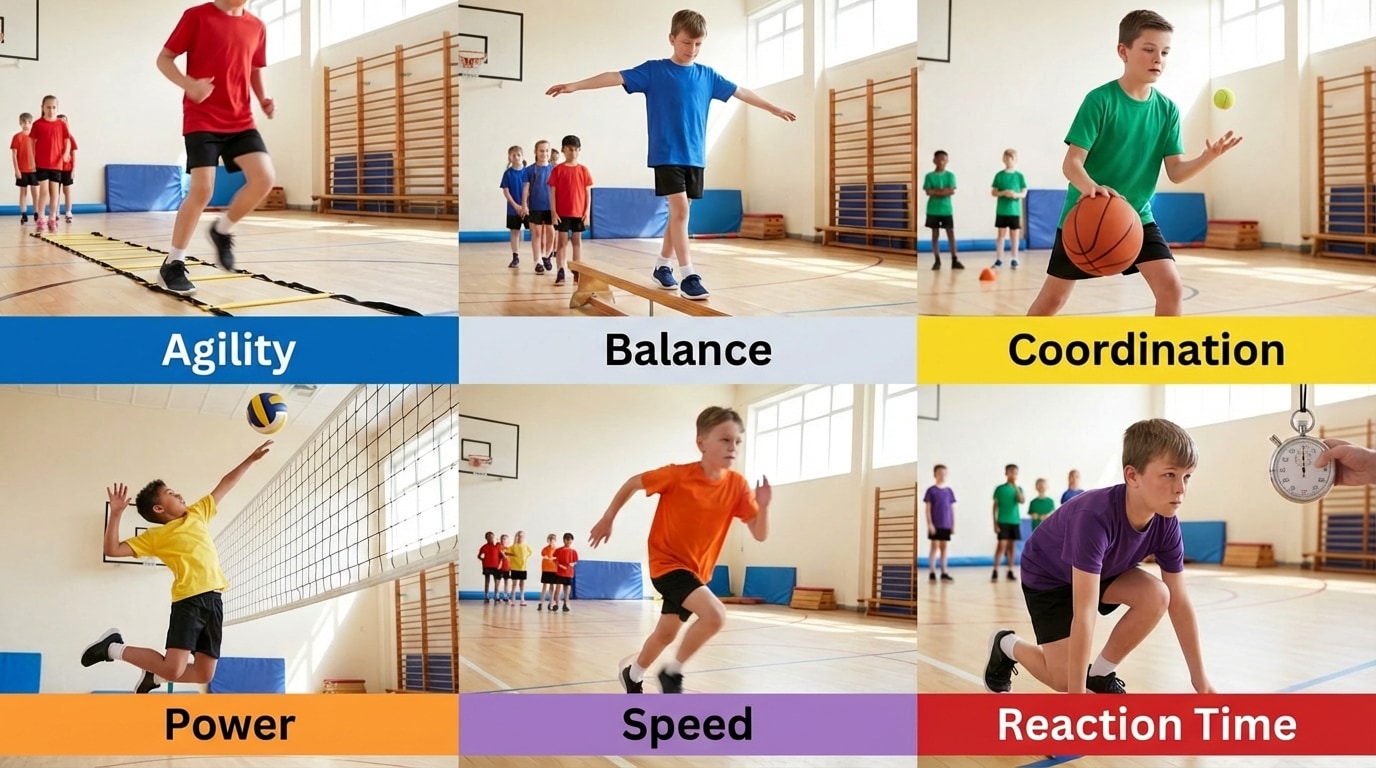
While health-related components focus on your body’s systems and long-term health, skill-related fitness components are more about how well you can perform specific movements, especially in games and sports. These skills often make activities more fun because they help you move with control and confidence.
Skill-related fitness includes the components shown in [Figure 3]:
Agility is the ability to change the direction of your body quickly and with control. When you dodge an opponent in basketball or quickly switch directions to chase a ball in soccer, you are using agility.
Practicing activities like zigzag runs, ladder drills, or games like tag can improve agility and make you more successful in many sports.
Balance is the ability to keep your body steady, whether you are still or moving. Standing on one foot, walking across a narrow line, or landing safely after a jump all require balance.
Good balance helps prevent falls and injuries. It also helps in activities like gymnastics, skateboarding, skiing, or simply standing on a bus without falling when it turns.
Coordination is when different parts of your body work together smoothly. Hand-eye coordination is used when you throw and catch a ball. Foot-eye coordination helps when you kick a soccer ball accurately.
Juggling scarves, dribbling a basketball while walking, or hitting a ball with a bat are all activities that use and improve coordination.
Power is using strength quickly. It is a mix of strength and speed. Jumping high for a rebound, sprinting off the starting line, or throwing a ball far all use power.
Jumping exercises, short sprints, or explosive moves like jumping jacks can help build power if they are done safely and with good technique.
Speed is how fast you can move your body or part of your body from one place to another. Running a short race, swimming a quick lap, or racing your friend across the playground all use speed.
You can improve speed by practicing short bursts of fast movement with rest in between and by paying attention to your running or movement form.
Reaction time is how quickly you respond to a signal, like a sound, a sight, or a touch. When you start running the moment you hear the whistle, or when you move your hand to catch a ball that suddenly bounces toward you, you are using reaction time.
Games where you have to respond quickly—like “red light, green light,” or catching a ball thrown without warning—can help you practice and improve reaction time. Activities in [Figure 3] show how all six skill-related components can be practiced during fun games, not just in serious competitions.
Even though health-related and skill-related fitness components are in separate groups in [Figure 1], your body uses them together almost all the time. When you participate in any sport, PE class, or even active play with friends, you are using at least some components from both groups.
Imagine you are playing a long game of basketball. You need:
All of these work together to help you play safely, effectively, and with more fun. If any one of these components is very weak, it can make the whole activity harder. For example, if your flexibility is poor, you might strain a muscle when reaching, or if your cardiorespiratory endurance is low, you might have to sit out because you feel too tired or out of breath.
These same combinations happen in everyday life too. If you ride your bike to school, you use cardiorespiratory endurance and muscular endurance in your legs, plus balance and coordination to stay upright and steer around obstacles.
A health-enhancing lifestyle is not about being perfect. It is about choosing regular habits that help you grow stronger, healthier, and more confident over time. At your age, you can start shaping these habits now.
Some key ideas include:
As you stay active week after week, you might notice positive changes: walking up stairs feels easier, you can play longer at recess, or you can stretch a little farther. These are signs that your health-related and skill-related fitness are improving and that your lifestyle is truly health-enhancing.
To understand how fitness components affect your life, it helps to notice where you are now and how you change over time. You do not need fancy equipment—simple checks can give you information.
Some examples include:
When you notice even small improvements, it can motivate you to keep going. Instead of comparing yourself to others, compare yourself to your past self. Ask: “Can I do more now than I could a month ago?” or “Do I feel more comfortable being active than I used to?” These questions help you see how health-related and skill-related fitness components are changing in your own body.
Physical fitness is made of different components that work together to support a health-enhancing lifestyle. Health-related fitness components—cardiorespiratory endurance, muscular strength, muscular endurance, flexibility, and body composition—are closely linked to how healthy your body is and how well it works during daily life. These components help your heart, lungs, muscles, joints, and overall body stay strong and lower your risk of health problems.
Skill-related fitness components—agility, balance, coordination, power, speed, and reaction time—help you move quickly, accurately, and safely in sports, games, and active play. These skills let you change direction, stay steady, control your body and equipment, move fast, and respond quickly to signals and situations.
Both groups of fitness components, shown together in [Figure 1], affect what you can do and how you feel. You use them together in almost every physical activity, from biking and swimming to playing basketball or dancing with friends. When you choose to be active most days, mix different kinds of activities, warm up and cool down, stay safe, and listen to your body, you are building a health-enhancing lifestyle that supports both your health and your skills.
As you practice and grow, you can notice changes in your endurance, strength, flexibility, balance, speed, and more. These improvements show that your fitness components are getting stronger and that you are taking care of your body in a way that will help you now and in the future. 🌈
