Develop, implement and monitor an individual health and fitness plan by establishing goals based on fitness assessment data.
Developing, Implementing, and Monitoring a Personal Health and Fitness Plan
What if you managed your body like a high-performance machine—tracking data, testing performance, and making smart adjustments, just like engineers do with rockets or F1 cars? That is exactly what a well-designed personal health and fitness plan does: it turns your everyday workouts and habits into a science-based strategy for feeling and performing your best.
Why Personal Fitness Planning Matters
Most people exercise by guessing: random workouts, occasional runs, or a few push-ups when they feel guilty. In contrast, athletes, military professionals, and serious performers follow structured plans built from data. They test, set goals, train, and retest.
A personal health and fitness plan helps you:
Understand your current fitness level instead of just “feeling” fit or unfit.
Target your specific needs (cardio, strength, flexibility, or body composition) instead of copying someone else’s routine.
Use time efficiently with training that matches your goals.
Monitor progress so you see real improvement and stay motivated.
Maintain health-enhancing activity levels that support long-term wellness, not just short-term looks.
Developing, implementing, and monitoring your own plan is a key life skill. You can apply it whether you are playing varsity sports, training for a 5K, managing stress, or just wanting more energy during the day.
Understanding Fitness Assessment Data
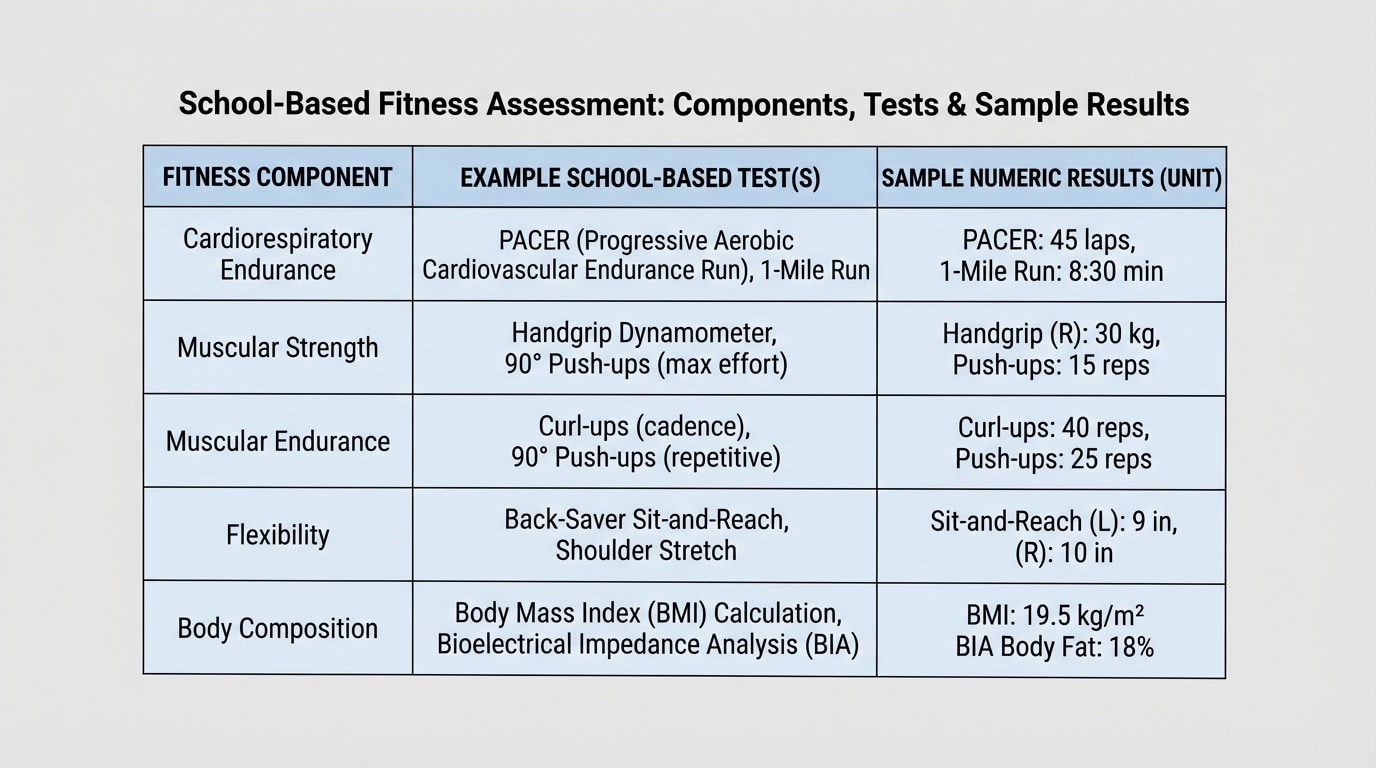
Before you build a plan, you need a starting point. Fitness assessments give you objective data about different parts of your fitness, as summarized in [Figure 1]. Instead of saying “I’m out of shape,” you can say, “My cardiorespiratory endurance is low, but my flexibility is good.”
Common fitness components and example assessments include:
1. Cardiorespiratory (Cardio) Endurance
This is your heart and lungs’ ability to supply oxygen during sustained physical activity.
Example tests: PACER test, 1-mile or 1.5-mile run, 12-minute run/walk.
Typical data: Time to complete a distance, number of laps, or level reached.
If you run 1 mile in 11 minutes, that number becomes part of your baseline.
2. Muscular Strength
Muscular strength is the maximum force a muscle or muscle group can produce in a single effort.
Example tests: 1-repetition maximum (1RM) in exercises like squat, bench press, or leg press (if supervised and safe); handgrip strength test.
Typical data: Maximum weight lifted once, measured in kilograms or pounds, or grip force.
For example, if you can perform 1 bench press at 95 pounds, that is part of your strength profile.
3. Muscular Endurance
Muscular endurance is your ability to perform repeated contractions over time without excessive fatigue.
Example tests: Maximum push-ups in 1 minute, maximum curl-ups/sit-ups in 1 minute, plank hold time.
Typical data: Number of correct repetitions or seconds held.
If you complete 18 push-ups with proper form, that is your muscular endurance data for that movement.
4. Flexibility
Flexibility is the range of motion available at a joint.
Example tests: Sit-and-reach test (for hamstrings and lower back), shoulder flexibility tests.
Typical data: Distance reached measured in centimeters or inches.
For instance, if in a sit-and-reach test you reach 24 centimeters, that number can later be compared to your retest result.
5. Body Composition
Body composition is the relative amount of fat mass and fat-free mass (muscle, bone, organs) in your body.
Example measurements: Body mass index (BMI), skinfold measurements, bioelectrical impedance analysis, waist circumference.
Typical data: BMI value, estimated body fat percentage, waist measurement.
One simple calculation many people encounter is BMI. To compute BMI, you use the formula \[\textrm{BMI} = \frac{\textrm{weight in kg}}{(\textrm{height in m})^2}.\] For example, if your weight is 68 (kilograms) and your height is 1.70 (meters), then \[\textrm{BMI} = \frac{68}{(1.70)^2} = \frac{68}{2.89} \approx 23.53.\] This value is just one piece of information and does not perfectly describe health, especially for very muscular people, but it can be part of your data set.
Interpreting Results
You can interpret your fitness assessment data in two main ways:
Norm-referenced: Comparing your scores to reference charts for your age and sex (for example, “above average,” “needs improvement”).
Criterion- or self-referenced: Comparing your scores to health-related standards or to your own previous results.
For personal progress, self-referenced comparison is powerful: you are trying to become fitter than your past self, not someone else.
Figure 1: A table-style chart listing fitness components (cardiorespiratory endurance, muscular strength, muscular endurance, flexibility, body composition) in one column and example school-based tests with sample numeric results in adjacent columns.
Setting SMART Fitness and Health Goals From Data
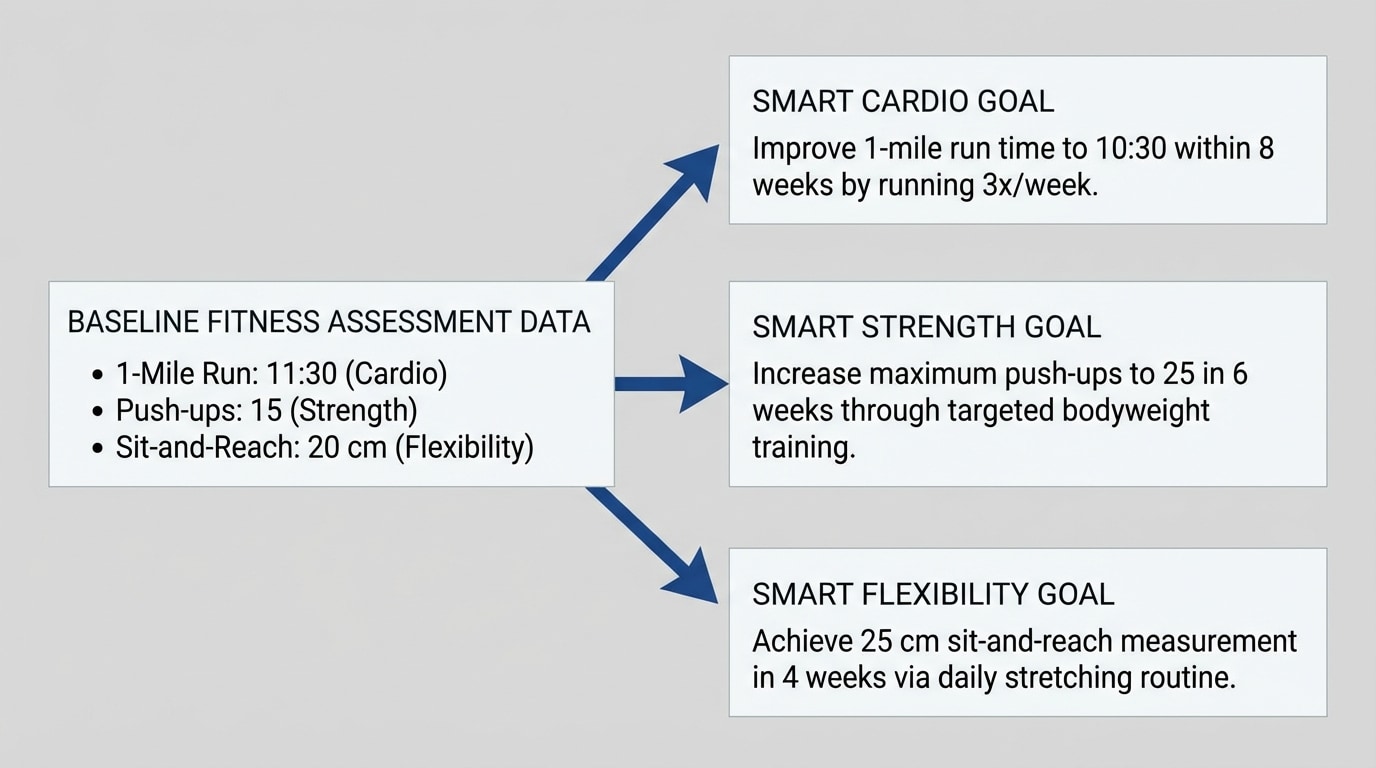
Once you have baseline data, the next step is turning those numbers into clear goals using the SMART framework, as illustrated in [Figure 2].
SMART Goals
Specific: Clear and focused on one area.
Measurable: Includes a number or concrete outcome.
Achievable: Realistic based on your current level and time.
Relevant: Connected to your health, performance, or personal priorities.
Time-bound: Has a deadline.
Example 1: Cardiorespiratory Goal
Suppose your 1-mile run time is 11 minutes 30 seconds, and you feel out of breath when you play full-court basketball.
Non-SMART goal: “I want better stamina.”
SMART goal: “I will improve my 1-mile run time from 11:30 to 9:30 within 10 weeks by running or doing cardio at least 4 days per week.”
This is specific (1-mile run), measurable (from 11:30 to 9:30), achievable (a 2-minute improvement over 10 weeks is challenging but realistic for many beginners), relevant (stamina for sports and health), and time-bound (10 weeks).
Example 2: Muscular Endurance Goal
If your baseline is 15 push-ups with good form:
Non-SMART: “I want to get stronger.”
SMART: “I will increase my maximum push-ups from 15 to 30 in 8 weeks by doing a structured push-up and upper-body strength routine 3 times per week.”
Example 3: Flexibility and Back Health Goal
Let’s say your sit-and-reach result is 20 centimeters, and you experience tight hamstrings after long periods of sitting.
SMART goal: “I will improve my sit-and-reach score from 20 to 27 (centimeters) within 6 weeks by doing 10 minutes of targeted stretching at least 5 days per week, focusing on hamstrings and lower back.”
Example 4: Body Composition and Energy Goal
If your BMI and waist measurement suggest you would benefit from reducing body fat, and you feel low energy:
SMART goal: “I will decrease my waist circumference from 88 (centimeters) to 82 (centimeters) and maintain my muscle mass over the next 12 weeks by combining 4 days per week of cardio, 2 days of strength training, and consistent portion-controlled nutrition.”
Safety and Individual Differences
Always consider your health status. If you have a medical condition (such as asthma, heart issues, or joint problems) or past injuries, your goals and activities may need medical clearance or professional guidance. Your plan should challenge you, not endanger you.
Figure 2: A flow diagram showing sample baseline data (e.g., 1-mile run 11:30, push-ups 15, sit-and-reach 20 cm) connected by arrows to three written SMART goals for cardio, strength, and flexibility.
Designing Your Individual Fitness Plan
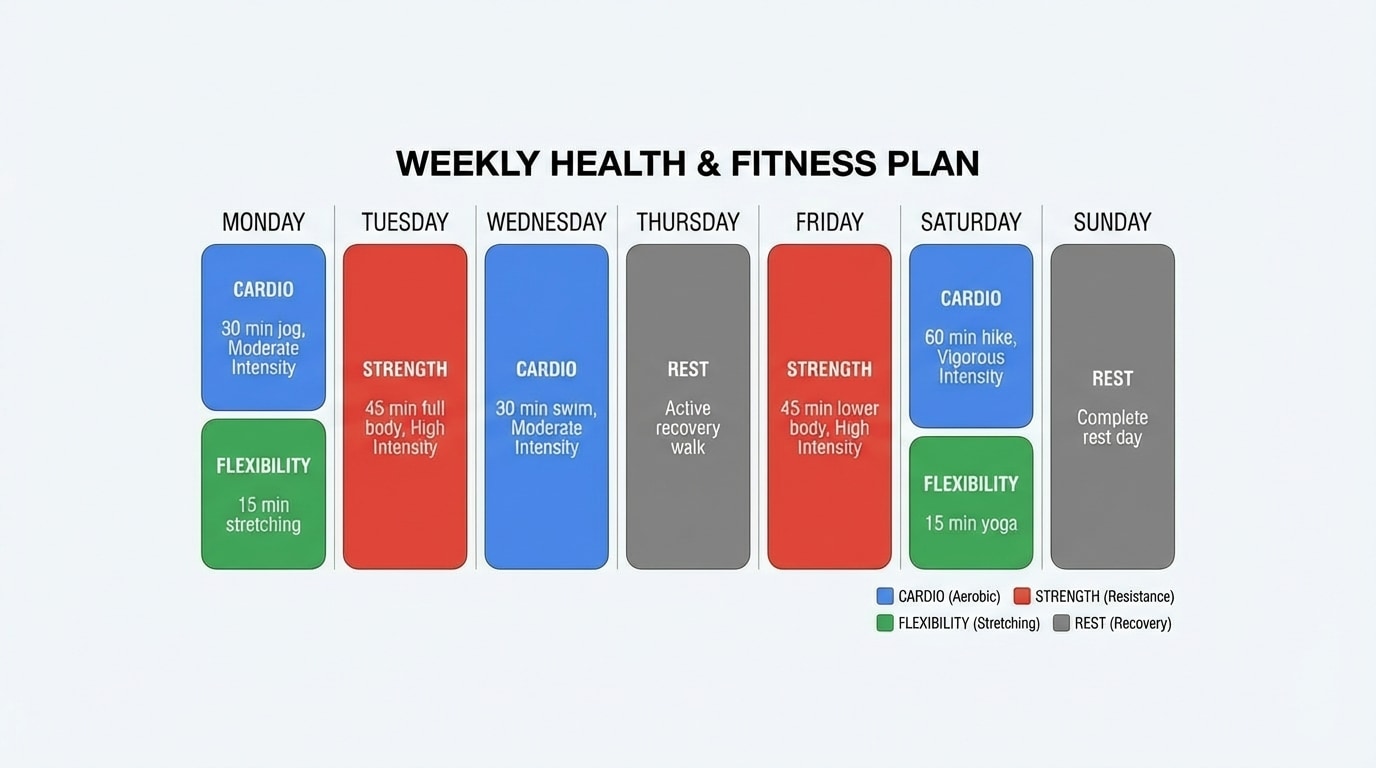
Once your goals are clear, you design the training process to reach them. A powerful tool for this is the FITT principle. A visual weekly schedule helps you see how all of this fits together, as shown in [Figure 3].
The FITT Principle
Frequency: How often you exercise (days per week).
Intensity: How hard you work (speed, weight, heart rate, perceived effort).
Time: How long each session lasts (minutes or sets/reps).
Type: What kind of activity you do (running, cycling, weightlifting, yoga, etc.).
1. Cardiorespiratory Training
For improving your 1-mile run time goal:
Frequency: 3–5 days per week.
Intensity: Moderate to vigorous. You might use a scale of perceived exertion from 1–10, aiming around 6–8 for cardio workouts.
Time: 20–40 minutes per session, depending on your level.
1–2 days of intervals (for example, alternating 1 minute faster, 2 minutes easier).
2. Muscular Strength and Endurance Training
For increasing push-ups and general strength:
Frequency: 2–3 non-consecutive days per week (to allow recovery).
Intensity: Challenging by the last few repetitions of each set but still with safe form.
Time: 20–45 minutes per session.
Type: Bodyweight exercises (push-ups, squats, lunges, planks) or resistance training with bands, machines, or free weights.
Example structure:
3 sets of 8–12 push-ups.
3 sets of 10–15 squats.
3 sets of 20–30 seconds plank.
Other supporting exercises for back and shoulders.
Over time, you apply the principle of progression: gradually increase sets, reps, or difficulty.
3. Flexibility Training
For improving sit-and-reach and reducing muscle tightness:
Frequency: At least 3–5 days per week.
Intensity: Stretch to a point of mild tension, not pain.
Time: Hold each stretch for about 15–30 seconds; repeat 2–4 times per muscle group.
Type: Static stretching (holding a position), dynamic stretching (controlled movement), or yoga-based routines.
4. Balancing Your Weekly Plan
A balanced plan includes cardio, strength, flexibility, and rest or active recovery. Here is one sample week for someone with goals to improve mile time, push-ups, and flexibility:
Friday: Steady cardio or active sport (30–40 minutes).
Saturday: Longer easy walk or light activity + extra stretching.
Sunday: Rest or gentle stretching.
Warm-Up and Cool-Down
Warm-up: 5–10 minutes of light movement (for example, easy jog, dynamic leg swings, arm circles) to prepare your body.
Cool-down: 5–10 minutes of slower movement and stretching to gradually lower heart rate and reduce stiffness.
Principles of Overload and Recovery
Overload: Your body improves when you challenge it slightly beyond its usual level (more distance, more reps, more resistance).
Recovery: Your body needs rest to repair and adapt. Without rest, overload becomes overtraining, which can lead to injury or burnout.
Figure 3: A color-coded weekly calendar showing days of the week with blocks labeled for cardio, strength, flexibility, and rest, demonstrating FITT variables and balance across the week.
Implementing the Plan Safely and Effectively
Having a plan is one thing; following it consistently and safely is another. This is where discipline and self-awareness meet.
1. Safety and Technique
Learn correct technique for each exercise (from a teacher, coach, or credible resource). Poor form can cause injury.
Increase intensity gradually; avoid sudden jumps in distance or weight.
Use proper equipment—supportive shoes, safe space, and appropriately adjusted machines.
2. Listening to Your Body
It is normal to feel some muscle fatigue or mild soreness, especially when you start or progress your plan. However, stop and modify if you experience:
Sharp or sudden pain.
Joint pain that worsens during the activity.
Dizziness, chest pain, or difficulty breathing beyond normal exertion.
3. Hydration, Sleep, and Basic Nutrition
Hydration: Drink water regularly throughout the day and around workouts.
Sleep: Aim for about 8–10 hours per night during adolescence. Recovery and adaptation happen during sleep.
Nutrition: Choose mostly whole foods—fruits, vegetables, lean proteins, whole grains, and healthy fats—to fuel training and recovery. Limit heavily processed foods and sugary drinks.
4. Time Management and Habit-Building
Students often have packed schedules. To make your plan realistic:
Schedule workouts like appointments—put them in a calendar.
Use “micro-workouts” on busy days (for example, 10 minutes morning, 10 minutes afternoon).
Pair habits: stretch while watching a show, or do bodyweight exercises after brushing your teeth in the evening.
5. Motivation and Support
Connect your goals to what you care about—sports performance, mental health, confidence, or long-term health.
Find a workout partner, team, or online community.
Track small wins: one more push-up, slightly faster run, or better energy during the day.
Monitoring Progress and Adjusting the Plan
Monitoring turns your plan into a living system. Instead of blindly repeating workouts, you collect feedback and adjust.
1. Tracking Methods
Workout log: Record date, activity, duration, and how you felt (for example, energy level 1–10).
Apps or wearables: Track steps, heart rate, or sleep.
Simple tables: Create a chart for key measures—mile time, push-ups, sit-and-reach, waist measurement—and update at regular intervals.
2. Re-Assessment
Schedule re-tests every 4–8 weeks, using the same methods as your baseline:
Repeat the 1-mile run or PACER.
Retest push-ups, curl-ups, or plank time.
Check sit-and-reach again.
Re-measure waist circumference or other selected measures.
Then compare:
Has your run time decreased?
Are you doing more push-ups with good form?
Has your flexibility improved?
Just like you compared earlier values in [Figure 1], you now compare your new results to your own older ones.
3. Quantitative Monitoring Examples
If your 1-mile time went from 11:30 to 10:20, you improved by 70 seconds.
If your push-ups increased from 15 to 28, that is a 13-repetition gain.
If your sit-and-reach improved from 20 (centimeters) to 26 (centimeters), you increased by 6 (centimeters).
These numbers show whether your plan is working. If nothing changes after several weeks, something in your plan likely needs to be adjusted.
4. Adjusting Your Plan
Use your data to make smart changes, similar to how engineers tune a system:
If progress is good: Keep most of the plan but slowly increase difficulty (more distance, more intensity, slightly heavier weights).
If progress is slow: Increase frequency or intensity slightly, or improve your sleep and nutrition.
If you feel overly fatigued: Reduce intensity, add an extra rest or active recovery day, or shorten sessions temporarily.
The SMART goals and plan you saw modeled in [Figure 2] are not meant to stay frozen; they evolve with your body’s responses.
5. Handling Plateaus and Setbacks
Every fitness journey includes plateaus and minor setbacks:
Plateau: When progress stalls, add variety (for example, switch from steady runs to intervals once a week) or change the training stimulus.
Injury or illness: Reduce or modify activity. Focus on what you can do safely (like upper-body work when you have a minor ankle sprain), under guidance.
Busy weeks: Scale down instead of quitting. Even short, lighter sessions help maintain your habit.
Real-World Applications and Lifelong Wellness
Learning to design and monitor a fitness plan in high school prepares you for many real-world situations.
1. Sports and Performance
A basketball player can use cardio and agility data to design conditioning that improves game endurance.
A track athlete can monitor split times and strength metrics to adjust training phases.
A dancer can track flexibility and core strength to prevent overuse injuries.
2. Injury Prevention and Rehabilitation
Good muscular balance, flexibility, and progressive overload reduce the risk of common injuries such as ankle sprains, knee pain, and lower-back issues. After injury, physical therapists often build individualized plans using the same ideas you are practicing: assess, set goals, plan, implement, and monitor.
3. Stress Management and Mental Health
Regular physical activity can reduce stress hormones and increase mood-boosting chemicals in the brain. A planned routine gives structure and a sense of control, which is especially valuable during exams or stressful life events.
4. Academic and Work Performance
Better fitness is linked to improved concentration, memory, and energy levels. Having a consistent fitness routine can help you stay mentally sharp for studying, exams, and, later, demanding jobs.
5. Long-Term Disease Prevention
Data-based activity and fitness habits lower the risk of developing conditions like heart disease, type 2 diabetes, and some forms of cancer. By learning to plan and monitor your fitness now, you are building skills for lifelong health management.
Key Points to Remember
• Fitness assessments provide objective data on cardiorespiratory endurance, muscular strength and endurance, flexibility, and body composition, forming your starting point.
• Effective goals are SMART—Specific, Measurable, Achievable, Relevant, and Time-bound—and they are built directly from your assessment data.
• The FITT principle (Frequency, Intensity, Time, Type) guides the design of your weekly plan, which should balance cardio, strength, flexibility, and rest, as reflected in the sample schedule similar to [Figure 3].
• Safe implementation includes proper technique, gradual progression, sufficient hydration, sleep, and attention to your body’s signals.
• Monitoring and adjusting your plan through logs, re-testing, and data analysis keeps your training effective and responsive to your progress.
• The skills you develop—assessing, planning, acting, and adjusting—apply not only to fitness but also to academics, careers, and personal goals throughout your life.
By taking ownership of your health and fitness in a structured, data-informed way, you give yourself a powerful advantage: the ability to intentionally design how you move, feel, and perform, both now and in the future.