How can you solve \(9 + 6\) faster than counting one by one? You can, and that is what strong mental math is all about. When you can add and subtract within \(20\) in your head, math feels quicker, smoother, and more fun. You use these skills when you count points in a game, figure out how many crackers are left, or tell how many more stickers you need to get to \(20\).
Mental math means solving a problem in your head without needing to write every step down. When numbers are small, your mind can use smart ways to work with them. Instead of only counting, you can notice patterns and use facts you already know.
When you become fast and careful with facts within \(20\), bigger math becomes easier too. For example, if you already know that \(8 + 7 = 15\), then later it is easier to solve larger problems that use the same thinking.
Mental strategy is a way to solve a math problem in your head by using number patterns and facts you know.
Fluent means you can solve correctly, efficiently, and with confidence.
Being fluent does not mean there is only one way to solve a problem. It means you can choose a smart strategy and use it correctly. One student might solve \(6 + 7\) by thinking about doubles. Another might make \(10\). Both can be good strategies.
To add and subtract fluently within \(20\), you should be able to solve problems accurately, without getting stuck, and by using thinking strategies instead of slow counting for every problem. At first, you may still need to think carefully. With practice, many facts become so familiar that you know them right away.
For example, if you know from memory that \(5 + 5 = 10\), then \(5 + 6\) is just one more, so \(5 + 6 = 11\). This is faster than counting: \(1, 2, 3, 4, 5, 6, 7, 8, 9, 10, 11\).
You already know how to count forward and backward and how to compare numbers. Those skills help you notice how numbers change when you add or subtract.
Good mental math uses what you know to figure out what you do not know yet. That is why number facts are connected like pieces of a puzzle.
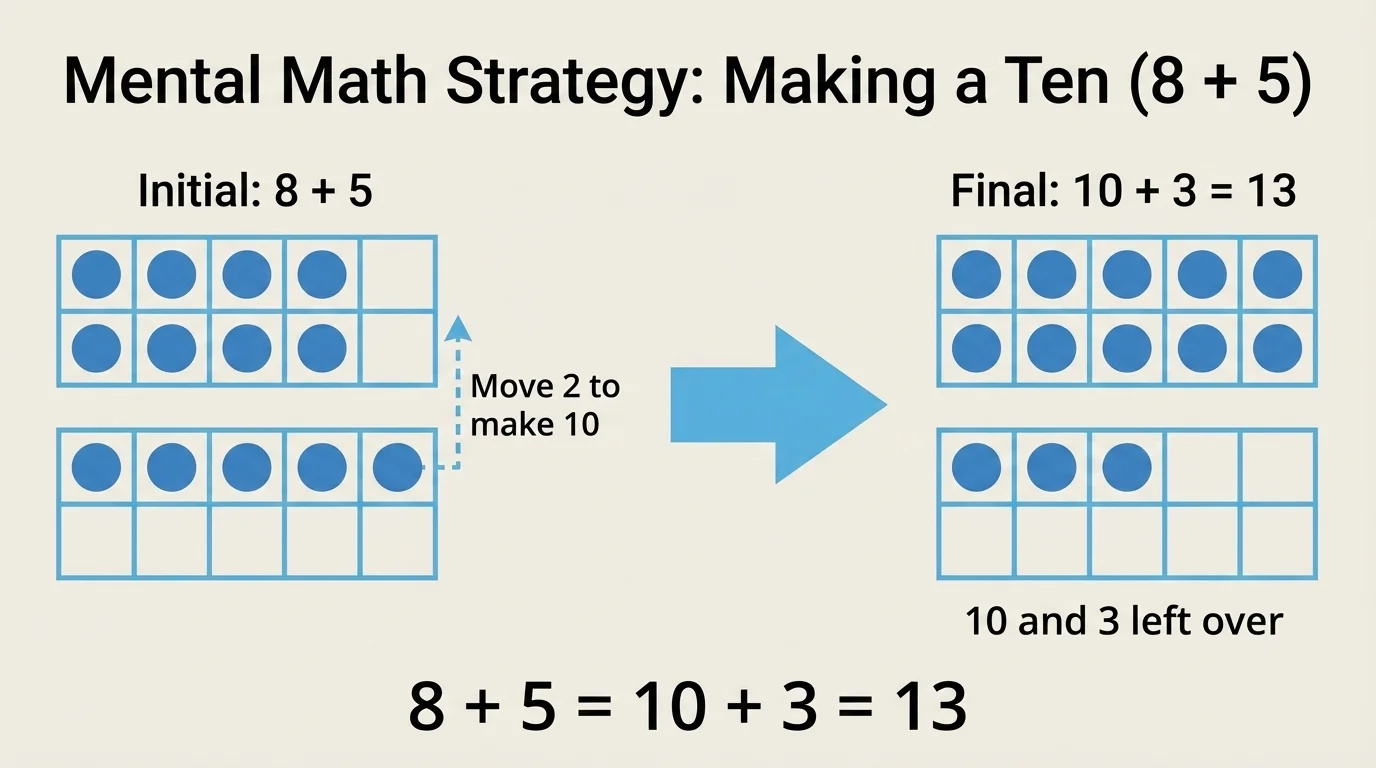
One helpful make 10 strategy is to look for a way to make \(10\) first, as [Figure 1] shows with dots grouped on a ten-frame. Since \(10\) is an easy number to work with, many addition problems become simpler when you turn part of a number into \(10\).
For example, in \(8 + 5\), you can take \(2\) from the \(5\) and give it to the \(8\). Then \(8 + 2 = 10\), and there are \(3\) left. So \(8 + 5 = 10 + 3 = 13\).
Another strategy is counting on. If you solve \(11 + 3\), you can start at \(11\) and count on: \(12, 13, 14\). So \(11 + 3 = 14\). This works best when the second addend is small.
A very powerful strategy uses double facts. A double fact is when the same number is added to itself, like \(4 + 4 = 8\) or \(7 + 7 = 14\). If you know doubles, you can solve many other facts quickly.
Now think about near doubles. If \(6 + 6 = 12\), then \(6 + 7\) is just one more, so \(6 + 7 = 13\). If \(8 + 8 = 16\), then \(8 + 9 = 17\).
You can also use the commutative property of addition. This means you can turn the addends around, and the sum stays the same: \(3 + 8 = 8 + 3\). Sometimes one order is easier to think about than the other.
Your brain gets faster at number facts when it sees patterns. Knowing just a few facts, like doubles and combinations that make \(10\), helps you solve many more facts.
For example, \(2 + 9\) may feel tricky, but if you turn it around, \(9 + 2\) is easy to picture. The answer is still \(11\).
Subtraction can mean taking away, but it can also mean finding the difference between two numbers. A number line can help you represent both ideas, as [Figure 2] illustrates with jumps backward and jumps up to compare numbers.
One strategy is counting back. For \(15 - 3\), start at \(15\) and count back three numbers: \(14, 13, 12\). So \(15 - 3 = 12\).
Another strategy is to think about the difference, which means asking, "What number do I add to get there?" For \(13 - 8\), ask: \(8 + ? = 13\). Since \(8 + 5 = 13\), the answer is \(5\).
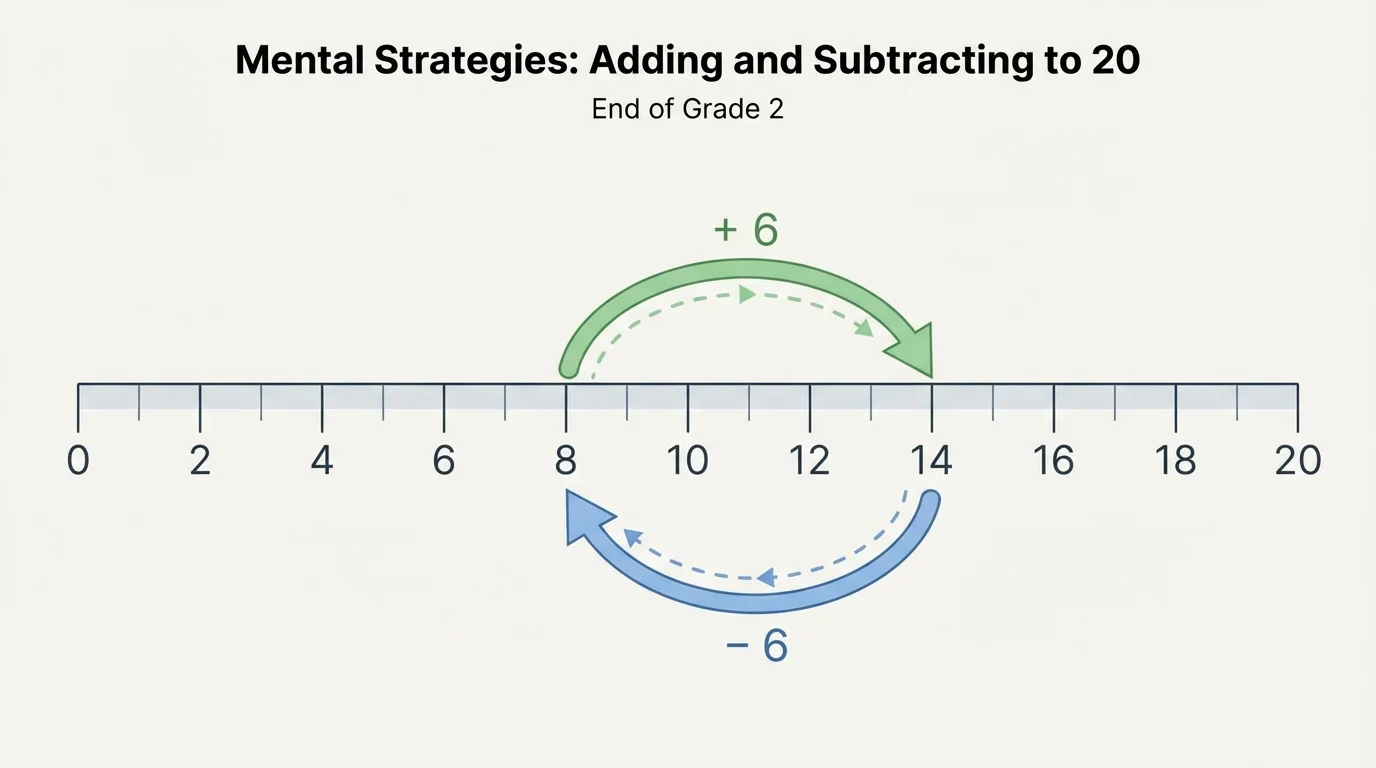
You can also use make \(10\) in subtraction. For \(12 - 5\), go from \(12\) back to \(10\), which is \(2\) steps. Then take away \(3\) more. Since \(2 + 3 = 5\), the answer is \(7\).
Known facts help here too. If you know \(9 + 4 = 13\), then you also know \(13 - 9 = 4\) and \(13 - 4 = 9\). Addition and subtraction are connected.
A fact family is a group of math facts made from the same three numbers. If you know one fact, the others become easier.
[Figure 3] Look at the numbers \(7\), \(5\), and \(12\). These make a fact family: \(7 + 5 = 12\), \(5 + 7 = 12\), \(12 - 7 = 5\), and \(12 - 5 = 7\).
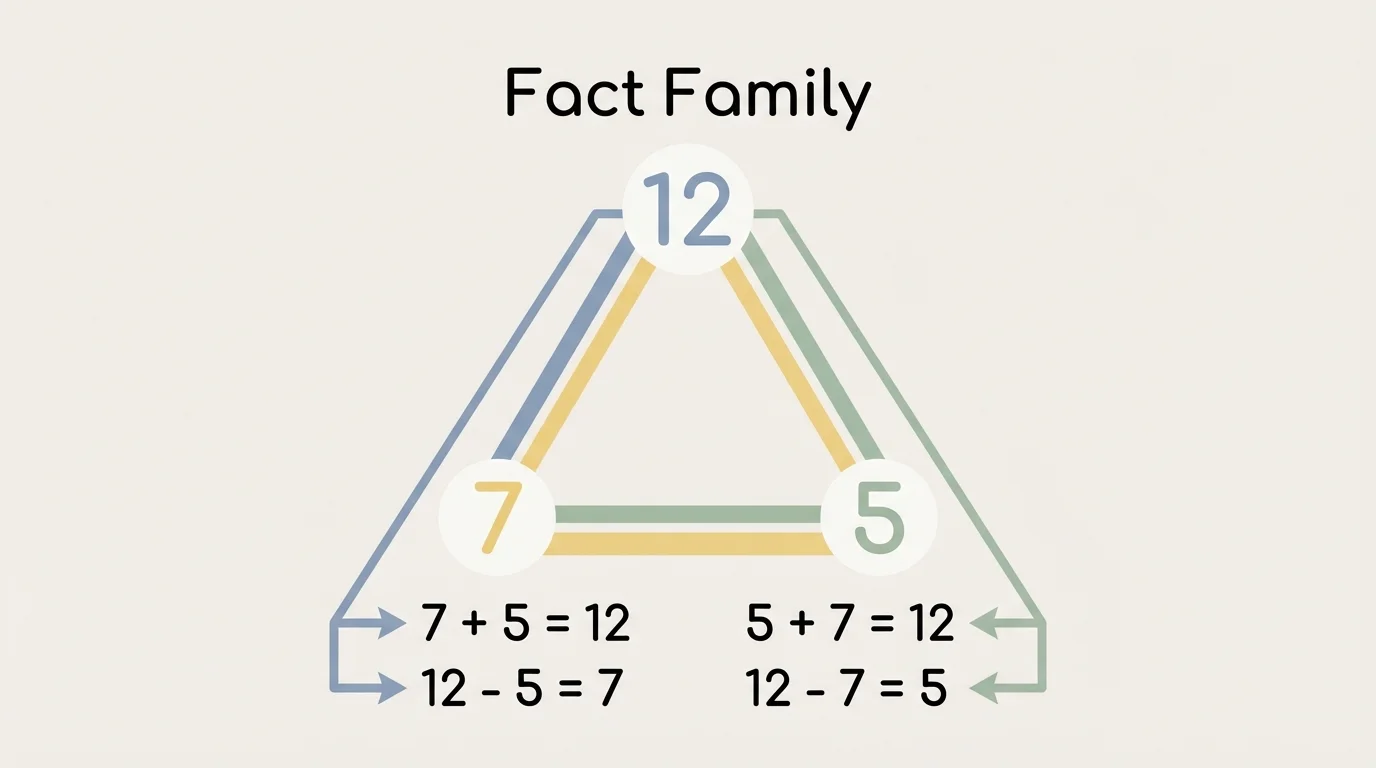
Fact families are useful because they help you remember facts instead of learning each one alone. If you know \(6 + 8 = 14\), then you also know \(14 - 6 = 8\) and \(14 - 8 = 6\).
This is one reason your memory of math facts grows stronger over time. Facts connect to one another. Later, when you see subtraction, you can think back to addition facts you already know from the same family.
Worked example 1
Solve \(9 + 7\).
Step 1: Use the make \(10\) strategy.
Take \(1\) from \(7\) and add it to \(9\).
Step 2: Make \(10\).
\(9 + 1 = 10\)
Step 3: Add the rest.
There are \(6\) left, so \(10 + 6 = 16\).
The answer is \(9 + 7 = 16\).
This strategy is fast because numbers that make \(10\) are easy to use. The same idea appears in many facts, just like the ten-frame earlier in [Figure 1].
Worked example 2
Solve \(8 + 9\).
Step 1: Use a near double.
You may already know that \(8 + 8 = 16\).
Step 2: Compare the problem.
\(8 + 9\) is one more than \(8 + 8\).
Step 3: Add one more.
\(16 + 1 = 17\).
The answer is \(8 + 9 = 17\).
Near doubles are helpful because many sums of one-digit numbers are close to doubles. Knowing \(4 + 4\), \(5 + 5\), \(6 + 6\), and more can unlock many answers.
Worked example 3
Solve \(14 - 6\).
Step 1: Think of the related addition fact.
Ask: \(6 + ? = 14\)
Step 2: Count up or use a known fact.
\(6 + 4 = 10\), and \(10 + 4 = 14\).
Step 3: Put the parts together.
\(4 + 4 = 8\), so \(6 + 8 = 14\).
The answer is \(14 - 6 = 8\).
This is another place where fact families help. Looking at subtraction through addition often feels easier, especially when you know the addition fact from memory.
Worked example 4
Solve \(13 - 9\).
Step 1: Think about making \(10\).
From \(9\) to \(10\) is \(1\).
Step 2: Keep counting to \(13\).
From \(10\) to \(13\) is \(3\).
Step 3: Add the jumps.
\(1 + 3 = 4\).
The answer is \(13 - 9 = 4\).
On a number line, as in [Figure 2], you can picture these jumps clearly. That makes subtraction feel less like guessing and more like moving through numbers step by step.
These facts are useful every day. Suppose you have \(8\) grapes and get \(6\) more. You can think \(8 + 2 = 10\), then add the last \(4\), so \(8 + 6 = 14\). Or maybe there are \(17\) toy cars in a bin and \(9\) are blue. The number of cars that are not blue is \(17 - 9 = 8\).
In games, if your team has \(12\) points and scores \(7\) more, you can solve \(12 + 7\) by making a friendly number: \(12 + 7 = 19\). If another team had \(15\) points and lost \(4\) on a challenge, then \(15 - 4 = 11\).
Even when sharing snacks, these facts appear. If there are \(20\) crackers and \(8\) are eaten, then \(20 - 8 = 12\). When you know facts quickly, you can spend more time thinking about the story and less time struggling with the numbers.
By the end of Grade \(2\), you should know from memory all sums of two one-digit numbers. That means facts like \(3 + 4 = 7\), \(6 + 7 = 13\), and \(9 + 8 = 17\) should become familiar enough that you can answer without counting each time.
This does not happen by magic. Memory grows from understanding. When you learn patterns such as doubles, near doubles, facts that make \(10\), and turnaround facts, your brain organizes the facts. Then the facts are easier to remember.
| Helpful fact type | Example | How it helps |
|---|---|---|
| Doubles | \(7 + 7 = 14\) | Gives a known fact right away |
| Near doubles | \(7 + 8 = 15\) | Use a double and change by \(1\) |
| Make \(10\) | \(8 + 5 = 13\) | Turn part of a number into \(10\) |
| Turnaround facts | \(4 + 9 = 9 + 4\) | Use the order that feels easier |
These are common mental strategies for adding and subtracting within \(20\).
When a fact pops into your mind quickly, that is a sign that it is becoming part of your memory. The more connections you make, the stronger your math thinking becomes.
One common mistake is forgetting to add or subtract the leftover part. For example, in \(8 + 5\), a student may make \(10\) and stop there. But after making \(10\), there are still \(3\) left, so the full answer is \(13\), not \(10\).
Another mistake happens with near doubles. If \(6 + 7\) is one more than \(6 + 6\), then the answer must be one more than \(12\), which is \(13\). Be careful not to change by too much.
How to check if an answer makes sense
If you add, the answer should usually be greater than either addend. If you subtract, the answer should be less than the starting number. You can also use a related fact to check. For example, if you think \(14 - 5 = 9\), then check by adding \(9 + 5\). Since \(9 + 5 = 14\), the subtraction answer works.
Fact families make checking easier too. The related equations around the same numbers, like the ones shown in [Figure 3], let you move back and forth between addition and subtraction.
As you grow stronger with these strategies, many facts will become automatic. Then you can choose the best strategy, solve accurately, and feel confident with numbers within \(20\).
