A small mistake in measurement can cost real money. If a company orders too little cardboard, boxes cannot be made. If a painter underestimates a wall's surface area, paint runs out halfway through the job. If an aquarium is built with the wrong volume, it may hold much less water than expected. Geometry helps us answer these practical questions by measuring flat regions, outer surfaces, and the space inside solid objects.
In this topic, you will work with shapes made from triangles, quadrilaterals, other polygons, cubes, and right prisms. The key is to recognize what kind of measurement a situation needs. Sometimes you need the amount of space on a flat surface. Sometimes you need the total covering around an object. Sometimes you need the amount of space inside it. Those three ideas are related, but they are not the same.
Area measures the amount of space inside a flat, two-dimensional figure. A poster, a garden bed, and a soccer field all have area. Surface area measures the total area of all the outside faces of a three-dimensional object. A cereal box, a gift box, and a refrigerator all have surface area. Volume measures the amount of space inside a three-dimensional object, such as water in a tank or air in a room.
These measurements use different units. Area is measured in square units, such as \(\textrm{cm}^2\) or \(\textrm{m}^2\). Volume is measured in cubic units, such as \(\textrm{cm}^3\) or \(\textrm{m}^3\). If the unit does not match the kind of measurement, the answer is not complete.
Area is the amount of space inside a flat figure.
Surface area is the total area of all the outer faces of a solid figure.
Volume is the amount of space inside a solid figure.
One of the most useful habits in geometry is to ask, "Am I measuring a flat region, the outside covering, or the inside space?" That question often tells you which formula to use before you even begin calculating.
Many area problems become easier when you break a shape into simpler parts, as [Figure 1] shows. A complex polygon can often be separated into rectangles, triangles, or other familiar shapes. Then you find the area of each part and add them together.
Here are some important area formulas:
For a rectangle,
\(A = lw\)
where \(l\) is length and \(w\) is width.
For a triangle,
\[A = \frac{1}{2}bh\]
where \(b\) is the base and \(h\) is the height.
For a parallelogram,
\(A = bh\)
For a trapezoid,
\[A = \frac{1}{2}(b_1 + b_2)h\]
where \(b_1\) and \(b_2\) are the two bases.
When a figure is a composite figure, do not look for one giant formula right away. Instead, redraw or imagine lines that separate it into smaller pieces. Add areas when parts are joined together. Subtract areas when a piece is missing, such as a rectangular courtyard with a triangular garden cut out of one corner.
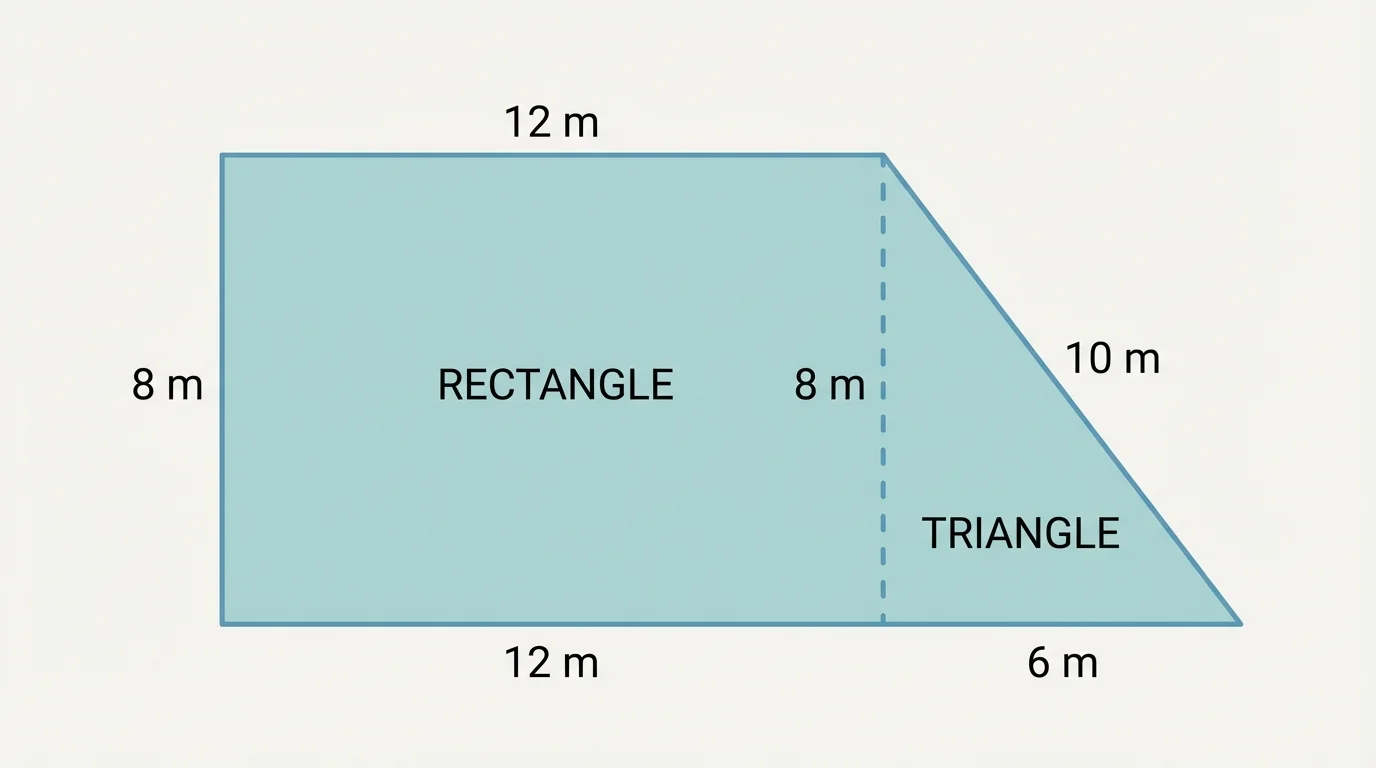
A common mistake is using the slanted side instead of the height in a triangle or trapezoid. The height must be perpendicular to the base. If the shape is tilted, the formula still works, but the height must form a right angle with the chosen base.
To find the area of a rectangle, multiply length by width. To find the area of a triangle, take half of the product of base and height. These ideas are building blocks for larger polygons and prism formulas.
Another useful strategy is to compare two methods. You might split a shape into smaller parts, or you might enclose it inside a larger rectangle and subtract the extra pieces. If both methods give the same result, that is a strong check that your work is correct.
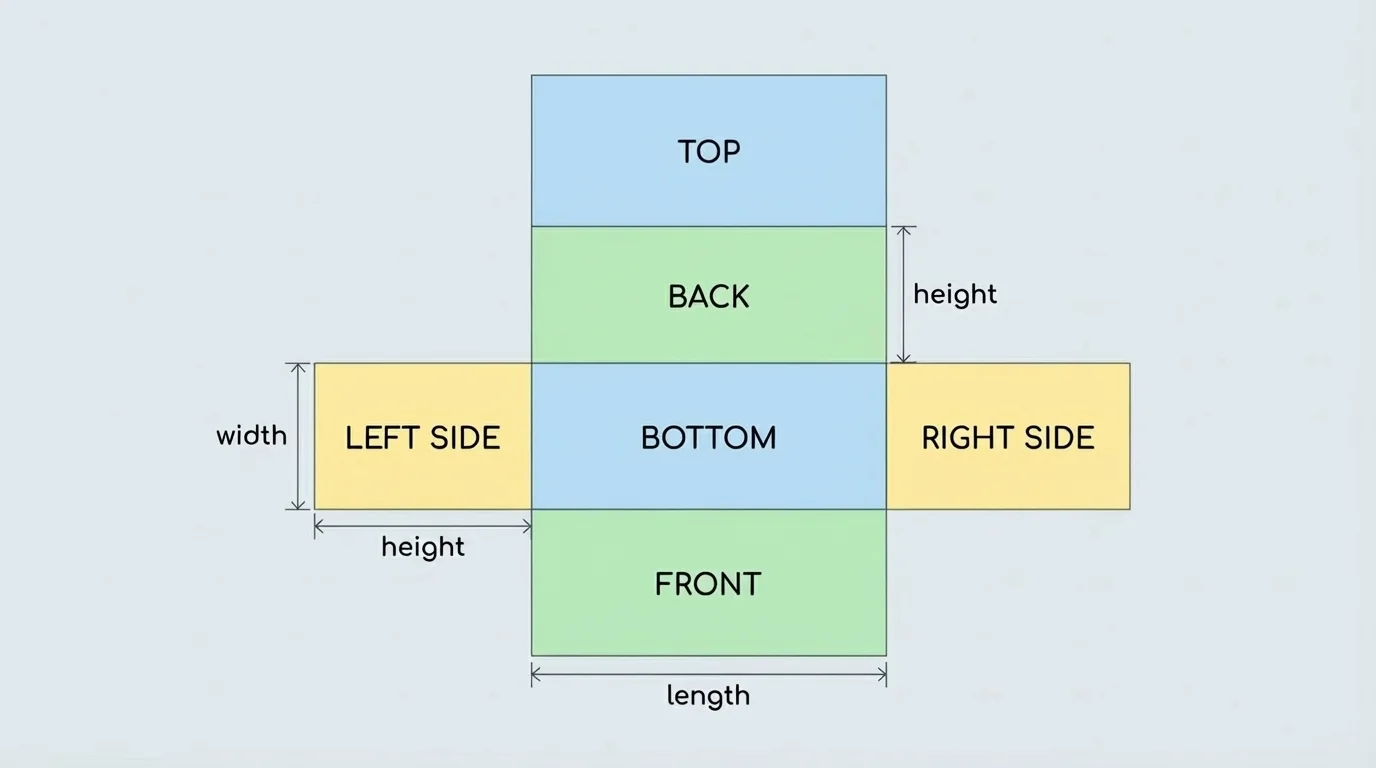
To understand surface area, picture peeling apart a box and laying all its faces flat, as [Figure 2] suggests. That flat pattern is called a net, and it shows how each face contributes to the total. Surface area is the sum of the areas of all those faces.
A cube has \(6\) congruent square faces. If each edge has length \(s\), then each face has area \(s^2\), so the total surface area is
\(SA = 6s^2\)
A rectangular prism has three pairs of matching faces. If its dimensions are length \(l\), width \(w\), and height \(h\), then its surface area is
\[SA = 2lw + 2lh + 2wh\]
A right prism has two congruent parallel bases and rectangular side faces. To find its surface area, add the area of both bases and the area of all the lateral faces. In many grade-level problems, the side faces are easy to find because the prism stands straight up from its base.
Suppose a rectangular prism has dimensions \(8 \textrm{ cm}\), \(3 \textrm{ cm}\), and \(2 \textrm{ cm}\). Then the surface area is \(2(8)(3) + 2(8)(2) + 2(3)(2) = 48 + 32 + 12 = 92\), so the total is
\[92 \, \textrm{cm}^2\]
This means \(92\) square centimeters of material would be needed to cover the outside, assuming there is no overlap and every face is included.
Sometimes a real-world problem does not include every face. A box with no top, for example, does not need the top face in its surface area. A fish tank may be open at the top. Always read carefully and decide which surfaces are actually part of the object.
Volume is about filling space. If you packed a solid with tiny unit cubes, the number of cubes would represent its volume. For prisms, there is a powerful shortcut: find the area of the base and multiply by the prism's height. This idea appears clearly in [Figure 3], where the same base shape extends through the prism.
For any right prism,
\(V = Bh\)
where \(B\) is the area of the base and \(h\) is the distance between the bases.
For a cube with edge length \(s\), volume is
\(V = s^3\)
For a rectangular prism, since the base area is \(lw\), the volume formula becomes
\(V = lwh\)
For a triangular prism, first find the area of the triangular base using \(\dfrac{1}{2}bh\), then multiply by the prism length.
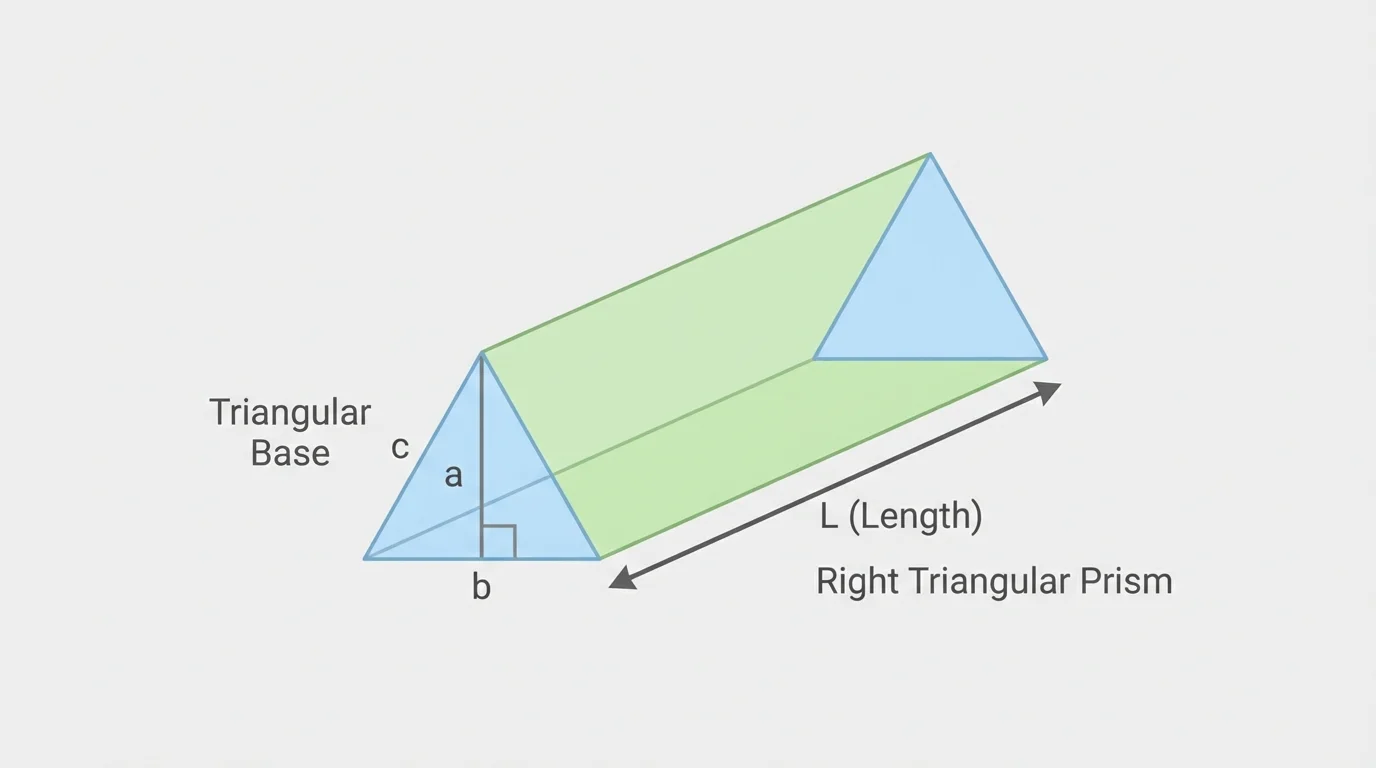
If a triangular prism has base \(6 \textrm{ cm}\), triangle height \(4 \textrm{ cm}\), and prism length \(10 \textrm{ cm}\), then the base area is \(\dfrac{1}{2}(6)(4) = 12\). Multiply by \(10\):
\[V = 120 \, \textrm{cm}^3\]
The answer uses cubic units because volume measures three-dimensional space. If a prism's dimensions double, the volume changes much faster than area. That is one reason scaling matters so much in construction, shipping, and design.
A shipping company cares about both surface area and volume. Surface area affects how much cardboard is needed for a box, while volume affects how much the box can hold.
Another way to think about volume is stacking layers. If one layer covers \(B\) square units and there are \(h\) equal layers, then the total space is \(Bh\) cubic units. This is why the prism formula works so well.
Now let's work through several problems step by step.
Worked example 1
Find the area of a composite figure made from a rectangle and a triangle. The rectangle measures \(10 \textrm{ m}\) by \(6 \textrm{ m}\). A triangle with base \(10 \textrm{ m}\) and height \(4 \textrm{ m}\) is attached to one side.
Step 1: Find the rectangle's area.
\(A = lw = (10)(6) = 60\)
Step 2: Find the triangle's area.
\(A = \dfrac{1}{2}bh = \dfrac{1}{2}(10)(4) = 20\)
Step 3: Add the parts.
\(60 + 20 = 80\)
The total area is
\[80 \, \textrm{m}^2\]
This same idea applies to floor plans, parks, patios, and signs. When a shape is built from simpler pieces, solve one piece at a time.
Worked example 2
Find the surface area of a rectangular prism with \(l = 9 \textrm{ cm}\), \(w = 5 \textrm{ cm}\), and \(h = 4 \textrm{ cm}\).
Step 1: Write the formula.
\(SA = 2lw + 2lh + 2wh\)
Step 2: Substitute the dimensions.
\(SA = 2(9)(5) + 2(9)(4) + 2(5)(4)\)
Step 3: Compute each part.
\(2(9)(5) = 90\), \(2(9)(4) = 72\), and \(2(5)(4) = 40\)
Step 4: Add.
\(90 + 72 + 40 = 202\)
The surface area is
\[202 \, \textrm{cm}^2\]
Notice how the prism has three different face sizes, and each one appears twice. That is why the formula has three terms, each multiplied by \(2\).
Worked example 3
Find the volume of a right triangular prism. The triangular base has base \(8 \textrm{ in}\) and height \(6 \textrm{ in}\). The prism length is \(15 \textrm{ in}\).
Step 1: Find the area of the triangular base.
\(B = \dfrac{1}{2}bh = \dfrac{1}{2}(8)(6) = 24\)
Step 2: Use the prism volume formula.
\(V = Bh = (24)(15)\)
Step 3: Multiply.
\(24 \cdot 15 = 360\)
The volume is
\[360 \, \textrm{in}^3\]
Because the base area is \(24\) square inches, each inch of prism length adds another \(24\) cubic inches. Over \(15\) inches, that becomes \(360\) cubic inches.
Worked example 4
A rectangular fish tank is \(24 \textrm{ in}\) long, \(12 \textrm{ in}\) wide, and \(16 \textrm{ in}\) high. Find its volume.
Step 1: Use the rectangular prism formula.
\(V = lwh\)
Step 2: Substitute values.
\(V = (24)(12)(16)\)
Step 3: Multiply.
\(24 \cdot 12 = 288\), and \(288 \cdot 16 = 4{,}608\)
The tank's volume is
\[4{,}608 \, \textrm{in}^3\]
If you were calculating the amount of glass needed for the tank instead, you would use surface area, not volume. That difference matters in real jobs such as manufacturing and architecture.
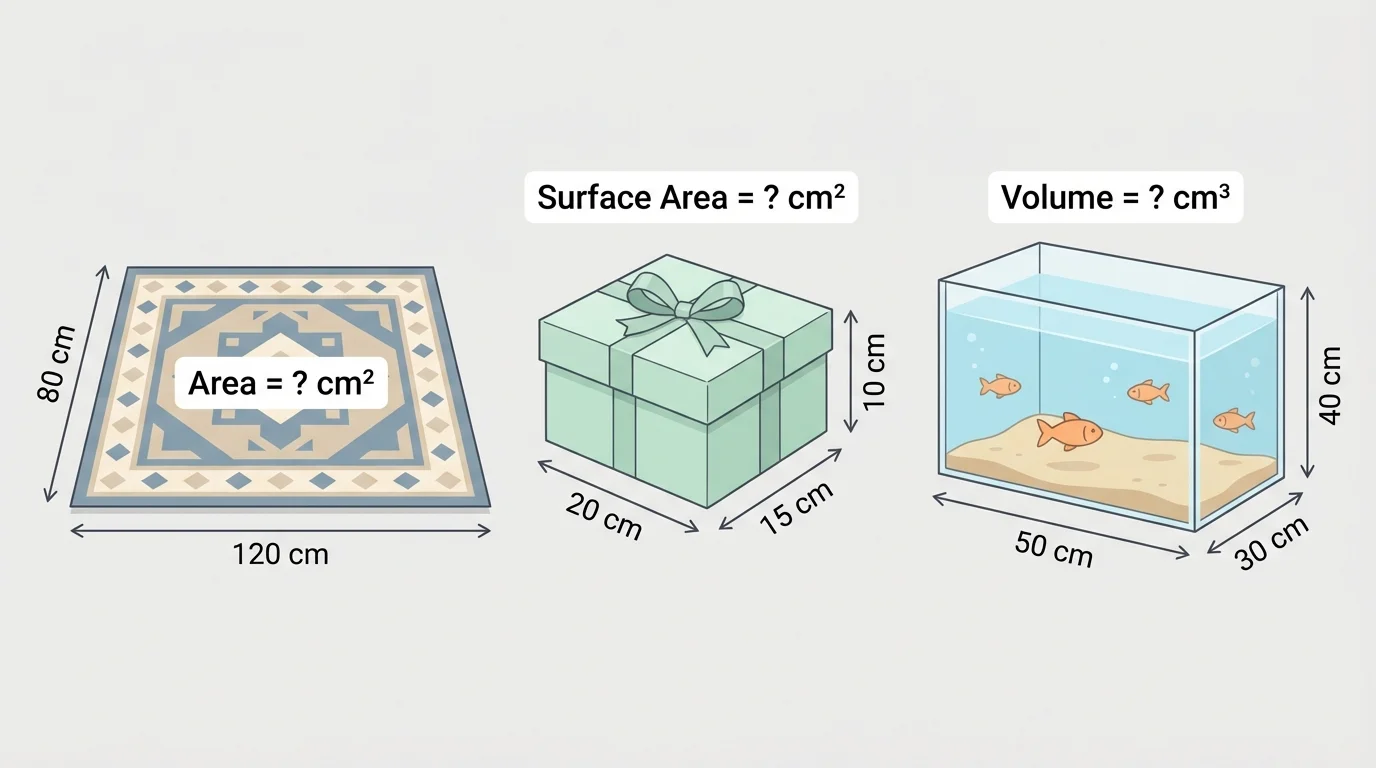
Students often know how to calculate, but the harder question is deciding which calculation belongs in a problem. The comparison in [Figure 4] helps separate the three ideas: flat covering, outside covering, and inside space.
Use area when the problem asks about covering a flat region, such as carpet on a floor, grass on a field, or tiles on a patio.
Use surface area when the problem asks about covering the outside of a solid, such as wrapping a gift box, painting a storage crate, or making a cardboard package.
Use volume when the problem asks how much a solid can hold or contain, such as water in a pool, cereal in a box, or air in a room.
A quick check can help: if your answer is in \(\textrm{cm}^2\), you are measuring a surface. If it is in \(\textrm{cm}^3\), you are measuring space inside a solid. As we saw earlier in [Figure 2], a net helps with surface area because surfaces unfold into flat faces. As shown earlier in [Figure 3], volume grows by extending a base through space.
| Measurement | What it measures | Typical units | Example |
|---|---|---|---|
| Area | Inside a flat figure | \(\textrm{m}^2\), \(\textrm{cm}^2\) | Flooring a room |
| Surface area | Total outside of a solid | \(\textrm{m}^2\), \(\textrm{cm}^2\) | Wrapping a box |
| Volume | Inside space of a solid | \(\textrm{m}^3\), \(\textrm{cm}^3\) | Filling a tank |
Table 1. Comparison of area, surface area, and volume.
Another common mistake is mixing dimensions. For example, if one measure is in centimeters and another is in meters, convert first. Geometry answers are only meaningful when the units are consistent.
Builders use area to estimate flooring, sod, shingles, and paint coverage on flat surfaces. Packaging designers use surface area to decide how much cardboard, plastic, or foil is needed. Engineers and manufacturers use volume to calculate capacity and storage.
Consider a school garden shaped like a trapezoid. Area tells how much soil or mulch is needed to cover the top. If the garden is raised in a wooden box, surface area helps estimate the outside boards to paint. If the box is filled with soil to a certain depth, volume helps estimate how much soil is required.
Sports and recreation also use these ideas. The area of a basketball court or soccer field matters for layout and maintenance. The volume of a swimming pool determines how much water it holds. The surface area of equipment containers affects the amount of material used to make them. The composite shapes from [Figure 1] are common in real plans because few lots, rooms, or platforms are perfect rectangles.
Why formulas make sense
Formulas are not random rules to memorize. Area formulas come from counting or rearranging square units. Surface area formulas come from adding the areas of faces. Volume formulas come from stacking layers or counting unit cubes. When you understand where a formula comes from, it becomes easier to remember and use correctly.
Geometry becomes especially powerful when one problem connects several ideas. A company designing a snack box might first decide the volume needed to hold the food, then calculate the surface area to know how much cardboard is required, and finally compare different base shapes to reduce wasted material.
Always include units with your final answer. If the answer is missing units, it is incomplete. If the units do not match the question, the answer is likely wrong.
Reasonableness also matters. Suppose a small gift box has side lengths less than \(10 \textrm{ cm}\). A volume of \(50{,}000 \textrm{ cm}^3\) would make no sense. If a notebook cover measures around \(20 \textrm{ cm}\) by \(30 \textrm{ cm}\), an area of \(600 \textrm{ cm}^2\) is reasonable, but \(600 \textrm{ cm}^3\) is not.
You can also estimate. For example, if a rectangular prism is about \(5\) by \(4\) by \(3\), then its volume should be near \(60\). If your exact answer turns out to be \(600\), it is a sign to recheck the multiplication or the units.
"Measure what is measurable, and make measurable what is not so."
— Galileo Galilei
Careful measuring and clear thinking turn geometry into a tool you can actually use. Whether you are planning a room, building a shelf, or figuring out how much a container can hold, area, surface area, and volume help turn shapes into answers.
