Have you ever started reading a story and felt lost by the second sentence? Maybe you did not know who was speaking, where the scene was happening, or why anything mattered. Strong narratives solve that problem right away. They pull readers in, give just enough information to make the story understandable, and then guide readers through events in an order that feels natural.
A narrative is more than a list of things that happened. It is a carefully shaped experience. A writer helps the reader enter the world of the story, meet the people in it, and follow the action step by step. When you establish context, you give the background the reader needs. When you introduce a narrator and important characters, you help readers connect to the story. When you build a clear sequence of events, you make the story easy to follow and satisfying to read.
Narrative writing tells about real or imagined experiences. It includes people, settings, events, and often a problem or conflict that develops over time.
Context is the background information that helps readers understand the story. This may include the setting, time, situation, mood, or what is already happening when the story begins.
The opening of a narrative is like the first few moments of a movie. It tells readers where to look and what to pay attention to. A weak opening may be confusing or dull. A strong opening creates interest while also helping readers understand the basics of the story.
Good openings do not need to explain everything at once. In fact, too much information can slow the story down. Instead, they choose details that matter most. A writer might begin with a surprising action, a line of dialogue, a vivid setting detail, or a character reacting to a problem. The key is that the reader can quickly figure out what kind of story this is and why it is worth continuing.
Compare these two openings:
Weak opening: "It was a day and stuff happened and I was there."
Stronger opening: "By the time the final bell rang, rain hammered the school windows, and I realized my science project was still sitting on the bus."
The stronger version gives setting clues, creates a problem, and introduces a speaker the reader can follow.
Many memorable stories begin in the middle of a problem instead of with a long explanation. That works because readers become curious and want to know what caused the situation.
When writers establish context, they answer important early questions for the reader: Where is this happening? When is it happening? What is going on? Why does this moment matter? Even a simple opening scene can quickly give clues about time, place, people, and the problem that starts the story.
As [Figure 1] shows, context often includes the setting. Setting is not only the location. It can also include the time of day, season, weather, and atmosphere. "At lunch" feels different from "past midnight." "In a noisy gym" feels different from "on a silent hiking trail." These details shape the reader's expectations.
Context can also include the situation. For example, if the narrator is about to perform in front of a crowd, lose a game, move to a new town, or finally face a fear, readers need to know enough to understand the importance of the events that follow.
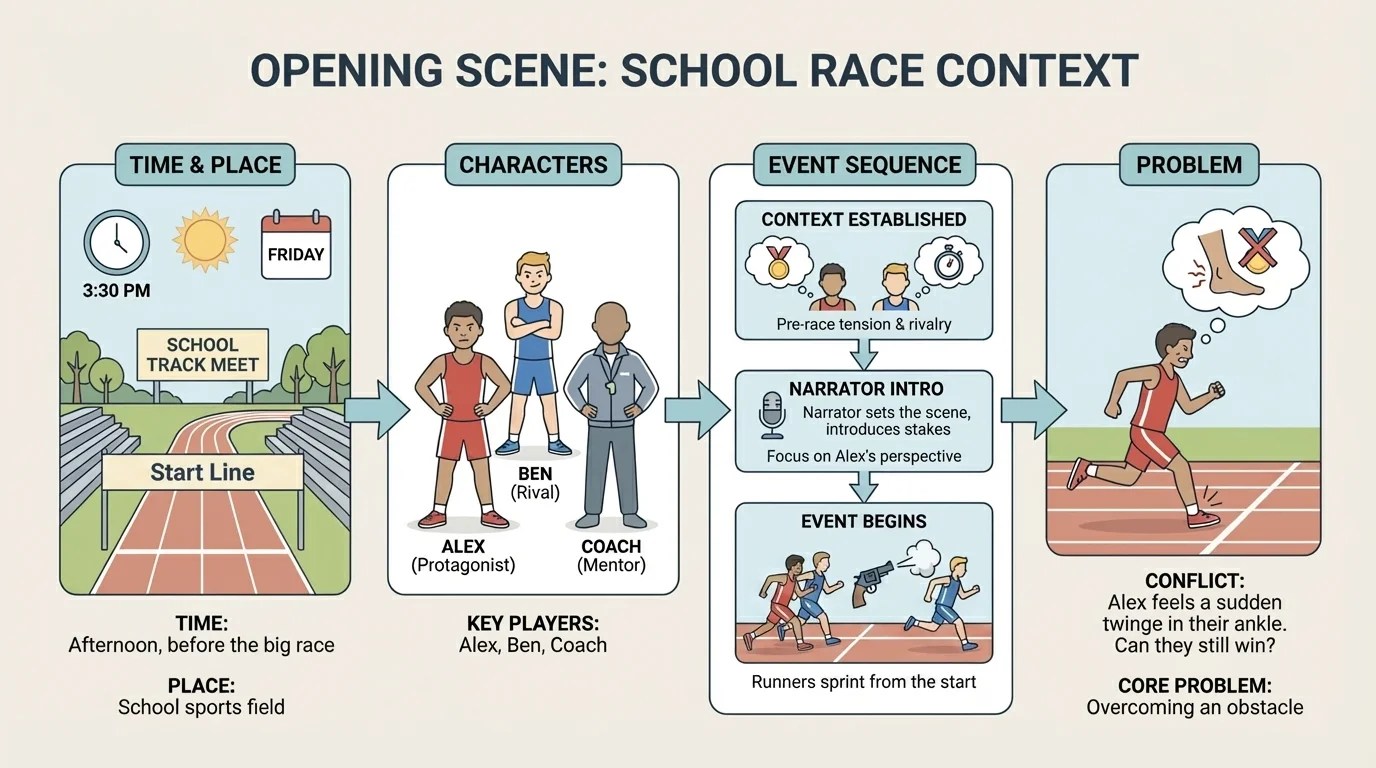
Here is an example of context being established clearly: "On the hottest Saturday of June, our track team gathered at Mesa Park for the regional finals. I had trained all spring for the 400-meter race, but as Coach handed out our lane numbers, my left shoe lace snapped." In just two sentences, the writer gives time, place, people, and a problem.
Notice that this opening does not explain the narrator's whole life. It selects details that matter right now. That is the goal of establishing context: not every fact, but the most relevant facts.
Choosing useful details means giving readers information that helps them understand the story's moment. If a detail does not affect the mood, action, or meaning, it may not belong in the opening. Writers often ask, "Will this help my reader see the scene or understand the problem?"
A narrative may be told in the first person, using words like I and my, or in the third person, using words like he, she, or they. The narrator is the voice guiding the reader through the story. That voice should feel clear and consistent.
If the story uses first person, readers should quickly learn something about the narrator's personality, thoughts, or point of view. For example, compare these two lines:
Plain: "I walked into the gym."
More revealing: "I walked into the gym trying to look calm, even though my hands were shaking so hard I nearly dropped my trumpet."
The second line introduces the narrator as nervous and gives the reader a reason to care.
Characters should also be introduced in a way that feels natural. You do not need to stop the story to list every detail about them. Instead, reveal characters through actions, dialogue, and small descriptions. A friend who whispers, "You've got this," feels more real than a sentence that simply says, "My friend was nice."
Writers often introduce characters by showing what they do when pressure appears. A brave character may step forward. A worried character may avoid eye contact. A competitive character may grin when a challenge appears. These choices help readers understand the people in the story without heavy explanation.
Here is a strong character introduction: "Mia shoved her wet hair under her cap and flashed me a grin. 'Last one to the dock has to clean the canoe,' she said." In one moment, the writer shows Mia's energy, confidence, and relationship with the narrator.
From earlier writing work, you may remember that good description shows instead of only telling. The same idea matters here. Instead of saying a character is angry, describe the slammed locker, crossed arms, or sharp tone of voice.
A strong narrative does not jump randomly from one moment to another. It follows a clear sequence, and each event leads to the next. The clearest sequences often connect events through time and cause and effect: one thing happens, so another thing happens after it.
As [Figure 2] illustrates, the simplest structure is chronological order, which means events happen in the order they occurred. This is often the easiest way for readers to follow a story. For example: first the alarm fails, then the narrator wakes up late, then misses the bus, then rides a bike to school, then arrives just before the contest begins.
But logical sequence is about more than time. It also depends on connection. If a character suddenly appears at a lake after being in a classroom, readers need a transition that explains the change. If a character becomes angry, the story should show what caused that feeling. Logical writing helps readers move smoothly from one event to the next.
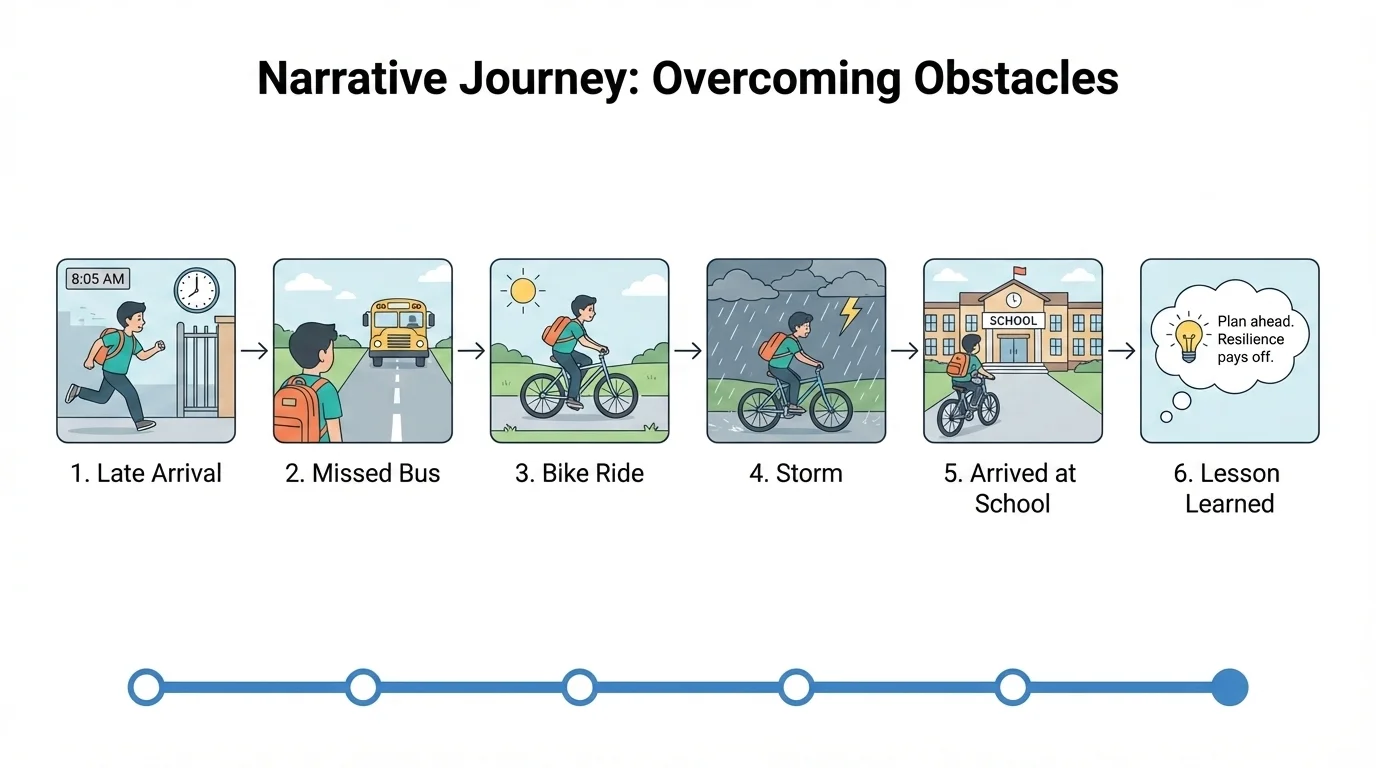
Transitions are useful tools for showing sequence. Words and phrases such as first, later, after a few minutes, meanwhile, because, as a result, and finally help readers follow the timeline and relationships between events. However, transitions work best when the events themselves are already logical. A transition cannot fix a sequence that does not make sense.
Pacing also matters. Important moments usually need more space. Writers often slow down at key points by using dialogue, sensory details, or thoughts. Less important moments can be shortened. For example, if the main event is a spelling bee, the writer might spend only one sentence on the bus ride to the school, but several paragraphs on the final round.
Readers should never feel that a major event came from nowhere. If a bicycle tire pops during a race, perhaps the path was rocky earlier. If a friend suddenly refuses to help, perhaps an earlier disagreement hinted at the change. These details create foreshadowing, a small clue about what may happen later.
Example of weak and strong sequencing
Weak version: "I got to the game. We were losing. Earlier that morning I forgot my shoes. Then I scored. My brother was yelling. I ate pancakes before school."
Step 1: Notice the problem
The events are not connected clearly. The reader does not know what happened first, which details matter most, or why some details are included.
Step 2: Reorder by time and importance
"That morning, I left my basketball shoes by the front door and did not realize it until we reached the gym. By halftime, our team was losing by six points, and I was sure the mistake had ruined everything. Then my brother rushed in from the parking lot, waving my shoes over his head. Ten minutes later, I scored the tying basket."
The revised version unfolds more naturally because each event leads to the next.
Realistic narratives mix different techniques. If a story is only action, it may feel rushed. If it is only description, it may feel slow. If every event is explained with no dialogue, characters may seem flat. Good storytelling balances action, description, dialogue, and reflection.
Dialogue can reveal character and move events forward. Description helps readers picture the scene. Reflection lets readers understand what the narrator thinks or feels. Together, these techniques make the sequence feel alive.
Consider this short passage: "'Don't open it yet,' Ben said, sliding the box across the picnic table. The cardboard was damp from the grass, and one corner had been crushed. I stared at the crooked lid, suddenly afraid that my guess had been wrong all week." This passage includes dialogue, description, and the narrator's inner reaction.
Sensory details are especially important. They involve sight, sound, smell, taste, and touch. Instead of writing, "The fair was fun," a writer might say, "The air smelled like popcorn and smoke, the metal ride gates clanged shut, and bright lights flashed across the parking lot." These details place the reader inside the event.
Another way to make a sequence feel real is to let characters react. If a storm interrupts a soccer game, players might shout, the grass might turn slick, and the coach might blow the whistle twice. Reactions help events feel connected to people, not just listed on a timeline.
Professional authors often revise the order of scenes many times. A story may contain all the right events, but if those events are arranged poorly, readers can still feel confused.
Most narratives move through a basic arc. The beginning introduces the situation, the middle develops the problem, and the ending brings change, realization, or resolution. This shape helps events feel complete.
[Figure 3] shows a basic story arc. In the conflict stage of a story, the character faces a challenge. In the rising action, the challenge grows or becomes more complicated. The climax is the most intense or important moment. The resolution shows what happens afterward and how the experience matters.
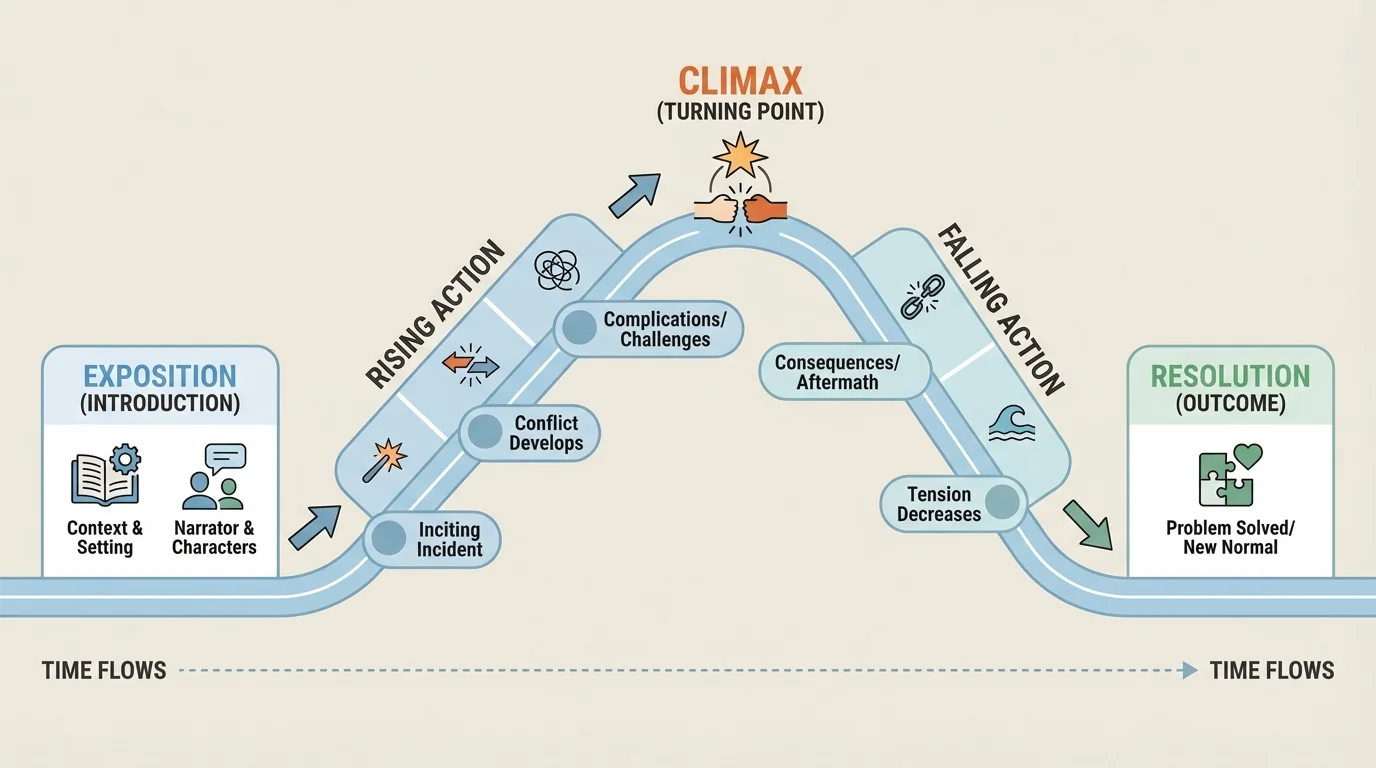
For example, in a story about a lost dog, the beginning may show that the narrator accidentally leaves the gate open. The middle may follow the search through the neighborhood, growing worry, and clues from neighbors. The climax may happen when the narrator hears barking near a storm drain. The ending may show the dog safely rescued and the narrator learning to be more responsible.
An ending should feel connected to what came before. If the story began with nervousness before a performance, the ending might show pride, disappointment, relief, or a new understanding. A random ending can make the whole narrative feel unfinished, even if the earlier parts were strong.
Writers do not need to tie up every tiny detail, but readers should feel that the main event has reached a meaningful stopping place. That meaning might be a lesson, a change in a relationship, or a clearer understanding of the character.
| Part of the narrative | Main job | Question it answers |
|---|---|---|
| Beginning | Establish context and introduce people | Who, where, when, and what is starting? |
| Middle | Develop events and increase tension | What happens, and why does it matter? |
| Ending | Resolve the main event or show the result | How does it turn out, and what changes? |
Table 1. The main jobs of the beginning, middle, and ending in a narrative.
Later, when you study more advanced stories, you may see flashbacks or unusual structures. Even then, strong writers still make sure readers can follow the logic. The order may be creative, but it is never careless. This is easier to understand when you look back at [Figure 2], which emphasizes that readers need clear connections between events.
Even good first drafts can have weak openings or confusing sequences. Revision helps writers fix those problems. One useful strategy is to ask simple questions: Do readers know where they are? Do they know who matters? Does each event connect clearly to the next one?
Writers should also check for missing information. Sometimes the writer knows the story so well that important details stay in the writer's mind instead of appearing on the page. If the narrator suddenly becomes upset, the reader should know why. If the setting changes, the story should show how and when that happened.
Another strategy is to look for places where the narrative drags or rushes. If the opening spends too long on background, the reader may lose interest. If the climax happens in one quick sentence after pages of buildup, the ending may feel disappointing. Balanced pacing gives the right amount of attention to the right moments.
Read this sentence pair: "I was scared. Then it was over." These lines are too vague. Revision adds clarity: "As my name echoed through the auditorium, my stomach tightened. But once I finished the final note, the room burst into applause, and I could finally breathe again." The second version gives a clear event sequence and stronger emotion.
Revision for sequence often means moving, cutting, or expanding parts of a draft. Writers may move an important detail earlier, cut an unrelated event, or expand a key scene so readers can fully experience it.
Read this short model:
"The hallway outside the cafeteria smelled like tomato soup and wet coats when I saw the poster for the robotics tryout. I had exactly ten minutes before lunch ended, and my best friend Elena was already halfway down the hall. 'Come on,' she called, but I stayed where I was, staring at the sign-up sheet. Last year I had promised myself I would join a club, but promising was easier than writing my name in front of everyone. A teacher pushed open the classroom door beside me. 'If you're interested, just step in,' he said. My hand shook a little as I picked up the pen. By the time Elena came back for me, my name was on the top line."
This model works because it establishes context quickly: a school hallway, lunchtime, and a tryout opportunity. The narrator is introduced through thoughts and feelings, which makes the moment personal. The event sequence also unfolds naturally. First the narrator sees the poster, then hesitates, then receives a small invitation, then decides to act. Nothing feels random.
The details are carefully chosen. The smell of soup and wet coats helps set the scene. Elena's dialogue shows urgency. The shaking hand reveals nervousness without directly saying, "I was nervous." The ending gives a small but meaningful change: the narrator takes a step forward.
This is also a good example of how a small event can make an effective narrative. A story does not need explosions, treasure maps, or huge drama. It needs a clear moment, believable people, and a sequence that matters. The setup leads to tension and then to a result.
"A good story doesn't just tell what happened. It helps the reader experience why it mattered."
When you write narratives, think like both a storyteller and a guide. Your job is not only to invent or remember events. Your job is to lead the reader through them with clarity. Start with enough context to ground the reader, introduce a narrator and characters in ways that feel alive, and arrange events so each one grows naturally from the last.
