One word can completely change a sentence. If someone says, "The band is going to record a song," the word record means one thing. If someone says, "She broke the school swimming record," it means something else. Strong readers do not just guess which meaning is correct. They check. That is where reference materials become powerful tools. They help you hear a word, understand a word, and use a word correctly.
When you read more challenging texts in English, science, history, and other subjects, you will meet words that are unfamiliar, words with several meanings, and words that change jobs in a sentence. A good reader knows how to turn to the right source. Sometimes the best tool is a dictionary. Sometimes it is a glossary at the back of a textbook. Sometimes a thesaurus helps you compare similar words. Learning to use these tools well gives you more than definitions. It gives you precision.
Reference materials are resources you consult when you need accurate information. They are especially important when a word seems confusing, has more than one meaning, or looks familiar but is used in a new way. In school, this happens all the time. A science article might use the word "cell" differently from a phone commercial. A history chapter might use "constitution" differently from a conversation about a person's health.
Using reference materials also makes you a more independent reader. Instead of skipping a difficult word or guessing from only part of the sentence, you can verify meaning, pronunciation, and grammar. This is an important reading strategy because complex texts often include technical language, precise academic terms, and subtle differences between similar words.
Reference material is a source you consult for information rather than read straight through from beginning to end. Common examples include dictionaries, glossaries, thesauri, encyclopedias, and reliable digital language tools.
Another reason these tools matter is that they help you become a better writer and speaker. If you mispronounce a word in a presentation, use a synonym that does not really fit, or choose the wrong meaning of a multiple-meaning word, your message becomes less clear. Reference materials help you make stronger choices.
A dictionary is a general reference source that gives information about words, including definitions, pronunciation, part of speech, and often example sentences. Dictionaries can be printed books or digital tools. A print dictionary may help you slow down and study neighboring words on the page. A digital dictionary may help you search faster and hear audio pronunciation.
A glossary is a list of terms and definitions related to a specific text or subject. Textbooks often include glossaries because some words have special meanings in one field. For example, in science, "theory" has a more specific meaning than it does in casual conversation. A glossary can explain the exact meaning the subject requires.
A thesaurus is a reference tool that groups words by similarity of meaning. It is useful when you are writing and want a more precise or varied word. However, a thesaurus should be used carefully because two words can be similar without meaning exactly the same thing.
Specialized digital tools can also act as reference materials. These include online learner's dictionaries, subject-specific databases, textbook glossaries, and pronunciation tools with audio. The key idea is not whether the source is on paper or on a screen. The key idea is whether the source is reliable, clear, and appropriate for your purpose.
A dictionary entry contains more information than many students first notice. As [Figure 1] shows, one entry can include the headword, syllable breaks, a pronunciation guide, one or more definitions, labels for part of speech, and example sentences. Some entries also include word origin, notes about formal or informal use, and hints about common mistakes.
Suppose you look up the word record. A dictionary may list it first as a noun and then as a verb. The noun might mean an achievement that has not been beaten, or stored information. The verb might mean to capture sound or video, or to write information down officially. The dictionary separates these meanings because they are related but not identical.
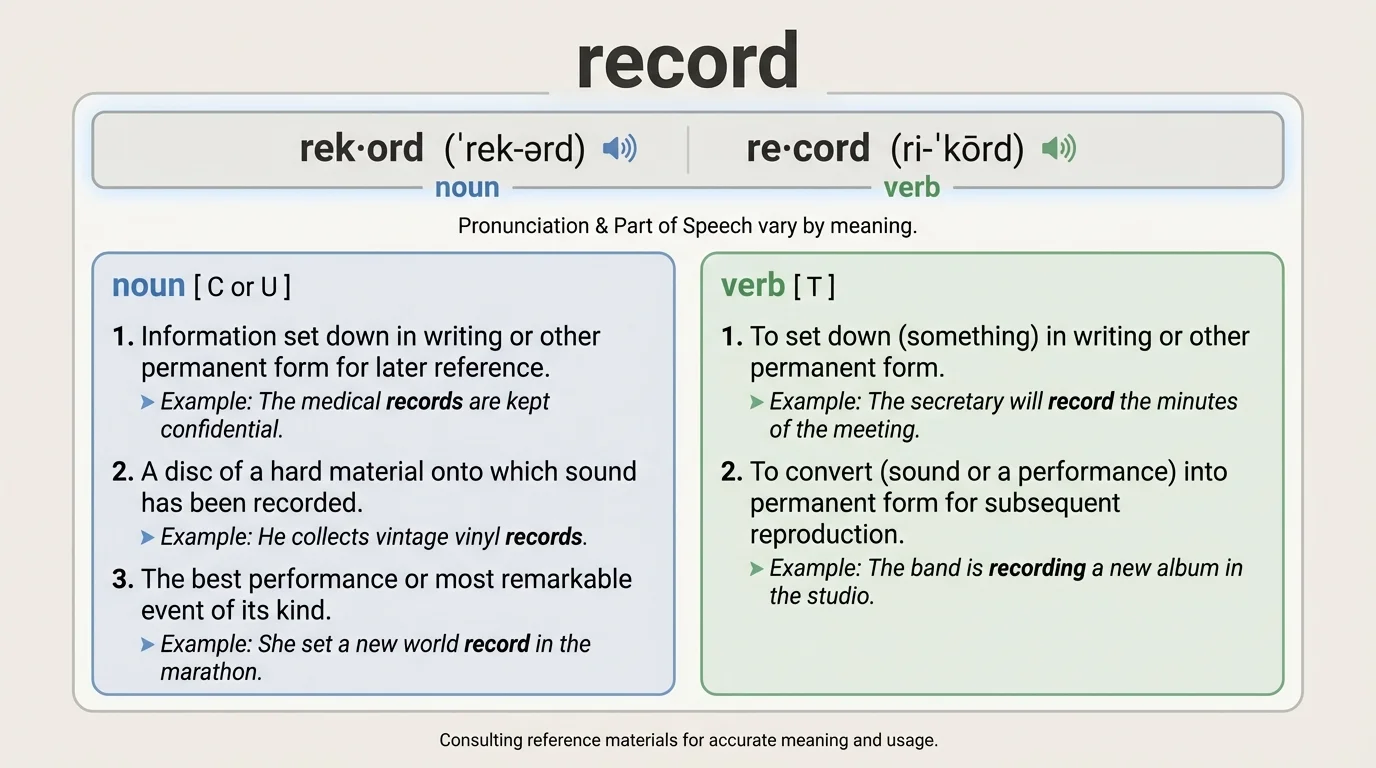
Many dictionary entries number the meanings. Meaning 1 is not automatically the right one for your sentence. It is often the most common meaning overall, but the correct meaning depends on context. Skilled readers compare the sentence in the text to the examples and definitions in the entry.
Print dictionaries also use guide words at the top of the page. These tell you the first and last words on that page, helping you locate an entry quickly. Digital dictionaries replace this with a search bar, but the goal is the same: find the exact word efficiently.
Example: Reading an entry for "current"
The word current can appear in different subjects and situations.
Step 1: Check the part of speech.
If the sentence says, "The current in the river was strong," the word is a noun.
Step 2: Compare the listed meanings.
A dictionary may define the noun as a flow of water, air, or electricity. It may define the adjective as belonging to the present time.
Step 3: Match the sentence context.
Because the sentence mentions a river, the correct meaning is the flow of water, not "happening now."
Looking carefully at the entry prevents confusion.
Some dictionaries also show whether a word is formal, informal, old-fashioned, or used mainly in a certain region. These details matter. A word may be technically correct but inappropriate for a school essay or too informal for an academic discussion.
Context is the surrounding text that helps explain a word. For multiple-meaning words, context is your best clue before and during your use of a reference source. As [Figure 2] illustrates, the same word can point to very different ideas depending on nearby words and the topic of the passage.
Take the word charge. In one sentence, "The store will charge $15 for delivery," it means to ask for a price. In another sentence, "The soldiers began to charge," it means to rush forward. In science, "an electric charge" has a specific technical meaning. If you simply pick the first definition you see, you may misunderstand the text.
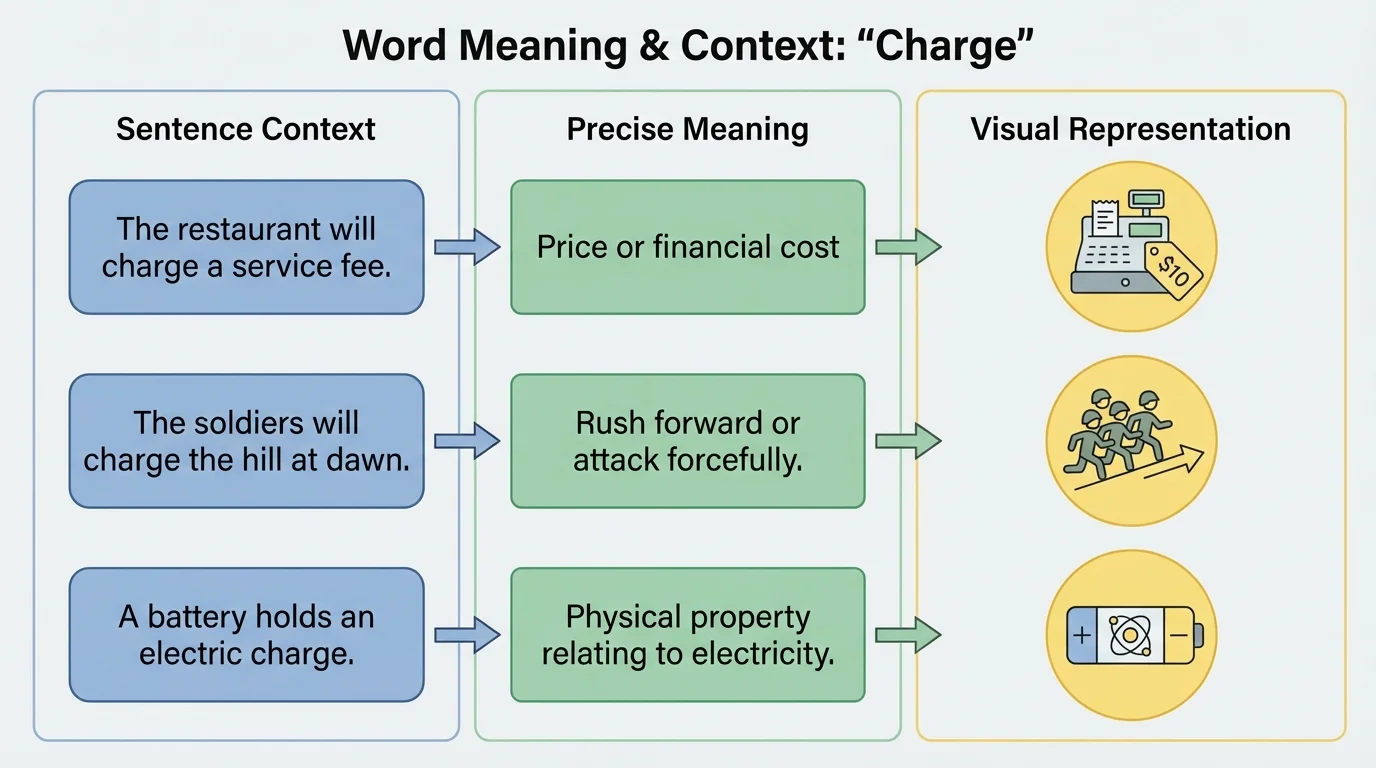
When you use a dictionary, start by reading the whole sentence from your text. Then ask what the sentence is discussing. Is it sports, science, money, music, weather, or emotions? Topic matters. If a weather article says a storm is "moving rapidly," you are probably not dealing with the same meaning of "rapid" that appears in medical writing about river rapids or a fast heartbeat.
Words also gain meaning from the sentences around them. A single sentence may not be enough. In a novel, the word "light" might refer to brightness, a lamp, or something not heavy. Reading the surrounding lines helps you test which meaning makes sense.
Later, when you compare words in a thesaurus, this same idea still matters. The meaning chart in [Figure 2] reminds you that words do not live alone. They work inside topics, sentences, and larger passages.
A word's part of speech tells how it functions in a sentence. This matters because the same spelling can belong to different categories. The most common parts of speech you will use in reference materials are noun, verb, adjective, and adverb.
A noun names a person, place, thing, or idea. A verb shows action or a state of being. An adjective describes a noun. An adverb describes a verb, adjective, or another adverb.
Consider the word present. In "She gave me a birthday present," it is a noun. In "Students are present today," it is an adjective. In "Please present your findings," it is a verb. A dictionary will label these uses so that you can match the correct one to your sentence.
| Word | Sentence | Part of speech | Meaning |
|---|---|---|---|
| record | She broke the record. | noun | best performance or result |
| record | They will record the podcast. | verb | capture sound or video |
| light | Turn on the light. | noun | source of brightness |
| light | This bag is light. | adjective | not heavy |
Table 1. Examples showing how the same spelling can have different parts of speech and meanings.
If you ignore part of speech, you may choose the wrong definition. For example, if you look up object, the noun refers to a thing, but the verb means to express disagreement. A reader must notice how the word behaves in the sentence before selecting a meaning.
To identify part of speech, look at position and function. Words after articles like a, an, and the are often nouns. Words showing action are often verbs. Words describing nouns are often adjectives. Words ending in -ly are often adverbs, though not always.
Knowing part of speech also improves writing. If a thesaurus gives you a list of synonyms but your sentence needs a verb, you cannot simply drop in a noun and expect the sentence to work. Grammar and meaning work together.
Sometimes you know what a word means but not how to say it aloud. That is when pronunciation tools become essential. As [Figure 3] shows, print and digital references both offer help, but they present it differently. Print dictionaries usually use symbols and stress marks, while digital references often add an audio button so you can hear the word spoken.
A pronunciation guide may show syllables and which syllable is stressed. Stress means one syllable is said more strongly than the others. In many dictionaries, a mark appears before the stressed syllable. This matters because stress can affect understanding. If a word is pronounced incorrectly, listeners may not recognize it right away.
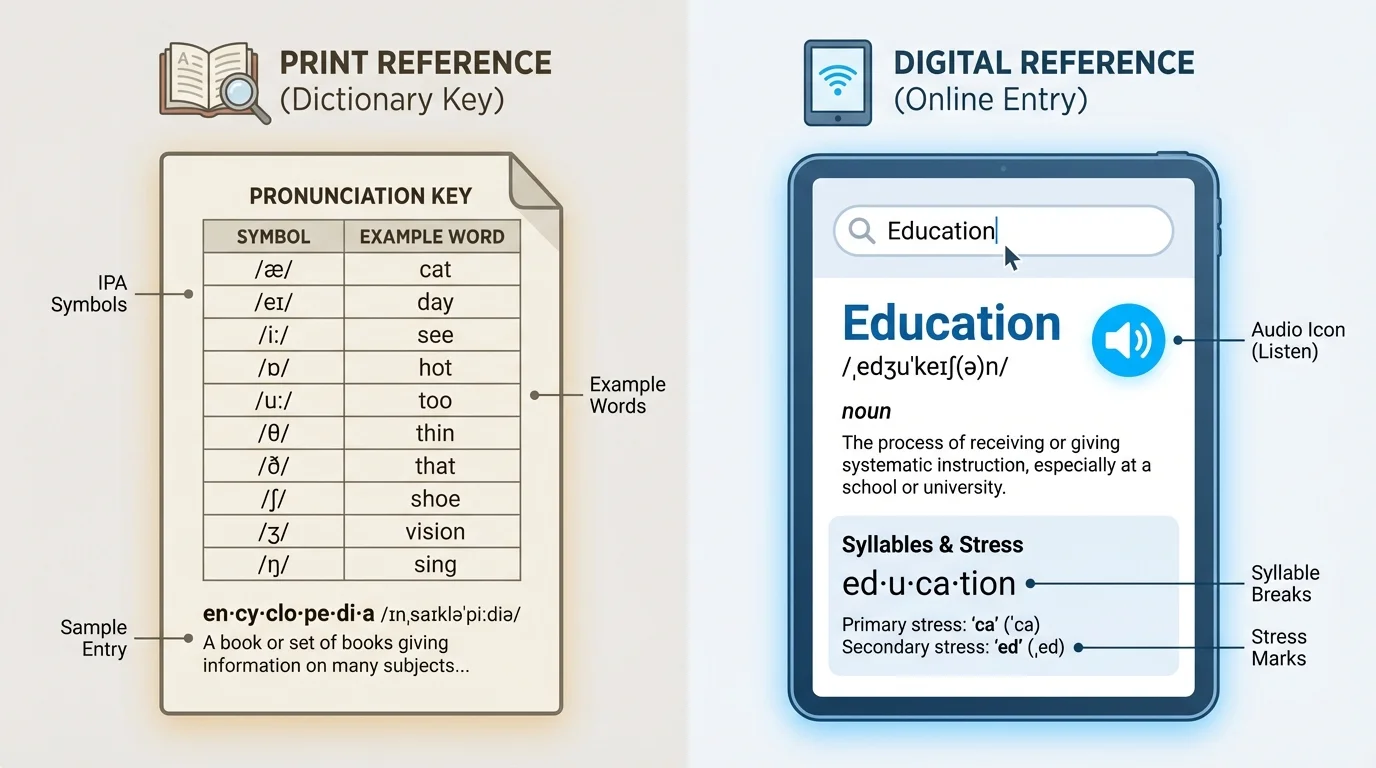
Digital tools are especially useful for hearing the difference between similar words, such as desert and dessert, or between noun and verb forms such as record. Some digital dictionaries also let you compare American and British pronunciations. These are both correct varieties of English, but they may sound different.
When using a pronunciation guide, pay attention to more than one feature: the number of syllables, the stress pattern, and the vowel sounds. If you only look quickly, you might miss the key difference. The side-by-side comparison in [Figure 3] helps show why digital audio can be useful after you have studied the printed symbols.
Some English words change pronunciation when their part of speech changes. For example, noun and verb forms of words like record or present may place the stress on different syllables.
Pronunciation matters in class discussions, presentations, and reading aloud, but it also matters quietly. Hearing a word correctly in your mind can help you remember it, connect it to other words, and notice patterns in language.
A general dictionary is useful, but sometimes it is not precise enough for a school subject. That is where specialized references matter. In a science textbook, a glossary may define each term in a way that matches the subject exactly. In history, a glossary may explain words such as amendment, federalism, or primary source with meanings tied to the course.
For example, the word cell in biology refers to the basic unit of life. In everyday language, a person might hear cell and think of a prison cell or a cell phone. A science glossary helps prevent that confusion by giving the precise academic meaning needed for the lesson.
Specialized references may also include diagrams, examples from the field, and explanations of how experts use the word. That makes them especially valuable when you are reading technical passages, instructions, lab reports, or historical documents.
General meaning versus precise meaning
Many words have a broad everyday meaning and a narrower academic meaning. Good readers notice when a text belongs to a subject area and switch to the most appropriate reference source. Precision is especially important in science, social studies, and formal writing because one small word choice can change the whole idea.
When you are reading across subjects, ask yourself whether the word is being used generally or technically. A glossary is often the fastest path to the exact meaning the author intends.
A thesaurus can be helpful, but it can also cause mistakes if you use it carelessly. It lists words with similar meanings, called synonyms. Similar does not mean identical. Two words may overlap, but one may sound more formal, more emotional, more specific, or more negative than another.
For instance, walk, stroll, march, and trudge all involve moving on foot, but they create very different pictures. A connotation is the feeling or association a word carries in addition to its dictionary meaning. If you write that a tired hiker "strolled" up a mountain, the word may sound too relaxed. If you say a child "marched" into the room, the image is more forceful.
The smartest way to use a thesaurus is to find a possible replacement and then check that word in a dictionary. That second step confirms its meaning, part of speech, and level of formality. This prevents awkward or incorrect word choices.
Example: Checking a thesaurus choice
A student wants to replace the word said in a sentence.
Step 1: Use the thesaurus to find possibilities.
The student sees remarked, muttered, announced, and declared.
Step 2: Think about context.
If the character is speaking softly and unhappily, announced does not fit well.
Step 3: Verify in a dictionary.
The student checks muttered and confirms that it means speaking in a low, often unclear voice.
The final choice is more precise because the writer used both tools together.
Writers who use a thesaurus well do not just try to sound smarter. They try to sound more exact.
Both print and digital sources can be effective. Print tools can help you slow down, scan neighboring words, and focus without pop-up distractions. They also make you practice alphabetical order and page navigation. For some students, that physical process helps memory.
Digital tools are fast, searchable, and often include audio pronunciation, word history, translation support, and example sentences. They are excellent when you need quick access or when you want to hear a word immediately. However, digital tools vary in quality. Some websites are reliable and edited by language experts. Others are incomplete, poorly explained, or filled with user-generated content that may not be accurate.
When choosing a digital source, look for signs of trustworthiness: clear definitions, labeled parts of speech, example sentences, pronunciation tools, and a professional design from a known publisher, educational organization, or textbook resource. If a site gives strange definitions, no source information, or confusing grammar labels, be cautious.
A strong reader is flexible. If one source is unclear, consult another. If a general dictionary is too broad, try a glossary. If a thesaurus gives options, verify them in a dictionary. Good readers do not depend on only one tool.
When you meet an unfamiliar or confusing word, it helps to follow a clear process. First, read the sentence and the surrounding lines. Try to identify clues from the topic and the grammar. Next, decide what kind of information you need most: pronunciation, definition, part of speech, or a more precise synonym.
Then choose the best source. Use a dictionary for general meaning, pronunciation, and grammar. Use a glossary for subject-specific meaning. Use a thesaurus only if you are comparing similar words for writing. Once you find the word, read more than the first line. Check all likely meanings, the part of speech label, and any example sentences.
Finally, test the meaning by putting it back into the original sentence. Ask yourself whether it fits the topic, grammar, and tone of the passage. If it does not, go back and try another listed meaning or another source.
Example: Clarifying the word "draft"
The sentence is: "The committee reviewed the first draft of the proposal."
Step 1: Use context.
The sentence mentions a committee and a proposal, so the topic is writing or planning, not wind or sports selection.
Step 2: Check the dictionary.
The dictionary may list meanings such as a current of air, a version of a piece of writing, or the selection of players for a team.
Step 3: Match the correct meaning.
The phrase "first draft of the proposal" clearly means an early version of a written document.
This process avoids picking the wrong meaning just because it appears earlier in the entry.
With practice, this process becomes faster. Skilled readers move from confusion to clarity in a few careful steps.
One common mistake is choosing the first definition without checking context. Another is ignoring the part of speech label. A third is using a thesaurus word as a replacement without checking whether it actually fits the sentence. These errors happen when readers move too quickly.
Another mistake is depending on unreliable websites or automatic tools without questioning them. Technology is useful, but not every result is accurate. If something sounds odd, verify it in another source.
Students also sometimes stop after finding a rough meaning. But a rough meaning is not always enough. Academic reading often requires a precise meaning, especially when studying science, history, literature, or argument writing. Precision helps you understand the author's point more completely.
These skills matter in nearly every class. In English, they help you analyze literature and choose stronger words in essays. In science, they help you understand technical vocabulary accurately. In social studies, they help you interpret key civic and historical terms. In presentations, they help you pronounce important words correctly and speak with confidence.
They also matter outside school. When you read news articles, instructions, sports reports, reviews, or online information, you constantly meet unfamiliar language. Strong reference skills help you sort out meaning instead of spreading misunderstandings. In a world full of fast information, careful word checking is a form of accuracy and responsibility.
The more you use dictionaries, glossaries, and thesauri thoughtfully, the more powerful your reading becomes. You are not just looking up words. You are learning how language works, how meaning changes with context, and how to choose the most accurate understanding every time.
