A single misspelled word can change how a reader judges an entire piece of writing. A strong idea in an essay, email, or response can suddenly seem rushed or unclear if words are spelled incorrectly. Spelling is not just about following rules; it is about helping your reader understand your meaning quickly and confidently.
In grade 8, you are expected to write in ways that fit different tasks, purposes, and audiences. That means your spelling should support your message, whether you are writing an argument, a narrative, a science explanation, or a message to a teacher. Correct spelling is part of standard English conventions, along with capitalization and punctuation. When these conventions are strong, your writing feels polished and trustworthy.
Spelling matters because readers should focus on your ideas, not get distracted by errors. If a student writes, "My freind gave me advise," the message is still understandable, but the mistakes may pull attention away from the main point. In a formal piece of writing, repeated spelling errors can make the work seem less careful than it really is.
Spelling also affects meaning. Some words sound similar but mean very different things. For example, principal and principle are not interchangeable. If you choose the wrong spelling, you may communicate the wrong idea. In fast digital communication, many people overlook mistakes, but in school writing and professional communication, correct spelling still matters a great deal.
Frequently used words are words that appear often in everyday reading and writing, so writers are expected to know them automatically.
Reference materials are tools used to check language information, such as spelling, meaning, pronunciation, and usage. These include dictionaries, glossaries, spell checkers, and trusted human sources.
Good spellers are not people who never make mistakes. Good spellers are usually people who notice uncertainty, pause, and check. That habit is powerful because it turns writing into a process of accuracy, not guessing.
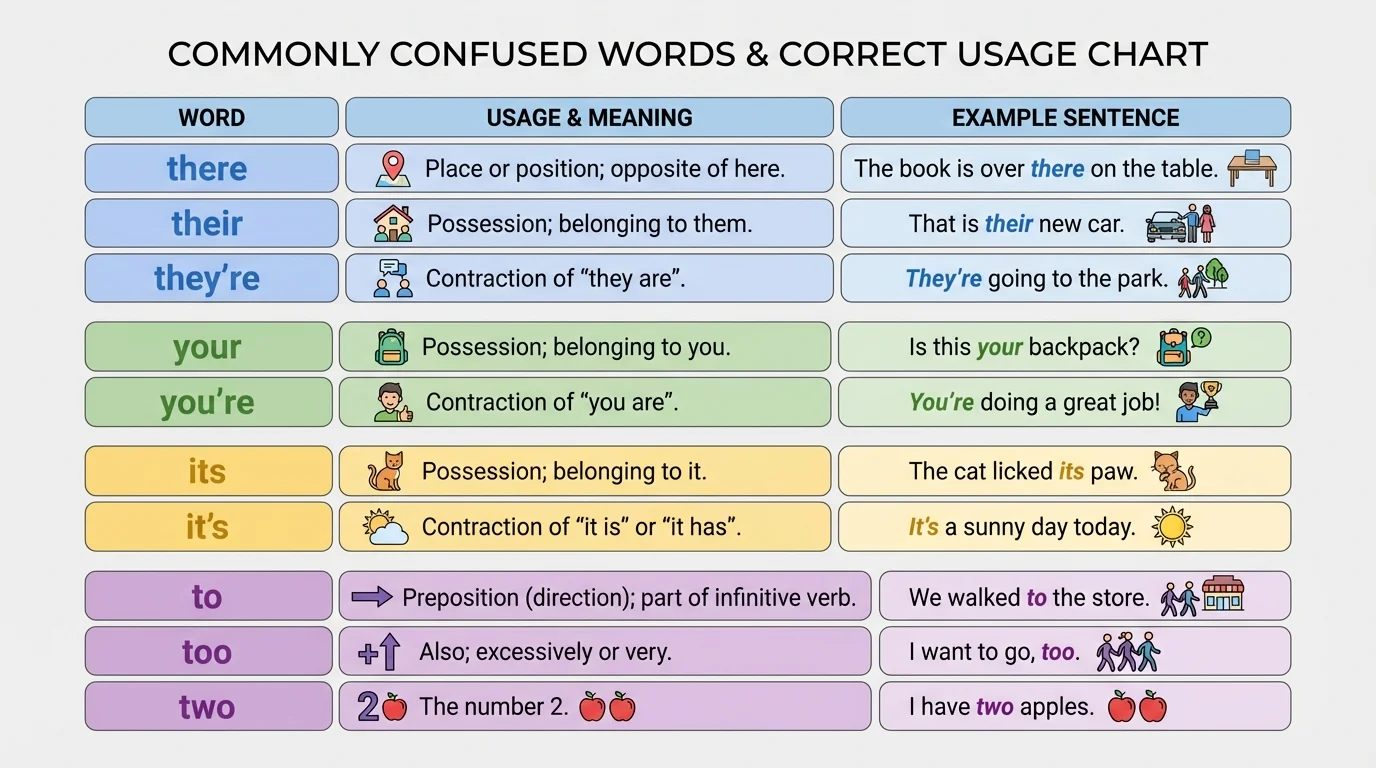
[Figure 1] Some words appear so often that you should learn to spell them automatically in your writing. These include words such as because, friend, different, enough, which, their, there, people, really, until, and believe. Many of these are common because they are used in school writing across subjects. Mastering them saves time and reduces preventable mistakes.
Some of the most common errors involve words that sound alike or look similar. Pairs and sets like there, their, and they're are easy to confuse because the problem is not pronunciation alone; it is choosing the word that fits the sentence. For example, their shows possession, there refers to a place, and they're is a contraction for they are. A writer who understands meaning as well as spelling makes fewer errors.
Another group of frequently used words causes trouble because the spelling does not perfectly match the sound. Many students spell definitely as definately or separate as seperate. These errors are common, but they still need attention because these words appear often in academic writing.
One helpful approach is to notice which words you misspell repeatedly. If you often write wierd instead of weird, that tells you something about your personal pattern. You may need to remember the letter order more carefully rather than just sounding the word out. Some spelling problems are not general; they are specific to your own habits.
The more often a word appears in your writing, the less acceptable it is to misspell it. Readers expect a grade 8 writer to control basic, high-frequency words with consistency. That does not mean perfection every time on a first draft, but it does mean that final writing should be checked carefully.
Some of the most misspelled English words are also some of the most common. Words like because, separate, necessary, and embarrass appear often enough that learning them well pays off again and again.
As you continue writing, the common word sets in Figure 1 stay useful because they remind you that spelling and meaning work together. A sentence may look almost correct, but the wrong member of a word pair can still create an error.
English spelling is challenging for a reason: it does not always match sound in a simple, predictable way. In some languages, letters and sounds line up more regularly. In English, one sound may be spelled in several ways, and one letter pattern may be pronounced differently in different words. Compare though, through, thought, and tough. They look related, but their pronunciations differ.
English also includes many words borrowed from other languages. That is one reason some spellings seem unusual. Words from French, Latin, Greek, and many other languages have shaped English spelling. Silent letters are another challenge. In words such as knight, honest, and debt, not every letter is pronounced.
Writers also struggle with homophones, which are words that sound the same but have different meanings and spellings. Examples include pair and pear, or allowed and aloud. If you depend only on sound, you may choose the wrong word. That is why spelling is connected to vocabulary and meaning, not just hearing.
Why memory matters in spelling
Spelling is partly a thinking skill and partly a memory skill. You use sound clues, but you also build a mental picture of words you see often in reading. The more you read accurate writing, the more familiar correct spellings become. Over time, many words start to "look right" or "look wrong" because your brain has stored the pattern.
Another challenge comes from contractions. Words like it's, don't, and you're include apostrophes, and mistakes happen when writers confuse them with similar forms such as its or your. Understanding grammar helps with spelling here. If you're means you are, then test the sentence by replacing it. If the sentence still works, the contraction is correct.
Strong spelling begins before you open a dictionary. The first strategy is to slow down enough to notice uncertainty. Many errors happen because writers rush and do not question a word that feels slightly wrong. If a spelling looks unfamiliar, that is a signal to check it.
One useful method is to break a word into syllables. For example, in-ter-est-ing is often easier to spell when you hear and see it in parts. Longer words become less intimidating when you divide them into manageable chunks.
Another effective strategy is to look for prefixes, roots, and suffixes. If you know happy, then unhappy and happiness become easier to spell because parts of the word stay consistent. If you know predict, then prediction and predictable are easier to build. Word families help writers see patterns rather than memorizing every word as completely new.
You can also use analogy. If you know how to spell light, that may help with bright or slight. If you know sign, it can help explain signature even though the pronunciation changes. This kind of pattern awareness is especially helpful with less frequent vocabulary.
Visual memory matters too. Some writers picture a word on the page. Others trace it mentally or write two possible spellings and choose the one that looks correct. For example, necessary may be easier to remember with a memory trick such as "one collar, two sleeves," referring to one c and two s letters. Memory tricks are useful when they help you remember an exact letter pattern.
Using multiple strategies on one word
Suppose you want to spell disappearance in a science-fiction story.
Step 1: Start with the base word.
The base word is appear.
Step 2: Add the prefix.
The prefix dis- means the opposite or removal, giving disappear.
Step 3: Add the suffix carefully.
The ending -ance creates the noun disappearance.
Step 4: Verify the full spelling.
Check that no letters have been dropped or doubled by mistake.
Instead of guessing randomly, you use word parts to build the spelling logically.
Proofreading is another essential strategy. During drafting, your brain often reads what you intended to write, not what is actually on the page. During revision, read more slowly. Some writers read backward one word at a time near the end of the process so they can focus on spelling instead of meaning. Others read aloud to catch places where the sentence feels off.
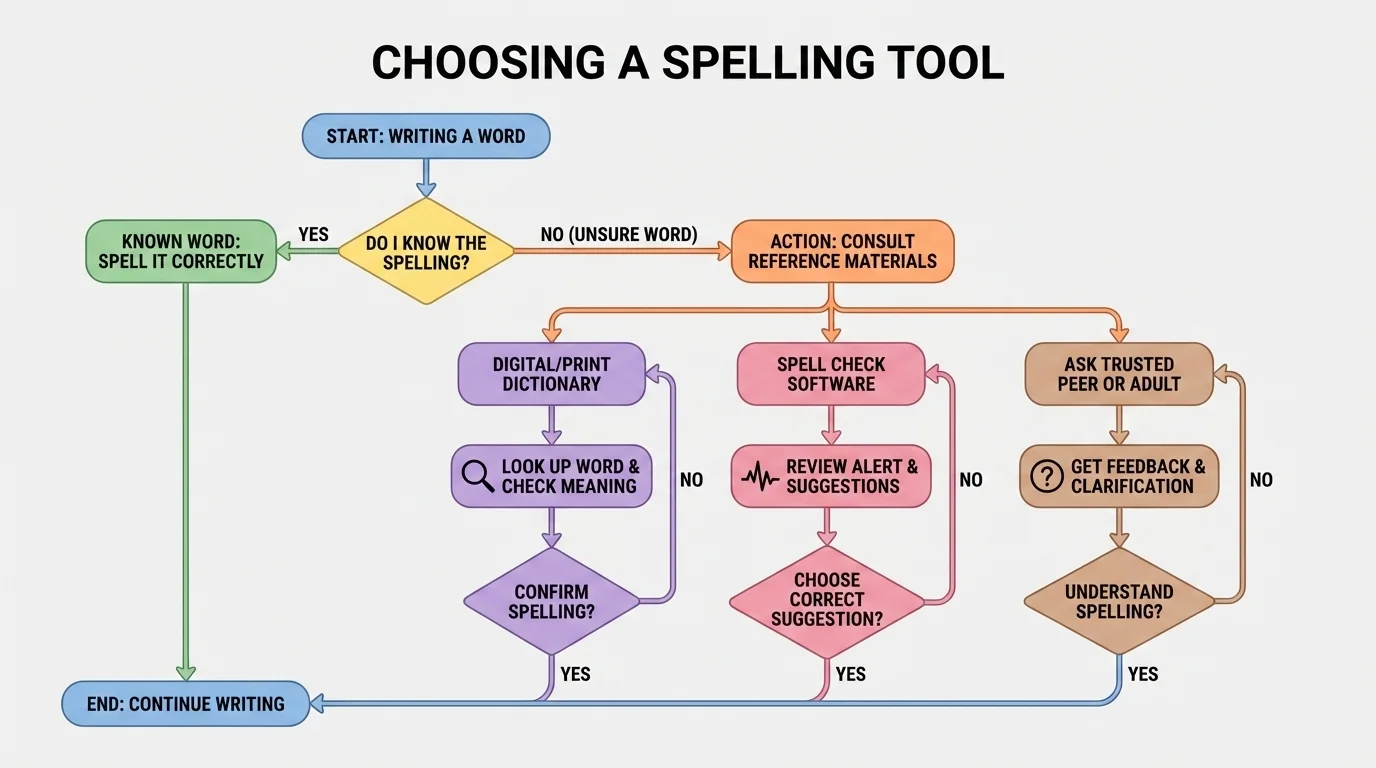
[Figure 2] When your own knowledge is not enough, different reference tools help with different kinds of spelling problems. A print dictionary, a digital dictionary, spell check, and a trusted peer or adult are all useful, but none of them should replace your own thinking. The goal is not just to fix one word; it is to learn the correct spelling and use it accurately.
A dictionary is one of the most reliable tools for checking spelling. A print dictionary can help you find the exact form of a word, confirm its meaning, and sometimes show pronunciation or word origin. A digital dictionary usually works faster and may include audio pronunciation, example sentences, and search suggestions if your first attempt is close but not perfect.
Spell check is useful because it quickly flags many mistakes in digital writing. However, it has limits. Spell check often catches words that are not recognized, but it may miss a correctly spelled word used in the wrong place. If you write "Their going to win," it might not mark Their because it is a real word. You still need to understand grammar and meaning.
Trusted peers and adults can also help, especially when a word is specialized, uncommon, or difficult to search. A teacher, librarian, parent, or knowledgeable classmate may help you hear the word more clearly, identify the base word, or suggest where to look. Still, a person is not just a shortcut. If someone gives you the correct spelling, pay attention to the pattern so you can remember it next time.
Digital tools are convenient, but convenience is not the same as certainty. Autocorrect may change a word to something unintended. Voice typing may mishear a word and create a completely different one. That is why writers must always review suggestions instead of accepting them automatically.
Capitalization, punctuation, and spelling work together. A final draft is strongest when all three are checked. A correctly spelled sentence can still be unclear if punctuation is missing, and strong punctuation cannot hide incorrect spelling.
Knowing how to use a dictionary efficiently is an important skill. If you are unsure about a word, try to identify the first few sounds, possible prefixes, or the base word. For example, if you are unsure how to spell irresponsible, notice the prefix ir- and the root related to responsible. That makes the word easier to locate and understand.
Different writing situations call for different tools. If you are drafting quickly in class, you might circle a doubtful word and continue writing so you do not lose your ideas. Later, during revision, you can check it in a dictionary or with digital tools. During a formal final draft, every uncertain word should be verified carefully.
The tool you choose depends on the problem. If you know the word but are unsure about one or two letters, a dictionary is usually best. If you typed quickly and want to catch obvious mistakes, spell check is efficient. If the word may be confused with another real word, use a dictionary and reread the sentence for meaning. If the word is technical or related to a class subject, asking a teacher may be especially helpful.
| Tool | Best Use | Strength | Limitation |
|---|---|---|---|
| Print dictionary | Checking exact spelling and meaning | Reliable and detailed | Slower to search |
| Digital dictionary | Fast lookup of unfamiliar words | Quick, searchable, often includes audio | Requires careful evaluation of results |
| Spell check | Finding obvious typing and spelling errors | Fast and automatic | May miss wrong-word errors |
| Trusted peer or adult | Clarifying confusing or specialized words | Can explain patterns and meaning | Human sources can also make mistakes |
Table 1. A comparison of common spelling reference tools, including when each one is most helpful.
The decision process in Figure 2 remains useful during revision because it reminds you not to rely on one tool for every problem. Skilled writers match the tool to the kind of uncertainty they have.
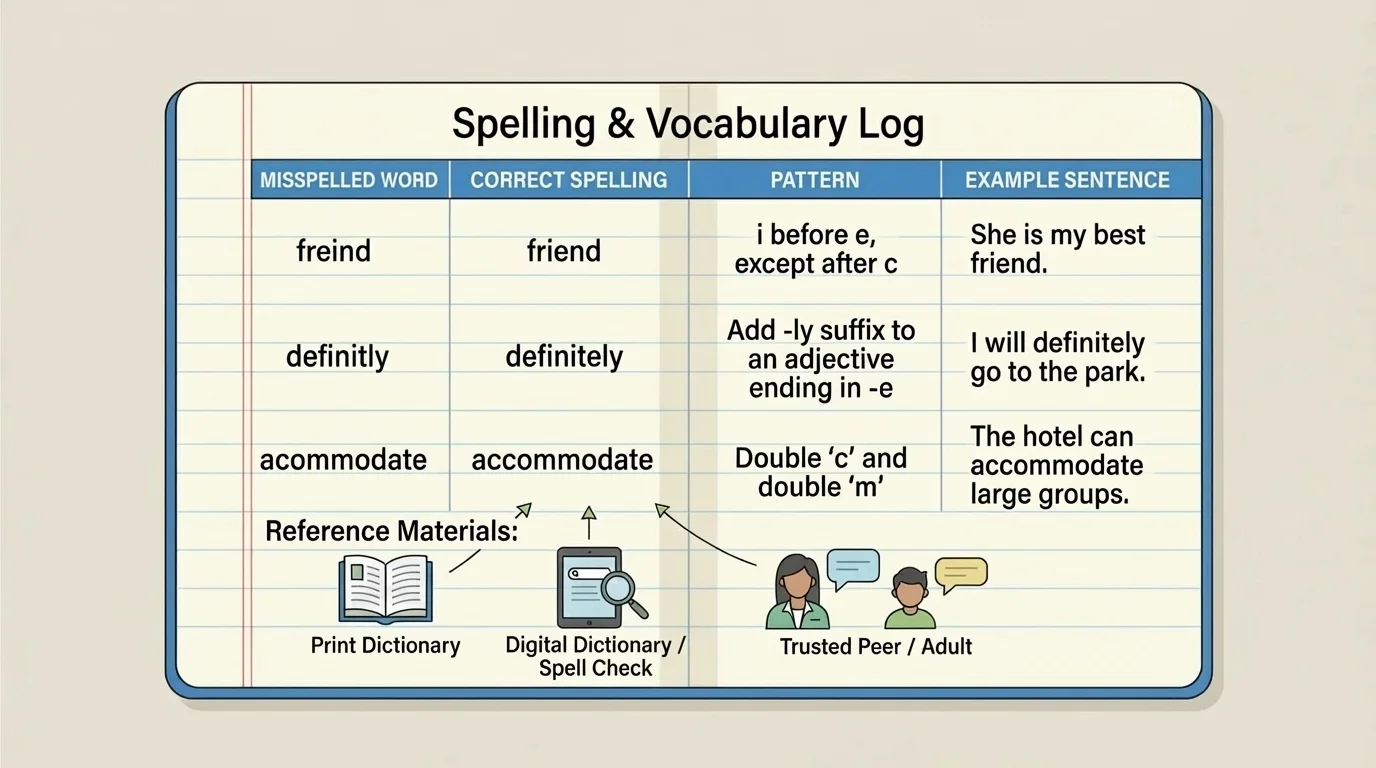
[Figure 3] Better spelling does not come only from correcting mistakes one at a time. Long-term improvement happens when you keep track of patterns in your errors. A personal spelling record helps you notice whether you often confuse vowel patterns, forget doubled consonants, or misuse homophones. Once you identify your pattern, improvement becomes more focused.
One practical habit is keeping a notebook or digital list of words you misspell often. Include the incorrect version, the correct version, and a sentence using the word correctly. You might also note the reason for the difficulty, such as "silent letter," "double consonant," or "confused with another word." That way, your mistakes turn into study material instead of disappearing.
Reading regularly is another major factor. When you read books, articles, and strong examples of writing, you see correct spelling repeatedly. This repeated exposure strengthens visual memory. Students who read more often tend to recognize standard spelling patterns more quickly, even in words they do not use every day.
Editing in stages also helps. On one read-through, focus on ideas and organization. On another, focus only on conventions such as spelling, capitalization, and punctuation. If you try to notice everything at once, you may miss important errors. Separating tasks improves attention.
Turning a repeated mistake into a learning habit
A student often writes enviroment instead of environment.
Step 1: Record the error.
Write down both forms: enviroment and environment.
Step 2: Notice the pattern.
The word contains the sequence n-m-e-n in the middle, which is easy to skip when writing quickly.
Step 3: Use the word in context.
Example: "The environment changes when pollution increases."
Step 4: Recheck in later writing.
When the word appears again, pause and verify it instead of assuming you remember.
This process builds accuracy over time because the writer studies the mistake, not just the correction.
Later, when you revise other assignments, the notebook system in [Figure 3] continues to help because it turns spelling from a random struggle into a pattern-based habit. Over time, the list of repeated mistakes should shrink as more spellings become automatic.
Spelling expectations may shift slightly depending on context, but accuracy is always valuable. In a quick text to a friend, informal shortcuts may not matter much. In a lab report, essay, scholarship application, or email to a principal, careful spelling matters much more. Audience and purpose influence how polished your writing must be.
In academic writing, less frequent vocabulary often appears because you are learning subject-specific terms. In science, you may need words such as photosynthesis or ecosystem. In history, you may use terms like industrialization or revolutionary. In those cases, reference materials are especially important because these words may be too uncommon to trust to memory alone at first.
Professional and digital spaces also raise the stakes. Social media posts, comments, and messages can spread quickly, and writing full of errors may affect how others judge your seriousness or attention to detail. In future jobs, correct spelling in applications, resumes, and emails can influence opportunities. The habits you build now carry into adult communication.
"Take care of the small things, and the big things will take care of themselves."
— A principle that fits strong writing habits
The main goal is not to become afraid of making mistakes. The goal is to become a writer who notices, checks, and learns. Spelling accuracy grows through attention, strategy, and smart use of available tools.
When a word is common, aim to know it automatically. When a word is less common, use the right reference material with purpose. That combination gives your final drafts clarity, correctness, and a style that respects your audience.
