Have you ever shared a sandwich with a friend and wanted it to be fair? In geometry, we can be fair with shapes too. We can cut shapes into parts that are the same size. When the parts are the same size, they are called equal shares. Today we will learn how circles and rectangles can be split into equal parts and how to name those parts.
A shape can be one whole. A whole circle is one full circle. A whole rectangle is one full rectangle. When we split a whole into parts, the parts must be the same size if we want equal shares.
If one part is bigger and one part is smaller, the shape is not split into equal shares. Equal means the same amount. So fair sharing means each share is the same size.
Equal shares are parts of a shape that are the same size. A whole is the complete shape before it is split.
Halves are two equal shares of a whole. Fourths or quarters are four equal shares of a whole.
Shapes can be split in different ways and still be equal. A rectangle can be split up and down, or across. A circle can be split straight through the middle in different directions. What matters is not the direction of the line. What matters is that the parts are equal.
[Figure 1] When one whole shape is split into halves, it becomes two equal shares. Each share is called one half. A circle and a rectangle can each be split into two equal parts, and each part is still a half even if the lines go in different directions.
If you take one of the two equal parts, you have half of the shape. We can write one half as \(\dfrac{1}{2}\). Two halves make the whole: \(\dfrac{1}{2} + \dfrac{1}{2} = 1\).
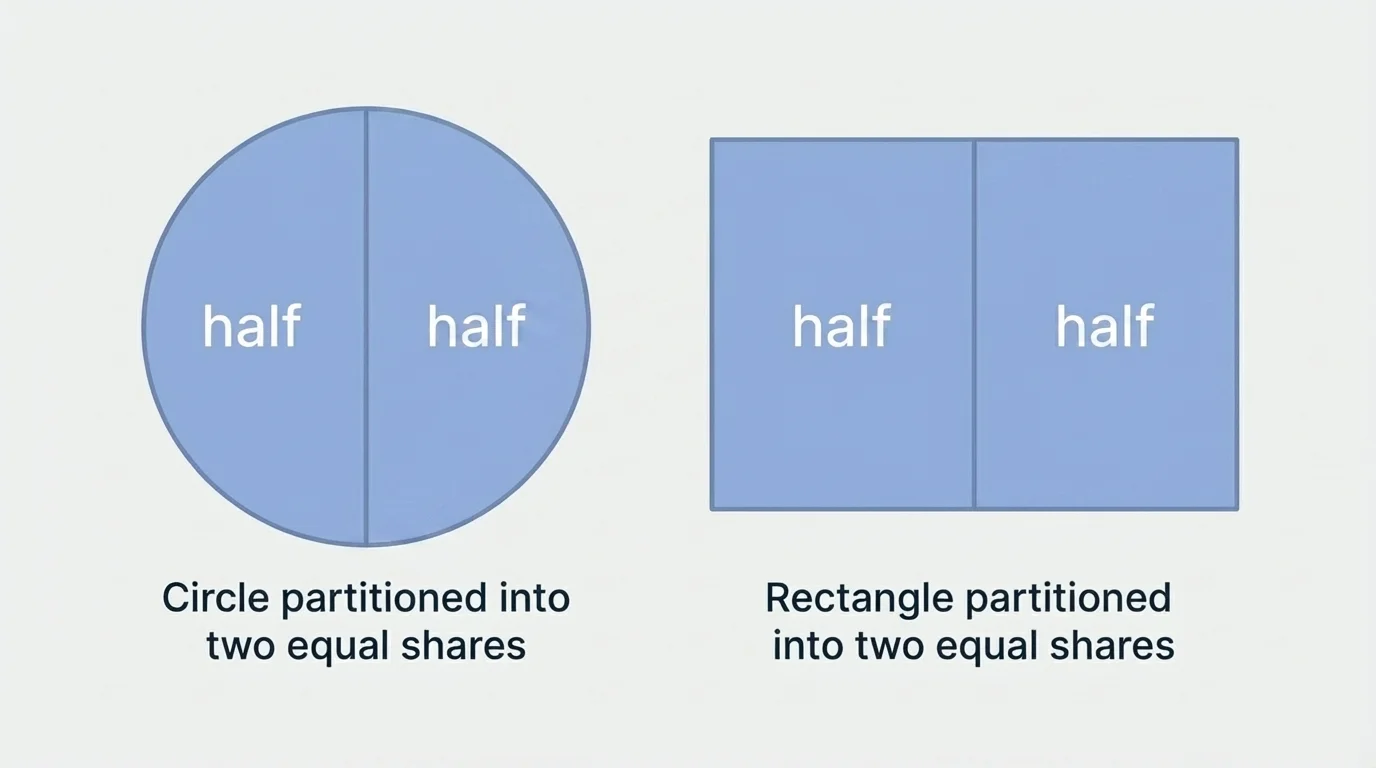
Think about a rectangle cut right down the middle. One side is \(\dfrac{1}{2}\) of the rectangle. The other side is also \(\dfrac{1}{2}\). Together, the two halves make one whole rectangle.
A circle can also have two halves. If the circle is split into two equal parts, each part is half of the circle. Later, when you look back at [Figure 1], you can notice that the two parts match in size even though the shapes of the pieces may look different from halves in other examples.
[Figure 2] When a whole shape is split into fourths, it has four equal shares. Another word for fourths is quarters. These two words mean the same thing. A circle and a rectangle can each be split into four equal parts, and each part is one fourth, or one quarter.
If you take one of the four equal parts, you have one fourth of the shape. You can also say one quarter of the shape. We can write one fourth as \(\dfrac{1}{4}\). Four fourths make one whole: \(\dfrac{1}{4} + \dfrac{1}{4} + \dfrac{1}{4} + \dfrac{1}{4} = 1\).
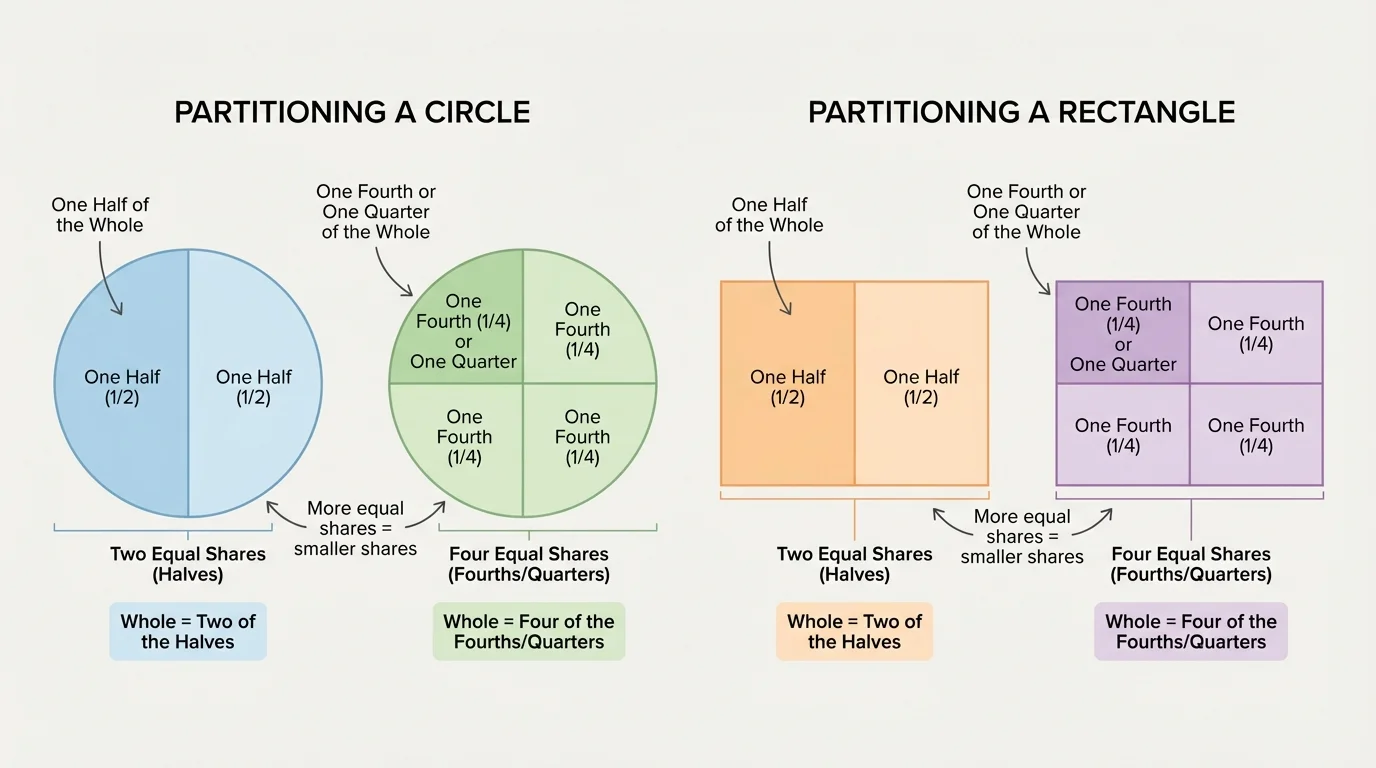
A rectangle might be split into four long skinny parts, or into four smaller box shapes. If all four parts are equal, they are fourths. A circle can be split into four equal wedges. Each wedge is one quarter of the circle.
People often use the word quarter in real life. A quarter of a pizza means one of four equal slices. A quarter of a paper rectangle means one of four equal parts. Looking again at [Figure 2], you can see that fourths and quarters name the same-sized share.
It is important to talk about the shape and the parts together. One whole can be described by its shares.
We can say:
This means all the equal parts together make the complete shape again. If you put \(2\) halves together, you get \(1\) whole. If you put \(4\) fourths together, you get \(1\) whole.
The whole stays the same. The size of the whole shape does not change just because we name its parts. A rectangle cut into \(2\) equal shares is still the same whole rectangle. A circle cut into \(4\) equal shares is still the same whole circle. Only the number and size of the shares change.
You can also compare shares. One half is bigger than one fourth when both come from the same size whole. That is because the whole is split into fewer equal parts.
[Figure 3] Here is a big idea: when the same whole is split into more equal shares, each share gets smaller. A rectangle split into \(4\) equal parts has smaller pieces than the same-size rectangle split into \(2\) equal parts.
Think about one brownie pan. If \(2\) children share it equally, each child gets a bigger piece. If \(4\) children share the same pan equally, each child gets a smaller piece. More equal shares means smaller shares.
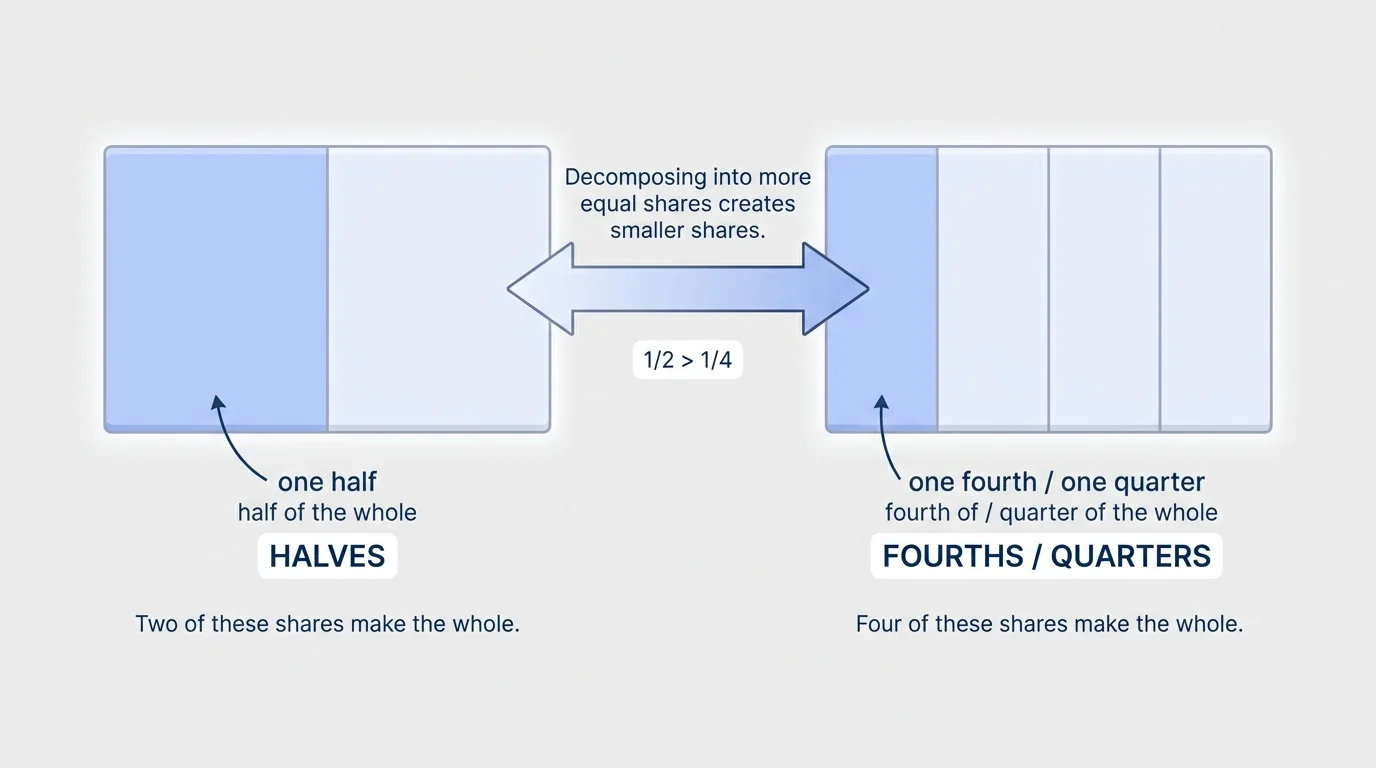
This is true for circles and rectangles. One half of a shape is larger than one fourth of the same shape. So \(\dfrac{1}{2}\) of a whole is more than \(\dfrac{1}{4}\) of that same whole.
A clock helps us hear the word quarter in everyday life. When \(15\) minutes pass, people say a quarter hour has passed because \(15\) minutes is one of \(4\) equal parts of \(60\) minutes.
When you compare sizes, always make sure the wholes are the same size. Half of a big rectangle can be larger than a whole small rectangle. The words half and fourth tell how many equal parts the whole was split into.
Let's look at some shapes and name the shares carefully.
Example 1
A rectangle is split into \(2\) equal parts. What is each part called?
Step 1: Count the equal shares.
The rectangle has \(2\) equal shares.
Step 2: Name the shares.
\(2\) equal shares are called halves.
Step 3: Name one part.
Each part is one half, or \(\dfrac{1}{2}\).
The answer is: each part is half of the rectangle.
If both parts are the same size, they are halves. If one part is bigger, then they are not halves.
Example 2
A circle is split into \(4\) equal parts. One part is shaded. What fraction of the circle is shaded?
Step 1: Count all the equal shares.
There are \(4\) equal shares.
Step 2: Count the shaded shares.
\(1\) share is shaded.
Step 3: Write and name the share.
The shaded part is \(\dfrac{1}{4}\), which is one fourth or one quarter.
The answer is: one fourth of the circle is shaded.
One fourth and one quarter mean the same thing, so either name is correct.
Example 3
A whole rectangle is made from \(4\) equal small parts. How can we describe the whole?
Step 1: Look at the number of equal shares.
The whole has \(4\) equal shares.
Step 2: Name the shares.
\(4\) equal shares are fourths, or quarters.
Step 3: Describe the whole.
The whole is four fourths. It is also four quarters.
The answer is: one whole rectangle is made of \(4\) fourths.
When all \(4\) equal parts are together, the whole shape is complete again.
Example 4
Two same-size rectangles are shown. One rectangle is split into \(2\) equal shares. The other is split into \(4\) equal shares. Which is bigger: one half or one fourth?
Step 1: Compare the wholes.
The rectangles are the same size, so the comparison is fair.
Step 2: Think about the number of equal shares.
When a whole is split into \(2\) equal shares, each share is bigger than when the same whole is split into \(4\) equal shares.
Step 3: Decide which share is larger.
\(\dfrac{1}{2}\) is bigger than \(\dfrac{1}{4}\).
The answer is: one half is bigger than one fourth.
You can connect this to [Figure 3], where the half takes up more space than the quarter from the same-size whole.
We use equal shares all the time. A pizza can be cut into \(2\) equal slices for halves or \(4\) equal slices for quarters. A sandwich can be cut into \(2\) equal parts. A sheet of paper can be folded into \(4\) equal rectangles.
Artists, cooks, and builders all care about equal parts. If a pan of cornbread is cut into equal pieces, everyone gets a fair share. If a rectangle tile design is split into matching parts, the pattern looks balanced.
You already know many shapes have names and attributes. A rectangle has \(4\) sides, and a circle is round. Now you are using those shapes in a new way by splitting them into equal shares.
Even when a shape is partitioned in a new way, it is still the same kind of shape as a whole. The lines inside help us see the shares.
Not every split makes halves or fourths. If the pieces are not equal, we cannot use those names. For example, a rectangle cut into one big part and one small part is not cut into halves.
Also, equal shares can have different looks. A rectangle split up-and-down into \(2\) equal parts and a rectangle split across into \(2\) equal parts both show halves. The parts do not have to face the same way. They only need to be equal.
The same is true for fourths and quarters. Some fourths may look tall and thin, while others look more like small boxes or wedges. If there are \(4\) equal shares, each one is one fourth, or one quarter.
