A spinning bicycle wheel, an alternating electric current, and the motion of ocean tides all have something surprising in common: their mathematics repeats. Trigonometric functions capture that repetition, but they do more than describe repeating motion. Using the unit circle, they also reveal deep patterns of symmetry. These patterns explain why some trig functions keep the same value when the input changes sign, while others flip sign. They also explain why trig values come back again and again after certain angle intervals.
When trigonometry begins with right triangles, angles usually stay between \(0^\circ\) and \(90^\circ\). But the real power of trigonometry appears when we extend angles beyond that range. The unit circle lets us talk about angles such as \(-\dfrac{\pi}{3}\), \(\dfrac{7\pi}{4}\), or even \(23\pi\). Once angles are viewed as rotations, rather than only as corners of triangles, symmetry and periodicity become natural and visual.
Right-triangle definitions are useful, but limited. A right triangle cannot directly show an angle of \(210^\circ\) or \(-45^\circ\). The unit circle solves this problem by defining trigonometric functions in terms of points on a circle of radius \(1\) centered at the origin.
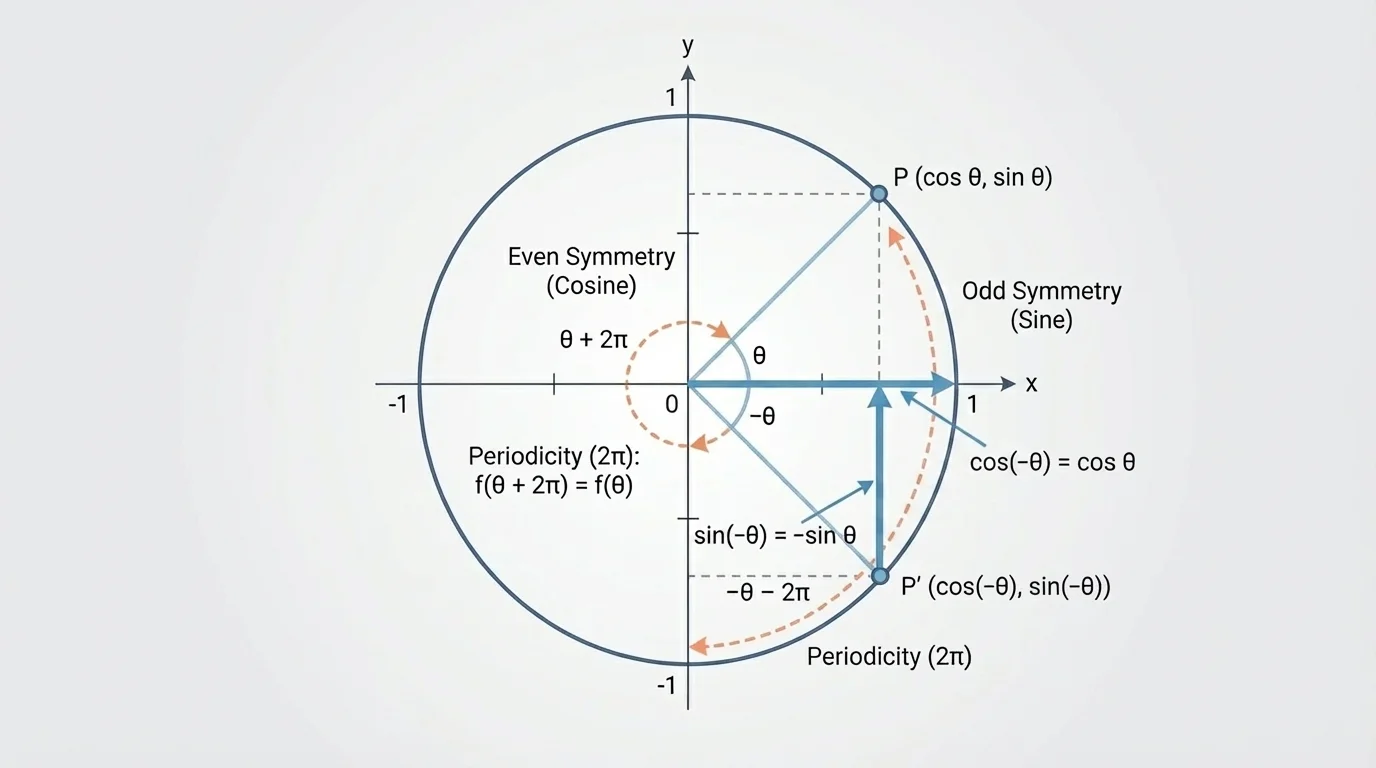
For an angle \(\theta\) in standard position, the point where its terminal side meets the unit circle has coordinates \((\cos \theta, \sin \theta)\). As [Figure 1] shows, that single fact connects geometry, algebra, and graphs. It means cosine is the horizontal coordinate, and sine is the vertical coordinate. Then tangent is the ratio \(\tan \theta = \dfrac{\sin \theta}{\cos \theta}\), when \(\cos \theta \neq 0\).
Unit circle: the circle centered at the origin with radius \(1\).
Standard position: an angle whose initial side lies on the positive \(x\)-axis.
Terminal side: the ray showing where the angle ends after rotation.
Coterminal angles: angles that end at the same location on the plane, differing by whole rotations.
Because every real angle corresponds to a rotation, the unit circle extends trig functions to all real numbers. This is exactly why we can study negative angles, angles larger than \(2\pi\), and repeated values. Each angle lands on a point of the circle, and the coordinates of that point determine the trig values.
For example, if \(\theta = \dfrac{\pi}{3}\), then the point on the unit circle is \(\left(\dfrac{1}{2}, \dfrac{\sqrt{3}}{2}\right)\). So \(\cos \dfrac{\pi}{3} = \dfrac{1}{2}\) and \(\sin \dfrac{\pi}{3} = \dfrac{\sqrt{3}}{2}\). If the angle changes, the point changes, but the same coordinate idea still works.
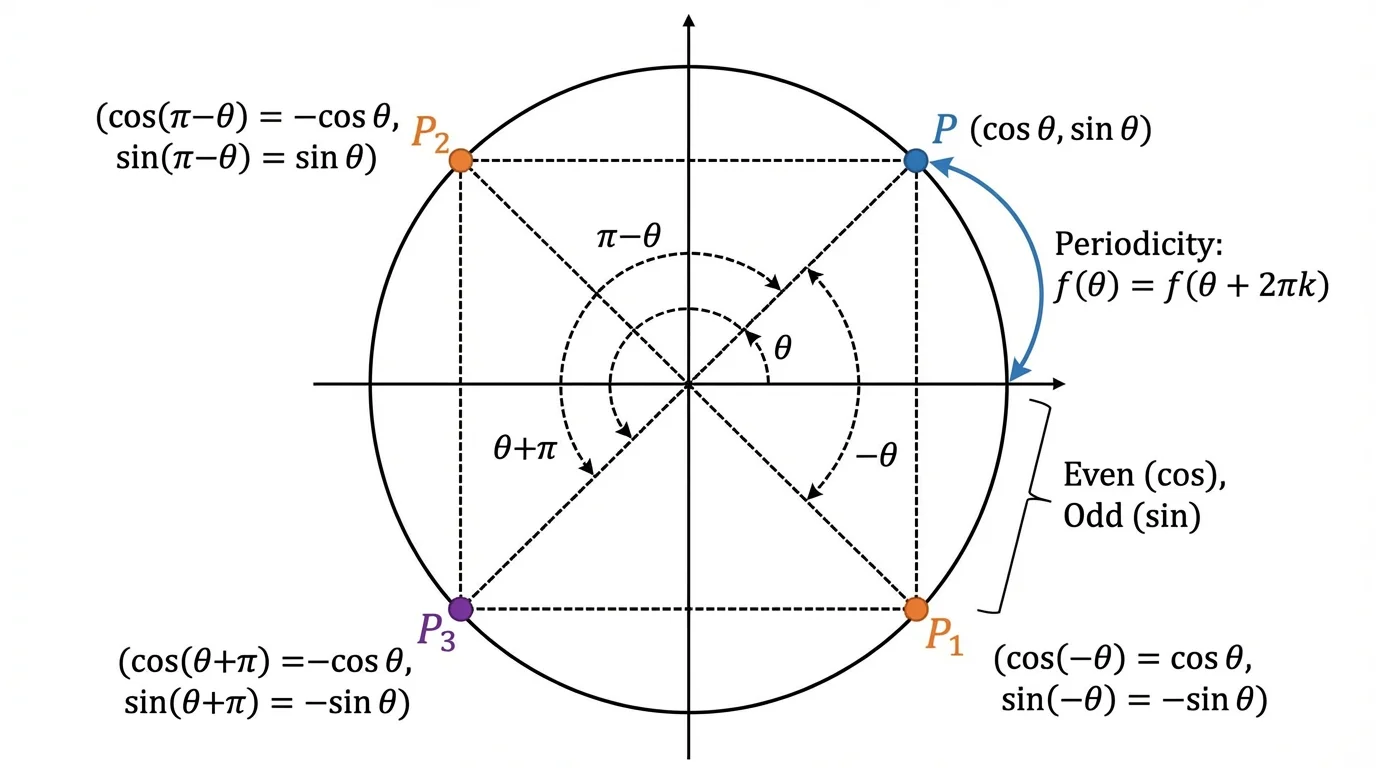
One of the most powerful ideas in trigonometry is that reflections on the unit circle create predictable sign changes. As [Figure 2] illustrates, a point on the circle can be reflected across the \(x\)-axis, across the \(y\)-axis, or through the origin. Each reflection changes the coordinates in a specific way.
Suppose a point on the unit circle is \((x,y)\). Then:
Since \(x = \cos \theta\) and \(y = \sin \theta\), these coordinate changes become trig identities. That is the heart of symmetry in trigonometry.
If an angle \(\theta\) corresponds to the point \((\cos \theta, \sin \theta)\), then the angle \(-\theta\) reflects that point across the \(x\)-axis. So the coordinates become \((\cos \theta, -\sin \theta)\). This immediately gives two important facts:
\[\cos(-\theta) = \cos \theta\]
\[\sin(-\theta) = -\sin \theta\]
These identities are not just rules to memorize. They come from geometry. The horizontal coordinate does not change when you reflect across the \(x\)-axis, but the vertical coordinate does. That is why cosine stays the same and sine changes sign.
How symmetry creates odd and even behavior
A function is even if \(f(-x) = f(x)\), which means the output stays the same when the input changes sign. A function is odd if \(f(-x) = -f(x)\), which means the output reverses sign when the input changes sign. On the unit circle, these patterns come directly from coordinate reflections.
Cosine is an even function because \(\cos(-\theta) = \cos \theta\). Sine is an odd function because \(\sin(-\theta) = -\sin \theta\). Since tangent is a quotient, we can use the sine and cosine identities together:
\[\tan(-\theta) = \frac{\sin(-\theta)}{\cos(-\theta)} = \frac{-\sin \theta}{\cos \theta} = -\tan \theta\]
So tangent is odd as well.
The same reasoning extends to the reciprocal trig functions:
| Function | Symmetry identity | Type |
|---|---|---|
| \(\sin \theta\) | \(\sin(-\theta) = -\sin \theta\) | Odd |
| \(\cos \theta\) | \(\cos(-\theta) = \cos \theta\) | Even |
| \(\tan \theta\) | \(\tan(-\theta) = -\tan \theta\) | Odd |
| \(\csc \theta\) | \(\csc(-\theta) = -\csc \theta\) | Odd |
| \(\sec \theta\) | \(\sec(-\theta) = \sec \theta\) | Even |
| \(\cot \theta\) | \(\cot(-\theta) = -\cot \theta\) | Odd |
Table 1. Symmetry identities showing which trigonometric functions are even and which are odd.
The unit circle also explains relationships involving reflections across the \(y\)-axis and rotations through \(\pi\). If \(\theta\) gives the point \((x,y)\), then \(\pi - \theta\) gives the reflected point \((-x,y)\). Therefore:
\[\cos(\pi - \theta) = -\cos \theta\]
\[\sin(\pi - \theta) = \sin \theta\]
Similarly, rotating by \(\pi\) moves a point to the opposite side of the circle, sending \((x,y)\) to \((-x,-y)\). So:
\[\cos(\theta + \pi) = -\cos \theta\]
\[\sin(\theta + \pi) = -\sin \theta\]
These are useful when simplifying trig expressions or finding exact values in different quadrants. The reflected points in [Figure 2] make these sign changes visible: the signs depend on whether the point has moved left, right, up, or down.
Recall the quadrant sign pattern: in Quadrant I, both sine and cosine are positive. In Quadrant II, sine is positive and cosine is negative. In Quadrant III, both are negative. In Quadrant IV, sine is negative and cosine is positive.
That quadrant sign pattern combines with symmetry. For instance, if you know the reference angle and the quadrant, you can often determine a trig value without any calculator.
A second major pattern of trigonometric functions is periodicity. A function is periodic if its outputs repeat after a fixed interval. On the unit circle, that happens because rotations eventually land back at the same point. As [Figure 3] shows, one full turn around the circle returns to the exact same coordinates.
If you add \(2\pi\) radians to any angle, you make one complete revolution. The terminal side ends in the same place, so the point on the unit circle is unchanged. Therefore:
\[\sin(\theta + 2\pi) = \sin \theta\]
\[\cos(\theta + 2\pi) = \cos \theta\]
Because tangent depends on the ratio of sine to cosine, something even more interesting happens. Rotating by \(\pi\) moves a point to the opposite side of the circle, so both sine and cosine change sign. Their ratio stays the same:
\[\tan(\theta + \pi) = \tan \theta\]
So sine and cosine have period \(2\pi\), while tangent has period \(\pi\).
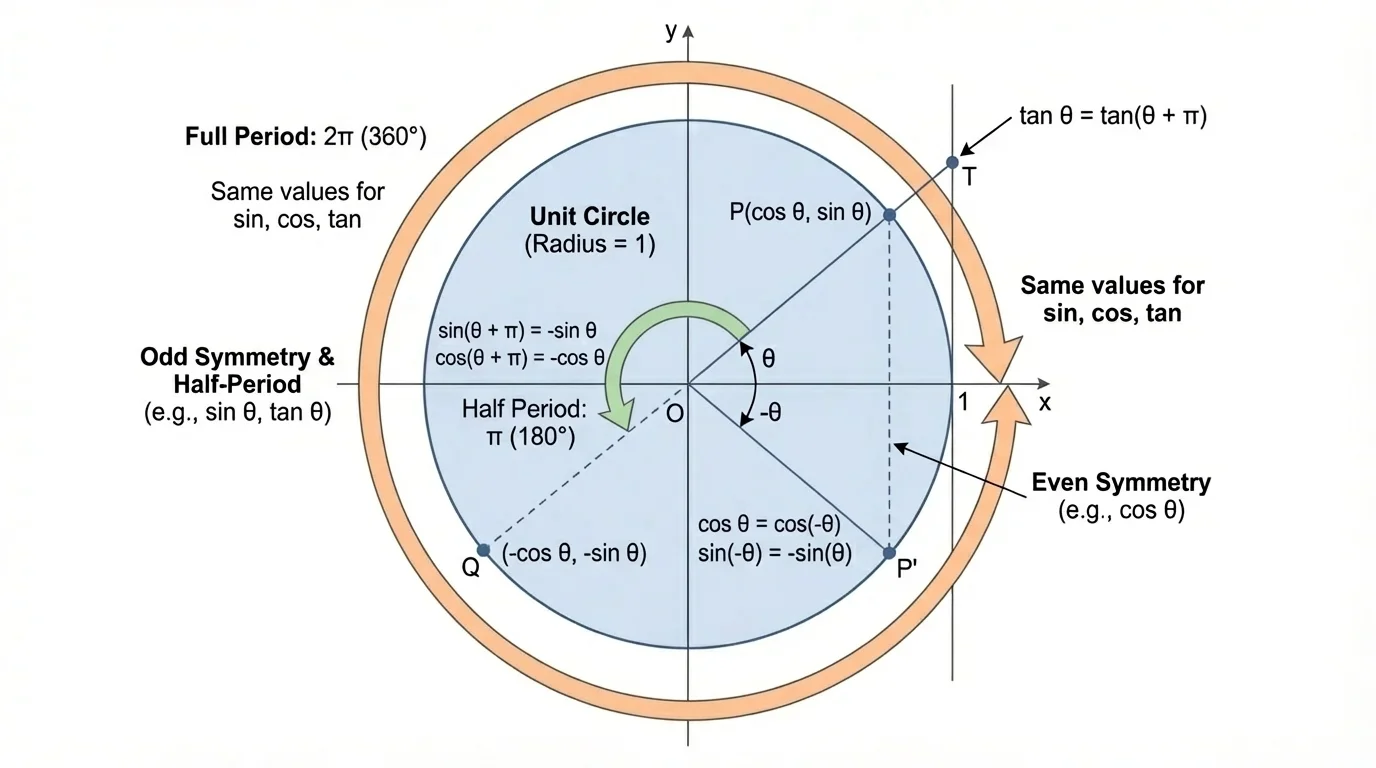
These repeating intervals explain coterminal angles. Any angles of the form \(\theta + 2\pi k\), where \(k\) is an integer, are coterminal. They share the same sine and cosine values because they end at the same point on the unit circle.
Tangent repeats more often. Angles of the form \(\theta + \pi k\) have the same tangent value, provided tangent is defined. This is because points opposite each other on the unit circle lie on the same line through the origin, giving the same slope.
Many repeating natural processes are modeled with sine and cosine because their values repeat exactly after a fixed interval. That repeating structure is not an accident of graphing; it comes directly from moving around a circle.
These ideas become most useful when evaluating trig expressions quickly and exactly. Instead of memorizing many separate facts, you can use the geometry of the circle.
Worked example 1
Find \(\sin\left(-\dfrac{\pi}{6}\right)\).
Step 1: Use odd symmetry of sine.
Since sine is odd, \(\sin(-\theta) = -\sin \theta\).
Step 2: Substitute \(\theta = \dfrac{\pi}{6}\).
\(\sin\left(-\dfrac{\pi}{6}\right) = -\sin\left(\dfrac{\pi}{6}\right)\).
Step 3: Use the known unit-circle value.
\(\sin\left(\dfrac{\pi}{6}\right) = \dfrac{1}{2}\).
Therefore, \[\sin\left(-\frac{\pi}{6}\right) = -\frac{1}{2}\]
This example shows how odd symmetry turns a negative-angle question into a familiar positive-angle value.
Worked example 2
Find \(\cos\left(\dfrac{13\pi}{6}\right)\).
Step 1: Use periodicity of cosine.
Cosine has period \(2\pi\), and \(2\pi = \dfrac{12\pi}{6}\).
Step 2: Subtract one full rotation.
\(\dfrac{13\pi}{6} - 2\pi = \dfrac{13\pi}{6} - \dfrac{12\pi}{6} = \dfrac{\pi}{6}\).
Step 3: Evaluate the equivalent angle.
\(\cos\left(\dfrac{13\pi}{6}\right) = \cos\left(\dfrac{\pi}{6}\right)\).
On the unit circle, \(\cos\left(\dfrac{\pi}{6}\right) = \dfrac{\sqrt{3}}{2}\).
So, \[\cos\left(\frac{13\pi}{6}\right) = \frac{\sqrt{3}}{2}\]
Large angles often look difficult, but periodicity reduces them to standard angles.
Worked example 3
Find \(\tan\left(-\dfrac{3\pi}{4}\right)\).
Step 1: Use odd symmetry of tangent.
\(\tan(-\theta) = -\tan \theta\), so \(\tan\left(-\dfrac{3\pi}{4}\right) = -\tan\left(\dfrac{3\pi}{4}\right)\).
Step 2: Evaluate \(\tan\left(\dfrac{3\pi}{4}\right)\).
At \(\dfrac{3\pi}{4}\), the unit-circle point is \(\left(-\dfrac{\sqrt{2}}{2}, \dfrac{\sqrt{2}}{2}\right)\).
So \(\tan\left(\dfrac{3\pi}{4}\right) = \dfrac{\dfrac{\sqrt{2}}{2}}{-\dfrac{\sqrt{2}}{2}} = -1\).
Step 3: Apply the negative sign.
\(\tan\left(-\dfrac{3\pi}{4}\right) = -(-1) = 1\).
Therefore, \[\tan\left(-\frac{3\pi}{4}\right) = 1\]
Because tangent is odd, the sign changed twice in this problem: once from odd symmetry and once from the value in Quadrant II.
Worked example 4
Explain why \(\sin\left(\theta + 2\pi\right) = \sin \theta\) using the unit circle.
Step 1: Think of \(2\pi\) as one complete rotation.
Adding \(2\pi\) means moving all the way around the unit circle once.
Step 2: Compare the ending point.
After one full turn, the terminal side ends at the same point as the original angle \(\theta\).
Step 3: Use the coordinate meaning of sine.
Sine is the \(y\)-coordinate of the point on the unit circle. Since the point is the same, the \(y\)-coordinate is the same.
So, \[\sin\left(\theta + 2\pi\right) = \sin \theta\]
The symmetry and periodicity seen on the unit circle appear again in the graphs of trig functions. As [Figure 4] shows, the graph of cosine is symmetric about the \(y\)-axis because cosine is even. The graphs of sine and tangent have rotational symmetry about the origin because those functions are odd.
Periodicity also becomes visible in graphs. The sine and cosine graphs repeat every \(2\pi\), while the tangent graph repeats every \(\pi\). This graph behavior is not a separate fact to memorize; it is a translation of the unit-circle rotation pattern into coordinate form.
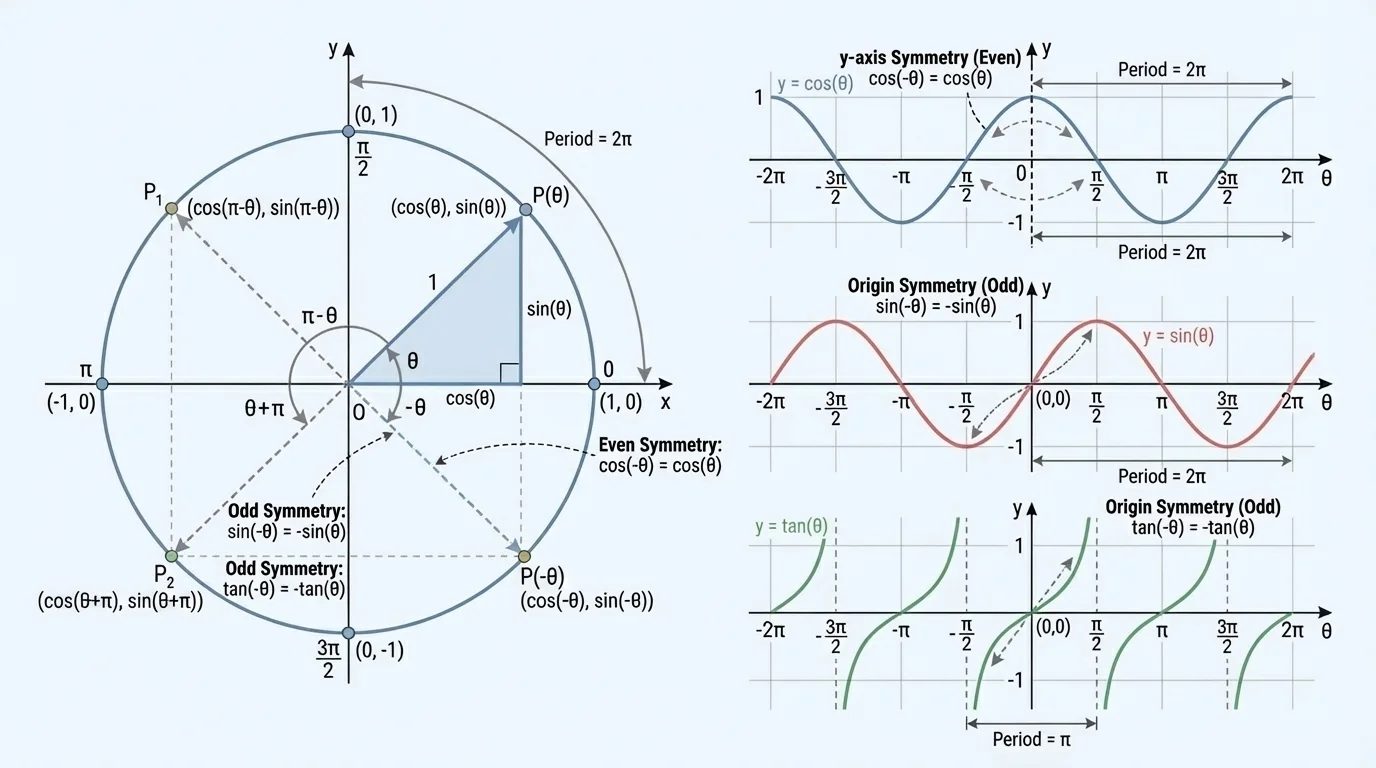
For cosine, even symmetry means if one point on the graph is \((a,b)\), then \((-a,b)\) is also on the graph. For sine, odd symmetry means if \((a,b)\) is on the graph, then \((-a,-b)\) is also on the graph. The same origin symmetry applies to tangent wherever it is defined.
Looking back to [Figure 1], the coordinates around the circle create the wave patterns of sine and cosine when plotted against angle. Looking again at [Figure 3], the repeated rotation explains why the graph repeats forever to the left and right.
These ideas are not only theoretical. Engineers, scientists, and programmers rely on symmetry and periodicity all the time.
In sound and music technology, a pure tone is modeled by a sinusoidal wave. Since the wave repeats, periodicity is essential. If a signal has period \(T\), then its behavior after time \(T\) matches its earlier behavior. Sine and cosine functions are natural models for this because their values repeat at fixed intervals.
In physics, circular motion and wave motion are deeply connected. A point moving around a wheel has horizontal and vertical coordinates given by cosine and sine. That means the up-down or side-to-side motion of the point is periodic. The unit circle model helps describe Ferris wheels, rotating motors, and planetary cycles.
In electrical engineering, alternating current changes direction in a regular pattern. The voltage in a circuit is often modeled with a sine function such as \(V(t) = V_0 \sin(\omega t)\). The repeating nature of the current comes from periodicity, while symmetry helps analyze what happens when time is reversed or shifted.
In data science and computer graphics, periodic functions help model repeating patterns such as seasonal temperature cycles, signal processing, and smooth animation loops. The fact that trig functions repeat exactly makes them especially useful when a motion or signal must cycle without abrupt jumps.
Why the unit circle is more powerful than a triangle alone
A right triangle can define trig values only for acute angles. The unit circle handles negative angles, large angles, symmetry, and repetition. It gives one geometric picture that explains exact values, signs in different quadrants, graph behavior, and periodic motion.
A very common mistake is thinking that all trig functions are odd because sine and tangent are odd. But cosine is even. That means \(\cos(-\theta)\) does not become \(-\cos \theta\); it stays \(\cos \theta\).
Another common mistake is confusing periods. Sine and cosine repeat every \(2\pi\), not every \(\pi\). Tangent repeats every \(\pi\), not every \(2\pi\). The reason is geometric: opposite points on the circle have different sine and cosine values, but they give the same tangent ratio.
Students also sometimes ignore whether a function is defined. For example, \(\tan \theta = \dfrac{\sin \theta}{\cos \theta}\), so tangent is undefined when \(\cos \theta = 0\), such as at \(\theta = \dfrac{\pi}{2}\) and \(\theta = \dfrac{3\pi}{2}\).
Finally, be careful when using reference angles. The reference angle helps you find the absolute value of the trig function, but the quadrant determines the sign.
Symmetry tells you what happens when an angle is reflected or reversed. Periodicity tells you what happens when an angle keeps rotating. The unit circle brings both ideas together: reflections explain odd and even behavior, and rotations explain repetition.
Once you understand trig functions as coordinates on a circle, identities such as \(\sin(-\theta) = -\sin \theta\), \(\cos(-\theta) = \cos \theta\), and \(\sin(\theta + 2\pi) = \sin \theta\) stop looking like isolated facts. They become consequences of a picture you can reason from.
