A surprising amount of real life can be modeled with a single variable. The number of tickets a club must sell to break even, the time it takes a medicine to lose half its strength, the side length of a garden with a fixed area, or the maximum amount you can spend without going over budget can all be captured by expressions like \(2x + 15 = 75\), \(x^2 - 12x = 0\), or \(50(1.08)^t = 100\). The skill is not just solving equations. The deeper skill is creating them from words, quantities, and relationships.
When you create an equation or inequality, you turn a situation into mathematics. That translation step matters because it lets you use algebra to answer questions that would otherwise be difficult to organize. In this lesson, you will learn how to build models in one variable and solve problems involving linear, quadratic, rational, and simple exponential relationships.
An equation states that two expressions are equal. An inequality compares two expressions when one may be greater than, less than, at least, or at most the other. In many problems, one quantity is unknown, so we represent it with a variable and use the information given to write a mathematical statement.
If a streaming service charges a $12 monthly fee plus $3 per movie rental, and a student spent $30 in one month, the unknown could be the number of rentals. If that number is \(r\), then the relationship becomes \(12 + 3r = 30\). A real situation has been turned into algebra.
Before creating equations, remember these basics: combining like terms, using the distributive property, undoing operations in reverse order, and checking solutions by substitution. These earlier algebra skills are the tools that make modeling possible.
Good modeling also requires interpretation. In some contexts, a negative answer makes no sense. In others, a decimal answer might need rounding, or only one of several algebraic solutions may fit the situation.
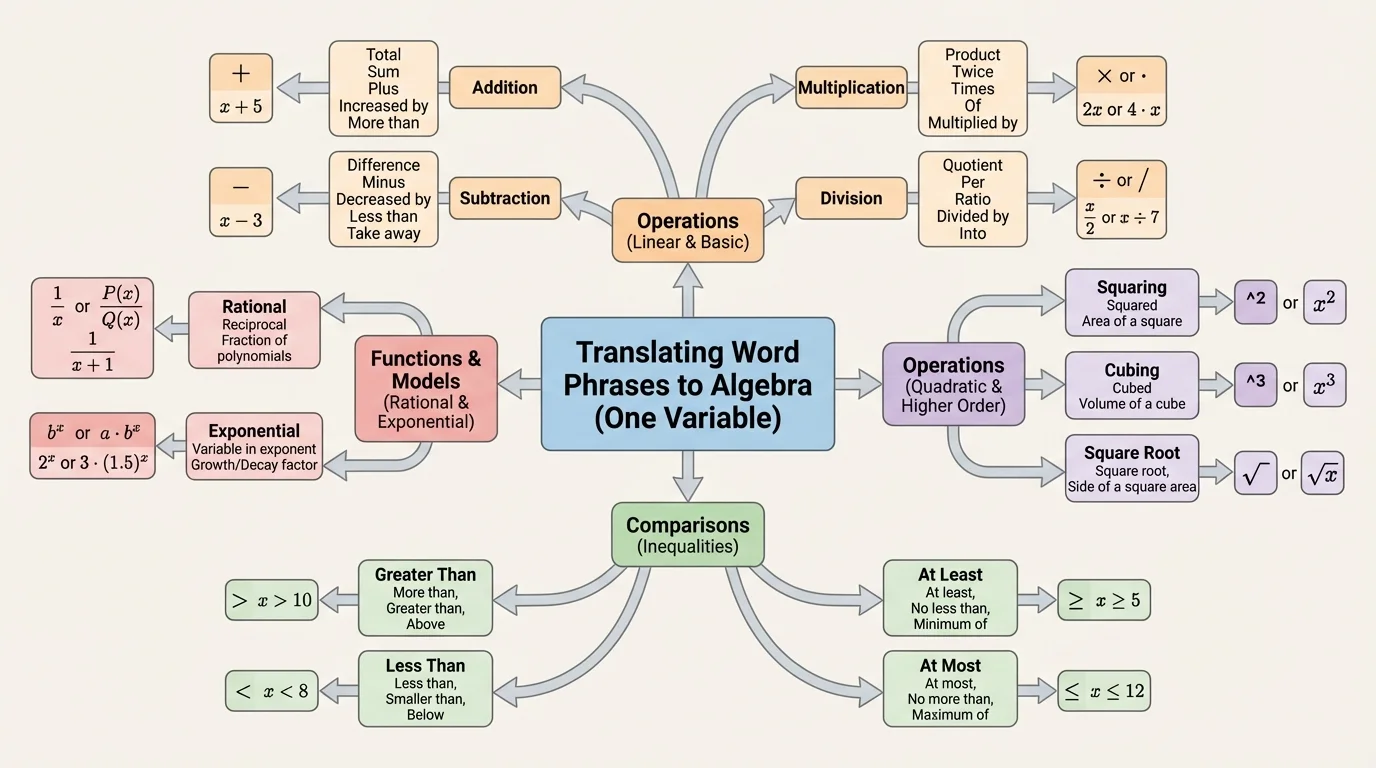
To create an equation, begin by defining a variable clearly. Let the unknown quantity be something specific, such as "the number of hours" or "the length of the rectangle." Then identify the relationship described in words. Certain phrases act like signals, as [Figure 1] illustrates: "sum" suggests addition, "difference" suggests subtraction, "twice" suggests multiplication by \(2\), "is" often signals equality, and phrases like "at least" or "no more than" signal inequalities.
For example, "five more than a number is \(17\)" becomes \(x + 5 = 17\). "A number decreased by \(8\) is at least \(20\)" becomes \(x - 8 \ge 20\). The structure of the sentence matters. "Three less than a number" means \(x - 3\), but "three less than twice a number" means \(2x - 3\).
Careful reading prevents common mistakes. "The quotient of a number and \(4\)" is \(\dfrac{x}{4}\), not \(4x\). "The product of \(7\) and a number" is \(7x\). "No more than \(50\)" means \(\le 50\), while "more than \(50\)" means \(> 50\).
Variable means a symbol, usually a letter, that represents an unknown quantity or a quantity that can change.
Solution means a value of the variable that makes an equation true or makes an inequality true.
Constraint means a condition or limit in a situation, such as a budget cap or a nonnegative quantity.
When the wording involves a real context, write down what the variable represents and include units mentally, even if the variable itself has no unit written beside it. This helps you interpret the final answer correctly.
A linear equation in one variable has the variable to the first power only. Its general form can be written as \(ax + b = c\), where \(a\), \(b\), and \(c\) are constants and \(a \ne 0\). Linear equations model constant rates and simple totals.
Suppose a gym charges a $25 sign-up fee and $18 per month. If someone has spent $133 total, let \(m\) represent the number of months. Then the equation is \(25 + 18m = 133\). Solving gives the number of months.
Solved example 1: Creating and solving a linear equation
A concert venue charges $14 for a student ticket. A group spent $196 on tickets. How many student tickets were bought?
Step 1: Define the variable.
Let \(t\) be the number of student tickets.
Step 2: Create the equation.
Each ticket costs $14, so the total cost is \(14t\). Since the group spent $196, write \(14t = 196\).
Step 3: Solve.
Divide both sides by \(14\): \(t = \dfrac{196}{14} = 14\).
Step 4: Interpret the answer.
The group bought \(14\) student tickets.
The solution is \(t = 14\)
Not all linear equations are this direct. Some involve several steps, such as collecting like terms or using the distributive property before isolating the variable.
Solved example 2: A multi-step linear model
A phone plan costs $20 per month plus $0.05 per text message. If a customer's bill was $32.50, how many text messages were sent?
Step 1: Define the variable.
Let \(x\) be the number of text messages.
Step 2: Write the equation.
The monthly cost is the fixed fee plus the texting charge: \(20 + 0.05x = 32.50\).
Step 3: Isolate the variable.
Subtract \(20\): \(0.05x = 12.50\).
Divide by \(0.05\): \(x = \dfrac{12.50}{0.05} = 250\).
Step 4: Check.
Substitute \(x = 250\): \(20 + 0.05(250) = 20 + 12.50 = 32.50\), which matches the bill.
The customer sent \(250\) text messages.
Linear equations are often used for totals, prices, perimeter, and constant-rate motion. If the relationship changes by the same amount each time, a linear model is often appropriate.
An inequality is used when a quantity is limited rather than fixed. Many real problems ask for all possible values that satisfy a condition, not just one exact value. Solution sets for inequalities are often represented on a number line, as [Figure 2] shows.
For example, if you have $60 to spend on a game that costs $24 plus $6 per accessory, and \(a\) is the number of accessories, then \(24 + 6a \le 60\). The inequality says your total spending cannot exceed $60.
When solving inequalities, the algebra is almost the same as solving equations. However, if you multiply or divide both sides by a negative number, the inequality symbol reverses direction. Also, strict inequalities such as \(<\) and \(>\) exclude the endpoint, while inclusive inequalities such as \(\le\) and \(\ge\) include it.
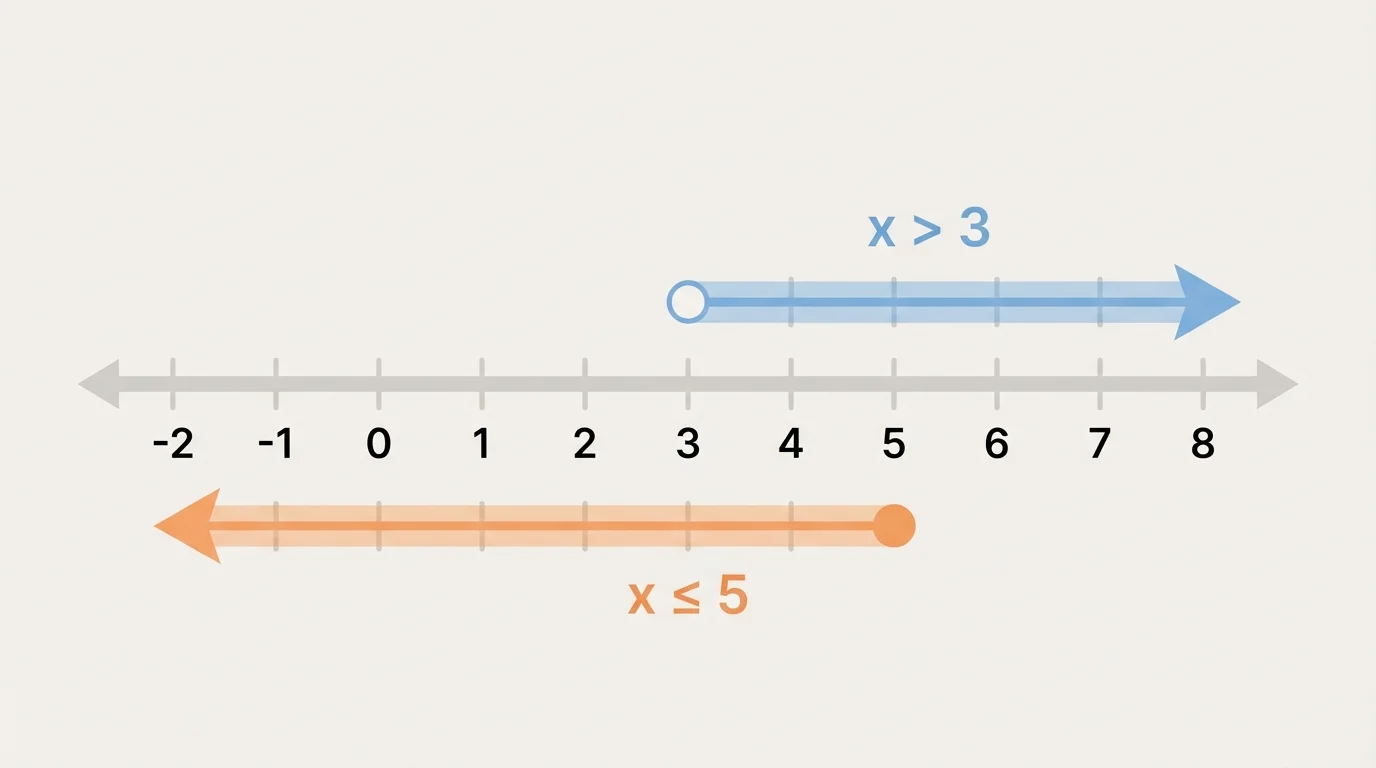
Suppose a student must score at least \(70\) points overall. If the student already has \(52\) points and the final task is worth \(x\) points, then \(52 + x \ge 70\). Solving gives \(x \ge 18\). That means the student must earn at least \(18\) more points. This example highlights the difference between inclusive and exclusive endpoints on a number line.
Solved example 3: Creating and solving an inequality
A bus can carry at most \(48\) passengers. The driver already has \(17\) passengers onboard. How many more passengers can board?
Step 1: Define the variable.
Let \(p\) be the number of additional passengers.
Step 2: Write the inequality.
The total number of passengers cannot be more than \(48\), so \(17 + p \le 48\).
Step 3: Solve.
Subtract \(17\) from both sides: \(p \le 31\).
Step 4: Interpret.
At most \(31\) more passengers can board.
The solution set is \(p \le 31\)
In applications, whole-number restrictions may matter. You cannot usually have \(31.4\) passengers or \(2.7\) cars, so context determines whether only integers make sense.
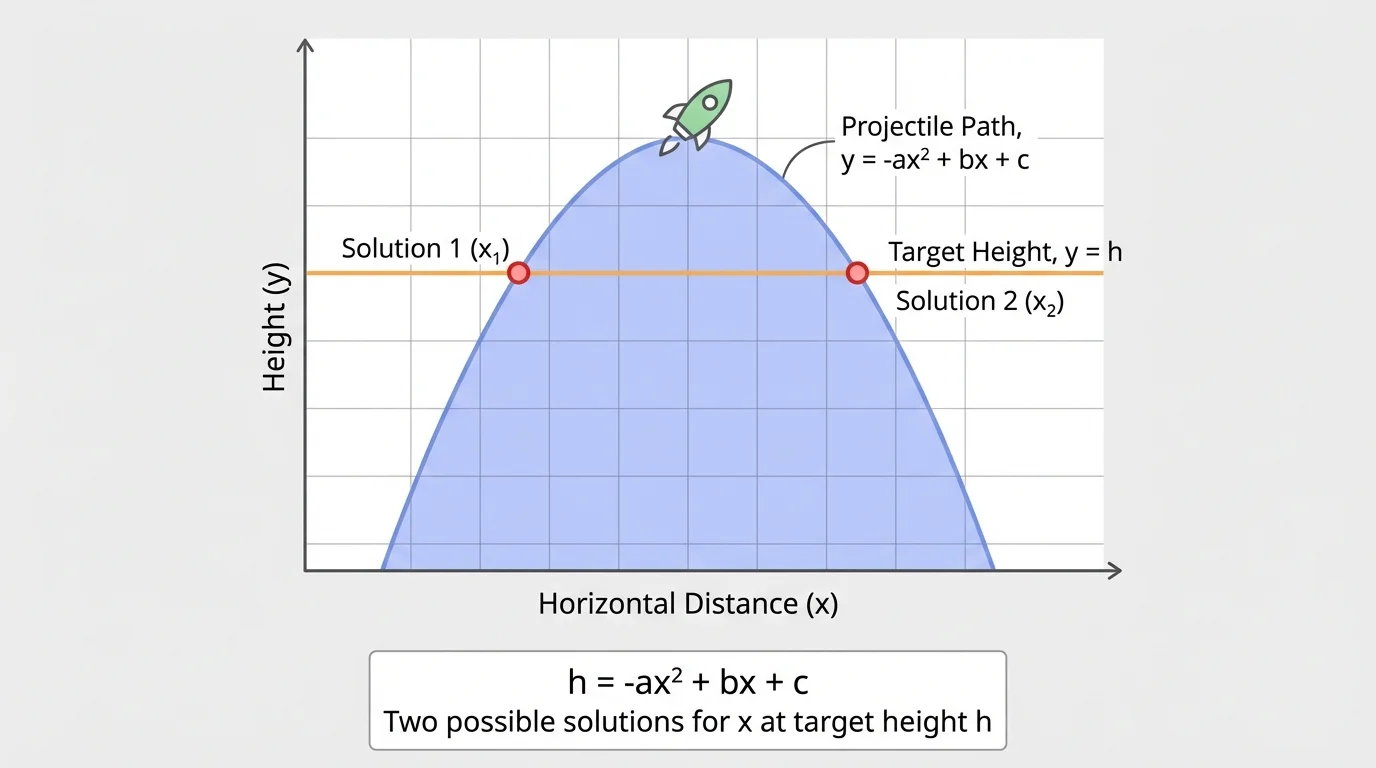
[Figure 3] A quadratic equation includes a squared variable term, such as \(x^2\). Quadratic models often appear in area problems, products of two related numbers, and motion situations. Their graphs are parabolas, and a quadratic can intersect a target value in two places, one place, or not at all.
If a rectangle has length \(x + 3\) and width \(x\), and its area is \(40\), then \(x(x + 3) = 40\). Expanding gives \(x^2 + 3x - 40 = 0\), which is a quadratic equation. Solving reveals the possible dimensions.
Quadratic equations can be solved by factoring, completing the square, or using the quadratic formula. In modeling, you should also test whether both algebraic solutions are meaningful. Negative lengths, for example, are usually impossible.
Why quadratics often give two answers
When a quantity depends on a product or on squared change, the same output can come from two different inputs. A projectile can reach the same height on the way up and on the way down. A parabola can cross a horizontal level twice. Algebra reflects that geometry.
Area and motion problems are especially common. For instance, if the height of an object above the ground is modeled by \(h = -16t^2 + 48t + 5\), and you want to know when it reaches a height of \(21\), set \(-16t^2 + 48t + 5 = 21\) and solve for \(t\).
Solved example 4: A quadratic area problem
The length of a rectangle is \(4\) units more than its width. Its area is \(96\) square units. Find the dimensions.
Step 1: Define the variable.
Let \(w\) be the width. Then the length is \(w + 4\).
Step 2: Write the equation.
Area equals width times length, so \(w(w + 4) = 96\).
Step 3: Rearrange into standard form.
Expand: \(w^2 + 4w = 96\).
Move all terms to one side: \(w^2 + 4w - 96 = 0\).
Step 4: Solve.
Factor: \((w + 12)(w - 8) = 0\).
So \(w = -12\) or \(w = 8\).
Step 5: Interpret.
A negative width is not possible, so \(w = 8\). The length is \(8 + 4 = 12\).
The dimensions are \[8 \textrm{ units by } 12 \textrm{ units}\]
Notice that the algebra produced two solutions, but only one fit the physical context. This is common in modeling.
A rational equation contains a variable in a denominator or involves fractional expressions. These appear in rate, ratio, and division-based situations. For example, if one part of a trip is driven at one speed and another at a different speed, time may be represented by distance divided by speed.
When creating rational equations, first identify what the fraction means. If a tank drains \(\dfrac{1}{x}\) of its volume per minute in one setting and \(\dfrac{1}{x+2}\) in another, the variable changes the rate. If two parts together make a whole, their fractions may add to \(1\).
One important idea is restriction. Any value that makes a denominator equal to \(0\) is not allowed. Even if algebra seems to produce that value later, it must be rejected.
Solved example 5: A counting model that must be interpreted carefully
A science club spent $24 on notebooks and pens. Pens cost $2 each, and notebooks cost $3 each. The number of notebooks was \(2\) less than the number of pens. How many pens were bought?
Step 1: Define the variable.
Let \(p\) be the number of pens. Then the number of notebooks is \(p - 2\).
Step 2: Create the equation.
Total cost equals cost of pens plus cost of notebooks: \(2p + 3(p - 2) = 24\).
Step 3: Solve.
Expand: \(2p + 3p - 6 = 24\).
Combine like terms: \(5p - 6 = 24\).
Add \(6\): \(5p = 30\).
Divide by \(5\): \(p = 6\).
Step 4: Interpret.
The club bought \(6\) pens and \(4\) notebooks. This whole-number result makes sense in the context.
The equation gives \(p = 6\)
The example above shows that creating equations is not only about calculation. It is also about checking whether the result makes sense. In a true rational-expression example, you might solve something like \(\dfrac{x}{4} + 3 = 7\), or \(\dfrac{12}{x} = 3\), always watching for forbidden values.
Solved example 6: Rational equation with a denominator
Four friends share a ride cost of $36 equally. If one more friend joins, each person pays $3 less. How many friends were in the original group?
Step 1: Define the variable.
Let \(x\) be the original number of friends.
Step 2: Write the equation.
Originally, each pays \(\dfrac{36}{x}\). With one more friend, each pays \(\dfrac{36}{x+1}\). The new amount is $3 less, so \(\dfrac{36}{x+1} = \dfrac{36}{x} - 3\).
Step 3: Solve carefully.
Multiply both sides by \(x(x+1)\): \(36x = 36(x+1) - 3x(x+1)\).
Simplify: \(36x = 36x + 36 - 3x^2 - 3x\).
Move terms: \(0 = 36 - 3x^2 - 3x\).
Divide by \(-3\): \(0 = x^2 + x - 12\).
Factor: \((x + 4)(x - 3) = 0\).
So \(x = -4\) or \(x = 3\).
Step 4: Apply restrictions and interpret.
A negative number of friends is impossible, and \(x \ne 0\) because it is in a denominator. So the valid solution is \(x = 3\).
The original group had \(3\) friends.
[Figure 4] An exponential function involves a variable in the exponent, such as \(a(b)^t\). These models describe repeated multiplication rather than repeated addition. Population growth, compound interest, and radioactive decay are classic examples. Compared with linear growth, exponential change can start slowly and then accelerate dramatically.
If an investment starts at $200 and grows by \(5\%\) each year, then after \(t\) years its value is \(200(1.05)^t\). If you want to know when it reaches $300, create the equation \(200(1.05)^t = 300\).
In simple cases, exponential equations can be solved by using inverse operations or by recognizing powers. For example, if \(2^x = 32\), then \(x = 5\) because \(32 = 2^5\). If \(100(0.5)^t = 25\), then \((0.5)^t = 0.25 = (0.5)^2\), so \(t = 2\).
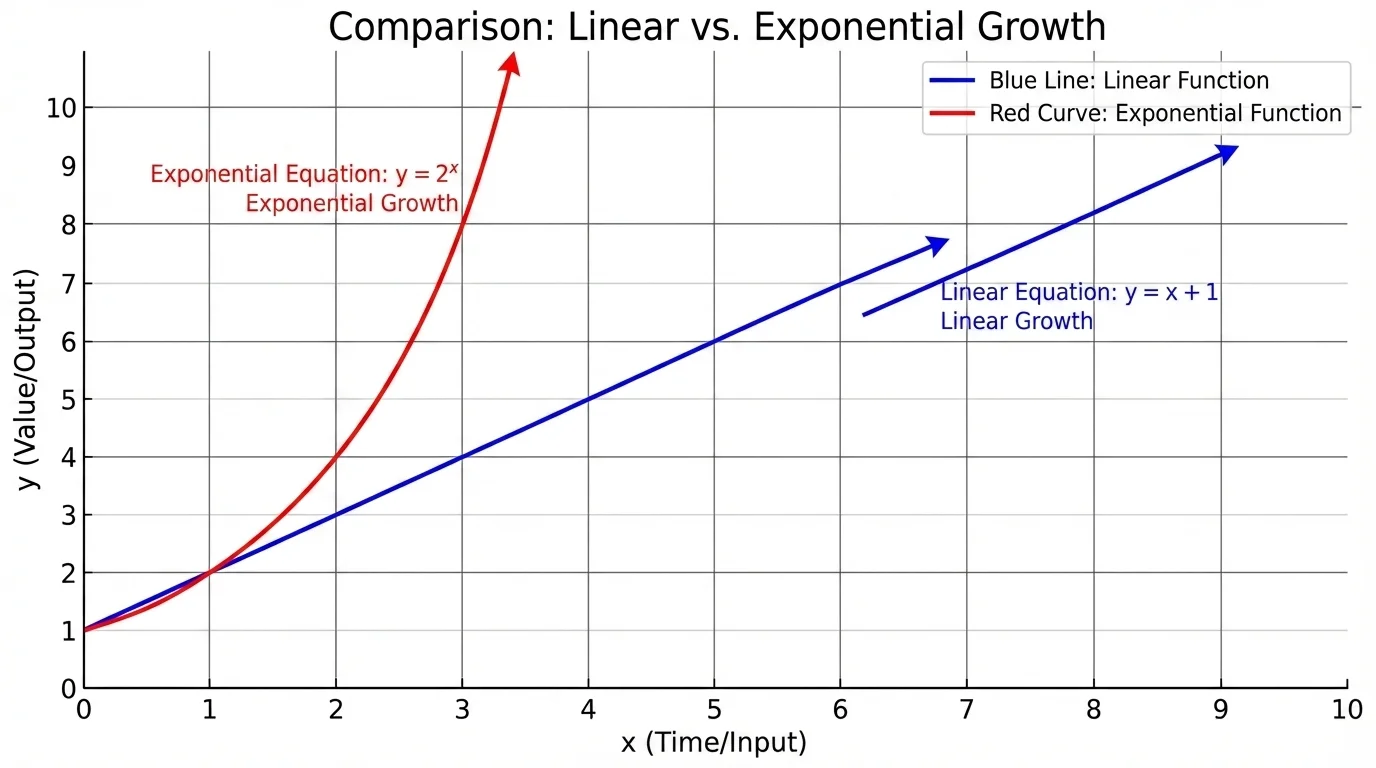
Even without advanced logarithms, many simple exponential models can be solved by pattern recognition, equivalent powers, or by estimating from a table or graph. When growth is by a constant percent, exponential modeling is usually more accurate than linear modeling.
Solved example 7: Exponential growth
A bacteria culture starts with \(500\) cells and doubles every hour. After how many hours will there be \(4{,}000\) cells?
Step 1: Define the variable.
Let \(h\) be the number of hours.
Step 2: Create the equation.
Doubling every hour means the model is \(500(2)^h\). Set it equal to \(4{,}000\): \(500(2)^h = 4{,}000\).
Step 3: Solve.
Divide both sides by \(500\): \(2^h = 8\).
Since \(8 = 2^3\), it follows that \(h = 3\).
Step 4: Interpret.
It takes \(3\) hours for the culture to reach \(4{,}000\) cells.
The solution is \(h = 3\)
As with earlier models, context matters. If time must be measured in whole hours, an estimate like \(h \approx 3.2\) may need to be rounded depending on whether the question asks when the amount reaches or exceeds a target.
One of the most important skills in algebra is deciding what kind of equation fits a situation. A fixed starting value plus a constant amount per unit suggests a linear equation. A product of related quantities or a squared term suggests a quadratic equation. A variable in a denominator suggests a rational relationship. Repeated percent growth or decay suggests an exponential model.
| Situation clue | Likely model | Typical form |
|---|---|---|
| Constant increase or decrease | Linear | \(ax + b = c\) |
| Area, product, or parabolic motion | Quadratic | \(ax^2 + bx + c = 0\) |
| Sharing, rates, or variable in denominator | Rational | \(\dfrac{a}{x} = b\) or similar |
| Repeated percent change | Exponential | \(a(b)^x = c\) |
Table 1. Common clues that help identify whether a situation is best modeled by a linear, quadratic, rational, or exponential equation.
Choosing the right model is like choosing the right tool. A hammer is useful, but not for every job. In mathematics, solving the wrong kind of equation perfectly still gives the wrong model.
Engineers use equations to set design limits. A bridge component might need to stay under a certain stress level, leading to an inequality. Business owners use equations to predict revenue, cost, and break-even points. Doctors and scientists use exponential models for medicine concentration and population growth. Architects and builders use quadratic relationships when area and dimensions are linked.
Suppose a school club is planning a fundraiser. The club pays a fixed rental fee plus a cost per item sold. The officers may ask: how many items must be sold to earn a profit? That question naturally becomes an inequality. Or suppose a company wants packaging with a certain volume but minimum material use. That can lead to quadratic relationships among dimensions.
Exponential growth is one reason why early changes in a process can be misleading. A quantity that doubles repeatedly can seem manageable at first and then become enormous much faster than intuition expects.
These examples show why the step of creating equations is not just school algebra. It is the language of planning, prediction, and decision-making.
One common mistake is choosing an unclear variable. If \(x\) is not clearly defined, it becomes easy to write the wrong relationship. Another is translating phrases in the wrong order. "Five less than twice a number" is \(2x - 5\), not \(5 - 2x\).
A third mistake is forgetting context restrictions. In rational equations, denominator values cannot be zero. In geometry, lengths cannot be negative. In counting problems, non-integer answers may signal that the model or interpretation needs attention. In inequalities, remember that dividing by a negative reverses the inequality sign.
Another important habit is checking. Substitute your answer back into the original equation or inequality. For quadratic and rational equations especially, this can catch extraneous solutions. It also helps confirm that your mathematical answer makes sense in the original problem.
As you move into more advanced algebra, this process becomes even more important: define the variable, identify the relationship, create the equation or inequality, solve carefully, and interpret the result in context.
