A pilot, a game designer, and a robotics engineer may seem to have little in common, but all of them rely on the same mathematical idea: how far something moves horizontally and vertically from one point to another. That idea is captured by a vector. When you know the starting point and ending point, you can find the vector's components with a subtraction rule that is simple, powerful, and used across mathematics, science, and technology.
A vector describes both magnitude and direction. In a coordinate plane, a vector can be pictured as an arrow. The arrow does not just tell you where something is; it tells you how to move from one location to another.
This is different from a point. A point such as \((3, 5)\) tells a location. A vector such as \(\langle 2, -1\rangle\) tells a change: move \(2\) units to the right and \(1\) unit down. So points describe position, while vectors describe displacement or motion between positions.
When a vector is drawn from one point to another, we often name it using the two endpoints. For example, \(\overrightarrow{AB}\) means the vector that starts at point \(A\) and ends at point \(B\).
Initial point is the starting point of a vector. Terminal point is the ending point of a vector. Components are the horizontal and vertical changes that describe the vector in coordinate form, usually written as \(\langle a, b\rangle\).
Component form is useful because it turns a picture into exact numbers. Once a vector is written in components, it becomes easier to compare vectors, add them, subtract them, and eventually find magnitudes and directions more precisely.
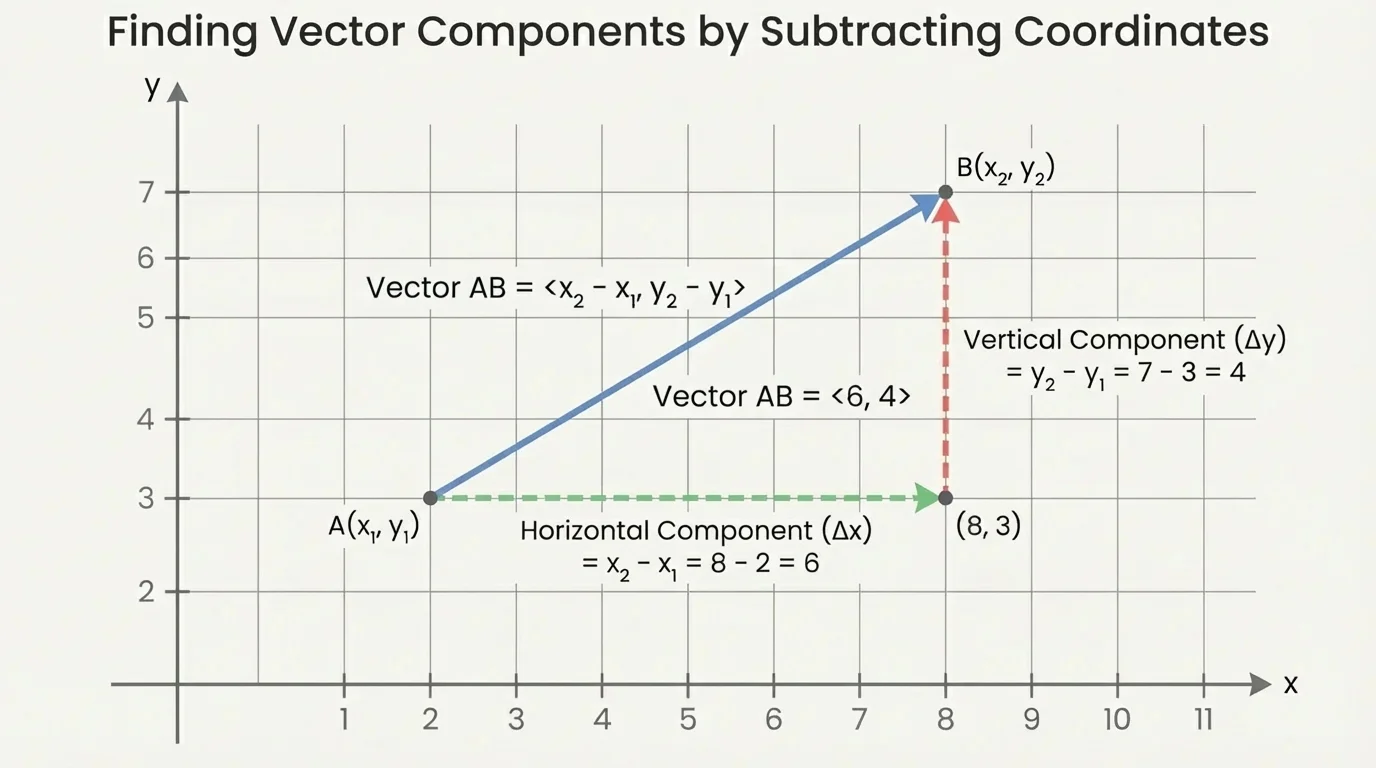
Direction matters, as [Figure 1] shows. If a vector begins at \(A(x_1, y_1)\) and ends at \(B(x_2, y_2)\), then the vector describes the movement from \(A\) to \(B\), not just the two points themselves. The order of the points is essential.
To find that movement, think in two separate parts: how much the \(x\)-coordinate changes and how much the \(y\)-coordinate changes. The horizontal change is the terminal \(x\)-coordinate minus the initial \(x\)-coordinate. The vertical change is the terminal \(y\)-coordinate minus the initial \(y\)-coordinate.
If the horizontal change is positive, the movement goes right. If it is negative, the movement goes left. If the vertical change is positive, the movement goes up. If it is negative, the movement goes down.
This gives an important interpretation: vector components are really changes in position. A vector does not care where it is drawn as long as its direction and length stay the same. That is why vectors are often used to represent displacement from one place to another.
Recall how subtraction works with signed numbers. For example, \(2 - (-3) = 5\), and \(-4 - 1 = -5\). These sign rules matter a great deal when vector endpoints include negative coordinates.
One of the most common mistakes is subtracting in the wrong order. The rule is always terminal minus initial. If you switch the order, you get a different vector that points in the opposite direction.
Suppose the initial point is \((x_1, y_1)\) and the terminal point is \((x_2, y_2)\). Then the vector from the initial point to the terminal point has component form
\[\langle x_2 - x_1,\; y_2 - y_1 \rangle\]
This formula is one of the central tools for working with vectors in the coordinate plane. It says: subtract corresponding coordinates, always using terminal minus initial.
If you are given \(A(x_1, y_1)\) and \(B(x_2, y_2)\), then
\[\overrightarrow{AB} = \langle x_2 - x_1,\; y_2 - y_1 \rangle\]
Notice that the subtraction is done coordinate by coordinate. The \(x\)-values are compared with each other, and the \(y\)-values are compared with each other. You never mix an \(x\)-coordinate with a \(y\)-coordinate.
Why subtraction works
A vector measures change. Change is found by taking the final value and subtracting the starting value. That idea appears throughout mathematics: change in temperature, change in population, and change in position all use final minus initial. Vector components are the changes in the coordinates.
The same idea can extend beyond two dimensions. In three dimensions, if a vector goes from \((x_1, y_1, z_1)\) to \((x_2, y_2, z_2)\), then its components are \(\langle x_2 - x_1, y_2 - y_1, z_2 - z_1 \rangle\). The logic is exactly the same.
Let \(A = (2, 1)\) and \(B = (7, 4)\). Find \(\overrightarrow{AB}\).
Worked example 1
Step 1: Identify the initial and terminal points.
The initial point is \(A(2, 1)\), and the terminal point is \(B(7, 4)\).
Step 2: Subtract the coordinates in the correct order.
For the \(x\)-component: \(7 - 2 = 5\).
For the \(y\)-component: \(4 - 1 = 3\).
Step 3: Write the vector in component form.
\[\overrightarrow{AB} = \langle 5, 3 \rangle\]
The vector means move \(5\) units right and \(3\) units up.
This example is straightforward because both coordinate changes are positive. Geometrically, the terminal point is to the right of and above the initial point, so the vector has positive components.
[Figure 2] Signs become more interesting when points lie in different quadrants. The path across quadrants makes it easier to understand why subtraction with negative numbers still follows the same rule.
Let \(C = (-4, 3)\) and \(D = (2, -5)\). Find \(\overrightarrow{CD}\).
Worked example 2
Step 1: Write the subtraction pattern.
\(\overrightarrow{CD} = \langle x_2 - x_1, y_2 - y_1 \rangle\)
Step 2: Substitute the coordinates.
\(x_2 = 2\), \(x_1 = -4\), \(y_2 = -5\), and \(y_1 = 3\).
So the \(x\)-component is \(2 - (-4) = 6\).
The \(y\)-component is \(-5 - 3 = -8\).
Step 3: State the vector.
\[\overrightarrow{CD} = \langle 6, -8 \rangle\]
This vector means move \(6\) units right and \(8\) units down.
The negative sign in the second component does not mean something went wrong. It simply records direction. A negative vertical component means downward movement.
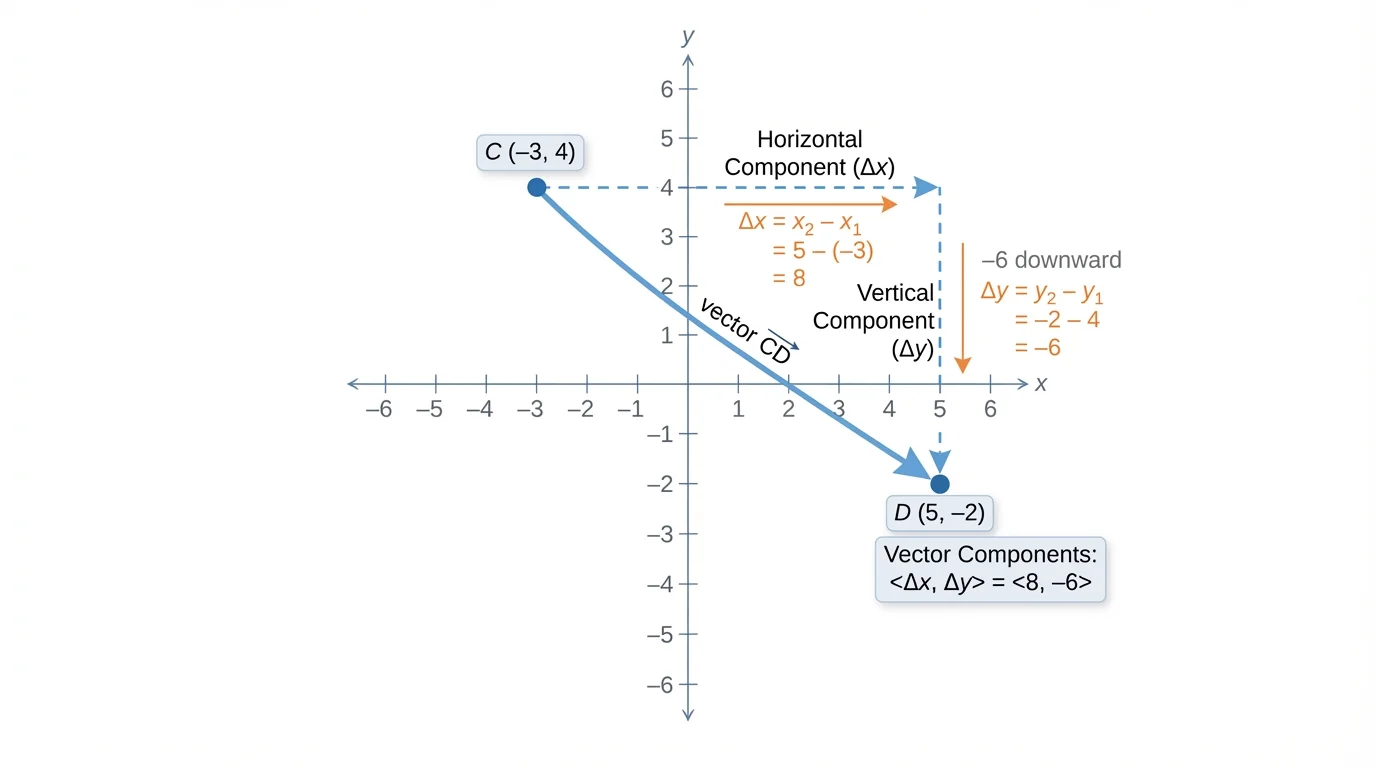
Students often make an error here by writing \(-4 - 2\) instead of \(2 - (-4)\). But because the vector goes from \(C\) to \(D\), the terminal coordinates must come first. The subtraction must match the direction of the arrow.
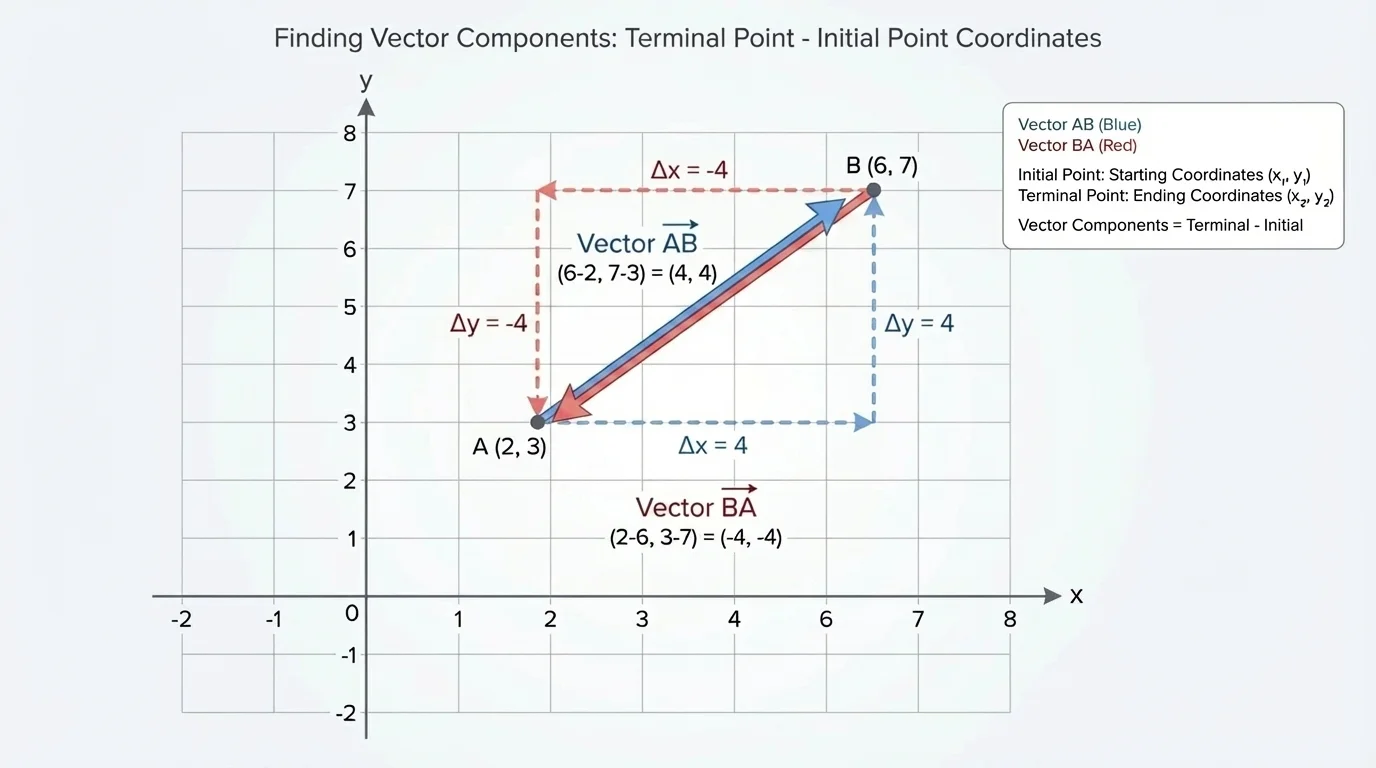
[Figure 3] Reversing direction changes every component sign. A vector from \(A\) to \(B\) and a vector from \(B\) to \(A\) have the same magnitude, but they point in opposite directions.
Let \(A = (1, -2)\) and \(B = (5, 4)\). Find both \(\overrightarrow{AB}\) and \(\overrightarrow{BA}\).
Worked example 3
Step 1: Find \(\overrightarrow{AB}\).
For \(\overrightarrow{AB}\), subtract coordinates of \(A\) from coordinates of \(B\):
\(5 - 1 = 4\) and \(4 - (-2) = 6\).
So \(\overrightarrow{AB} = \langle 4, 6 \rangle\).
Step 2: Find \(\overrightarrow{BA}\).
For \(\overrightarrow{BA}\), subtract coordinates of \(B\) from coordinates of \(A\):
\(1 - 5 = -4\) and \(-2 - 4 = -6\).
So \(\overrightarrow{BA} = \langle -4, -6 \rangle\).
Step 3: Compare the two vectors.
\[\overrightarrow{BA} = -\overrightarrow{AB}\]
The vectors are opposites because they have the same magnitude but point in opposite directions.
This is an important pattern: if one vector is \(\langle a, b \rangle\), then the reverse vector is \(\langle -a, -b \rangle\).
Later, when you study vector operations, this opposite relationship will appear again. For now, it helps explain why order matters so much in naming vectors.
Some vectors have components that reveal special situations immediately. If the initial and terminal points are the same, then there is no movement at all. For example, from \((3, -1)\) to \((3, -1)\), the vector is \(\langle 3-3, -1-(-1) \rangle = \langle 0, 0 \rangle\). This is called the zero vector.
If the \(x\)-coordinates are the same, the vector is vertical. For example, from \((2, 1)\) to \((2, 7)\), the vector is \(\langle 0, 6 \rangle\). If the \(y\)-coordinates are the same, the vector is horizontal. From \((-3, 4)\) to \((5, 4)\), the vector is \(\langle 8, 0 \rangle\).
Another common confusion is mixing up a point and a vector. The point \((4, -2)\) names a location. The vector \(\langle 4, -2 \rangle\) names a change. They may use the same numbers, but they represent different ideas.
| Situation | What to Do | Result |
|---|---|---|
| Vector from \(A\) to \(B\) | Subtract \(A\) from \(B\) | \(\langle x_2-x_1, y_2-y_1 \rangle\) |
| Reverse direction | Subtract \(B\) from \(A\) | Opposite vector |
| Same start and end | Subtract equal coordinates | \(\langle 0, 0 \rangle\) |
| Same \(x\)-coordinates | Horizontal change is \(0\) | Vertical vector |
| Same \(y\)-coordinates | Vertical change is \(0\) | Horizontal vector |
Table 1. Common vector situations and the results of coordinate subtraction.
Modern video games and animation software constantly track changes in position using coordinate differences. Every time an object moves across a screen, vectors help describe that motion.
A reliable check is to ask whether your answer matches the picture. If the terminal point is left of the initial point, the \(x\)-component should be negative. If it is higher, the \(y\)-component should be positive. Estimating direction can catch arithmetic mistakes before they become bigger problems.
The component form \(\langle a, b \rangle\) has a simple geometric meaning. The first number, \(a\), tells the horizontal change. The second number, \(b\), tells the vertical change. So a vector can be understood as a pair of movements combined into one directed quantity.
In this way, vector components connect algebra and geometry. Algebra gives the subtraction rule, while geometry gives the visual meaning of right, left, up, and down. As we saw earlier in [Figure 1], the vector can be broken into horizontal and vertical parts without changing the overall movement from start to finish.
This idea also explains why vectors with the same components are equal even if they are drawn in different places. A vector \(\langle 3, 2 \rangle\) always means move \(3\) units right and \(2\) units up, no matter where the arrow begins.
Component form and direction
The signs of the components encode direction. Positive \(x\) means right, negative \(x\) means left, positive \(y\) means up, and negative \(y\) means down. Reading the signs gives an immediate sense of the vector's direction before any graph is drawn.
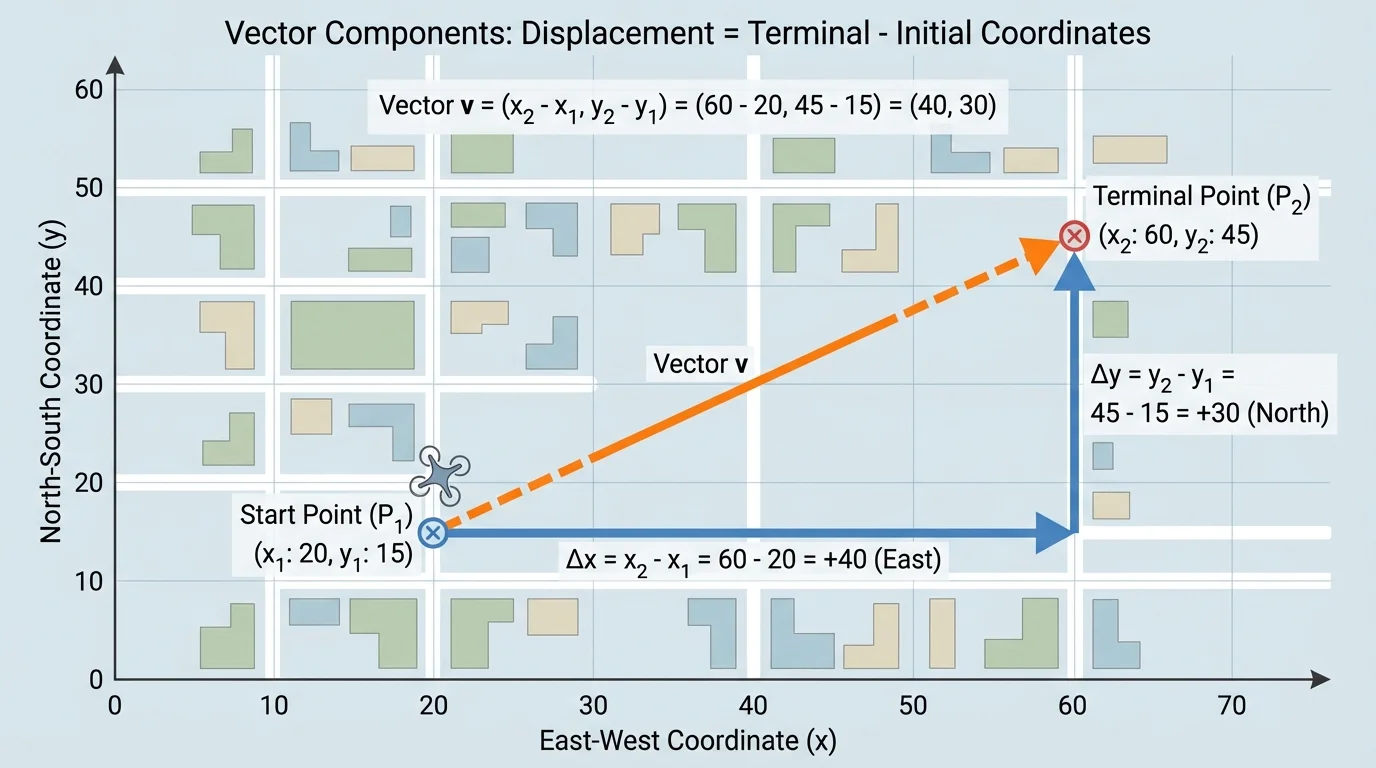
[Figure 4] That makes component form especially useful in modeling. A moving car, a thrown ball, or a drone changing position can all be described with coordinate changes rather than just pictures.
In navigation, a trip can be described by how far east or west and how far north or south a person travels. This is exactly a vector idea, and it connects the mathematics to a grid-based movement model. If a drone starts at one location and ends at another, the displacement vector records the overall change in position.
Suppose a drone starts at \((1, 2)\) on a map grid and ends at \((9, 7)\). Its displacement vector is \(\langle 9-1, 7-2 \rangle = \langle 8, 5 \rangle\). That means the drone moved \(8\) units east and \(5\) units north.
In physics, a vector can represent displacement of an object. If a ball rolls from one point on a floor to another, the vector components tell how far it moved in each direction. The numbers can then be used in later calculations involving velocity or force.
In robotics, engineers program machines to move to target points. The robot does not just need to know the destination; it often needs the exact coordinate change from its current position. That change is a vector.
In computer graphics, moving an object from one pixel location to another uses the same subtraction rule. The software calculates the difference in coordinates to determine how the object should shift on the screen.
These examples all depend on the same central idea: the vector is the change from where something starts to where it ends. Whether the setting is a game engine, a satellite map, or a factory robot, the mathematics stays the same.
The subtraction method works in three dimensions as well. If a point moves from \((1, -2, 4)\) to \((6, 3, -1)\), then the vector components are found by subtracting coordinate by coordinate:
\[\langle 6-1,\; 3-(-2),\; -1-4 \rangle = \langle 5, 5, -5 \rangle\]
Even though the lesson's focus is on two-dimensional vectors, this extension shows that the idea is part of a much bigger mathematical system used in engineering, physics, and computer modeling.
You will often see vector components used as the starting point for other topics, including magnitude, unit vectors, vector addition, and geometric modeling. But all of those ideas depend on first being able to identify the vector correctly from its endpoints.
"Mathematics reveals structure by measuring change."
That is exactly what vector components do: they measure change in position with clarity and precision.
