Two airplanes can both move at the same speed and still end up in completely different places. A soccer ball can be kicked equally hard twice, yet one shot curves into the goal and another flies wide. The reason is that many quantities in the real world are not described by size alone. They also depend on direction. That is why vectors matter.
A scalar quantity has magnitude only. Examples include mass, time, temperature, and speed. A vector quantity has both magnitude and direction. Examples include velocity, displacement, and force.
A runner may have a speed of \(6 \textrm{ m/s}\), but to describe the motion fully, we need direction too, such as \(6 \textrm{ m/s}\) east. That full description is a vector.
Scalar and vector quantities are different ways to describe measurable quantities. A scalar tells how much. A vector tells how much and in what direction.
Magnitude is the size or length of a vector. Direction tells where the vector points.
In many problems, vectors help us combine motions that happen at the same time. A boat may move through water while the current also pushes it. A drone may fly forward while wind blows sideways. A person may walk north, then east. These situations are easier to analyze when we treat motion as vectors.
A vector can be drawn as an arrow. The length of the arrow shows its size, and the arrowhead shows its direction. On a coordinate plane, as [Figure 1] illustrates, we often represent a vector by its horizontal and vertical components. For example, a vector from \((0,0)\) to \((3,4)\) can be written as \(\langle 3,4 \rangle\).
The two numbers in \(\langle 3,4 \rangle\) tell how far the vector moves horizontally and vertically. Positive \(3\) means \(3\) units to the right, and positive \(4\) means \(4\) units upward. This component form is extremely useful for calculations.
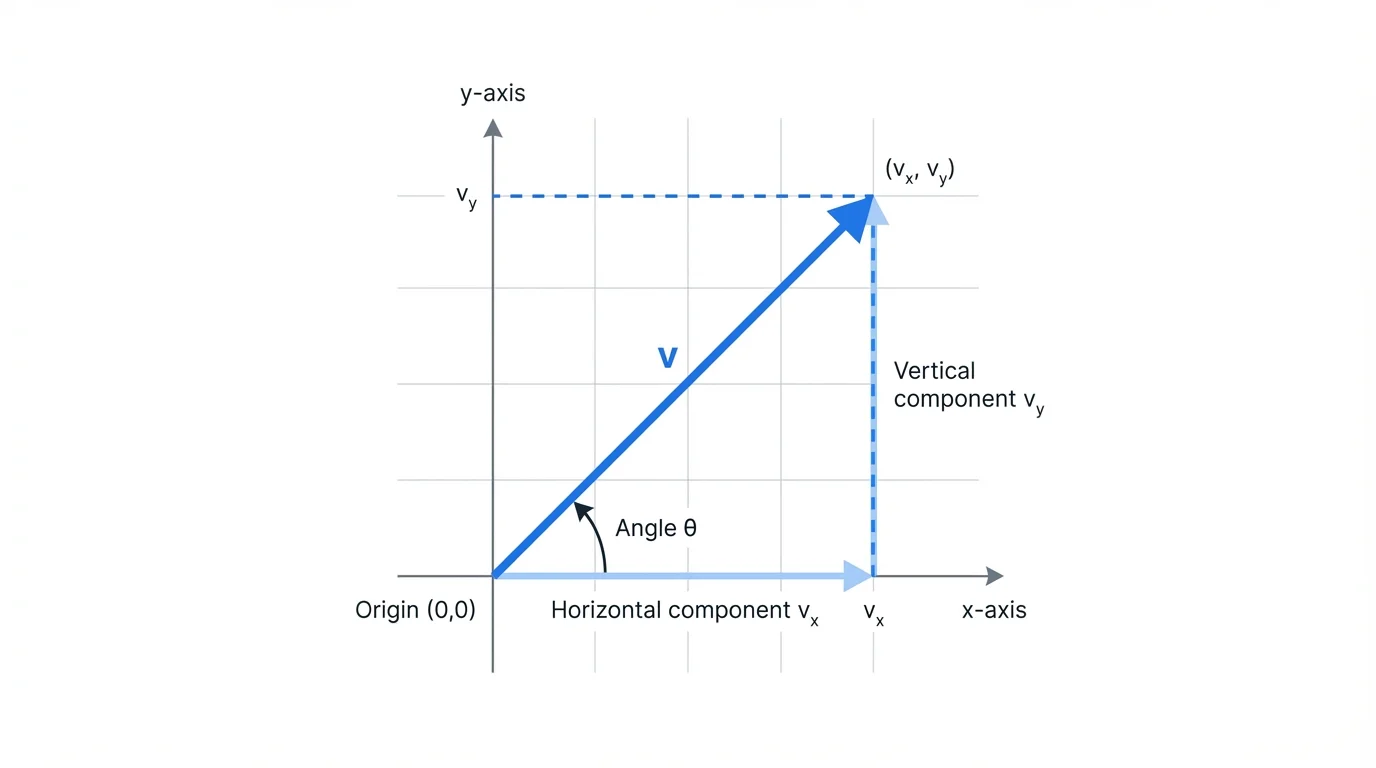
The components of a vector are its horizontal and vertical parts. If a vector is \(\vec{v} = \langle a,b \rangle\), then its magnitude is found with the Pythagorean theorem:
\[|\vec{v}| = \sqrt{a^2+b^2}\]
For \(\vec{v} = \langle 3,4 \rangle\), the magnitude is \(|\vec{v}| = \sqrt{3^2+4^2} = \sqrt{9+16} = \sqrt{25} = 5\). So this vector has length \(5\).
Direction is often measured as an angle from the positive \(x\)-axis. If the horizontal component is \(a\) and the vertical component is \(b\), then the angle \(\theta\) can often be found using
\[\tan \theta = \frac{b}{a}\]
When using this relationship, you must also pay attention to the quadrant so that the direction makes sense.
To break vectors into components or rebuild them from components, you need right-triangle ideas: the Pythagorean theorem and the trigonometric ratios \(\sin \theta\), \(\cos \theta\), and \(\tan \theta\).
If a vector has magnitude \(m\) and direction angle \(\theta\), then its components are usually written as
\[\langle m\cos \theta,\; m\sin \theta \rangle\]
This is one of the most important tools in vector problem-solving because it converts a problem about direction into algebra.
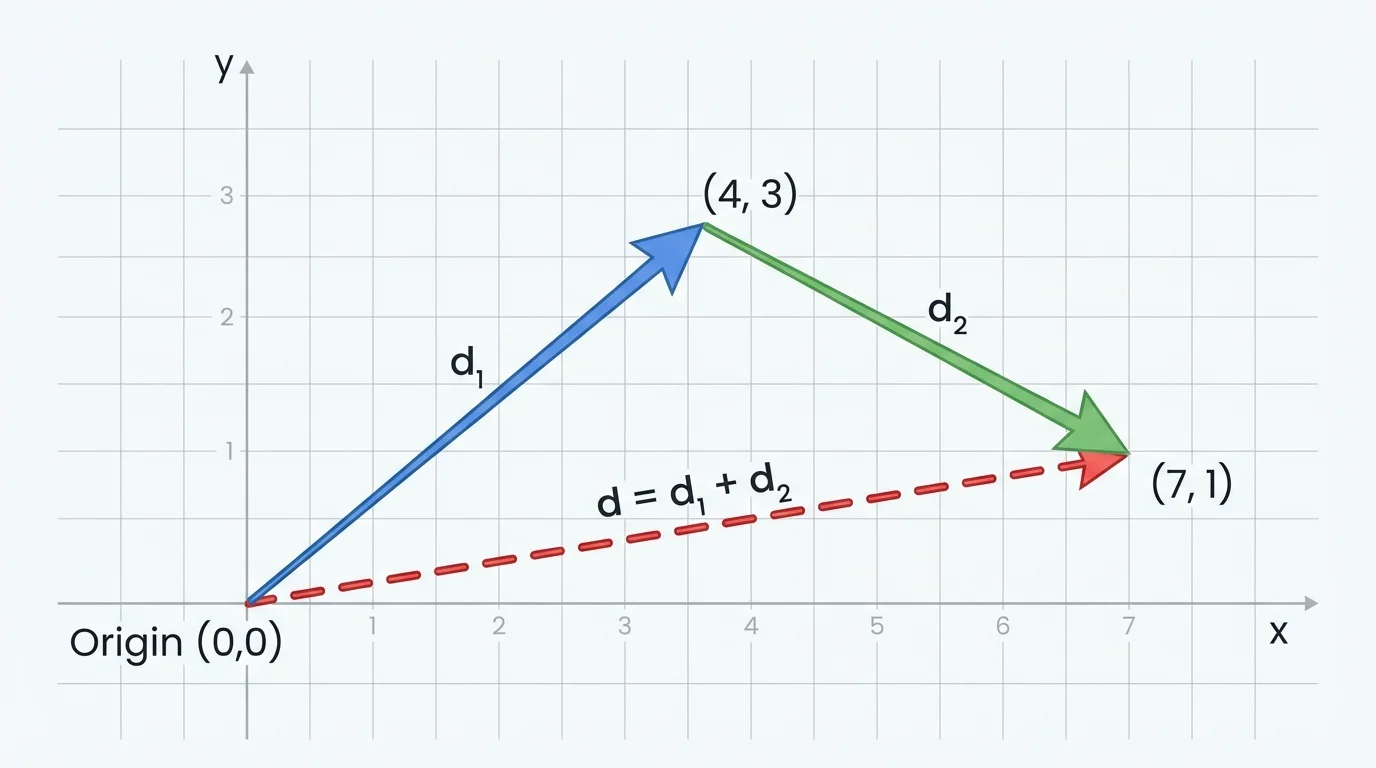
When two vector quantities act together, we combine them by vector addition. The final vector is called the resultant vector, and [Figure 2] shows the common tip-to-tail picture for this idea. If one displacement is followed by another, the total displacement is their vector sum.
Graphically, place the tail of the second vector at the tip of the first. The resultant goes from the start of the first vector to the end of the second. This method gives a visual understanding of how vectors combine.
Algebraically, vector addition is even more precise. If \(\vec{u} = \langle a,b \rangle\) and \(\vec{v} = \langle c,d \rangle\), then
\[\vec{u}+\vec{v} = \langle a+c,\; b+d \rangle\]
Similarly, vector subtraction is
\[\vec{u}-\vec{v} = \langle a-c,\; b-d \rangle\]
Subtraction is useful when you want to compare two motions or find a missing vector. For example, if an airplane's ground velocity and wind velocity are known, then the airplane's velocity relative to the air may be found by subtraction.
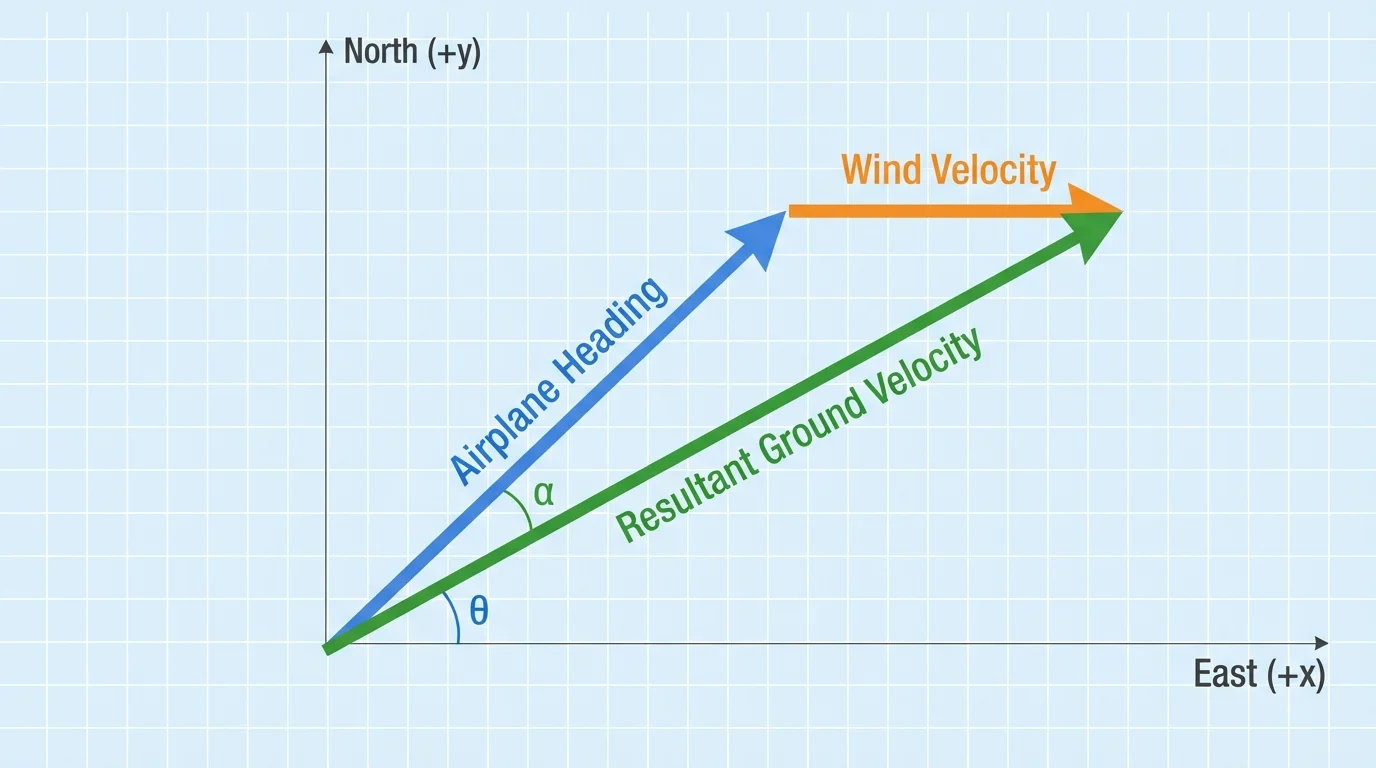
[Figure 3] Velocity tells both speed and direction. In navigation, direction matters just as much as magnitude because wind or current can change the actual path.
It is important to distinguish speed from velocity. Speed is a scalar quantity. Velocity is a vector quantity. A car moving at \(20 \textrm{ m/s}\) north and a car moving at \(20 \textrm{ m/s}\) south have the same speed but different velocities.
When solving problems, students often accidentally use a speed when the situation really requires velocity.
A related vector quantity is displacement. Displacement measures the change in position from start to finish. If you walk around the block and return to where you started, the total distance is not zero, but the displacement is \(0\) because your final position is the same as your initial position.
Many real problems become easier when each vector is written in component form. Then you add or subtract corresponding components, and finally convert back to magnitude and direction if needed.
Suppose a vector has magnitude \(m\) and makes an angle \(\theta\) with the positive \(x\)-axis. Then the horizontal component is \(m\cos \theta\), and the vertical component is \(m\sin \theta\). If the direction is measured from north or south instead of from the \(x\)-axis, you must think carefully about which component uses sine and which uses cosine.
Component strategy
Most vector word problems follow the same pattern: choose axes, write each vector in components, combine the components, and then interpret the result. This method works for walking paths, airplane motion, boat motion, and many force problems.
Signs are also important. East and north are often treated as positive directions, while west and south are negative. A component of \(-5\) does not mean a negative length; it means the vector points in the negative direction along that axis.
Worked example 1: Walking in two directions
A student walks \(120 \textrm{ m}\) east and then \(90 \textrm{ m}\) north. Find the student's displacement.
Step 1: Represent each displacement as a vector.
East is positive \(x\), and north is positive \(y\). So the vectors are \(\langle 120,0 \rangle\) and \(\langle 0,90 \rangle\).
Step 2: Add the vectors.
\(\langle 120,0 \rangle + \langle 0,90 \rangle = \langle 120,90 \rangle\)
Step 3: Find the magnitude.
\(|\vec{d}| = \sqrt{120^2+90^2} = \sqrt{14{,}400+8{,}100} = \sqrt{22{,}500} = 150\)
Step 4: Find the direction.
\(\tan \theta = \dfrac{90}{120} = \dfrac{3}{4}\), so \(\theta \approx 36.9^\circ\).
This angle is measured north of east.
The displacement is \(150 \textrm{ m}\) at about \(36.9^\circ\) north of east.
This result is shorter than the total distance walked, which is \(120+90=210\) meters, because displacement measures the straight-line change in position.
Worked example 2: Airplane and wind
An airplane flies at \(200 \textrm{ km/h}\) due east relative to the air. A wind blows at \(50 \textrm{ km/h}\) due north. Find the airplane's ground velocity.
Step 1: Write each velocity as a vector.
The airplane's velocity relative to the air is \(\langle 200,0 \rangle\). The wind velocity is \(\langle 0,50 \rangle\).
Step 2: Add the vectors.
Ground velocity \(= \langle 200,0 \rangle + \langle 0,50 \rangle = \langle 200,50 \rangle\).
Step 3: Find the magnitude.
\(|\vec{v}| = \sqrt{200^2+50^2} = \sqrt{40{,}000+2{,}500} = \sqrt{42{,}500} \approx 206.2\)
Step 4: Find the direction.
\(\tan \theta = \dfrac{50}{200} = 0.25\), so \(\theta \approx 14.0^\circ\).
The airplane's ground velocity is approximately \(206.2 \textrm{ km/h}\) at \(14.0^\circ\) north of east.
This is exactly the kind of situation pilots study. The plane points east through the air, but the wind changes the actual path over the ground, as we also see in [Figure 3].
Worked example 3: Boat crossing a river
A boat moves at \(8 \textrm{ m/s}\) straight across a river, heading north. The river current flows east at \(3 \textrm{ m/s}\). How fast and in what direction does the boat move relative to the bank?
Step 1: Assign coordinates.
Let east be positive \(x\) and north be positive \(y\). Then the boat's velocity is \(\langle 0,8 \rangle\) and the current is \(\langle 3,0 \rangle\).
Step 2: Add the vectors.
\(\langle 0,8 \rangle + \langle 3,0 \rangle = \langle 3,8 \rangle\)
Step 3: Find the speed relative to the shore.
\(|\vec{v}| = \sqrt{3^2+8^2} = \sqrt{9+64} = \sqrt{73} \approx 8.54\)
Step 4: Find the direction.
If the angle is measured east of north, then \(\tan \theta = \dfrac{3}{8}\), so \(\theta \approx 20.6^\circ\).
The boat moves at about \(8.54 \textrm{ m/s}\) and travels \(20.6^\circ\) east of north.
This explains why a boat aimed straight across a river often lands downstream from the point directly opposite its start.
Worked example 4: Finding components from magnitude and direction
A drone has velocity magnitude \(30 \textrm{ m/s}\) at an angle of \(40^\circ\) above the positive \(x\)-axis. Find its component form.
Step 1: Use the component formulas.
Horizontal component: \(30\cos 40^\circ\)
Vertical component: \(30\sin 40^\circ\)
Step 2: Evaluate.
\(30\cos 40^\circ \approx 22.98\)
\(30\sin 40^\circ \approx 19.28\)
Step 3: Write the vector.
\(\vec{v} \approx \langle 22.98, 19.28 \rangle\)
The drone's velocity has components approximately \(\langle 22.98, 19.28 \rangle\), in meters per second.
The same mathematical tools apply to more than velocity. In physics, forces can be added to find a net force. In motion problems, displacement vectors combine to give total change in position. In engineering, component methods help describe loads on bridges, cables, and machine parts.
For example, if one force is \(\langle 5,2 \rangle\) newtons and another is \(\langle -3,4 \rangle\) newtons, then the net force is \(\langle 2,6 \rangle\) newtons. The process is the same as adding velocity vectors.
| Quantity | Scalar or Vector | Why direction matters |
|---|---|---|
| Speed | Scalar | Only size is given |
| Velocity | Vector | Motion depends on direction |
| Distance | Scalar | Total path length only |
| Displacement | Vector | Start-to-finish change has direction |
| Force | Vector | Push or pull acts in a direction |
Table 1. Comparison of common scalar and vector quantities.
Vector thinking appears everywhere once you know how to look for it. Navigation systems combine directions and speeds. Pilots account for wind correction angles. Sailors and kayakers think about current. Game designers use vectors to control motion on a screen. Robot arms use vectors to plan movement in different directions.
Sports also use vectors. A basketball shot has horizontal and vertical velocity components. A tennis player changing the angle of a swing changes the direction of the ball's velocity. In track and field, a long jumper's motion is often analyzed through components.
Modern smartphones and drones use sensors that constantly track direction and motion. Behind many of those calculations are vector ideas, especially when motion must be described in more than one direction at once.
Even weather forecasting uses vectors. Wind maps represent each wind measurement with both speed and direction. Meteorologists do not just ask how strong the wind is; they also ask where it is heading.
One common mistake is adding magnitudes when you should add components. For instance, in the airplane example, it would be wrong to say the ground speed is \(200+50=250\). Those velocities are perpendicular, so the correct magnitude comes from the resultant vector.
Another mistake is giving only the magnitude without direction. A vector answer is incomplete unless both are included, unless the problem asks only for one part.
Students also mix up expressions like north of east and east of north. These mean different starting directions, so they produce different angle descriptions. Drawing a quick sketch often helps.
As in [Figure 1], thinking in terms of horizontal and vertical components helps prevent confusion. And as in [Figure 2], the graphical picture can be used to check whether a computed resultant points in a reasonable direction.
"Direction is part of the answer."
— A central idea in vector modeling
To check reasonableness, ask questions such as these: Should the resultant be longer or shorter than one of the original vectors? Should it point northeast or southeast? If a boat is pushed east by current and north by its motor, then a southwest answer cannot be correct.
