If two airplanes travel through the sky with different velocities, how can you describe one plane's motion relative to the other? That question leads directly to vector subtraction. Unlike ordinary numbers, vectors carry both magnitude and direction, so subtracting them is not just "taking away." It means finding the vector that compares one directed quantity to another.
A vector represents a quantity with both magnitude and direction. Examples include displacement, velocity, acceleration, and force. A number like \(5\) tells you only "how much," but a vector such as \(\langle 5,2\rangle\) tells you both "how much" and "which way."
Because direction matters, vector subtraction must preserve that directional information. If \(\mathbf{v}\) and \(\mathbf{w}\) are vectors, then \(\mathbf{v}-\mathbf{w}\) does not mean erasing \(\mathbf{w}\). Instead, it means combining \(\mathbf{v}\) with the opposite of \(\mathbf{w}\).
From earlier work with integers, subtracting a number can be rewritten as adding its opposite: \(7-3=7+(-3)\). Vector subtraction follows the same idea, but now the "opposite" must reverse direction as well as sign.
This is one of the most important ideas in vector operations: subtraction is really a special case of addition.
[Figure 1] The opposite of a vector is called its additive inverse. If a vector is \(\mathbf{w}\), then its additive inverse is written \(-\mathbf{w}\). \(-\mathbf{w}\) has the same magnitude as \(\mathbf{w}\), but it points in exactly the opposite direction.
If \(\mathbf{w}=\langle a,b\rangle\), then
\[-\mathbf{w}=\langle -a,-b\rangle\]
If \(\mathbf{w}=\langle a,b,c\rangle\), then
\[-\mathbf{w}=\langle -a,-b,-c\rangle\]
Adding a vector and its additive inverse always gives the zero vector:
\[\mathbf{w}+(-\mathbf{w})=\mathbf{0}\]
The zero vector has magnitude \(0\). In component form, it is \(\langle 0,0\rangle\) in two dimensions or \(\langle 0,0,0\rangle\) in three dimensions.
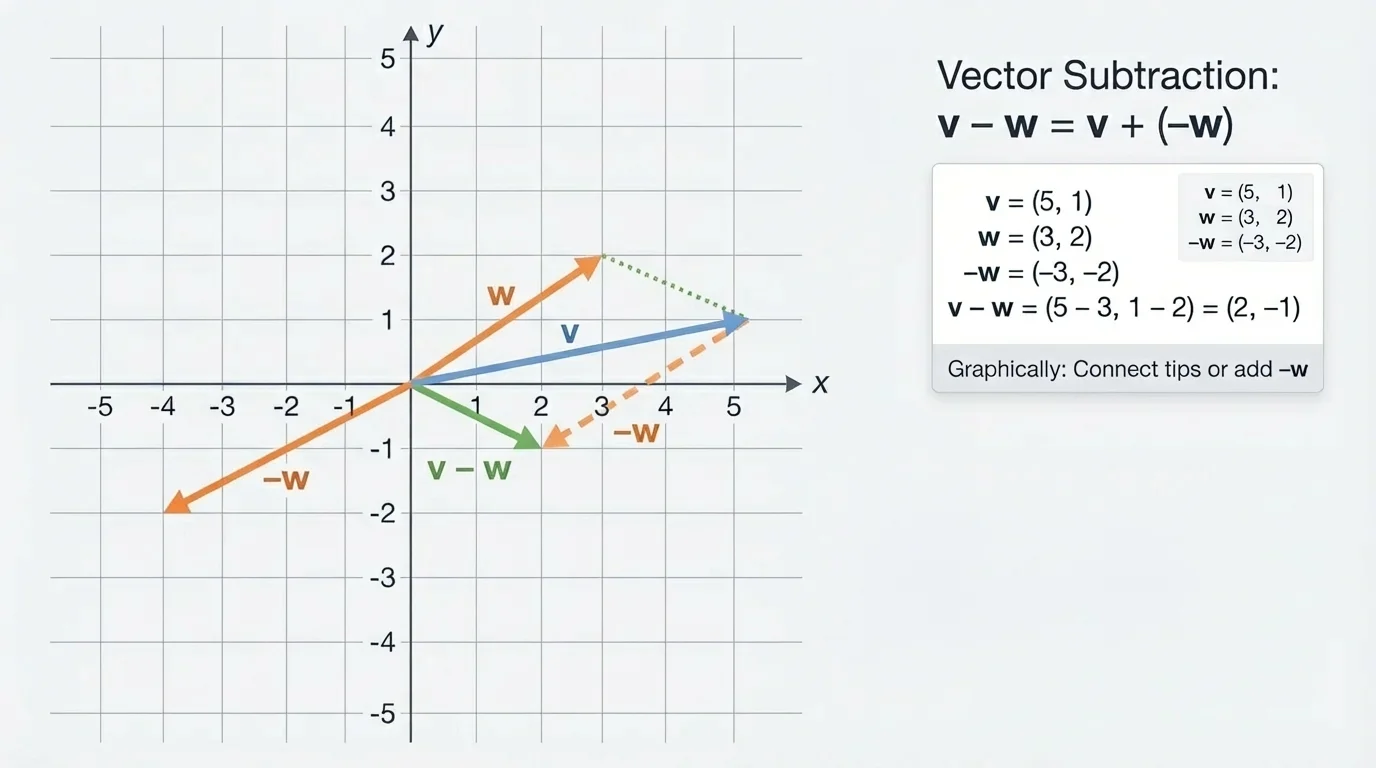
For example, if \(\mathbf{w}=\langle 3,-4\rangle\), then \(-\mathbf{w}=\langle -3,4\rangle\). The length stays the same, but every direction component is reversed. This idea matters because subtraction depends completely on identifying the opposite vector correctly.
Additive inverse means the vector that adds to the original vector to make the zero vector.
Magnitude is the length of a vector.
Direction tells which way the vector points.
In physical terms, if a force pushes \(5\) units east, its additive inverse pushes \(5\) units west. It has the same strength but the opposite direction.
The central rule for vector subtraction is
\[\mathbf{v}-\mathbf{w}=\mathbf{v}+(-\mathbf{w})\]
This formula says that to subtract \(\mathbf{w}\), you first replace it with its opposite, then use vector addition.
That means every method for adding vectors can also be used for subtracting vectors, as long as you reverse the second vector first. This makes subtraction much less mysterious: it is not a completely new operation, but an application of addition.
Suppose \(\mathbf{v}\) represents walking \(8\) meters east and \(\mathbf{w}\) represents walking \(3\) meters east. Then \(\mathbf{v}-\mathbf{w}\) gives the difference in displacement, which is \(5\) meters east. But if \(\mathbf{w}\) points in a different direction, the result is no longer a simple number difference; it becomes a new vector with its own direction.
Why this rule makes sense
Subtraction asks, "What vector must be added to \(\mathbf{w}\) to get \(\mathbf{v}\)?" That missing vector is exactly \(\mathbf{v}-\mathbf{w}\). So vector subtraction compares two vectors rather than merely removing one from another.
This comparison idea is especially useful in physics. If one car has velocity \(\mathbf{v}\) and another has velocity \(\mathbf{w}\), then \(\mathbf{v}-\mathbf{w}\) tells how fast and in what direction the first car moves relative to the second.
[Figure 2] Graphically, vector subtraction can be understood in two connected ways. First, you can rewrite \(\mathbf{v}-\mathbf{w}\) as \(\mathbf{v}+(-\mathbf{w})\) and use the head-to-tail addition method. Second, when \(\mathbf{v}\) and \(\mathbf{w}\) start at the same point, \(\mathbf{v}-\mathbf{w}\) is the vector from the tip of \(\mathbf{w}\) to the tip of \(\mathbf{v}\).
That "tip-to-tip" interpretation is extremely useful. If both vectors begin at the origin, then the subtraction vector shows how to move from where \(\mathbf{w}\) ends to where \(\mathbf{v}\) ends. Order matters: \(\mathbf{v}-\mathbf{w}\) is the vector from the tip of \(\mathbf{w}\) to the tip of \(\mathbf{v}\), not the other way around.
To draw \(\mathbf{v}-\mathbf{w}\) graphically:
Step 1: Draw \(\mathbf{v}\) and \(\mathbf{w}\).
Step 2: Reverse \(\mathbf{w}\) to get \(-\mathbf{w}\).
Step 3: Add \(\mathbf{v}\) and \(-\mathbf{w}\) using head-to-tail.
Step 4: Or, if \(\mathbf{v}\) and \(\mathbf{w}\) start at the same point, connect the tip of \(\mathbf{w}\) to the tip of \(\mathbf{v}\).
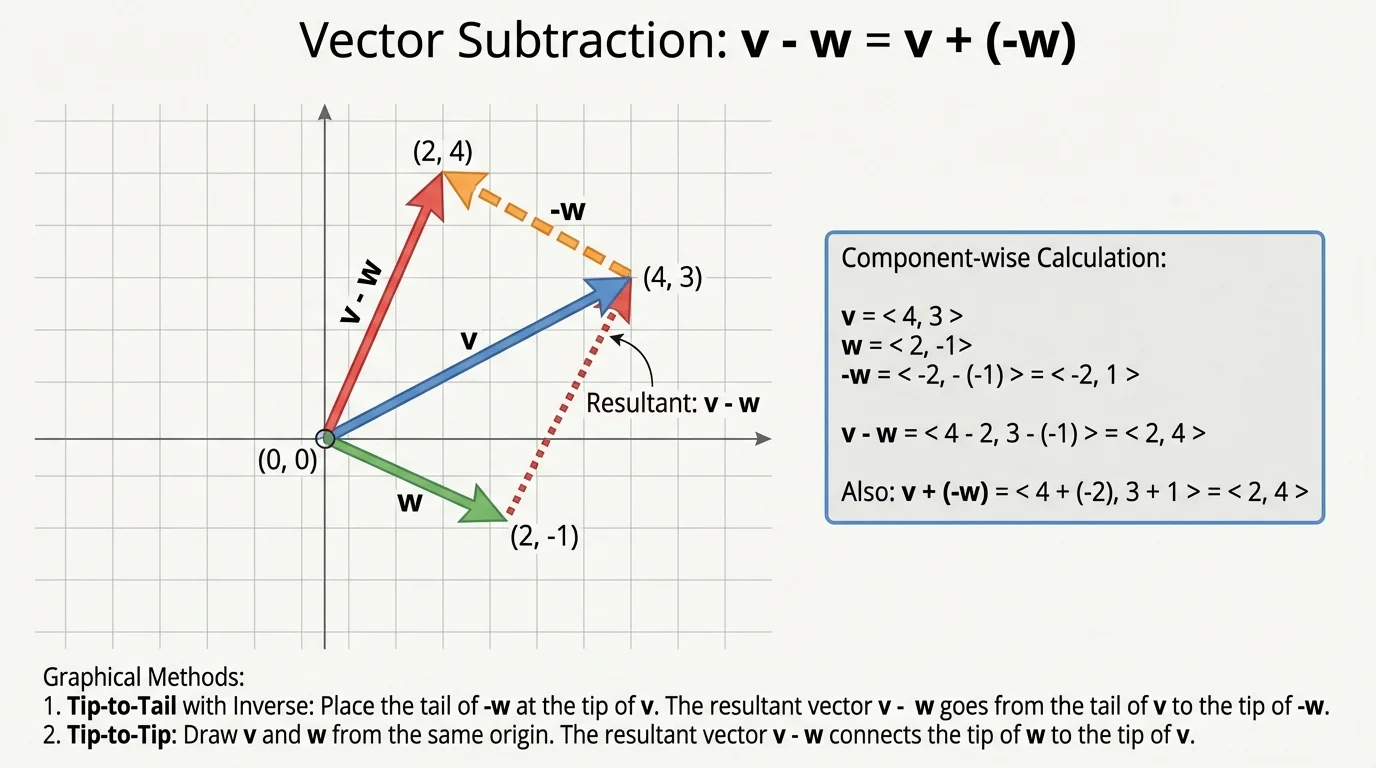
Notice how the order changes everything. The vector \(\mathbf{w}-\mathbf{v}\) would go from the tip of \(\mathbf{v}\) to the tip of \(\mathbf{w}\). Therefore,
\[\mathbf{w}-\mathbf{v}=-(\mathbf{v}-\mathbf{w})\]
This means the two subtraction results are opposites of each other, so they have the same magnitude unless the result is the zero vector.
Pilots and ship navigators constantly compare vectors. A plane's motion through the air and the wind's motion are different vectors, and subtracting them helps determine relative movement and course corrections.
Later, when you work with relative velocity, the tip-to-tip picture from [Figure 2] becomes one of the fastest ways to understand what the subtraction means physically.
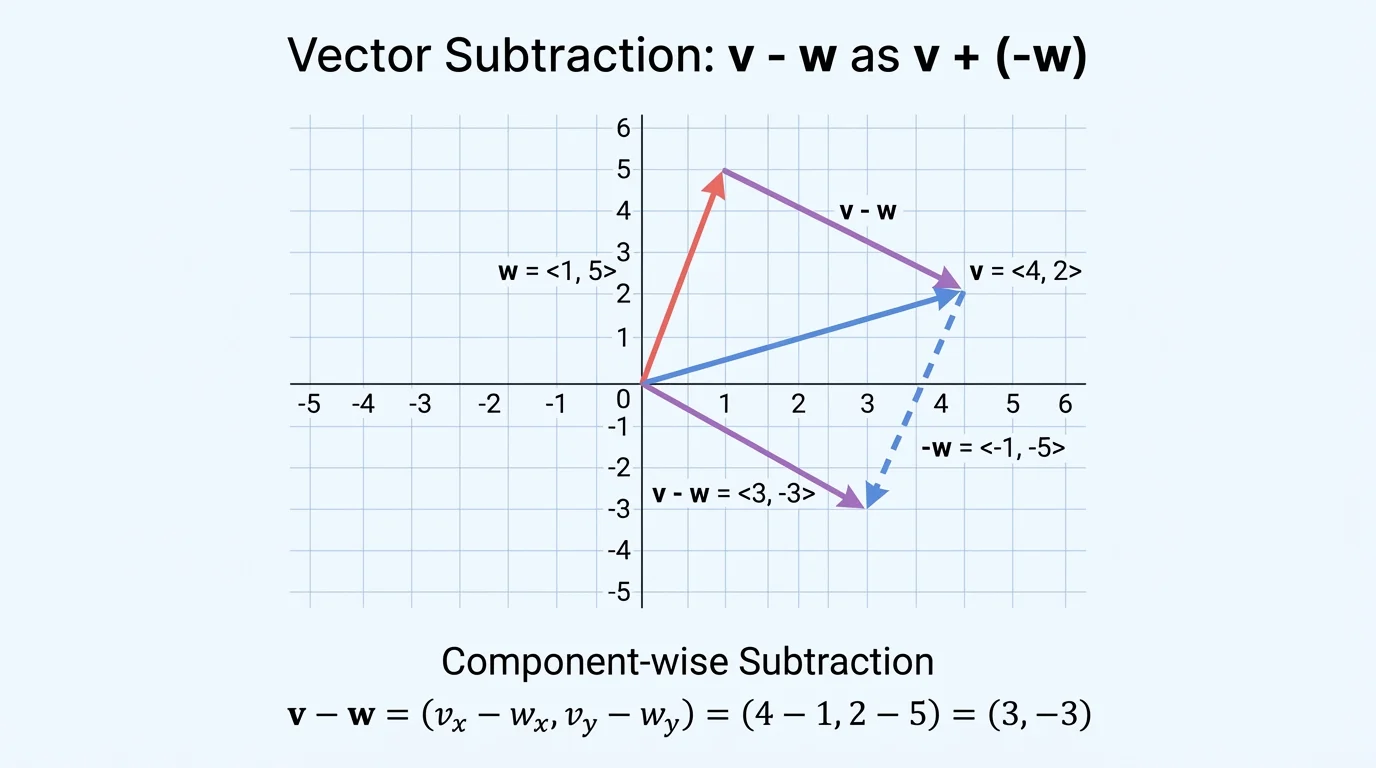
[Figure 3] In coordinate form, vector subtraction is done component by component. The graphical picture and the algebra match exactly, and subtracting coordinates creates the difference vector on a grid.
If
\[\mathbf{v}=\langle v_1,v_2\rangle \quad \textrm{and} \quad \mathbf{w}=\langle w_1,w_2\rangle\]
then
\[\mathbf{v}-\mathbf{w}=\langle v_1-w_1,\,v_2-w_2\rangle\]
In three dimensions, if
\[\mathbf{v}=\langle v_1,v_2,v_3\rangle \quad \textrm{and} \quad \mathbf{w}=\langle w_1,w_2,w_3\rangle\]
then
\[\mathbf{v}-\mathbf{w}=\langle v_1-w_1,\,v_2-w_2,\,v_3-w_3\rangle\]
This rule works because
\[\mathbf{v}-\mathbf{w}=\mathbf{v}+(-\mathbf{w})=\langle v_1,v_2\rangle+\langle -w_1,-w_2\rangle\]
and then adding gives
\[\langle v_1-w_1,\,v_2-w_2\rangle\]
Component-wise subtraction is usually the quickest and most accurate method, especially when vectors are given as coordinates.
| Form of vectors | Subtraction rule |
|---|---|
| \(\langle a,b\rangle-\langle c,d\rangle\) | \(\langle a-c,\,b-d\rangle\) |
| \(\langle a,b,c\rangle-\langle d,e,f\rangle\) | \(\langle a-d,\,b-e,\,c-f\rangle\) |
Table 1. Component-wise subtraction rules for two-dimensional and three-dimensional vectors.
The most reliable way to master vector subtraction is to connect the algebra, the geometry, and the meaning of the result.
Worked Example 1: Subtracting in two dimensions
Find \(\mathbf{v}-\mathbf{w}\) if \(\mathbf{v}=\langle 7,-2\rangle\) and \(\mathbf{w}=\langle 3,4\rangle\).
Step 1: Write the subtraction component-wise.
\(\mathbf{v}-\mathbf{w}=\langle 7,-2\rangle-\langle 3,4\rangle\)
Step 2: Subtract corresponding components.
\(7-3=4\) and \(-2-4=-6\)
Step 3: Write the result as a vector.
\[\mathbf{v}-\mathbf{w}=\langle 4,-6\rangle\]
The difference vector is \(\langle 4,-6\rangle\).
You can also interpret this as adding the opposite: \(-\mathbf{w}=\langle -3,-4\rangle\), so \(\mathbf{v}+(-\mathbf{w})=\langle 7,-2\rangle+\langle -3,-4\rangle=\langle 4,-6\rangle\).
Worked Example 2: Understanding the graph
Let \(\mathbf{v}=\langle 5,1\rangle\) and \(\mathbf{w}=\langle 2,4\rangle\). Find \(\mathbf{v}-\mathbf{w}\) and explain it graphically.
Step 1: Subtract the components.
\(\mathbf{v}-\mathbf{w}=\langle 5-2,\,1-4\rangle=\langle 3,-3\rangle\)
Step 2: Identify the opposite of \(\mathbf{w}\).
\(-\mathbf{w}=\langle -2,-4\rangle\)
Step 3: Add \(\mathbf{v}\) and \(-\mathbf{w}\).
\(\langle 5,1\rangle+\langle -2,-4\rangle=\langle 3,-3\rangle\)
Step 4: Interpret on the graph.
If both original vectors start at the origin, then the vector from the tip of \(\mathbf{w}\) to the tip of \(\mathbf{v}\) is \(\langle 3,-3\rangle\).
This is the same relationship shown on a coordinate grid.
The graph and the component calculation agree because both describe the same movement: \(3\) units right and \(3\) units down.
Worked Example 3: Subtracting three-dimensional vectors
Find \(\mathbf{a}-\mathbf{b}\) if \(\mathbf{a}=\langle 6,-1,4\rangle\) and \(\mathbf{b}=\langle 2,3,-5\rangle\).
Step 1: Write the subtraction.
\(\mathbf{a}-\mathbf{b}=\langle 6,-1,4\rangle-\langle 2,3,-5\rangle\)
Step 2: Subtract each component carefully.
\(6-2=4\), \(-1-3=-4\), and \(4-(-5)=9\)
Step 3: State the final vector.
\[\mathbf{a}-\mathbf{b}=\langle 4,-4,9\rangle\]
The third component becomes \(9\) because subtracting a negative is the same as adding a positive.
This sign change is a very common place for mistakes, so it is worth checking each component separately.
Worked Example 4: Relative velocity
A boat moves with velocity \(\langle 12,5\rangle\) relative to the shore, while the river current has velocity \(\langle 4,1\rangle\). Find the boat's velocity relative to the water.
Step 1: Identify what is being compared.
Velocity relative to water equals total velocity minus current velocity.
Step 2: Subtract the vectors.
\(\langle 12,5\rangle-\langle 4,1\rangle=\langle 8,4\rangle\)
Step 3: Interpret the result.
The boat's own motion through the water is \(\langle 8,4\rangle\).
Vector subtraction separates one effect from another.
Relative motion problems are one reason vector subtraction matters far beyond the classroom.
The most common error is subtracting in the wrong order. In general,
\[\mathbf{v}-\mathbf{w} \neq \mathbf{w}-\mathbf{v}\]
These two results are opposites, not equals. The direction changes completely.
A second common error is forgetting to reverse the second vector. To subtract \(\mathbf{w}\), you must use \(-\mathbf{w}\), not \(\mathbf{w}\) itself. The opposite-vector idea from [Figure 1] helps prevent this mistake.
A third common error appears with negative components. For instance, if you compute \(2-(-3)\), the result is \(5\), not \(-1\). Writing one component at a time can make the signs easier to manage.
A useful check is to rewrite every subtraction as addition:
\[\mathbf{v}-\mathbf{w}=\mathbf{v}+(-\mathbf{w})\]
If your result does not match both methods, go back and look for a sign error.
Vector subtraction appears whenever two motions, positions, or forces are compared.
Displacement: If a hiker's position is represented by one vector and a campsite's position by another, subtracting the vectors gives the direction and distance relationship between the two locations.
Relative velocity: Airplanes, boats, drones, and satellites often move in environments that are themselves moving. Engineers use subtraction to compare one velocity vector to another. The geometric interpretation from [Figure 2] helps show why the answer represents one object's motion as seen from another object.
Forces: If two forces act in different directions, subtracting them can help determine how much one force offsets another. In equilibrium problems, opposite vectors are especially important because vectors that sum to zero balance out.
Computer graphics and gaming: Programs use vector subtraction to determine direction from one object to another, camera movement, and collision response. A game engine might subtract a player's position vector from a target's position vector to determine which way the player should move.
"A vector tells not only how much, but which way."
— Core idea of vector reasoning
That is why vector subtraction is so powerful: it gives a comparison that still contains both magnitude and direction.
By now, three views of subtraction should fit together. Algebraically, you subtract components. Geometrically, you connect tips in the correct order or add the opposite vector. Conceptually, you compare two directed quantities.
When those three views agree, you know you understand the operation rather than just memorizing a rule.
