Have you ever noticed that a number like \(500\) looks big, but it is actually built in a very neat way? It means five hundreds and nothing else. No extra tens. No extra ones. That is what makes numbers like \(100\), \(200\), \(300\), all the way to \(900\) a special group of three-digit numbers.
When we understand these numbers, we understand something very important about our number system: the place where a digit sits changes its value. As [Figure 1] shows, a \(5\) in \(500\) does not mean five ones. It means five hundreds. That is a much bigger amount.
In our place value system, a three-digit number has three places: hundreds, tens, and ones. The digit in each place tells how many hundreds, tens, or ones the number has. For example, in \(300\), the \(3\) is in the hundreds place, so it means \(3\) hundreds.
We can think of a three-digit number as pieces put together. A number can have some hundreds, some tens, and some ones. For example, \(472\) has \(4\) hundreds, \(7\) tens, and \(2\) ones. But exact hundreds are a special case because the tens and ones parts are both \(0\).
This means that exact hundreds are built in a very simple way. The first digit tells the number of hundreds, and the next two digits are zeros. So \(100\) means \(1\) hundred, \(0\) tens, and \(0\) ones. And \(800\) means \(8\) hundreds, \(0\) tens, and \(0\) ones.
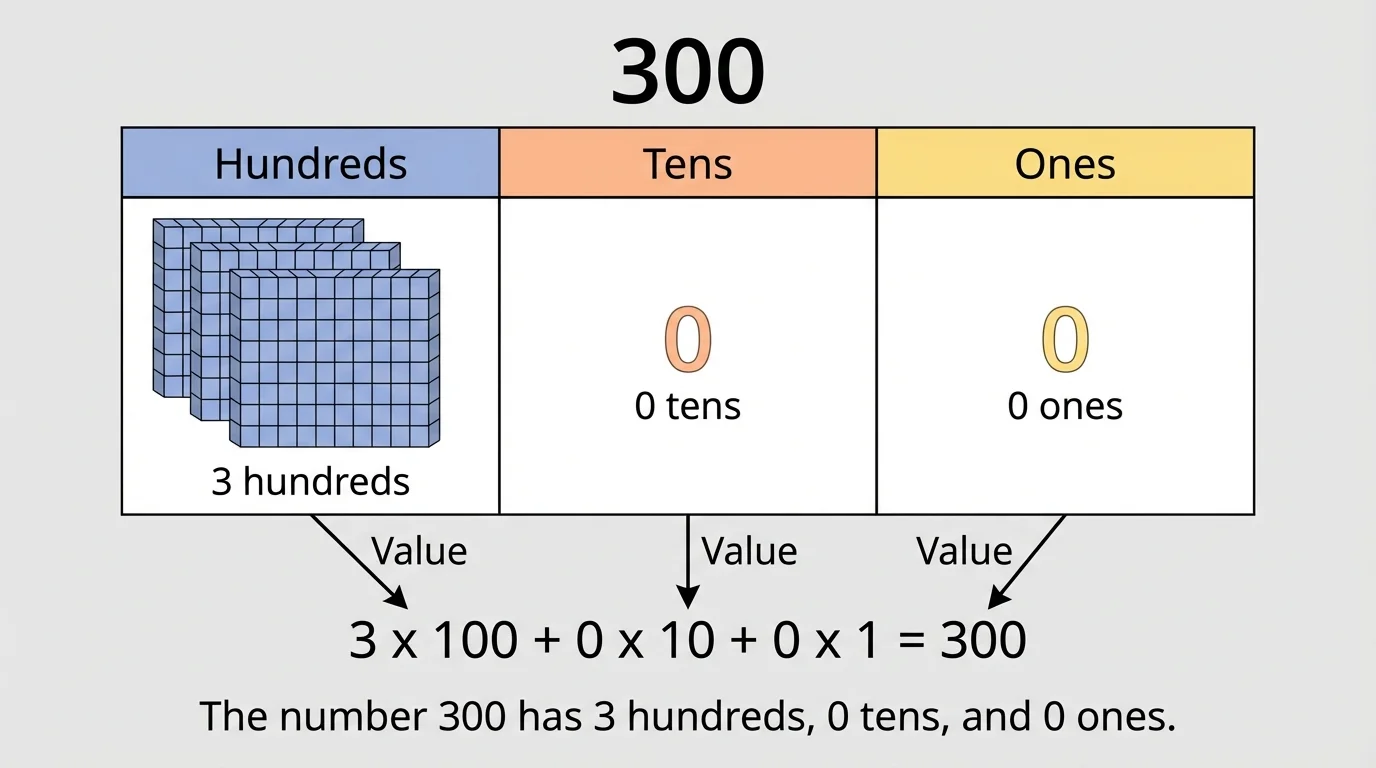
Exact hundreds are the numbers \(100\), \(200\), \(300\), \(400\), \(500\), \(600\), \(700\), \(800\), and \(900\). Each one has a certain number of hundreds and has \(0\) tens and \(0\) ones.
You already know that \(10\) ones make \(1\) ten. There is another important pattern: \(10\) tens make \(1\) hundred. So:
\(100 = 10\) tens
and
\(100 = 100\) ones.
That is why one hundred is such a big jump from two-digit numbers. A hundred is made of many smaller parts, but when we write it as \(100\), we are showing it as one hundred.
Now let us focus on the special numbers in this lesson:
\(100, 200, 300, 400, 500, 600, 700, 800, 900\)
Each of these numbers tells how many hundreds there are.
The zeros are important. They tell us there are no tens and no ones left over. If we changed one of those zeros, the number would no longer be an exact hundred. For example, \(500\) is five hundreds exactly, but \(507\) is five hundreds, zero tens, and seven ones.
Why zeros matter
Zeros can be very powerful in place value. In \(400\), the two zeros do not mean "nothing important." They tell us that all the value is coming from the hundreds place. Without the zeros, the number would not show exact hundreds correctly.
We can also write exact hundreds in expanded form. Expanded form shows the value of each place.
For exact hundreds, the expanded form looks like this:
\(300 = 300 + 0 + 0\)
\(700 = 700 + 0 + 0\)
Often, we simply say that \(700\) is \(7\) hundreds.
When we count by hundreds, we jump from one exact hundred to the next by adding \(100\) each time. As [Figure 2] illustrates, the numbers land in an even pattern: \(100, 200, 300, 400, 500, 600, 700, 800, 900\). This pattern helps us read and say these numbers correctly.
Here is how to match the numeral, the word name, and the number of hundreds.
| Numeral | Word form | How many hundreds? |
|---|---|---|
| \(100\) | one hundred | \(1\) |
| \(200\) | two hundred | \(2\) |
| \(300\) | three hundred | \(3\) |
| \(400\) | four hundred | \(4\) |
| \(500\) | five hundred | \(5\) |
| \(600\) | six hundred | \(6\) |
| \(700\) | seven hundred | \(7\) |
| \(800\) | eight hundred | \(8\) |
| \(900\) | nine hundred | \(9\) |
Table 1. The numeral, word form, and number of hundreds for exact hundreds from \(100\) to \(900\).
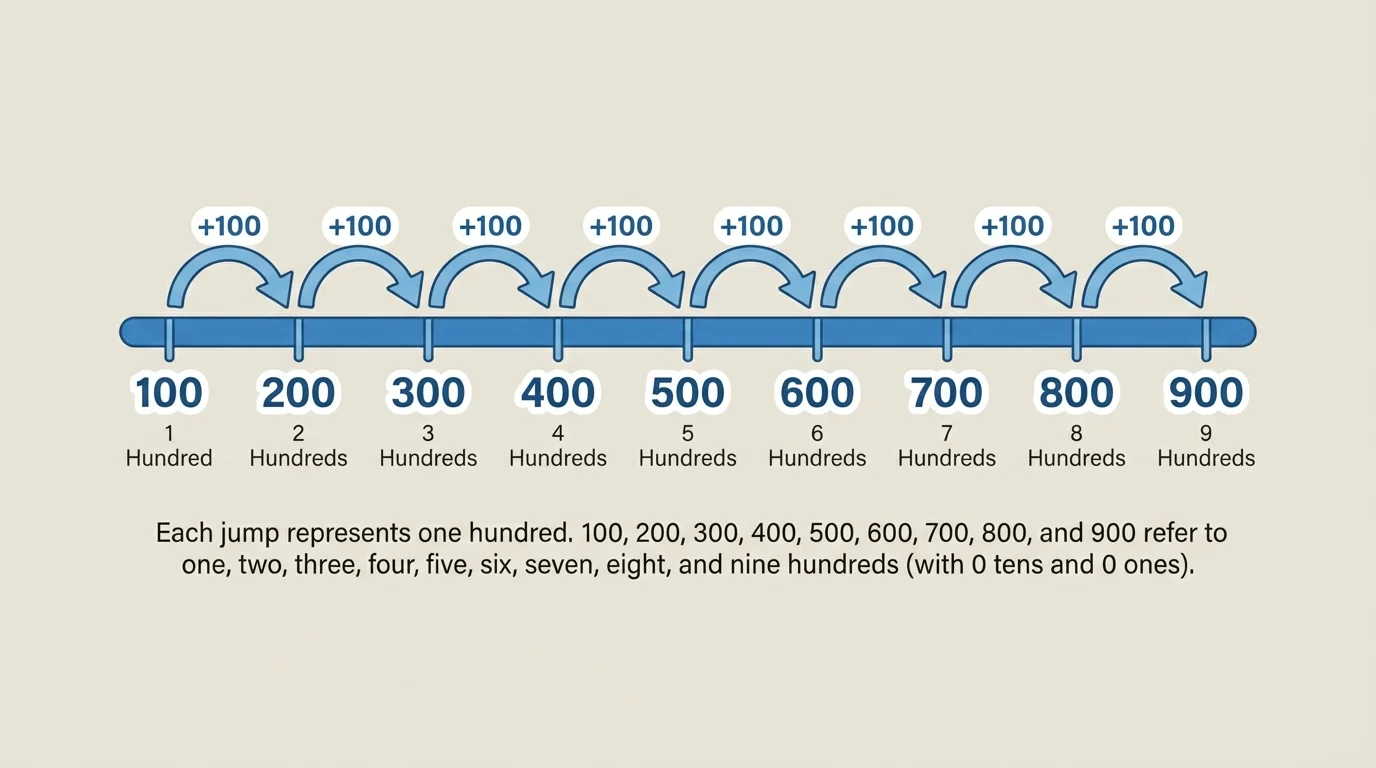
Notice the pattern in the hundreds digit. It goes \(1, 2, 3, 4, 5, 6, 7, 8, 9\), while the tens and ones digits stay \(0\) and \(0\). That is what makes these numbers easy to spot.
If you see a number ending in two zeros and the first digit is from \(1\) to \(9\), then you know it is an exact hundred. We can see the same pattern again on the number line in [Figure 2], where each jump is exactly \(100\).
The number \(100\) is sometimes called a century in other situations. For example, \(100\) years make one century. That shows how often people use groups of \(100\) in real life.
Another way to represent these numbers is with base-ten blocks. One flat can stand for \(100\). So \(600\) would be shown with six hundreds blocks, no tens rods, and no ones cubes.
Let us work through some examples step by step.
Worked example 1
What does \(400\) mean in hundreds, tens, and ones?
Step 1: Look at each digit.
In \(400\), the digits are \(4\), \(0\), and \(0\).
Step 2: Match each digit to its place.
The \(4\) is in the hundreds place, the first \(0\) is in the tens place, and the second \(0\) is in the ones place.
Step 3: State the value of each place.
\(400\) means \(4\) hundreds, \(0\) tens, and \(0\) ones.
The answer is: \(400 = 4\) hundreds, \(0\) tens, \(0\) ones.
This example shows the special pattern again: one nonzero digit in the hundreds place and zeros in the other two places.
Worked example 2
Write the number for seven hundreds, zero tens, and zero ones.
Step 1: Put \(7\) in the hundreds place.
The number starts as \(7\_\_\).
Step 2: Put \(0\) in the tens place.
Now it is \(70\_\).
Step 3: Put \(0\) in the ones place.
The number is \(700\).
The answer is: \(700\).
You can say this number as seven hundred.
Worked example 3
Which is greater: \(300\) or \(800\)?
Step 1: Compare the hundreds digits.
\(300\) has \(3\) hundreds. \(800\) has \(8\) hundreds.
Step 2: Decide which hundreds amount is larger.
Since \(8\) hundreds is more than \(3\) hundreds, \(800\) is greater.
The answer is: \(800 > 300\).
When exact hundreds are compared, the hundreds digit tells the whole story because the tens and ones are both \(0\).
Worked example 4
Write \(900\) in expanded form and in words.
Step 1: Think about the place values.
\(900\) has \(9\) hundreds, \(0\) tens, and \(0\) ones.
Step 2: Write the expanded form.
\(900 = 900 + 0 + 0\).
Step 3: Write the word form.
The word form is nine hundred.
The answer is: expanded form \(900 = 900 + 0 + 0\), word form nine hundred.
Exact hundreds are easy to compare because only the hundreds digit changes. The tens and ones are always \(0\).
Here are some comparisons:
Here is the exact-hundreds order from least to greatest:
\(100, 200, 300, 400, 500, 600, 700, 800, 900\)
Every step increases by \(100\). If you add \(100\) to an exact hundred, you move to the next exact hundred. For example, \(300 + 100 = 400\).
You may already know how to count by tens: \(10, 20, 30, 40\). Counting by hundreds works the same way, but each jump is bigger: \(100, 200, 300, 400\).
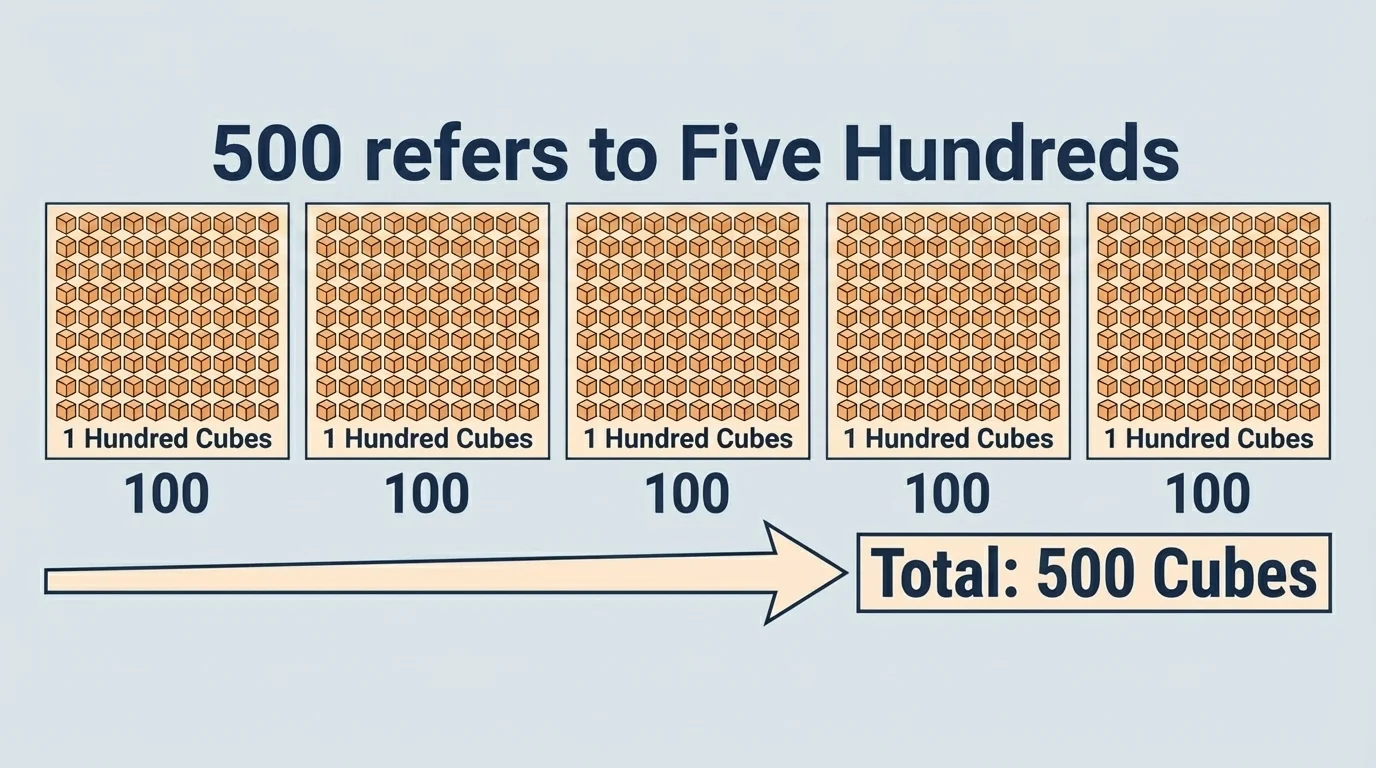
As [Figure 3] shows, this counting pattern is useful in many math situations, especially when you estimate or count large groups quickly.
Groups of \(100\) appear in everyday life more often than you might think. If there are \(5\) groups of \(100\) stickers, then there are \(500\) stickers altogether. That means \(500\) is not just a number to read; it describes a real collection made of five hundreds.
A school library might have \(300\) new books. A stadium section might have \(800\) seats. A toy factory might pack blocks in boxes of \(100\), so \(600\) blocks means six full boxes of \(100\).
Money can also connect to hundreds. If someone has \(100\) pennies, that is \(100\) ones. If objects are bundled in groups of \(100\), it becomes much easier to count large amounts.
Later, when students work with larger numbers, this idea becomes very helpful. The picture of equal groups in [Figure 3] reminds us that exact hundreds are really counts of how many groups of \(100\) there are.
One mistake is thinking that \(400\) means four ones because of the digit \(4\). But the digit's value depends on its place. In \(400\), the \(4\) is in the hundreds place, so it means \(4\) hundreds.
Another mistake is ignoring the zeros. In \(200\), the zeros matter. They tell us there are no tens and no ones. If the number were \(210\), that would be \(2\) hundreds, \(1\) ten, and \(0\) ones, which is different from \(200\).
Some students also mix up \(100\) and \(1000\). The number \(100\) has one hundred. The number \(1000\) has one thousand. They look similar, but \(1000\) has one more zero and is much larger.
Exact hundreds help us understand other three-digit numbers too. For example, \(706\) means \(7\) hundreds, \(0\) tens, and \(6\) ones. That number is not an exact hundred because it has \(6\) ones.
Also, \(340\) means \(3\) hundreds, \(4\) tens, and \(0\) ones. Again, it is not an exact hundred because the tens digit is not \(0\).
So the special rule is this: a number is an exact hundred only when it has one nonzero digit in the hundreds place and \(0\) in both the tens and ones places.
