Have you ever noticed how often people use length math without even saying, "I am doing math"? When someone cuts ribbon, measures a desk, or compares two jumps on the playground, they are using length. Length tells how long something is, and we can use addition and subtraction to solve length problems when the measurements use the same unit, such as centimeters or inches.
Sometimes we put lengths together. Sometimes we compare lengths. Sometimes we know the whole length and one part, and we need to find the missing part. All of these can be solved with the math you already know: addition and subtraction within \(100\).
When we solve a length problem, we should look carefully at the words. The words help us decide whether to add or subtract. We should also notice the unit. If one object is measured in centimeters, the other length should also be in centimeters before we combine or compare them.
You already know that addition can join parts to make a whole, and subtraction can find what is left or how much bigger one number is than another. Length problems use those same ideas, but now the numbers stand for measured distances.
A length problem is not only about getting a number. It is also about understanding what that number means. If a rope is \(35\) centimeters long and another rope is \(22\) centimeters long, the answer tells a real distance, not just a math fact.
Some word clues often appear in length problems. Words like total, altogether, or in all usually mean we are joining lengths, so addition may help. Words like how much longer, how much shorter, how many centimeters more, or left often mean subtraction may help.
But the most important step is to think about the story. Do not choose an operation just because of one word. Ask yourself: "Am I joining lengths, comparing lengths, or finding a missing part?"
Length is the distance from one end of an object to the other.
Same units means the measurements use the same kind of unit, such as all centimeters or all inches.
Unknown is the number we do not know yet. We can show it with a symbol such as \(\square\) or \(x\).
If a problem says a book is \(19\) inches long and a table is \(54\) inches long, the lengths are in the same unit, so we can compare them directly. If both are measured in centimeters, that also works. Keeping units the same makes the math meaningful.
Drawings help us see what is happening in a problem, as [Figure 1] shows with ruler-style and bar-model pictures. A drawing can show two lengths joined together, or it can show the extra part when one length is longer than another.
One helpful drawing is a ruler drawing. You can sketch a line like a ruler and mark where a length starts and ends. Another helpful drawing is a bar model. A bar model uses rectangles or strips to show lengths. Longer bars mean longer lengths.
Suppose one string is \(26\) centimeters and another is \(18\) centimeters. A drawing can show one bar of length \(26\) and one bar of length \(18\). If we place them end to end, we can see the whole length. If we line them up at one end, we can see the difference between them.
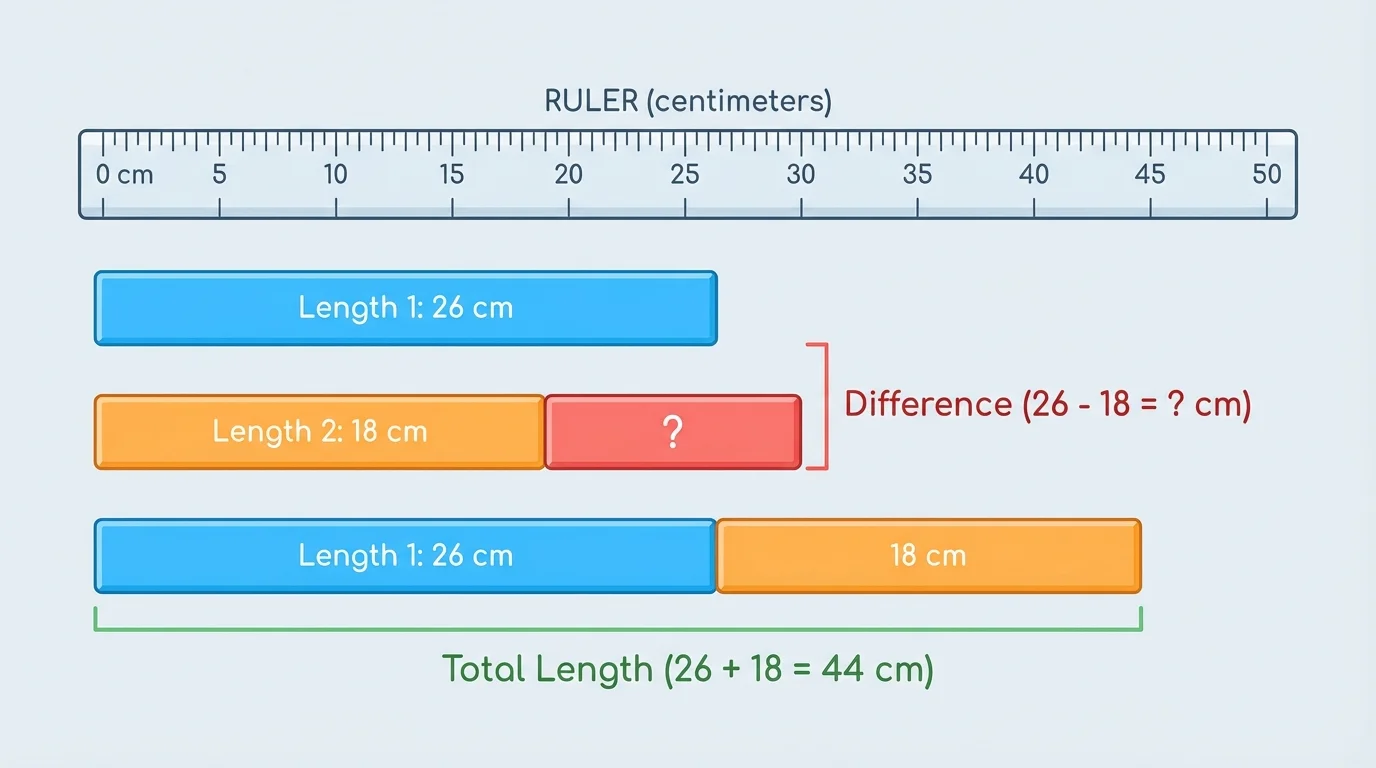
These drawings are not just pictures. They help us choose the operation. End-to-end bars usually help us think about addition. Side-by-side bars with one longer than the other usually help us think about subtraction.
How drawings connect to equations
A drawing shows the story, and an equation shows the math. If the drawing shows two parts joined to make one whole, we can write an addition equation. If the drawing shows one longer bar and one shorter bar, with an extra piece, we can write a subtraction equation to find that extra piece.
Later, when you solve harder measurement problems, the same idea stays useful. The picture helps you organize the information before you start calculating.
An equation is a math sentence. In length problems, we often write an equation with a symbol for the number we do not know yet. That symbol might be \(\square\), \(?\), or \(x\).
For example, if two ribbons are \(24\) centimeters and \(13\) centimeters long, and we want the total length, we can write:
\[24 + 13 = \square\]
If one ribbon is \(41\) centimeters long and another is \(26\) centimeters long, and we want to know how much longer the first ribbon is, we can write:
\[41 - 26 = \square\]
If a rope is \(60\) centimeters long in all, and one piece is \(25\) centimeters, the missing piece can be shown with:
\[25 + \square = 60\]
We can also solve that same problem with subtraction:
\[60 - 25 = \square\]
Both equations can help because they tell the same story in different ways.
When two lengths are joined, we add. This happens when objects are placed end to end, such as two pieces of ribbon or two toy train tracks.
Worked example
A red ribbon is \(27\) centimeters long. A blue ribbon is \(15\) centimeters long. If the ribbons are put end to end, how long are they altogether?
Step 1: Decide what the problem is asking.
We are finding the total of two lengths, so we add.
Step 2: Write an equation.
\(27 + 15 = \square\)
Step 3: Solve.
\(27 + 10 = 37\), and \(37 + 5 = 42\).
Step 4: Write the answer with the unit.
\[27 + 15 = 42\]
The ribbons are \(42\) centimeters long altogether.
The unit stays centimeters because both lengths were measured in centimeters. If we forgot the unit, the answer would not tell the whole story.
Comparison problems ask how much longer or shorter one object is than another. [Figure 2] shows how a comparison drawing makes the subtraction easy to see by highlighting the extra part that belongs only to the longer length.
Worked example
A marker is \(47\) centimeters long. A crayon is \(32\) centimeters long. How much longer is the marker?
Step 1: Decide what the problem is asking.
We are comparing two lengths, so we subtract.
Step 2: Write an equation.
\(47 - 32 = \square\)
Step 3: Solve.
Subtract to find the difference: \(47 - 32 = 15\).
Step 4: State the answer.
\[47 - 32 = 15\]
The marker is \(15\) centimeters longer.
Another way to think about this is to ask, "What number added to \(32\) makes \(47\)?" Since \(32 + 15 = 47\), the difference is \(15\). That is why addition and subtraction are connected.
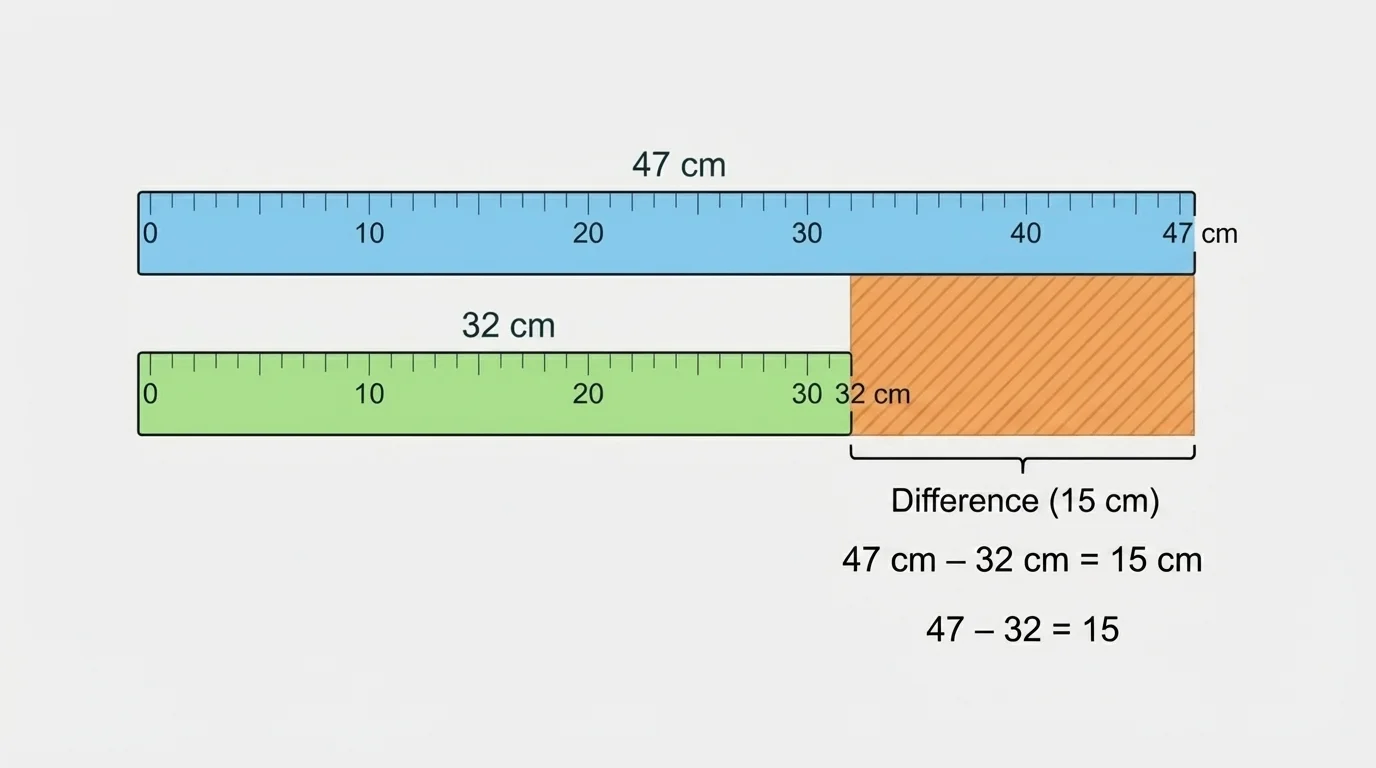
We can return to the comparison picture later when checking our work. If the shorter bar plus the extra part equals the longer bar, the answer makes sense.
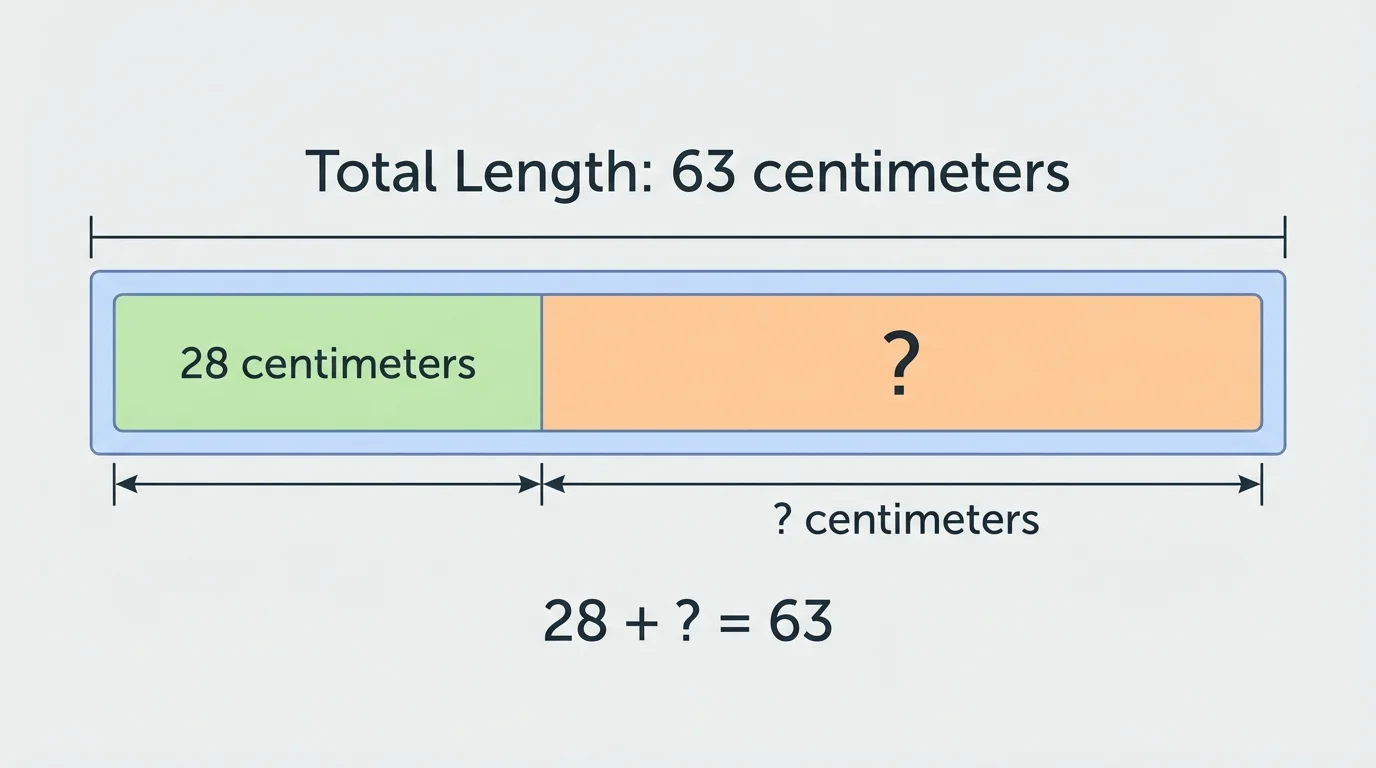
A missing-part drawing, shown in [Figure 3], helps us see how the unknown piece fills the rest of the whole when we know the total length and one part.
This kind of problem can be solved with subtraction, or with an addition equation that has the unknown in it. Both methods are correct.
Worked example
A strip of paper is \(63\) centimeters long. One piece of the strip is \(28\) centimeters long. How long is the other piece?
Step 1: Understand the story.
We know the whole length and one part. We need the missing part.
Step 2: Write an equation with an unknown.
\(28 + \square = 63\)
Step 3: Solve by subtraction.
Since the whole is \(63\) and one part is \(28\), compute \(63 - 28 = 35\).
Step 4: Check with addition.
\(28 + 35 = 63\), so the answer fits the story.
The other piece is \(35\) centimeters long.
Notice that the unknown did not have to come at the end of the equation. An unknown can appear in any place. The equation still tells the length story.
Good problem solvers do not stop after finding a number. They check the answer. One way is to ask whether the answer should be bigger or smaller than the numbers in the problem.
If you add two lengths, the total should be greater than each part. For example, \(19 + 21 = 40\), and \(40\) is greater than \(19\) and \(21\). If you subtract to compare lengths, the difference should usually be smaller than the longer length.
Professional builders, tailors, and designers check measurements more than once. A tiny mistake in length can change how something fits together.
You can also use the opposite operation to check. If you solved \(54 - 17 = 37\), check by adding: \(37 + 17 = 54\). In missing-part problems, this is especially useful. The bar model from [Figure 3] reminds us that the known part and missing part should join to make the whole length.
Length math appears in many places. In art class, students may join strips of paper. In sports, they may compare the distances of two jumps. At home, someone may cut string for a project. In the classroom, students may compare the lengths of pencils, books, or desks.
Here are a few quick situations:
These are all length stories. The numbers mean real measured distances, so the unit matters every time.
One common mistake is mixing up addition and subtraction. If the problem asks for the total length, add. If it asks how much longer, how much shorter, or how much is left, subtract.
Another common mistake is forgetting the unit. An answer should say centimeters, inches, or whichever unit the problem uses. Writing only \(31\) is not as clear as writing \(31\) centimeters.
A third mistake is ignoring the story and only looking at the numbers. For example, if a problem says a rope is \(80\) centimeters long and \(22\) centimeters are cut off, the remaining length must be less than \(80\), so subtraction makes sense.
| Problem type | What it means | Helpful equation |
|---|---|---|
| Total length | Join two or more lengths | \(a + b = \square\) |
| Compare lengths | Find how much longer or shorter | \(a - b = \square\) |
| Missing part | Find an unknown piece of a whole | \(a + \square = c\) or \(c - a = \square\) |
Table 1. Common types of length word problems and equations that match them.
As you become more confident, drawings may become quicker and simpler. You might sketch just a few lines or bars. Even a simple picture can help you understand a problem before solving it.
"A picture helps the numbers tell the story."
When you combine careful reading, a helpful drawing, and a clear equation, length problems become much easier to solve. [Figure 1] highlights the two big ideas of this lesson: lengths can be joined to make a total, or compared to find a difference.
