Have you ever noticed that a game score, the number of books in a library, or the distance on a road sign can be a big number, but you can still work with it if you understand the parts inside it? A number like \(684\) may look large, but it is really made of \(6\) hundreds, \(8\) tens, and \(4\) ones. Once you see those parts, adding and subtracting within \(1{,}000\) becomes much easier.
When you add and subtract larger numbers, you can use more than one method. You might break numbers apart, use what you know about easier facts, make a friendly number, or use a standard algorithm. Good mathematicians do not just find answers. They also understand why the methods work.
[Figure 1] Place value tells the value of a digit because of where it is in the number. In a number such as \(472\), the \(4\) means \(400\), the \(7\) means \(70\), and the \(2\) means \(2\). This idea is the key to all the addition and subtraction in this lesson.
You can write a number in expanded form by breaking it into parts. For example, \(472 = 400 + 70 + 2\). This helps you see what you are really adding or subtracting.
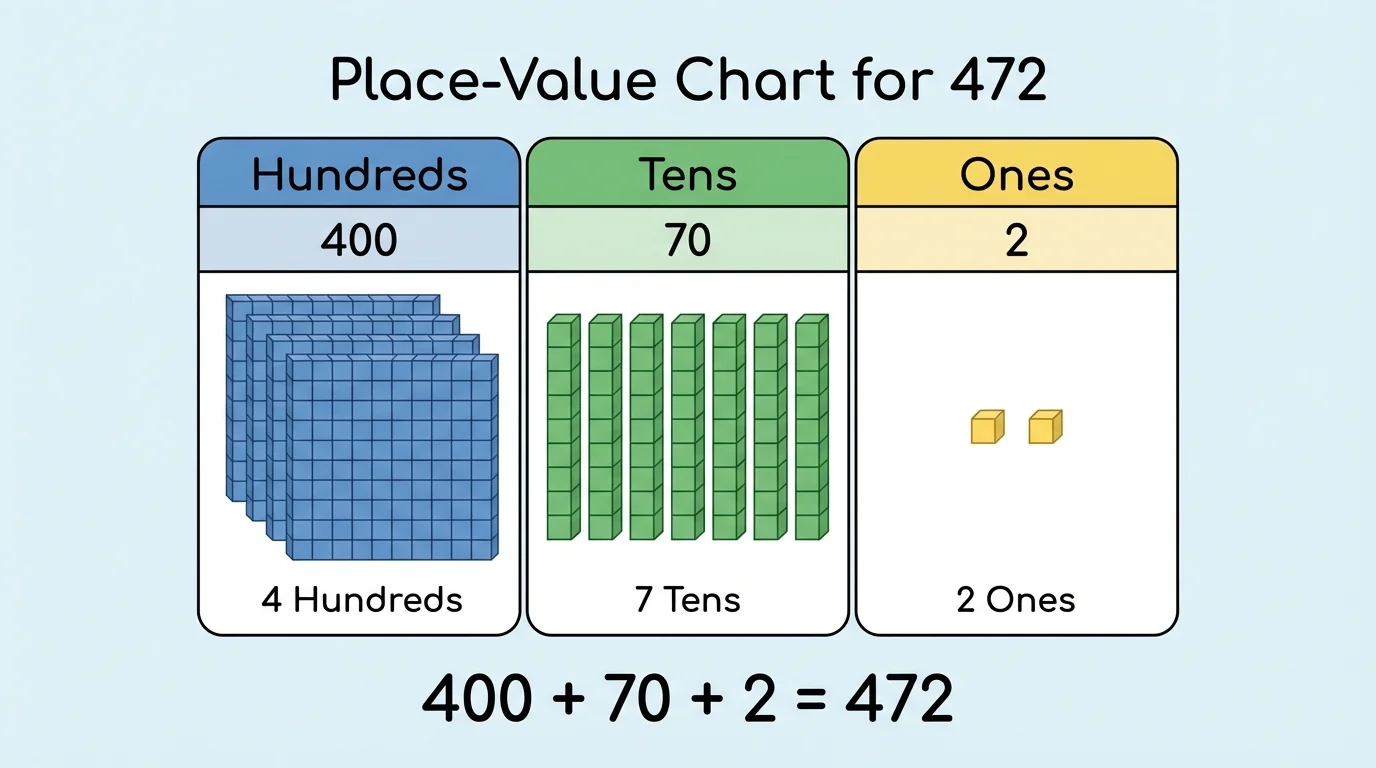
Thinking in place values also helps you regroup. If you have \(10\) ones, that is the same as \(1\) ten. If you have \(10\) tens, that is the same as \(1\) hundred. This is why regrouping means trading between place values.
Hundreds, tens, and ones are the place-value parts of a three-digit number. A number such as \(583\) means \(5\) hundreds, \(8\) tens, and \(3\) ones.
Regroup means to trade \(10\) of one place-value unit for \(1\) of the next larger unit, or the other way around when subtracting.
For example, \(10\) ones can be regrouped as \(1\) ten, and \(1\) hundred can be regrouped as \(10\) tens. These trades do not change the amount. They only change how the amount is written.
One way to add is to break numbers apart by place value. Suppose you want to find \(356 + 243\). You can add the hundreds, tens, and ones separately: \(300 + 200 = 500\), \(50 + 40 = 90\), and \(6 + 3 = 9\). Then combine the sums: \(500 + 90 + 9 = 599\).
Another useful strategy is to make a friendly number. Friendly numbers are easy to work with mentally, like multiples of \(10\) or \(100\). To find \(398 + 205\), you can think, "\(398\) is close to \(400\)." Add \(2\) to \(398\) to make \(400\), so subtract \(2\) from \(205\) to keep the total balanced. Then \(400 + 203 = 603\).
This balancing idea uses the compensation strategy. You change a number to make the math easier, but you also adjust the other number so the total stays the same.
Add by place value means combining hundreds with hundreds, tens with tens, and ones with ones. This works because our number system is based on groups of \(10\). When a place-value sum reaches \(10\) or more, regrouping is needed.
You can also add in parts on an open number line or in your head. For \(264 + 128\), start with \(264\), then add \(100\) to get \(364\), add \(20\) to get \(384\), and add \(8\) to get \(392\). This method is clear because it follows the value of each part.
[Figure 2] The algorithm is a step-by-step method for solving a problem. In standard addition, you line up the digits by place value so ones are under ones, tens are under tens, and hundreds are under hundreds.
Then you add from right to left. Start with the ones. If the ones sum is \(10\) or more, regroup \(10\) ones as \(1\) ten. Write the ones digit in the ones place and add the regrouped ten to the tens column.
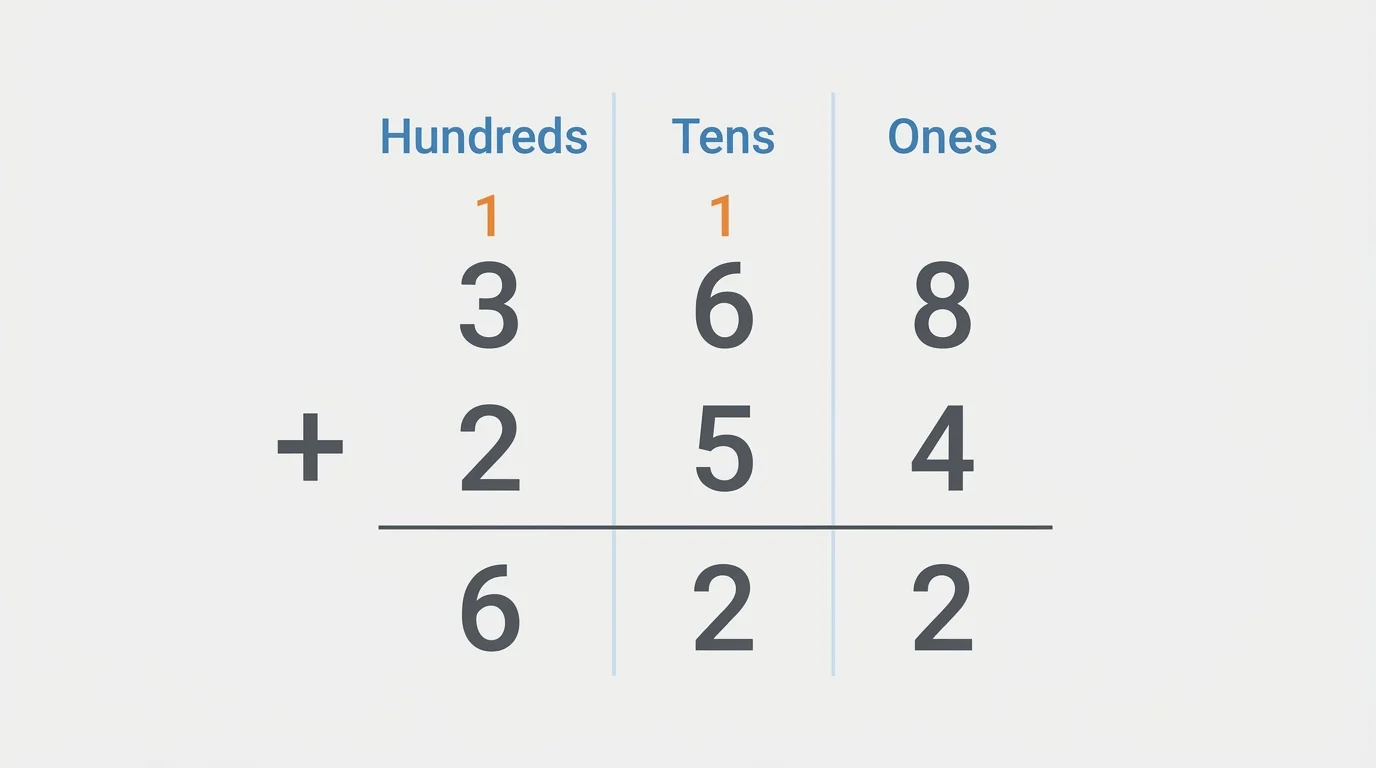
Here is an example with the standard algorithm:
Find \(278 + 156\).
\[\begin{array}{r} 278 \\+\;156 \hline434\end{array}\]
Why does this work? In the ones place, \(8 + 6 = 14\), so write \(4\) ones and regroup \(1\) ten. In the tens place, \(7 + 5 + 1 = 13\), so write \(3\) tens and regroup \(1\) hundred. In the hundreds place, \(2 + 1 + 1 = 4\). The sum is \(434\).
Always line up digits by place value before using a standard algorithm. If the digits are not lined up correctly, the answer will not make sense.
Even when you use the standard algorithm, place value is still the reason it works. You are not just writing numbers in columns. You are adding ones, then tens, then hundreds.
Subtraction can also be done by breaking numbers apart. To solve \(685 - 243\), subtract the hundreds, tens, and ones: \(600 - 200 = 400\), \(80 - 40 = 40\), and \(5 - 3 = 2\). Then combine the differences: \(400 + 40 + 2 = 442\).
Sometimes counting up is easier than taking away. For \(503 - 298\), it may be simpler to think, "What do I add to \(298\) to get \(503\)?" Add \(2\) to get \(300\), then add \(200\) to get \(500\), then add \(3\) to get \(503\). Altogether, \(2 + 200 + 3 = 205\), so \(503 - 298 = 205\).
This strategy shows the relationship between addition and subtraction. If \(298 + 205 = 503\), then \(503 - 298 = 205\). These two operations are connected.
Many subtraction problems near a hundred, like \(401 - 199\), are often faster if you count up. From \(199\) to \(200\) is only \(1\), and then the rest is much easier to see.
You can also use compensation in subtraction. To find \(612 - 299\), think of \(299\) as \(300\). Then \(612 - 300 = 312\). Since you subtracted \(1\) too much, add it back: \(312 + 1 = 313\).
[Figure 3] Standard subtraction also depends on place value. When the top digit is too small, you regroup by trading from the next place to the left.
Suppose you need to solve \(432 - 178\). In the ones place, you cannot subtract \(8\) from \(2\), so regroup \(1\) ten from the tens place. The \(3\) tens become \(2\) tens, and the \(2\) ones become \(12\) ones. Then \(12 - 8 = 4\).
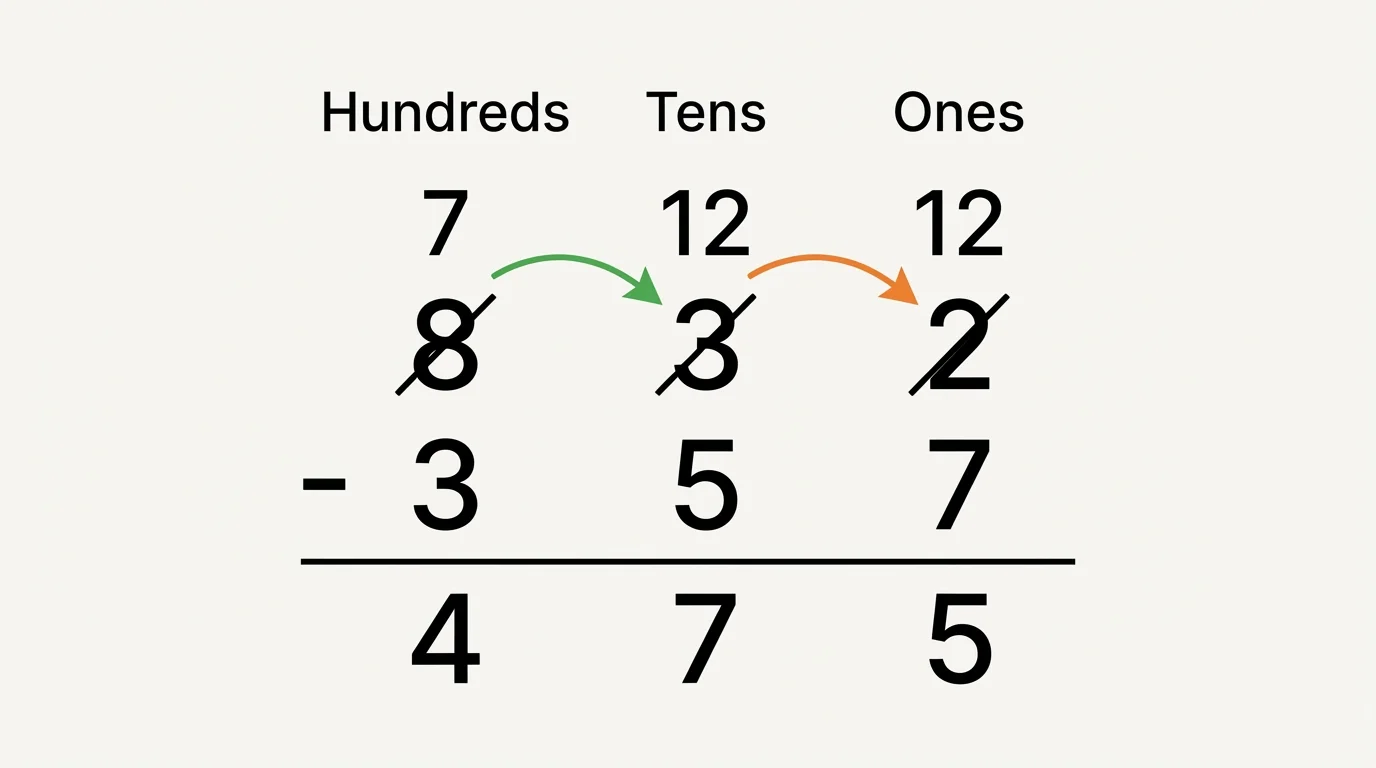
Next, in the tens place, \(2 - 7\) still does not work, so regroup \(1\) hundred as \(10\) tens. The \(4\) hundreds become \(3\) hundreds, and the \(2\) tens become \(12\) tens. Then \(12 - 7 = 5\). Finally, \(3 - 1 = 2\). So \(432 - 178 = 254\).
Written vertically, the subtraction looks like this:
\[\begin{array}{r} 432 \\-\;178 \hline254\end{array}\]
Later, when you check your work with addition, the regrouping in [Figure 3] makes more sense because each trade keeps the total amount the same while changing its form.
Now let's look carefully at several complete examples.
Worked example 1: Add by place value
Find \(346 + 127\).
Step 1: Break apart each number.
\(346 = 300 + 40 + 6\)
\(127 = 100 + 20 + 7\)
Step 2: Add the same place values.
Hundreds: \(300 + 100 = 400\)
Tens: \(40 + 20 = 60\)
Ones: \(6 + 7 = 13\)
Step 3: Combine the parts.
\(400 + 60 + 13 = 473\)
The sum is \(346 + 127 = 473\).
Notice that the ones made more than \(10\), so the total could also be thought of as \(400 + 70 + 3\).
Worked example 2: Add with the standard algorithm
Find \(587 + 268\).
Step 1: Line up the digits by place value.
\[\begin{array}{r} 587 \\+\;268\end{array}\]
Step 2: Add the ones.
\(7 + 8 = 15\). Write \(5\) in the ones place and regroup \(1\) ten.
Step 3: Add the tens.
\(8 + 6 + 1 = 15\). Write \(5\) in the tens place and regroup \(1\) hundred.
Step 4: Add the hundreds.
\(5 + 2 + 1 = 8\).
The sum is \(587 + 268 = 855\).
When you use the standard algorithm, the regrouping works because \(10\) ones make \(1\) ten and \(10\) tens make \(1\) hundred, just as shown earlier in [Figure 1].
Worked example 3: Subtract by counting up
Find \(602 - 487\).
Step 1: Start at \(487\) and count up to a friendly number.
From \(487\) to \(500\) is \(13\).
Step 2: Count from \(500\) to \(600\).
That is \(100\).
Step 3: Count from \(600\) to \(602\).
That is \(2\).
Step 4: Add the jumps.
\(13 + 100 + 2 = 115\)
The difference is \[602 - 487 = 115\]
This method is especially useful when the numbers are close to a hundred or a ten.
Worked example 4: Subtract with the standard algorithm
Find \(700 - 458\).
Step 1: Notice that \(0 - 8\) is not possible, so regroup.
Trade \(1\) hundred from \(700\) to make \(6\) hundreds and \(10\) tens.
Step 2: The tens place is still too small because you cannot subtract \(5\) tens from \(0\) tens without regrouping.
Trade \(1\) ten to the ones place. Now there are \(9\) tens and \(10\) ones.
Step 3: Subtract each place.
Ones: \(10 - 8 = 2\)
Tens: \(9 - 5 = 4\)
Hundreds: \(6 - 4 = 2\)
The difference is \[700 - 458 = 242\]
Zeroes can make subtraction look tricky, but place-value trading still works every time.
A smart mathematician checks whether an answer makes sense. One way is to estimate by rounding. For example, \(587 + 268\) is close to \(600 + 300 = 900\). The exact answer, \(855\), is close to \(900\), so it is reasonable.
For subtraction, \(602 - 487\) is about \(600 - 500 = 100\). The exact answer, \(115\), is close to that estimate, so it makes sense.
You can also check subtraction with addition. If you found that \(700 - 458 = 242\), then test it by adding \(458 + 242\). Since \(458 + 242 = 700\), the subtraction is correct.
Reasonable answers are answers that fit what you know about the numbers. Estimation does not give the exact answer, but it helps you catch mistakes.
If you estimate \(356 + 243\) as about \(600\), but your exact answer is \(159\), something clearly went wrong. Estimation is a powerful checking tool.
Addition and subtraction within \(1{,}000\) appear in everyday life. A store may receive \(375\) boxes on Monday and \(248\) boxes on Tuesday. The total is \(375 + 248 = 623\) boxes.
A school library might have \(914\) books in one room. If \(286\) books are checked out, then \(914 - 286 = 628\) books remain. Problems like these need careful place-value thinking.
Sports scores also use these skills. A team may score \(487\) points over part of a season and then score \(136\) more. The new total is \(623\). If another team scored \(700\) and your team scored \(623\), the difference is \(77\).
Road trips, rainfall totals, sticker collections, and saving money all use these operations. The methods you learn in math class are tools for solving real problems.
One common mistake is not lining up place values. If \(243\) is written under \(56\) the wrong way, you may accidentally add digits from different place values.
Another mistake is forgetting to regroup. In addition, if \(8 + 7 = 15\), you must write \(5\) ones and regroup \(1\) ten. In subtraction, if the top digit is smaller, you must trade from the place to the left.
A third mistake is not checking whether the answer makes sense. Estimating first or checking with the opposite operation can help you catch errors quickly.
As you practice, remember that every method in this lesson is built on the same idea: numbers are made of hundreds, tens, and ones. When you understand those parts, larger calculations become much less mysterious.
