If you know a basic fact like \(8 \times 6 = 48\), then you are already very close to solving \(8 \times 60\). That might sound surprising at first, but it is one of the best things about place value: a fact you already know can grow into a much bigger fact just by thinking carefully about tens.
When you multiply a one-digit whole number by a multiple of \(10\), you are not starting from scratch. You are using a basic multiplication fact and combining it with what you know about tens. For example, in \(4 \times 30\), the \(30\) means 3 tens. So the problem is really asking for \(4\) groups of \(3\) tens.
This kind of multiplication is important because it helps develop strong number sense. It also prepares you for multiplying larger numbers later. Instead of memorizing every new fact, you can use patterns, place value, and properties of operations to reason it out.
You already know many basic facts such as \(2 \times 5 = 10\), \(6 \times 7 = 42\), and \(9 \times 8 = 72\). You also know that \(10\) ones make \(1\) ten, and numbers like \(40\) and \(90\) are made of tens.
Those two ideas together are the key to this lesson: basic multiplication facts and place value.
A multiple of 10 is a number you get when you multiply \(10\) by a whole number. The multiples of \(10\) in this lesson are \(10, 20, 30, 40, 50, 60, 70, 80, 90\). Each of these numbers has a certain number of tens, as shown in [Figure 1]. For example, \(80\) is \(8\) tens, and \(60\) is \(6\) tens.
You can write these numbers in different but equal ways:
\(20 = 2 \times 10\)
\(50 = 5 \times 10\)
\(80 = 8 \times 10\)
Thinking this way helps because it turns a problem like \(7 \times 80\) into \(7 \times 8 \times 10\).
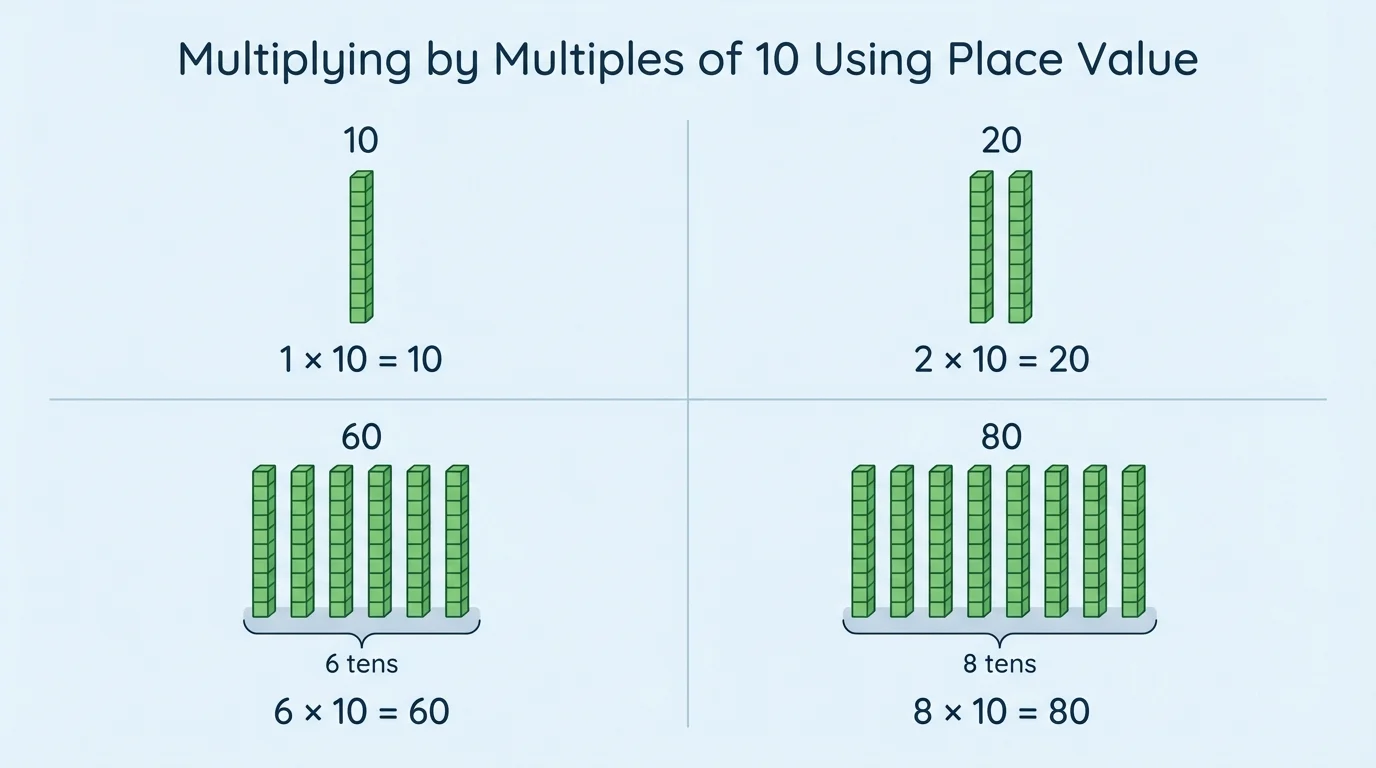
Place value tells us what each digit means. In \(80\), the \(8\) is not just \(8\) ones. It means \(8\) tens. That is why \(80\) is much larger than \(8\). Understanding that difference makes multiplication easier and more accurate.
Place value tells the value of a digit based on where it is in a number. In \(80\), the digit \(8\) means \(8\) tens, which is \(80\).
Product is the answer to a multiplication problem.
When students understand place value, they do more than get the right answer. They can also explain why the answer makes sense.
A place value strategy works by breaking a multiple of \(10\) into tens. A visual model helps show that multiplying by \(60\) means multiplying by \(6\) tens, not just by \(6\).
[Figure 2] Look at \(5 \times 60\). Since \(60 = 6\) tens, the problem becomes \(5\) groups of \(6\) tens. First, use the basic fact \(5 \times 6 = 30\). That gives \(30\) tens. And \(30\) tens equals \(300\). So \(5 \times 60 = 300\).
Here is another way to say it: multiply the one-digit numbers first, then think about the tens. This is why knowing your basic facts matters so much.
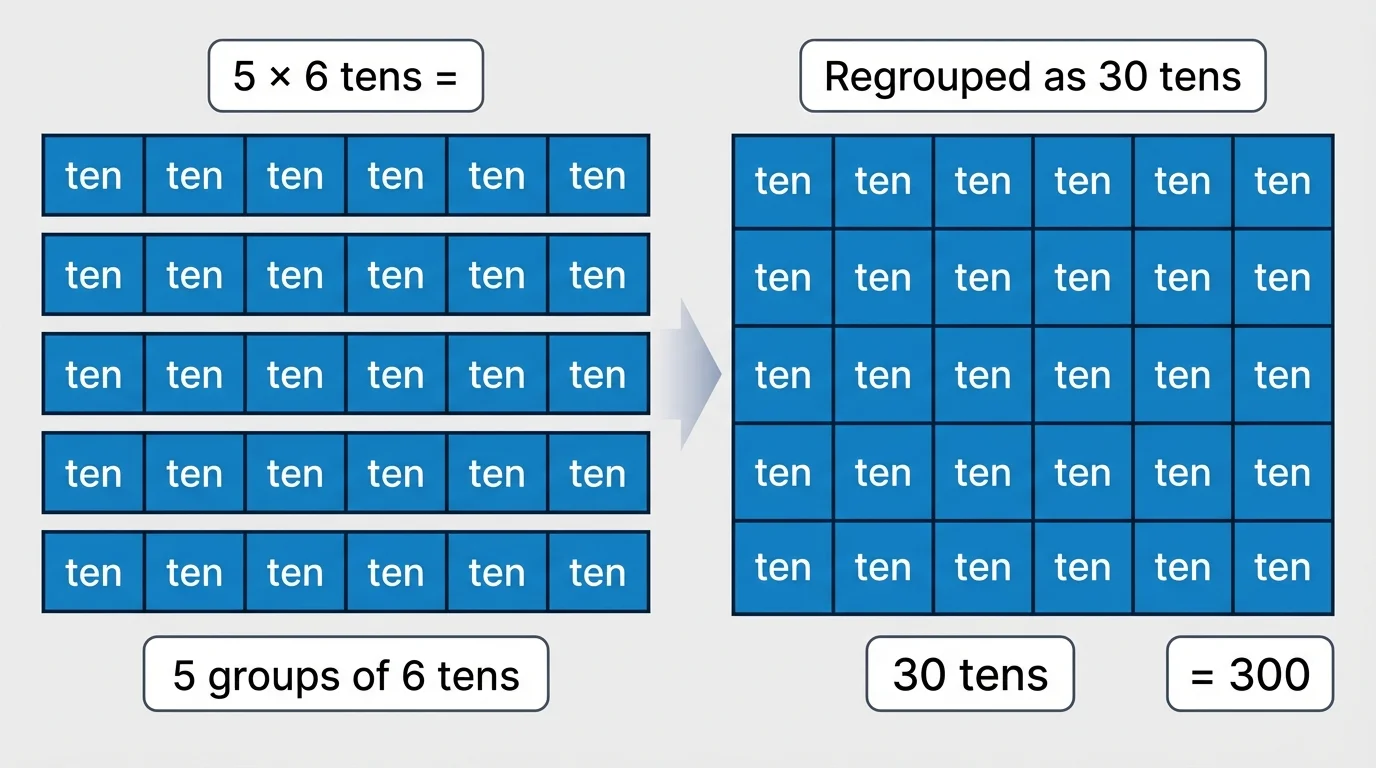
Try the same idea with \(3 \times 40\). Since \(40\) is \(4\) tens, this is \(3 \times 4\) tens. Because \(3 \times 4 = 12\), the answer is \(12\) tens, which equals \(120\).
Notice what happens: the basic fact gives a number, and then the tens make the answer ten times as large. This is not magic. It happens because each group is a group of ten.
Why the zero appears
Many products in this lesson end with \(0\), such as \(7 \times 40 = 280\). The zero appears because you are multiplying by tens. But it is important to understand the reason, not just copy a pattern. The factor \(40\) means \(4\) tens, so the answer must be made of tens too.
That is why \(6 \times 70\) is connected to \(6 \times 7\). First, \(6 \times 7 = 42\). Then think of that as \(42\) tens, which equals \(420\).
Another helpful tool is the properties of operations. These are rules about numbers that help us rearrange multiplication in ways that make sense.
For example, in \(9 \times 80\), you can think of \(80\) as \(8 \times 10\). Then:
\(9 \times 80 = 9 \times (8 \times 10) = (9 \times 8) \times 10 = 72 \times 10 = 720\)
This works because multiplication can be grouped in different ways without changing the answer. That idea makes hard-looking problems easier.
You can also use this with \(2 \times 90\):
\(2 \times 90 = 2 \times (9 \times 10) = (2 \times 9) \times 10 = 18 \times 10 = 180\)
The properties of operations and place value work together. Place value helps you understand the tens, and the properties help you rewrite the problem in a useful way.
Some multiplication problems look much bigger than they really are. Once you know \(8 \times 7 = 56\), you also have a quick path to \(8 \times 70 = 560\) and even \(80 \times 7 = 560\).
That is a powerful idea: one fact you know can unlock many other facts.
Now let's work through several problems carefully and explain each step.
Worked example 1
Find \(4 \times 30\).
Step 1: Rewrite the multiple of \(10\).
\(30 = 3\) tens.
Step 2: Use the basic multiplication fact.
\(4 \times 3 = 12\)
Step 3: Put the tens back.
\(12\) tens equals \(120\).
\[4 \times 30 = 120\]
The answer makes sense because \(4\) groups of \(30\) should be much larger than \(4\) groups of \(3\).
Worked example 2
Find \(9 \times 80\).
Step 1: Think about tens.
\(80 = 8\) tens.
Step 2: Use the basic multiplication fact.
\(9 \times 8 = 72\)
Step 3: Change the answer into tens.
\(72\) tens equals \(720\).
\[9 \times 80 = 720\]
You can also check this with properties of operations: \(9 \times 80 = 9 \times (8 \times 10) = 72 \times 10 = 720\).
Worked example 3
Find \(5 \times 60\).
Step 1: Rewrite \(60\) as tens.
\(60 = 6\) tens.
Step 2: Multiply the one-digit numbers.
\(5 \times 6 = 30\)
Step 3: Interpret the result.
\(30\) tens equals \(300\).
\[5 \times 60 = 300\]
This matches the visual idea from earlier: \(5\) groups of \(6\) tens combine into \(30\) tens.
Worked example 4
Find \(7 \times 20\).
Step 1: Rewrite the tens.
\(20 = 2\) tens.
Step 2: Multiply the one-digit factors.
\(7 \times 2 = 14\)
Step 3: Convert to tens.
\(14\) tens equals \(140\).
\[7 \times 20 = 140\]
Even though the answer ends in \(0\), it is not enough to just stick on a zero. You need the correct basic fact first.
There is a strong pattern when you compare a basic fact to a tens fact. If \(3 \times 4 = 12\), then \(3 \times 40 = 120\). If \(8 \times 9 = 72\), then \(8 \times 90 = 720\).
The product becomes ten times greater because one factor became ten times greater. Changing \(9\) to \(90\) means multiplying that factor by \(10\), so the product is also multiplied by \(10\).
| Basic fact | Tens fact | How they are related |
|---|---|---|
| \(2 \times 6 = 12\) | \(2 \times 60 = 120\) | The factor \(60\) is \(10\) times \(6\), so the product is \(10\) times \(12\). |
| \(4 \times 7 = 28\) | \(4 \times 70 = 280\) | The product grows from \(28\) to \(280\). |
| \(9 \times 5 = 45\) | \(9 \times 50 = 450\) | The tens factor makes the product a multiple of \(10\). |
Table 1. A comparison of basic multiplication facts and related facts with multiples of \(10\).
These patterns are useful, but they should always connect back to place value. The zero is not a trick by itself. It shows that the answer has tens in it.
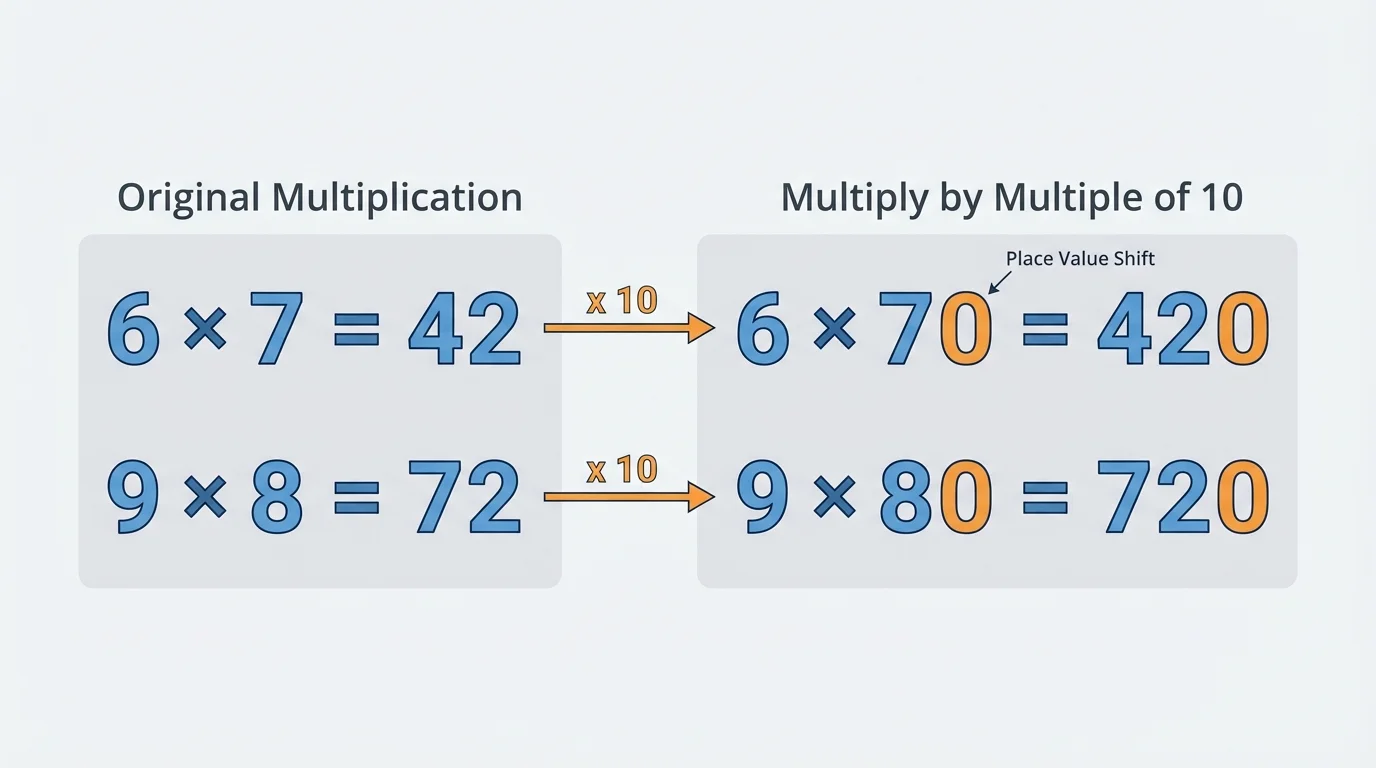
It helps to compare related equations side by side. The comparison in [Figure 3] shows how a basic fact and a tens fact are connected. For example, \(6 \times 7 = 42\), but \(6 \times 70 = 420\). The digits \(4\) and \(2\) stay important, but their value changes because the product now counts tens.
Look at these pairs:
\(6 \times 7 = 42\) and \(6 \times 70 = 420\)
\(9 \times 8 = 72\) and \(9 \times 80 = 720\)
\(3 \times 2 = 6\) and \(3 \times 20 = 60\)
Each time, one factor becomes \(10\) times larger, so the product becomes \(10\) times larger too.
This is a great way to check whether an answer is reasonable. If \(8 \times 4 = 32\), then \(8 \times 40\) should be \(320\), not \(32\) and not \(3,200\).
Multiplying by multiples of \(10\) happens in everyday life more often than you might think. Suppose a school buys \(7\) boxes of markers, and each box has \(40\) markers. The total number of markers is \(7 \times 40 = 280\).
Or imagine a sports store has \(5\) racks, and each rack holds \(60\) baseball caps. The store can hold \(5 \times 60 = 300\) caps.
Money is another place where this matters. If \(8\) movie tickets cost \(\$20\) each, the total cost is \(8 \times 20 = 160\), so the total is \(\$160\).
Even classroom supplies use this idea. If \(9\) students each collect \(30\) stickers, then together they collect \(9 \times 30 = 270\) stickers. Thinking in tens makes the calculation quick.
When you solve these problems, you are using the same idea every time: multiply the basic fact, then think about the tens.
One common mistake is using the wrong basic fact. For example, in \(4 \times 70\), a student might know the answer should end in \(0\), but then use \(4 \times 6\) by accident instead of \(4 \times 7\). The correct basic fact is \(4 \times 7 = 28\), so \(4 \times 70 = 280\).
Another mistake is forgetting that the answer represents tens. In \(3 \times 50\), the basic fact is \(3 \times 5 = 15\), but the full answer is not \(15\). It is \(15\) tens, which equals \(150\).
A third mistake is making the answer too large. For example, \(2 \times 30\) is \(60\), not \(600\). Since \(2 \times 3 = 6\), you need \(6\) tens, which is \(60\).
How to check your answer
Ask yourself whether the answer is reasonable. Since \(5 \times 60\) means \(5\) groups of \(60\), the answer should be bigger than \(60\) and should be a multiple of \(10\). A product of \(300\) makes sense, but a product of \(30\) does not.
This kind of checking helps you catch errors before repeated mistakes become habits. It also builds confidence because you are thinking about the size of the numbers, not just following steps.
Earlier, [Figure 1] showed that numbers like \(60\) and \(80\) are groups of tens. That same idea explains every problem in this lesson. And the comparison in [Figure 3] reminds you that a known fact can lead directly to a related fact when one factor is multiplied by \(10\).
