Have you ever looked at a floor made of tiles and wondered how many tiles cover it? That question is really an area question. Area helps us measure how much surface a shape covers, like a book cover, a tabletop, or a playground rectangle. When we study rectangles, something exciting happens: we can find the area by counting little squares, and we can also find it faster by multiplying the side lengths.
We use area when we want to cover a surface. If you put stickers on a notebook, plant grass in a yard, or place square tiles on a floor, you are thinking about how much flat space needs to be covered. Area is different from length. Length tells how long one side is. Area tells how much space is inside the shape.
[Figure 1] A rectangle is a very useful shape for learning area because rectangles can be filled with equal square tiles in neat rows and columns. When the side lengths are whole numbers, the squares fit in an organized pattern, and that pattern helps us connect area to multiplication.
You already know how to count equal groups and how to multiply. For example, if there are \(3\) groups of \(4\), then \(3 \times 4 = 12\). Area uses this same idea, but the groups are rows or columns of square units.
You also know that rectangles have opposite sides that are equal. If one side is \(5\) units long and the side next to it is \(3\) units long, those side lengths help tell us how many squares will fit across and how many will fit down.
area is the amount of surface inside a flat shape. We measure area by covering the shape with equal-size squares. These squares must fit with no gaps and no overlaps. Then we count how many squares cover the shape.
Each little square we use is called a square unit. If each side of the little square is \(1\) unit long, then the area of that little square is \(1\) square unit. We can use square inches, square centimeters, or square feet, depending on the size of the surface.
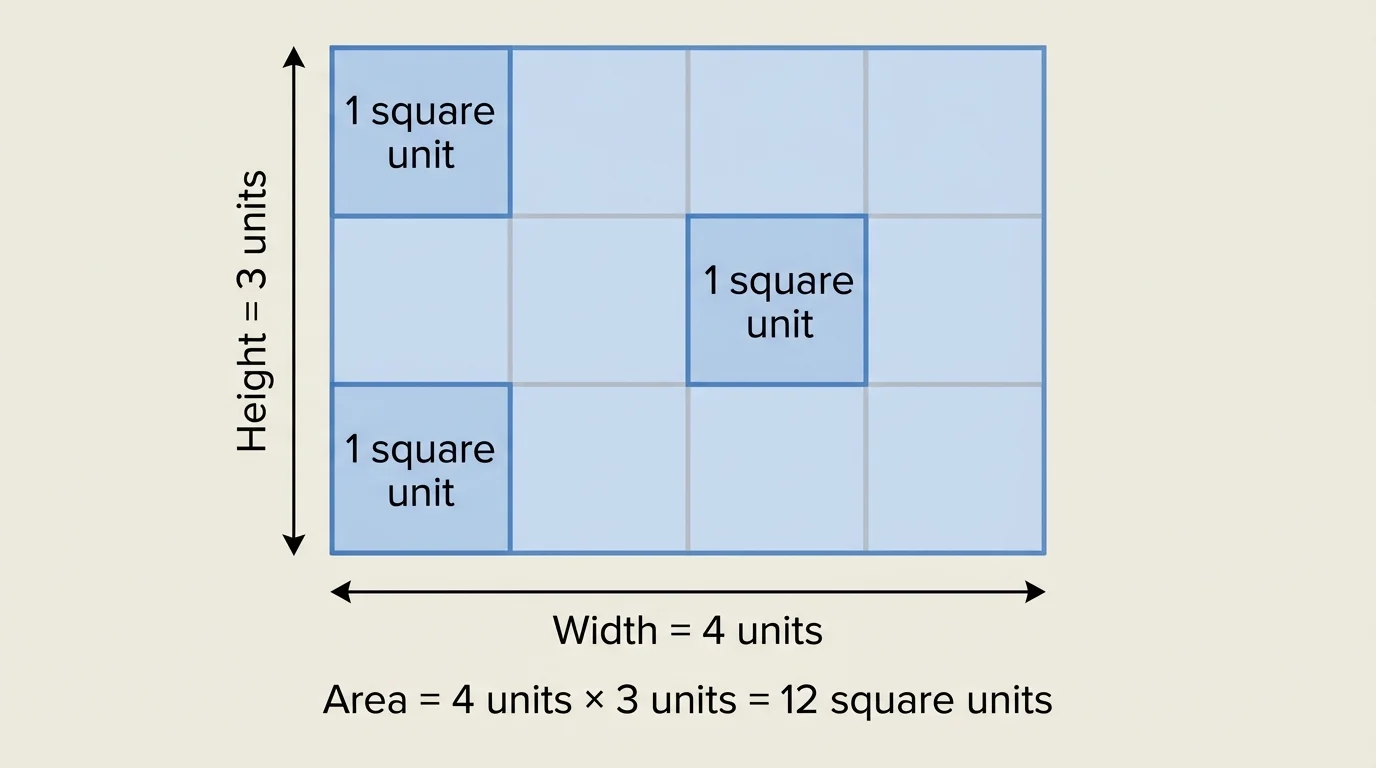
If a rectangle is covered by \(12\) little unit squares, then its area is \(12\) square units. It does not matter whether the rectangle is wide or tall. What matters is how many unit squares cover it.
Area is the number of square units needed to cover a shape with no gaps or overlaps.
Rectangle is a shape with \(4\) sides and \(4\) right angles.
Whole-number side lengths means that the side lengths are whole numbers such as \(1, 2, 3, 4\), and so on.
Notice that area uses square units, not just units. If a side is \(4\) units long, that is length. If a surface is covered by \(12\) unit squares, that is area. This is why we say "square units."
A rectangle can be tiled with unit squares in straight lines. Across the rectangle, the squares make columns. Down the rectangle, the squares make rows. Because the shape is a rectangle, every row has the same number of squares, and every column has the same number of squares.
Suppose a rectangle is \(5\) units long and \(3\) units wide. That means \(5\) unit squares fit across each row, and \(3\) rows fit from top to bottom. Instead of counting one square at a time, we can count the rows or count the columns.
[Figure 2] This neat arrangement is the reason multiplication works so well for rectangles. Equal rows make equal groups, and equal groups are exactly what multiplication describes.
A tiled rectangle has equal rows and columns. Let's think about a rectangle that is \(4\) units long and \(3\) units wide. If we cover it with unit squares, each row has \(4\) squares, and there are \(3\) rows.
We could count all the squares one by one: \(1, 2, 3, 4, 5, 6, 7, 8, 9, 10, 11, 12\). That tells us the area is \(12\) square units.
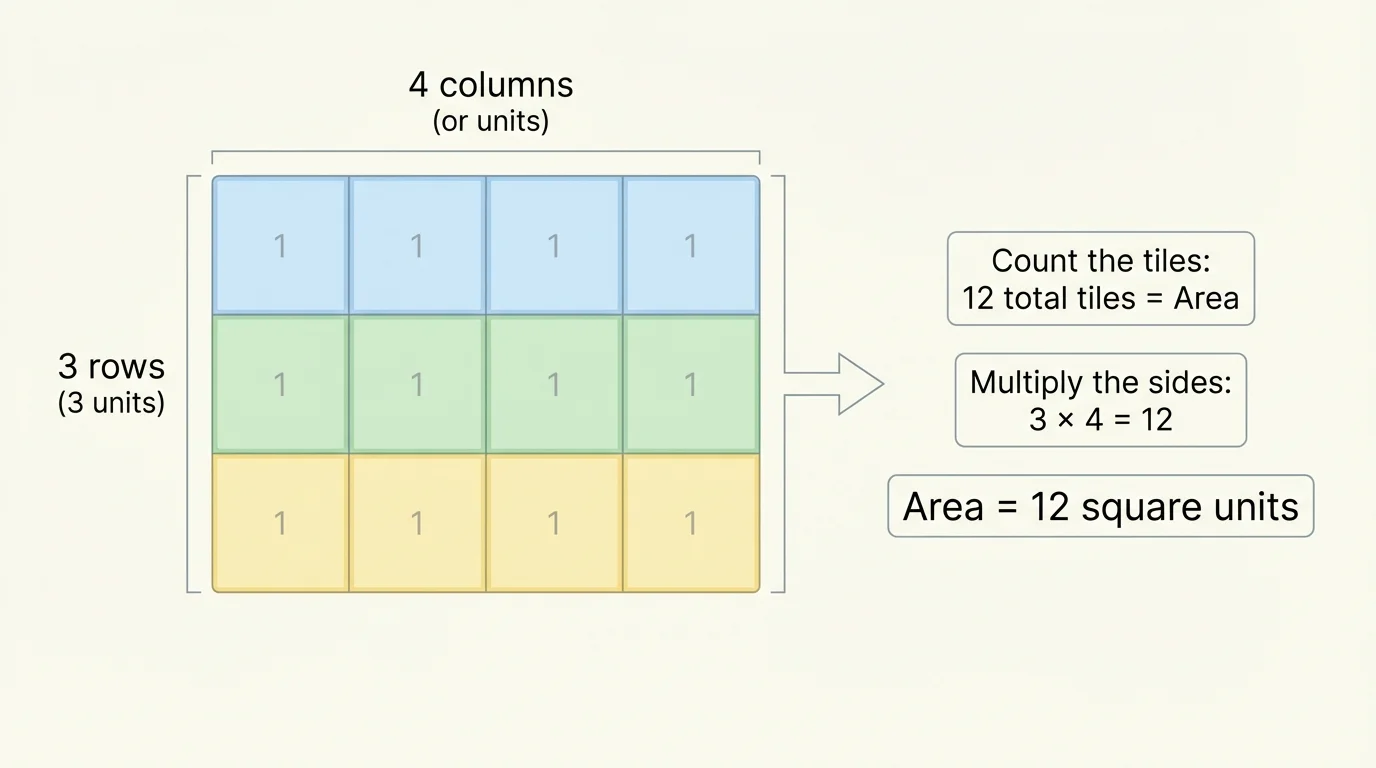
But there is a faster way. Since there are \(3\) rows of \(4\) squares, we can use multiplication: \(3 \times 4 = 12\). So the area is still \(12\) square units.
This shows an important idea: tiling and multiplying give the same answer for a rectangle with whole-number side lengths.
Why multiplication matches tiling
When a rectangle is tiled with unit squares, the squares form equal rows and equal columns. Multiplication helps count equal groups quickly. If there are \(l\) squares in each row and \(w\) rows, then the total number of squares is \(l \times w\). That total is the area.
We often write the area formula for rectangles like this:
\[A = l \times w\]
Here, \(A\) means area, \(l\) means length, and \(w\) means width. This formula is not a new trick. It is just a short way to say, "Count the squares in all the equal rows."
Let's connect the ideas clearly. If a rectangle is \(6\) units long and \(2\) units wide, then one row has \(6\) squares. Since there are \(2\) rows, the total number of squares is \(6 + 6 = 12\). Multiplication says the same thing in a shorter way: \(2 \times 6 = 12\).
Repeated addition and multiplication match each other:
\[6 + 6 = 2 \times 6 = 12\]
That means area is related to both addition and multiplication. We can add equal rows, or we can multiply the side lengths.
Rectangles are one of the easiest shapes for area because their rows and columns line up perfectly. This is why floor tiles, notebook grids, and game boards often use rectangular layouts.
As we saw earlier in [Figure 2], each row in a rectangle has the same number of unit squares. That sameness is the clue that multiplication will work every time for whole-number side lengths.
Now let's find area in several ways and prove that tiling and multiplying match.
Worked example 1
Find the area of a rectangle with side lengths \(3\) units and \(5\) units.
Step 1: Think about tiling.
A rectangle that is \(5\) units long has \(5\) unit squares in each row. A width of \(3\) units means there are \(3\) rows.
Step 2: Count the squares by rows.
There are \(3\) rows of \(5\) squares, so the total is \(5 + 5 + 5 = 15\).
Step 3: Multiply the side lengths.
Use \(A = l \times w\): \(A = 5 \times 3 = 15\).
So the area is \(15 \textrm{ square units}\). Both tiling and multiplication give the same answer.
This example shows that you can picture the squares or use multiplication directly. Both methods describe the same rectangle.
Worked example 2
Find the area of a rectangle with side lengths \(4\) units and \(4\) units.
Step 1: Tile the rectangle in your mind.
Each row has \(4\) squares, and there are \(4\) rows.
Step 2: Add the equal rows.
\(4 + 4 + 4 + 4 = 16\).
Step 3: Multiply.
\(A = 4 \times 4 = 16\).
The area is \(16 \textrm{ square units}\).
Even when both side lengths are the same, the idea stays the same: the area is still the number of unit squares covering the rectangle.
Worked example 3
A rectangle has length \(7\) units and width \(2\) units. Find its area.
Step 1: Count with rows.
If each row has \(7\) squares and there are \(2\) rows, then there are \(7 + 7 = 14\) squares.
Step 2: Use multiplication.
\(A = 7 \times 2 = 14\).
Step 3: State the unit.
Area must be written in square units.
The area is \(14 \textrm{ square units}\).
Here the rectangle is longer than it is wide, but that does not change the method. We still count square units or multiply side lengths.
Worked example 4
A rectangle is \(6\) units by \(5\) units. Show that tiling and multiplying match.
Step 1: Describe the tiling.
There are \(5\) rows, and each row has \(6\) unit squares.
Step 2: Count by repeated addition.
\(6 + 6 + 6 + 6 + 6 = 30\).
Step 3: Multiply the side lengths.
\(A = 6 \times 5 = 30\).
So the area is \(30 \textrm{ square units}\). The two methods agree.
Once you understand why multiplication works, you can find area quickly even when there are many squares.
[Figure 3] shows two rectangles that are turned in different directions. One is \(2\) units by \(5\) units, and the other is \(5\) units by \(2\) units. They look different because one is tall and one is wide, but both contain \(10\) unit squares.
This happens because \(2 \times 5 = 10\) and \(5 \times 2 = 10\). Turning a rectangle does not change its area. The order of the factors can switch, but the product stays the same.
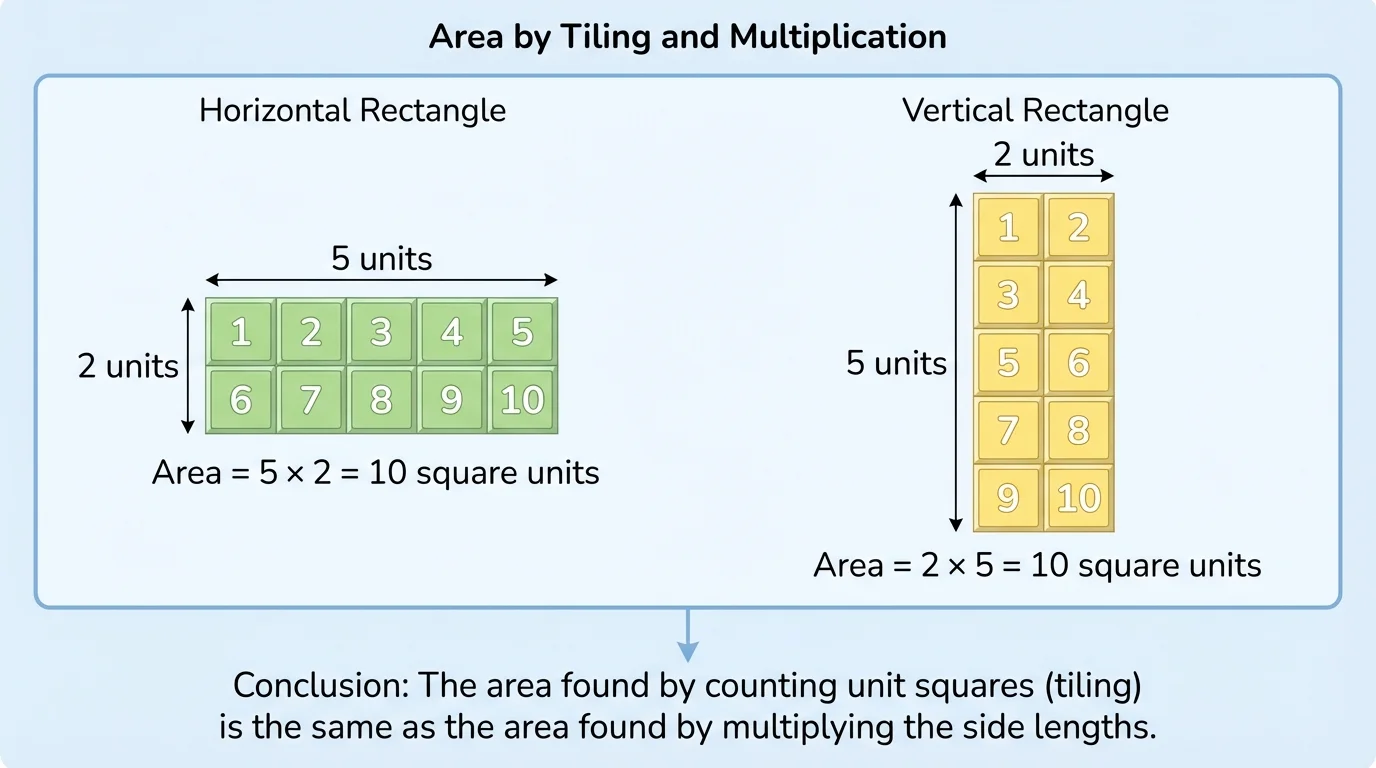
Also, different rectangles can have the same area. A \(3\)-by-\(4\) rectangle has area \(12\) square units. A \(2\)-by-\(6\) rectangle also has area \(12\) square units. The shapes are not the same, but the number of square units is the same.
Looking back at [Figure 3], we can tell that area depends on how many unit squares cover the shape, not just whether the rectangle stands tall or lies wide.
Area is also related to addition in another way. Suppose a \(6\)-by-\(4\) rectangle is split into two smaller rectangles: one \(2\)-by-\(4\) and one \(4\)-by-\(4\). The first smaller rectangle has area \(2 \times 4 = 8\). The second smaller rectangle has area \(4 \times 4 = 16\).
When we add the smaller areas, we get \(8 + 16 = 24\). The full rectangle also has area \(6 \times 4 = 24\). So the total area can be found by adding the areas of parts.
This is another important pattern: rectangles connect area to multiplication and to addition.
Area is useful in many real situations. If a classroom bulletin board is \(8\) feet long and \(3\) feet wide, the area is \(8 \times 3 = 24\) square feet. That tells how much paper is needed to cover the board.
If a garden bed is \(5\) meters by \(4\) meters, then the area is \(20\) square meters. That helps people decide how many plants can fit. If a rectangular rug is \(6\) feet by \(9\) feet, then the rug covers \(54\) square feet of floor.
Artists, builders, gardeners, and game designers all use area. A checkerboard, a sheet of graph paper, and a phone screen all involve surfaces that can be measured. Area helps us describe those surfaces clearly.
Choosing the right unit
Small surfaces might use square inches or square centimeters. Larger surfaces might use square feet or square meters. No matter which unit you use, the idea stays the same: area counts how many square units cover the surface.
When you hear someone ask how much space a wall, floor, or poster covers, area is often the measurement they need.
One common mistake is mixing up area and perimeter. Area measures the inside surface. Perimeter measures the distance around the outside. If you are counting unit squares inside a rectangle, you are finding area, not perimeter.
Another mistake is forgetting the unit. If the area is \(12\), it is not enough to write only \(12\). You should write \(12\) square units, or a named square unit such as square inches.
A third mistake is counting incorrectly when tiling. The unit squares must not overlap, and there must be no gaps. That is why the picture of area in [Figure 1] is so important: the square units cover the surface exactly.
| Rectangle side lengths | Rows and columns | Multiplication | Area |
|---|---|---|---|
| \(3\) by \(2\) | \(2\) rows of \(3\) | \(3 \times 2\) | \(6\) square units |
| \(4\) by \(3\) | \(3\) rows of \(4\) | \(4 \times 3\) | \(12\) square units |
| \(5\) by \(5\) | \(5\) rows of \(5\) | \(5 \times 5\) | \(25\) square units |
| \(7\) by \(2\) | \(2\) rows of \(7\) | \(7 \times 2\) | \(14\) square units |
Table 1. Examples showing that rows of unit squares and multiplication give the same rectangle area.
The table shows the same pattern again and again: count square units in rows, or multiply the side lengths. Either way, the area is the same.
The formula \(A = l \times w\) is powerful, but it is even better when you know why it works. It works because a rectangle with whole-number side lengths can be tiled with unit squares arranged in equal rows and equal columns.
So when you multiply the side lengths, you are not doing a magic trick. You are counting all the tiles in a fast, organized way.
