Have you ever looked at a floor made of tiles and wondered how many tiles it takes to cover the whole space? That question is really about area. Area helps us measure how much space is inside a flat shape. For rectangles, there is a fast and powerful way to find area: multiply the side lengths. This works because rectangles are built from rows and columns of equal squares.
Area is the amount of space inside a flat shape. When we measure area, we use equal-sized square units. A square unit might be a square that is 1 unit by 1 unit, or 1 inch by 1 inch, or 1 foot by 1 foot. When a rectangle is covered with square units in rows and columns, as shown in [Figure 1], we can count how many squares cover it.
A rectangle has four sides and four right angles. Opposite sides are the same length. If one side is 6 units long and the side next to it is 4 units long, then the rectangle can be filled with 4 rows of 6 square units each.
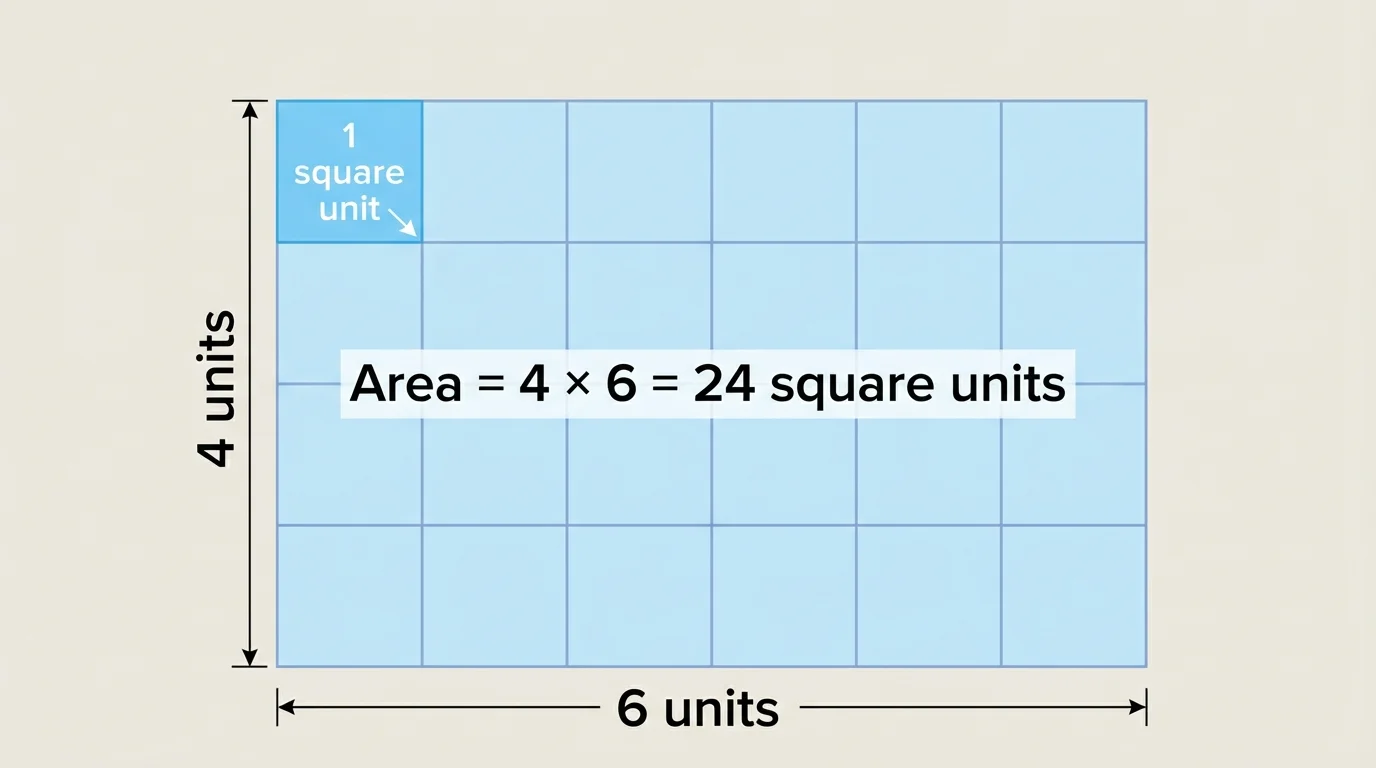
Instead of counting every square one by one, we can use what we know about rows and columns. If there are 4 rows and each row has 6 squares, then the total number of squares is \(6 + 6 + 6 + 6 = 24\). We can also write that as \(4 \times 6 = 24\).
Length is the measurement of one side of a rectangle, often the longer side.
Width is the measurement of the side next to the length.
Square unit is a unit used to measure area, such as square inches, square feet, or square centimeters.
When we find area, we are counting how many square units cover a shape with no gaps and no overlaps. That is why area is not measured in just units. It is measured in square units.
An array is a set of objects arranged in equal rows and columns. Arrays help us understand multiplication, and they also help us understand area. In [Figure 2], a rectangle with 3 rows and 5 columns shows the product \(3 \times 5\).
If we count by rows, we get \(5 + 5 + 5 = 15\). If we count by columns, we get \(3 + 3 + 3 + 3 + 3 = 15\). Both ways give the same total because they count the same squares in the rectangle.
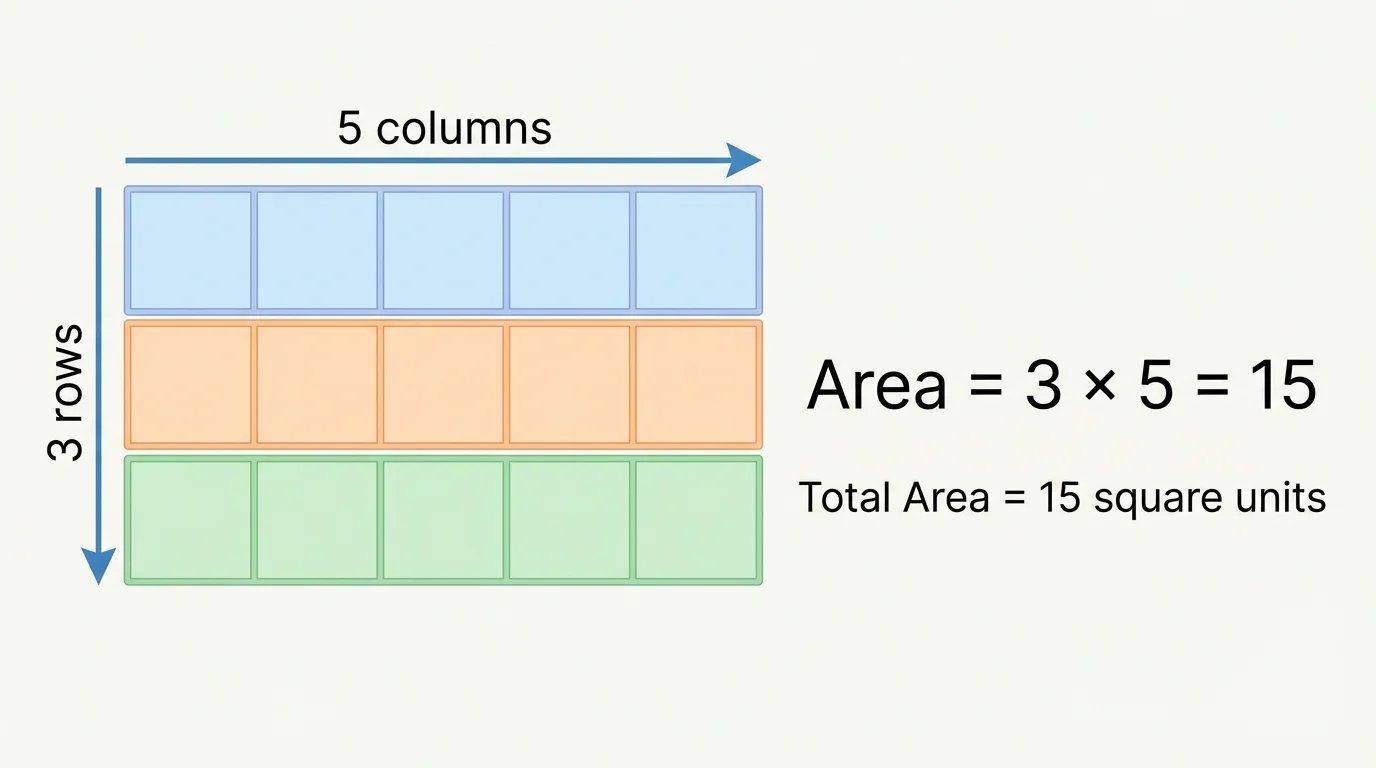
This is why multiplication is so useful for area. A rectangle with whole-number side lengths can be thought of as an array of square units. The number of rows times the number of columns gives the total number of square units.
For example, if a rectangle has 7 rows and 2 columns, then its area is \(7 \times 2 = 14\) square units. We do not need to draw all 14 squares if we already know the side lengths.
You already know that multiplication can show equal groups. Area uses the same idea. The rows are equal groups, and each row has the same number of square units.
So area and multiplication are connected. Repeated addition, arrays, and rectangles all work together to help us think about products.
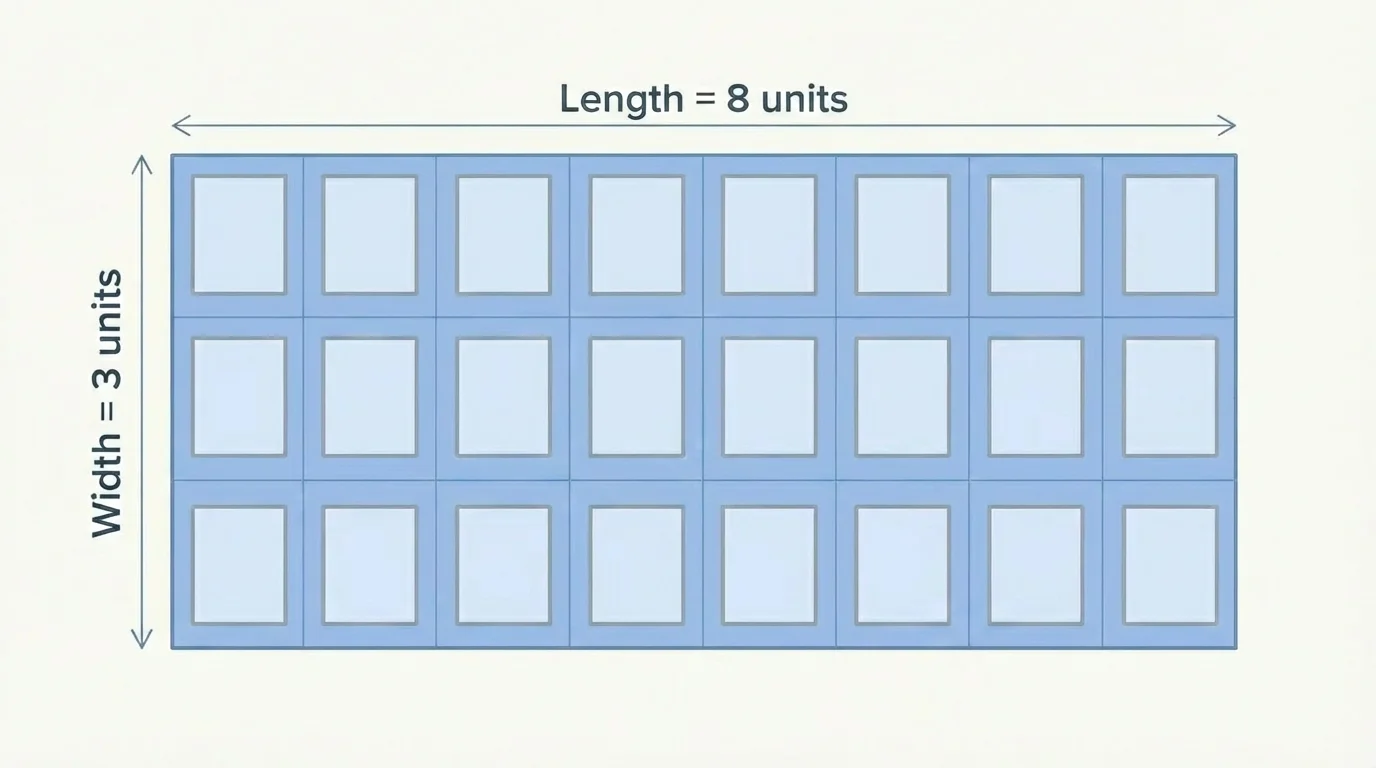
To find the area of a rectangle, measure the side going across and the side going down. These side lengths tell us the number of columns and rows, as [Figure 3] shows with a grid inside the rectangle.
The rule for the area of a rectangle is:
\[\textrm{Area} = \textrm{length} \times \textrm{width}\]
We can also write this as:
\[A = l \times w\]
If the length is 8 units and the width is 3 units, then the area is \(8 \times 3 = 24\) square units.
It is important to write the correct unit. If the side lengths are in inches, the area is in square inches. If the side lengths are in feet, the area is in square feet.
| Length | Width | Area |
|---|---|---|
| \(4\) | \(3\) | \(4 \times 3 = 12\) square units |
| \(5\) | \(2\) | \(5 \times 2 = 10\) square units |
| \(6\) | \(6\) | \(6 \times 6 = 36\) square units |
| \(9\) | \(4\) | \(9 \times 4 = 36\) square units |
Table 1. Examples of rectangle side lengths and their areas.
Notice that different side lengths can sometimes make the same area. A 6-unit by 6-unit square and a 9-unit by 4-unit rectangle both have area \(36\) square units.
A classroom rug is a rectangle. It is 5 feet long and 4 feet wide. How much floor space does it cover?
Worked example
Step 1: Identify the side lengths.
The length is 5 feet, and the width is 4 feet.
Step 2: Use the area rule.
Area equals length times width, so we multiply 5 \(\times\) 4.
Step 3: Calculate.
\(5 \times 4 = 20\)
So the rug covers \(20\) square feet.
This means 20 square feet of floor are under the rug. If the rug were made of 1-foot by 1-foot squares, it would take 20 of those squares to cover it.
A small garden bed is 3 meters wide and 7 meters long. What is its area?
Worked example
Step 1: Write the multiplication sentence.
\(7 \times 3\)
Step 2: Think of repeated addition.
\(7 + 7 + 7 = 21\) or 3 rows of 7 square meters each.
Step 3: State the area with the correct unit.
\(21\) square meters
The garden bed has an area of \(21\) square meters.
If each square meter could hold one group of plants, then 21 groups of plants could fit in the garden bed.
Builders, gardeners, and tile workers use area all the time. They need to know how much space must be covered before they buy materials.
The same math works whether the rectangle is a tiny card, a notebook cover, or a giant sports field. The side lengths tell the whole story.
A rectangular floor is 9 feet long and 6 feet wide. How many 1-foot square tiles are needed to cover it?
Worked example
Step 1: Find the area of the floor.
Multiply the side lengths: 9 \(\times\) 6.
Step 2: Compute the product.
\(9 \times 6 = 54\)
Step 3: Connect area to tiles.
Each tile covers 1 square foot, so 54 square feet means 54 tiles.
The floor needs \(54\) tiles.
This example shows how area helps solve real problems. We are not just finding a number. We are finding how much covering is needed.
When side lengths change, area changes too. A rectangle that is 2 units by 8 units has area \(2 \times 8 = 16\) square units. A rectangle that is 3 units by 8 units has area \(3 \times 8 = 24\) square units.
Even though only one side changed, the area changed by a lot. This happens because the whole rectangle gets larger. Each extra row or column adds more square units.
Compare these rectangles:
| Rectangle | Multiplication | Area |
|---|---|---|
| \(2\) by \(8\) | \(2 \times 8\) | \(16\) square units |
| \(3\) by \(8\) | \(3 \times 8\) | \(24\) square units |
| \(4\) by \(8\) | \(4 \times 8\) | \(32\) square units |
Table 2. A comparison showing how area changes when one side length increases.
This is one reason multiplication is so helpful. It lets us see quickly how many square units are in the rectangle without drawing every square.
One whole-number product can be represented by a rectangular area in more than one way, as [Figure 4] illustrates. For example, the product 12 can be shown by a 3 by 4 rectangle or by a 2 by 6 rectangle.
Both rectangles have 12 square units, but they have different shapes. One is shorter and wider. The other is taller and narrower.
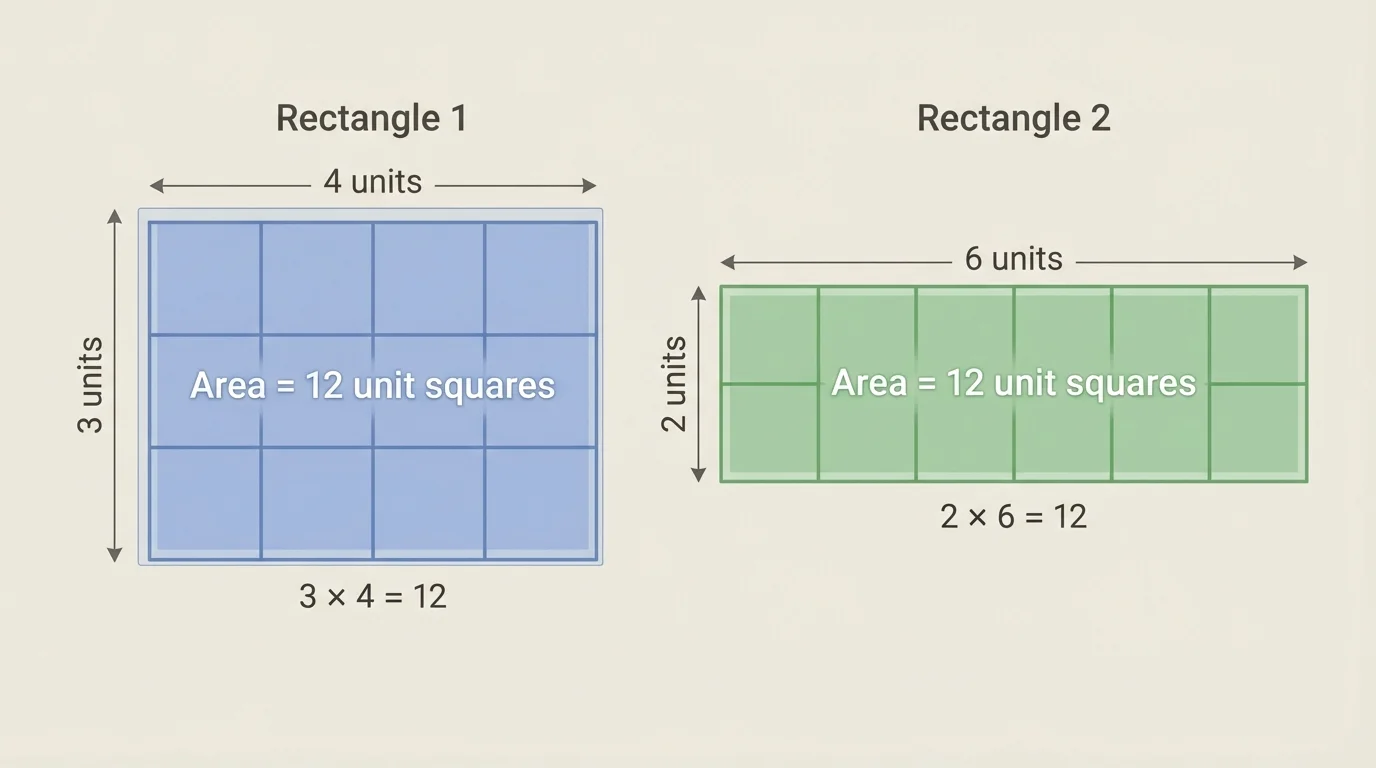
This helps us think about multiplication facts in a new way. If 3 \(\times\) 4 = 12, then a rectangle with 3 rows and 4 columns has the same area as any other rectangle that uses 12 total unit squares arranged in equal rows and columns.
We can list some rectangles for the same area:
| Area | Possible Side Lengths |
|---|---|
| \(12\) square units | \(1 \times 12\), \(2 \times 6\), \(3 \times 4\) |
| \(18\) square units | \(1 \times 18\), \(2 \times 9\), \(3 \times 6\) |
| \(24\) square units | \(1 \times 24\), \(2 \times 12\), \(3 \times 8\), \(4 \times 6\) |
Table 3. Examples of one area represented by different whole-number side lengths.
Later, when you learn more multiplication, you can use rectangle areas to understand factors. Right now, the important idea is that products can be pictured as rectangles.
Area matters in many everyday situations. If you need to buy grass seed for a yard, wrap paper for a bulletin board, or tiles for a kitchen floor, you need area. The shape may be a rectangle, and then multiplying the side lengths gives the answer fast.
Suppose a poster board is 8 inches by 11 inches. Its area is \(8 \times 11 = 88\) square inches. That tells how much flat space is on the poster board.
Suppose a dog pen is 12 feet by 5 feet. Its area is \(12 \times 5 = 60\) square feet. That tells how much ground space is inside the pen.
As we saw earlier in [Figure 1], area is really about covering space with equal squares. In real life, those squares might be tiles, floor mats, squares on graph paper, or square feet of grass.
Why multiplication makes sense for area
A rectangle is special because its square units line up in straight rows and columns. That means the same number of squares fits in each row. Multiplication is the perfect tool for equal groups, so it is also the perfect tool for finding rectangle area.
Area also helps in math problems that use drawings. If a picture shows a rectangle with side lengths marked, you can find the area even without counting every square. That is efficient and accurate.
One common mistake is adding side lengths when you should multiply. If a rectangle is 4 units by 7 units, the area is not \(4 + 7 = 11\). The area is \(4 \times 7 = 28\) square units.
Another mistake is forgetting the square unit. If the side lengths are in centimeters, the answer is in square centimeters, not just centimeters.
A third mistake is mixing up side lengths and total squares. The side lengths tell how many rows and columns there are. The area is the total number of square units inside. In [Figure 3], the side labels and interior grid make this connection clear.
Be careful to read the problem. If it asks how much space is covered, you need area. If it asks how far around a shape, that is a different measurement.
Rectangles help us reason about multiplication facts. For example, if you know \(5 \times 4 = 20\), you can picture a rectangle with 5 rows and 4 columns. That picture shows why the product is 20.
You can also break a rectangle into smaller rectangles. A 7 by 6 rectangle has area \(42\) square units because \(7 \times 6 = 42\). But you can also think of it as a 7 by 5 rectangle and a 7 by 1 rectangle. Then \(7 \times 5 = 35\) and \(7 \times 1 = 7\), and \(35 + 7 = 42\).
This shows that area connects to addition too. Bigger rectangles can be made from smaller rectangles, and the total area is the sum of the smaller areas.
When we use rectangles to show products, we build strong multiplication understanding. A product is not just a fact to memorize. It is also a picture of rows, columns, and space covered by square units, just as [Figure 4] helps us see for equal products arranged in different rectangle shapes.
"Multiplication tells how many in all when equal groups are arranged in rows and columns."
That idea is at the heart of rectangle area. Multiplying side lengths gives the number of square units inside the rectangle.
