Suppose you and three friends share one pan of brownies. If one person gets a huge piece and the others get tiny pieces, would that feel fair? Probably not. In geometry, equal sharing matters too. When we split a shape into parts, the parts must have the same amount of space inside them. That amount of space is called area. When all parts have equal area, we can describe each part with a fraction of the whole.
Shapes can be split in many ways, but not every split is correct for fractions. If a shape is partitioned into \(4\) equal-area parts, then each part is \(\dfrac{1}{4}\) of the whole shape. If a shape is partitioned into \(3\) equal-area parts, each part is \(\dfrac{1}{3}\). The denominator tells how many equal parts the whole is divided into, and the numerator tells how many of those parts we are talking about.
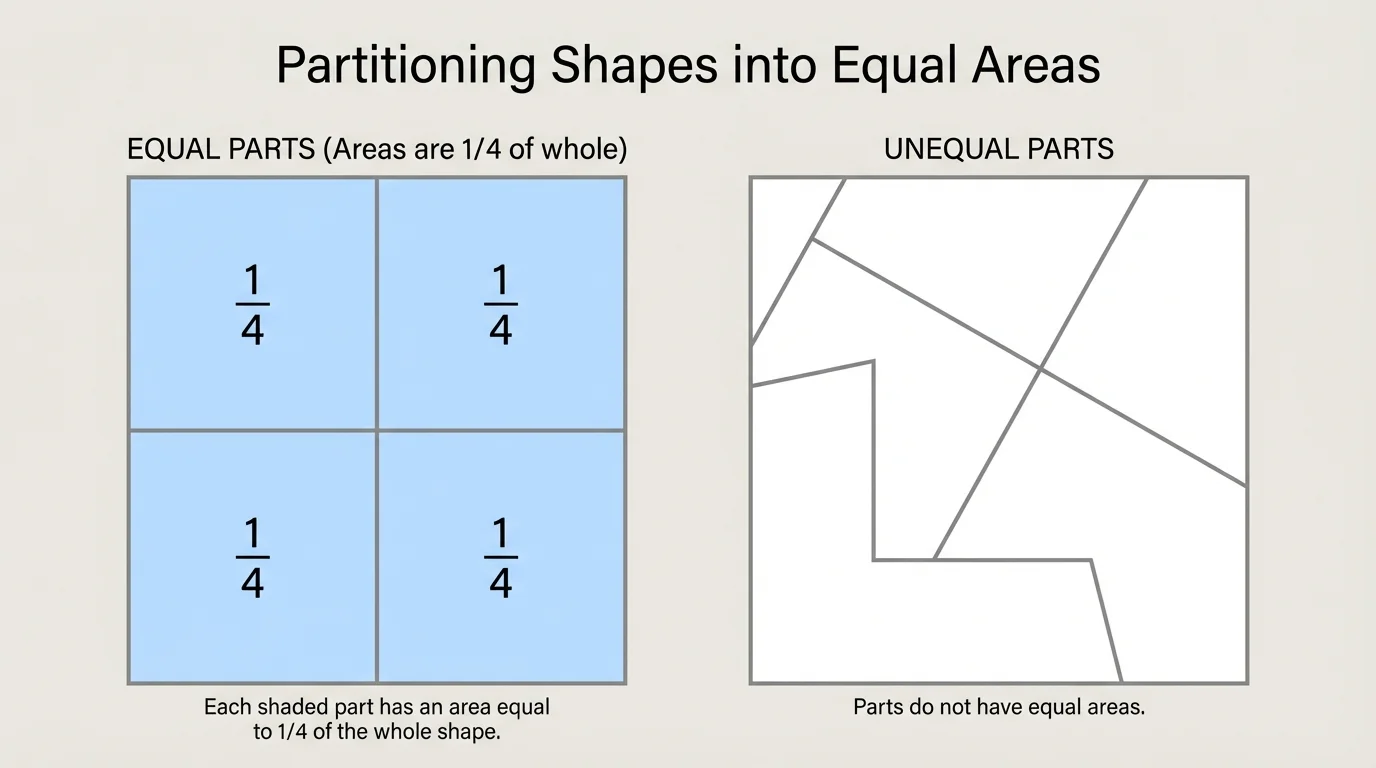
When mathematicians say a shape is partitioned into equal parts, they mean each part has the same area, as [Figure 1] shows. It is not enough for the parts to look almost equal. They must really cover the same amount of space.
For example, think about a rectangle divided into \(4\) pieces. If all \(4\) pieces have the same area, then each piece is \(\dfrac{1}{4}\) of the rectangle. But if one piece is wider than the others, then the parts are not equal. In that case, you cannot correctly say each part is \(\dfrac{1}{4}\).
This idea is very important: fractions of shapes depend on equal area. We are not just counting pieces. We are checking whether the pieces are fair shares of the whole.
You already know that a shape is a flat figure such as a square, rectangle, triangle, or circle. You also know that a whole means one complete object or one complete shape. Fractions begin with a whole and then describe equal parts of it.
Two shapes can be cut into the same number of parts, but only one partition may be correct. If one circle is divided into \(4\) equal slices, each slice is \(\dfrac{1}{4}\). If another circle is divided into \(4\) slices of different sizes, those slices are not fourths.
A whole is one complete shape before it is divided. A part is one piece of that whole after it has been split. When the whole is divided into equal parts, we can name each part with a fraction.
Unit fraction means a fraction with \(1\) on top. A unit fraction names one equal part of a whole. Examples include \(\dfrac{1}{2}\), \(\dfrac{1}{3}\), \(\dfrac{1}{4}\), and \(\dfrac{1}{8}\).
Partition means to divide a shape into parts.
If a square is partitioned into \(2\) equal parts, each part is \(\dfrac{1}{2}\) of the square. If the same square is partitioned into \(4\) equal parts, each part is \(\dfrac{1}{4}\). Notice that the whole shape is still the same square, but the size of each part changes depending on how many equal parts there are.
The more equal parts a whole is divided into, the smaller each unit fraction becomes. For example, one part out of \(8\) equal parts, \(\dfrac{1}{8}\), is smaller than one part out of \(4\) equal parts, \(\dfrac{1}{4}\).
A rectangle is often the easiest shape to partition because you can draw straight lines across it. One rectangle can be divided into \(2\), \(3\), \(4\), \(6\), or even \(8\) equal parts. If there are \(6\) equal parts, then each part is \(\dfrac{1}{6}\) of the rectangle.
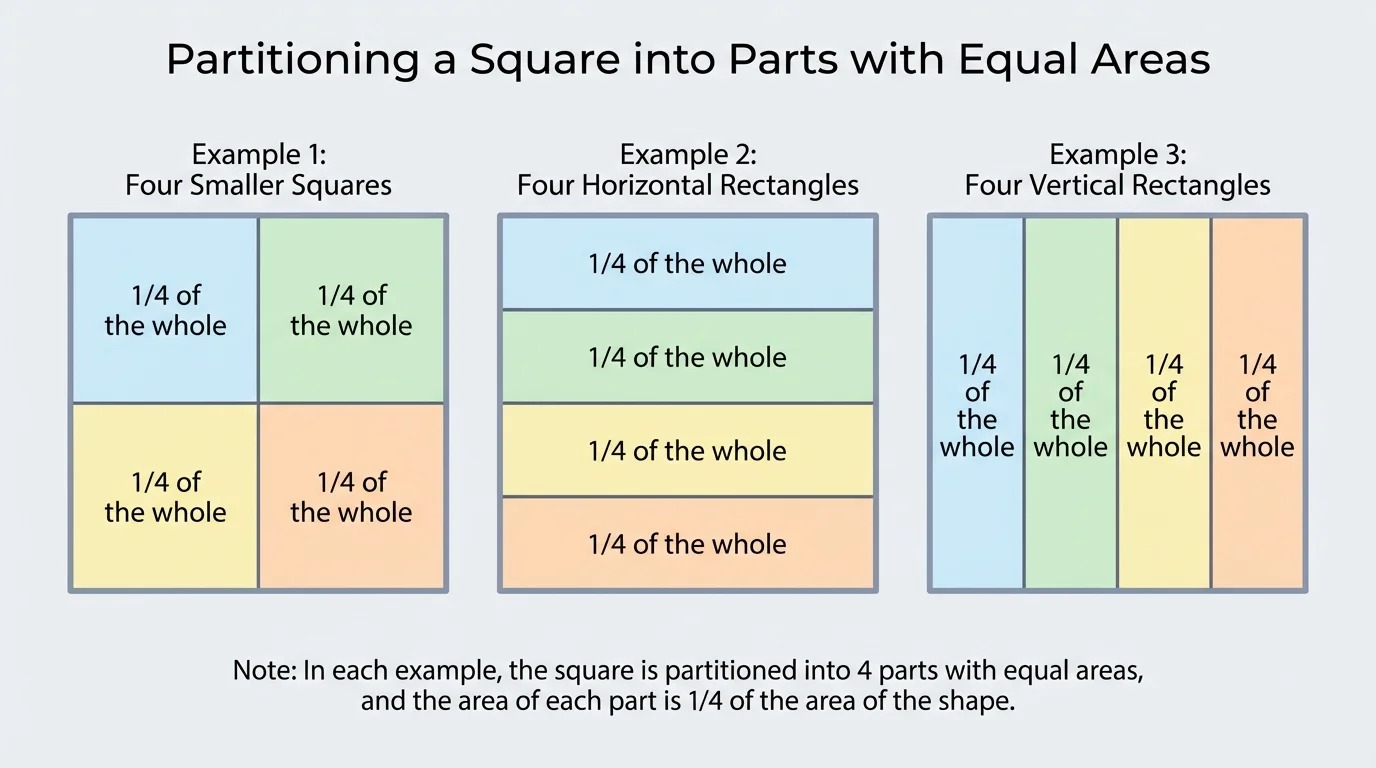
The same whole shape can be partitioned in more than one correct way, as [Figure 2] illustrates. A square can be split into \(4\) equal vertical strips, \(4\) equal horizontal strips, or \(4\) smaller equal squares. In every case, each part is still \(\dfrac{1}{4}\) of the whole square.
Circles can also be partitioned into equal areas. A circle divided into \(2\) equal halves gives pieces of \(\dfrac{1}{2}\). A circle divided into \(4\) equal slices gives pieces of \(\dfrac{1}{4}\). These are like equal pizza slices.
Triangles and other polygons can be partitioned too. What matters is not the kind of shape, but whether the parts have equal area. A triangle divided from one vertex to the midpoint of the opposite side makes \(2\) equal-area parts, so each part is \(\dfrac{1}{2}\).
Sometimes lines may look different, but the areas can still be equal. As we saw with the square in [Figure 2], different partitions can name the same fraction.
How to name each part
To name one part of a partitioned shape, count how many equal-area parts make the whole. Put \(1\) on top and that total number on the bottom. If the whole has \(5\) equal parts, one part is \(\dfrac{1}{5}\). If the whole has \(8\) equal parts, one part is \(\dfrac{1}{8}\).
You can think of the denominator, the bottom number, as telling the number of equal shares in the whole. The numerator, the top number, tells how many shares you are naming. In this lesson, we focus mostly on one share, so we use unit fractions.
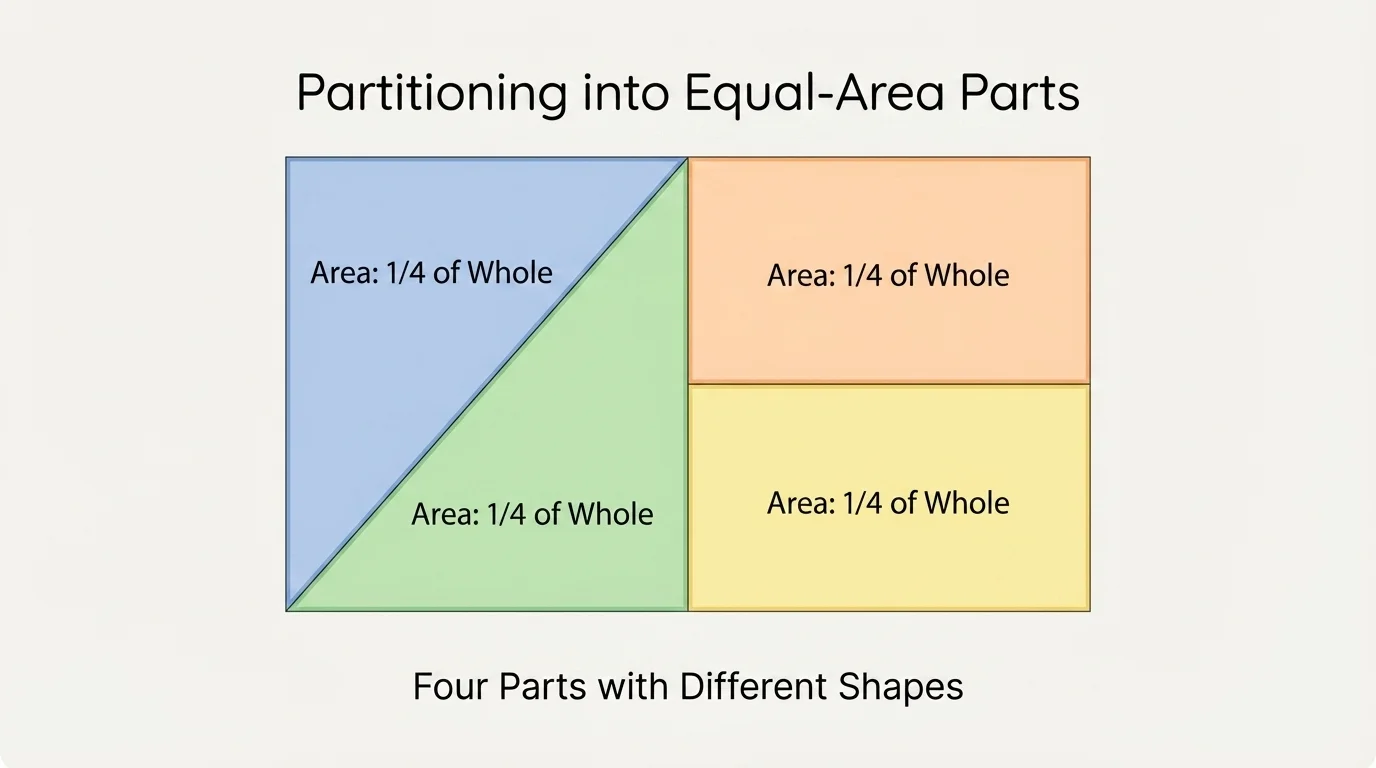
Many students think equal parts must always look exactly the same. That is not true. Parts can have different shapes and still have the same area, as [Figure 3] shows. In geometry, equal area is the rule that matters.
For example, a rectangle can be split by a diagonal line into \(2\) triangles. Those triangles have a different shape from the original rectangle, but they have equal area. Each triangle is \(\dfrac{1}{2}\) of the rectangle.
Another shape might be divided into parts that are not congruent. Congruent means exactly the same size and shape. But for fractions of area, the parts only need equal area. They do not always need to be congruent.
This is why it is important to ask, "Do these parts cover the same amount of space?" instead of only asking, "Do these parts look the same?" A clever partition can make equal areas with different-looking pieces.
Worked examples help make this idea clear. In each example, we look carefully at the whole, the number of equal parts, and the fraction name for one part.
Worked Example 1
A rectangle is partitioned into \(4\) equal strips. What fraction of the whole rectangle is one strip?
Step 1: Count the equal parts.
The rectangle is divided into \(4\) equal parts.
Step 2: Write the unit fraction.
One part out of \(4\) equal parts is \(\dfrac{1}{4}\).
Step 3: State the answer clearly.
Each strip is \(\dfrac{1}{4}\) of the rectangle.
Answer: \[\frac{1}{4}\]
This example shows the most basic idea: count the equal parts in the whole, then write one of those parts as a unit fraction.
Worked Example 2
A circle is partitioned into \(8\) equal slices. What fraction of the circle is one slice?
Step 1: Count the equal slices.
There are \(8\) equal slices.
Step 2: Write one part as a fraction.
One slice out of \(8\) equal slices is \(\dfrac{1}{8}\).
Step 3: Check the meaning.
If all \(8\) slices were put together again, they would make one whole circle.
Answer: \[\frac{1}{8}\]
Notice that because the circle is divided into more parts than the rectangle in the first example, each piece is smaller. That is why \(\dfrac{1}{8}\) is smaller than \(\dfrac{1}{4}\).
Worked Example 3
A square is divided into \(2\) equal triangles by drawing one diagonal line from corner to corner. What fraction of the square is each triangle?
Step 1: Look at the partition.
The diagonal splits the square into \(2\) equal-area parts.
Step 2: Name one part.
One part out of \(2\) equal parts is \(\dfrac{1}{2}\).
Step 3: Connect the idea to area.
Each triangle covers half of the square's area.
Answer: \[\frac{1}{2}\]
This example is important because the pieces are triangles, not smaller squares or rectangles. Even so, each part is still a fraction of the original square.
Worked Example 4
A rectangle is cut into \(3\) pieces, but one piece is larger than the other two. Can each piece be called \(\dfrac{1}{3}\) of the rectangle?
Step 1: Check whether the parts are equal.
The pieces are not equal in area because one piece is larger.
Step 2: Use the rule for fractions of shapes.
Unit fractions describe one equal part of a whole.
Step 3: Decide.
Since the pieces are not equal, they are not thirds.
Answer: No. The pieces cannot each be called \(\dfrac{1}{3}\).
This is one of the most important checks in the whole topic. We cannot use fraction names unless the parts have equal area.
One common mistake is counting the number of pieces without checking whether they are equal. A shape cut into \(4\) pieces does not automatically mean each piece is \(\dfrac{1}{4}\). The pieces must have equal area first.
Another mistake is thinking equal perimeter means equal area. Perimeter is the distance around a shape, but area is the amount of space inside. For partitioning fractions, we care about area, not perimeter.
Students also sometimes think the parts must all point the same way or have the same exact shape. But as we learned earlier from equal-area partitions like the one in [Figure 3], parts can look different and still represent the same fraction of the whole.
A sandwich, a chocolate bar, a quilt, and a soccer field diagram can all be understood using the same fraction idea: one whole divided into equal parts. Geometry helps us describe fair shares in many different situations.
When you look at a partitioned shape, ask yourself three questions: What is the whole? Into how many equal-area parts is it divided? What fraction names one part? These questions help you stay accurate.
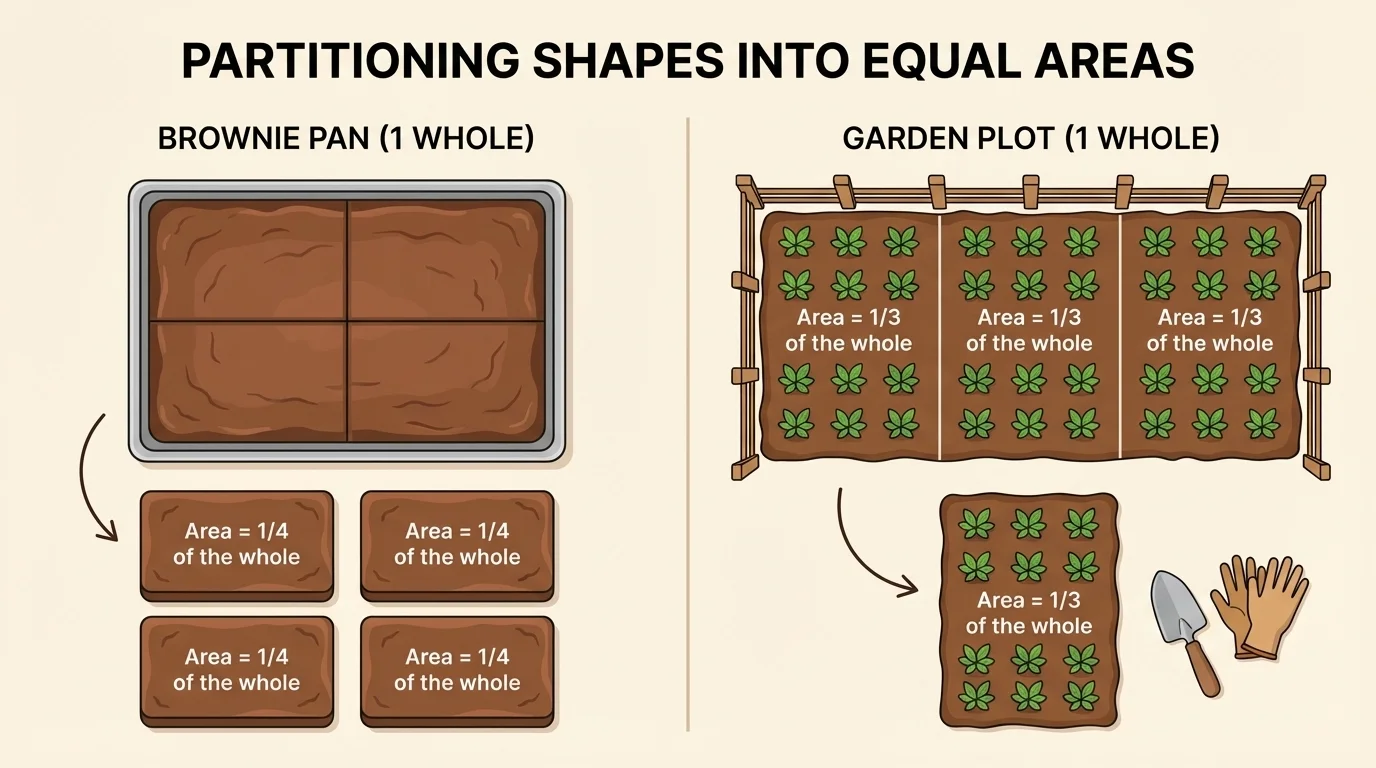
[Figure 4] Partitioning shapes is not just a classroom idea. It appears in daily life with food and garden spaces. If a pan of brownies is cut into \(8\) equal pieces, each piece is \(\dfrac{1}{8}\) of the pan. If a garden bed is split into \(4\) equal sections for planting, each section is \(\dfrac{1}{4}\) of the garden bed.
Artists and designers also use equal parts. A tile floor might repeat a square pattern divided into equal pieces. A paper craft may begin with folding a sheet into \(2\), \(4\), or \(8\) equal parts.
Sports fields can be partitioned too. A coach may divide a practice area into equal zones. Each zone is a fraction of the whole field space. Equal areas help keep the practice balanced and organized.
Even sharing time can connect to this idea. If an hour is divided into \(4\) equal parts, each part is one quarter of an hour, or \(\dfrac{1}{4}\) of the whole hour. The same fraction idea works for shapes, time, and many other wholes.
Here are some common unit fractions for partitioned shapes:
| Number of equal parts in the whole | Fraction name for one part |
|---|---|
| \(2\) | \(\dfrac{1}{2}\) |
| \(3\) | \(\dfrac{1}{3}\) |
| \(4\) | \(\dfrac{1}{4}\) |
| \(6\) | \(\dfrac{1}{6}\) |
| \(8\) | \(\dfrac{1}{8}\) |
Table 1. Common unit fractions based on the number of equal parts in a whole shape.
As the number of equal parts increases, each part gets smaller. That means \(\dfrac{1}{2}\) is larger than \(\dfrac{1}{3}\), and \(\dfrac{1}{4}\) is larger than \(\dfrac{1}{8}\). All of these fractions can describe one part of a shape, but the size of that part depends on how many equal parts make the whole.
This is why a shape partitioned into \(2\) equal parts gives bigger pieces than the same shape partitioned into \(8\) equal parts. The whole stays the same, but the number of equal shares changes.
We can write this comparison using words and fractions: one half is larger than one fourth, so \(\dfrac{1}{2} > \dfrac{1}{4}\). One fourth is larger than one eighth, so \(\dfrac{1}{4} > \dfrac{1}{8}\).
When you return to the earlier square partitions in [Figure 2], you can see that no matter how the square is correctly split into \(4\) equal areas, each part keeps the same fraction name: \(\dfrac{1}{4}\).
"Fractions of shapes make sense only when the shares are equal."
Geometry helps us reason about shapes and their attributes. One important attribute is area. When we partition a shape into equal areas, we connect geometry and fractions at the same time. That is why this topic is such an important bridge between shape ideas and number ideas.
