If you cover a tabletop with square sticky notes, you can count the whole top all at once, or you can count one part and then another part. Either way, the tabletop does not change. That is exactly what happens with rectangles in math: one big rectangle can be broken into smaller rectangles, and the total area stays the same.
Area tells how much surface is covered inside a flat shape. We measure area in square units, such as square tiles or square centimeters. A rectangle with side length \(4\) and side length \(3\) has \(4\) rows and \(3\) columns of square units, so its area is \(4 \times 3 = 12\) square units.
When we find the area of a rectangle, we multiply its side lengths. If a rectangle has length \(l\) and width \(w\), then its area is \(l \times w\). For this lesson, we will use side lengths named \(a\), \(b\), and \(c\).
You already know two important ideas: multiplication can count equal groups, and addition can combine amounts. Area uses both ideas together. A rectangle can be seen as rows of equal length, and separate parts of a rectangle can be added to find the whole.
A tiled rectangle makes this easy to see. Each little square is \(1\) square unit. Counting all the tiles gives the area. Multiplying the number of rows by the number of columns gives the same answer.
[Figure 1] A rectangle with side lengths \(a\) and \(b+c\) can be split into two smaller rectangles. The height stays \(a\), but the long side is broken into two parts: one part of length \(b\) and one part of length \(c\).
That means the first small rectangle has area \(a \times b\), and the second small rectangle has area \(a \times c\). Since the two small rectangles exactly fill the big rectangle, their areas add to make the whole area.
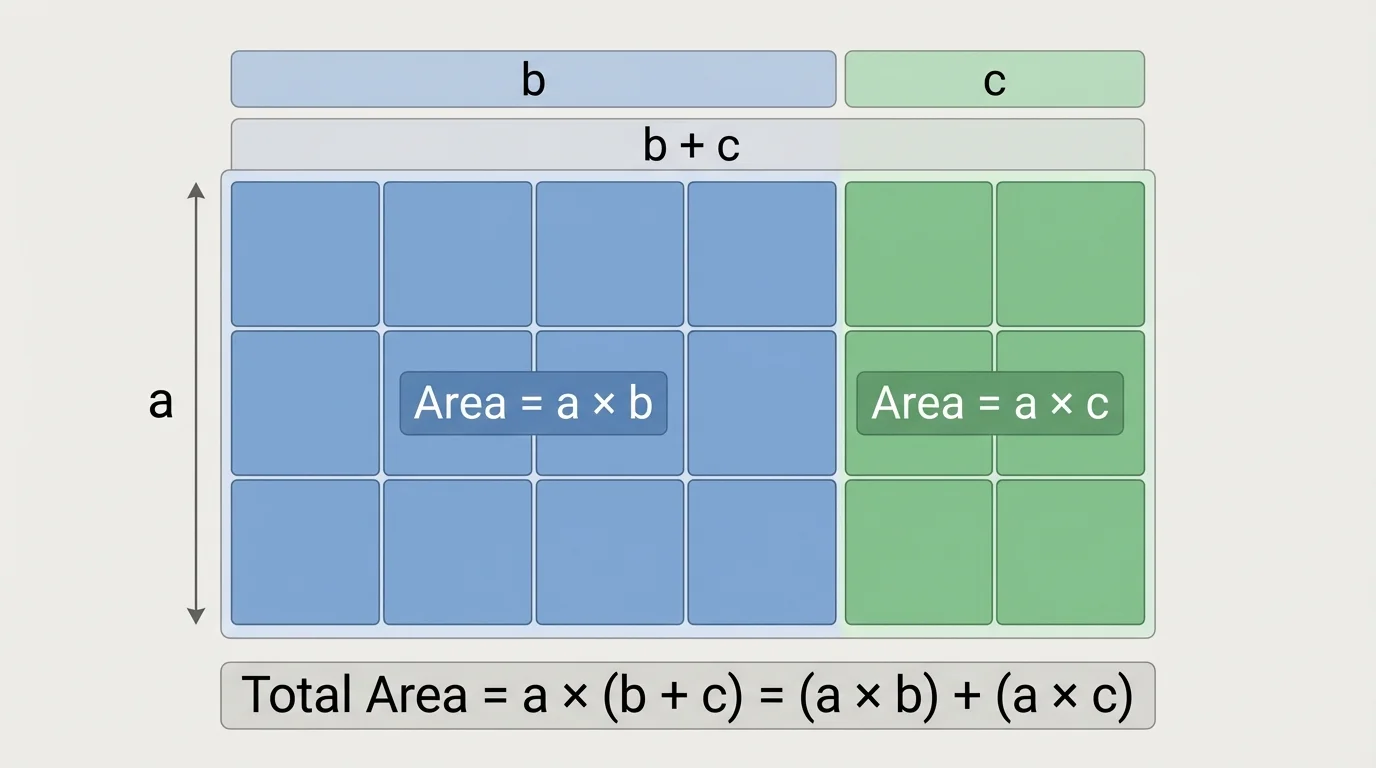
This is a concrete model because we can imagine real square tiles covering the shape. No spaces are left empty, and no tiles overlap. So the whole area is the sum of the two parts:
\[a \times (b+c) = a \times b + a \times c\]
This equation is called the distributive property. In area models, it means one side length multiplies each part of the other side length.
An area model is a picture of a rectangle or other shape used to show multiplication and addition. It helps us see how a whole can be broken into parts and how those parts fit together.
Tiling means covering a shape with equal-sized squares and no gaps or overlaps.
Notice something important: we are not adding the side lengths \(a+b+c\). We are finding areas. The areas of the parts are \(a \times b\) and \(a \times c\), and those two areas add together.
Suppose the big rectangle is \(a\) units tall. Every row stretches across \(b+c\) units. In each row, there are \(b\) tiles in one part and \(c\) tiles in the other part. So each row has \(b+c\) tiles total.
If there are \(a\) equal rows, then the whole rectangle has \(a \times (b+c)\) tiles. But we can also count the left part first and the right part next. The left part has \(a \times b\) tiles, and the right part has \(a \times c\) tiles. Adding them gives \(a \times b + a \times c\).
Because both ways count the exact same tiles, the expressions must be equal. That is why the area model proves the distributive property in a concrete way.
One whole, two parts
Area models help us reason carefully. If a big rectangle is made from two smaller rectangles placed together with no gap, then the area of the big rectangle must equal the sum of the areas of the two small rectangles. This idea works because area measures covering, and the same space cannot have two different total areas.
Later, when you see [Figure 1] in your mind again, remember that the split does not change the amount of space. It only changes how we count it.
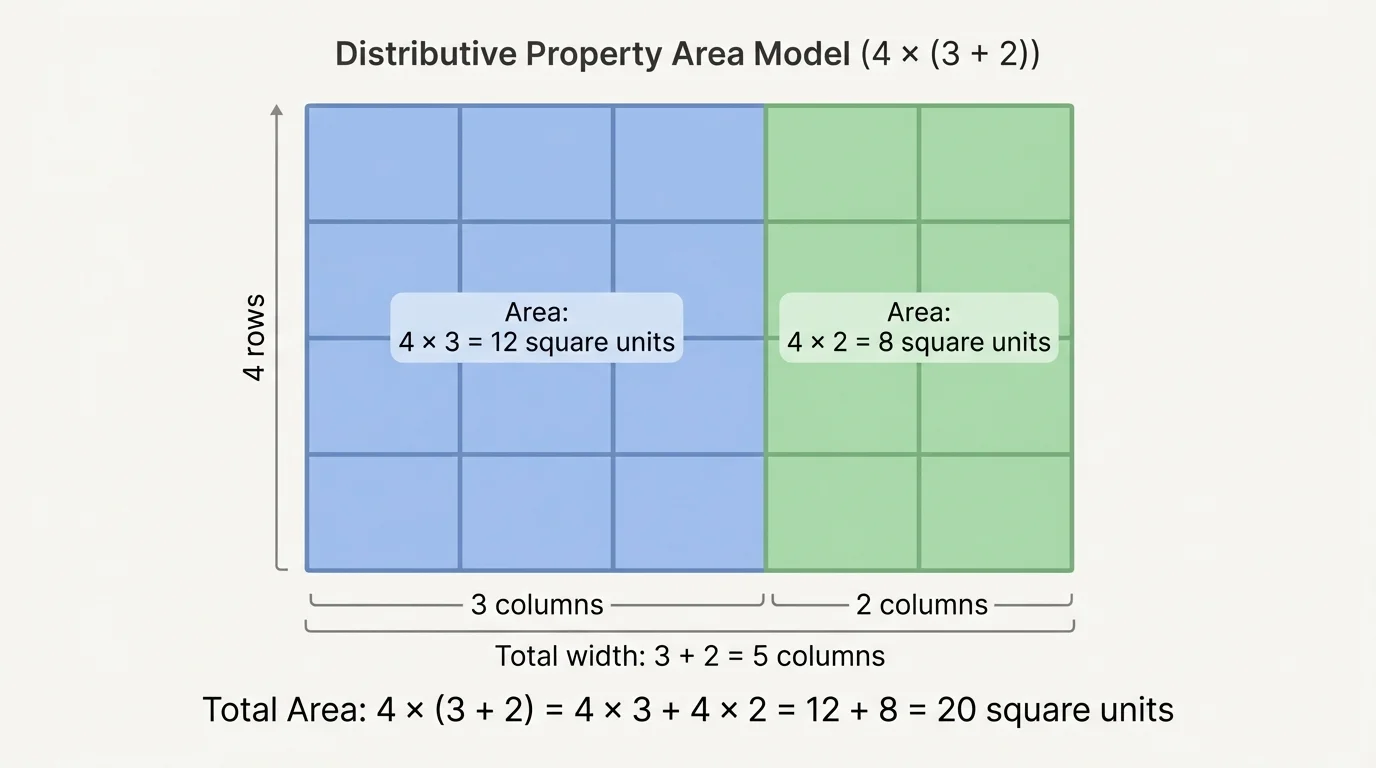
[Figure 2] Let us use a concrete case with numbers. A rectangle is \(4\) units tall and \(3+2\) units wide. The tiled model shows one big rectangle split into a \(4 \times 3\) part and a \(4 \times 2\) part.
Worked example: Show that \(4 \times (3+2) = 4 \times 3 + 4 \times 2\).
Step 1: Find the total width.
\(3+2=5\), so the whole rectangle is \(4\) by \(5\).
Step 2: Find the area of the whole rectangle.
\(4 \times 5 = 20\)
Step 3: Find the area of each part.
Left part: \(4 \times 3 = 12\)
Right part: \(4 \times 2 = 8\)
Step 4: Add the parts.
\(12 + 8 = 20\)
So, \(4 \times (3+2) = 4 \times 3 + 4 \times 2 = 20\).
The two methods match because they count the same \(20\) square units. One method finds the whole first. The other method finds the parts first.
This is what mathematicians mean by using a model to support reasoning. The tiles make the equation visible.
Now use a rectangle with height \(5\) and width \(6+1\). This time one part is much larger than the other, but the rule still works.
Worked example: Show that \(5 \times (6+1) = 5 \times 6 + 5 \times 1\).
Step 1: Add inside the parentheses.
\(6+1=7\)
Step 2: Find the area of the whole rectangle.
\(5 \times 7 = 35\)
Step 3: Find the area of each smaller rectangle.
\(5 \times 6 = 30\) and \(5 \times 1 = 5\)
Step 4: Add the two smaller areas.
\(30 + 5 = 35\)
So, \(5 \times (6+1) = 35\) and \(5 \times 6 + 5 \times 1 = 35\).
Even when one side part is only \(1\) unit wide, it still has area because it covers space. That small strip matters.
Here is a case where we compare two correct ways to think. Suppose a rectangle has side lengths \(3\) and \(4+5\).
Worked example: Compare whole-first and part-first thinking.
Step 1: Whole-first method.
\(4+5=9\), so the whole area is \(3 \times 9 = 27\).
Step 2: Part-first method.
First part: \(3 \times 4 = 12\)
Second part: \(3 \times 5 = 15\)
Step 3: Add the part areas.
\(12 + 15 = 27\)
Both methods give \(27\), so \(3 \times (4+5) = 3 \times 4 + 3 \times 5\).
It is helpful to notice that addition happens inside the width first, but multiplication tells how many rows of that width there are.
[Figure 3] You can split a rectangle in more than one way. A vertical split makes left and right parts, and a horizontal split makes top and bottom parts. Another partition is shown where the rectangle is cut across instead of up and down.
If the width is the same but the height is split into \(b\) and \(c\), then the total area can be written as \((b+c) \times a = b \times a + c \times a\). This matches the same big idea: the whole area equals the sum of the areas of the parts.
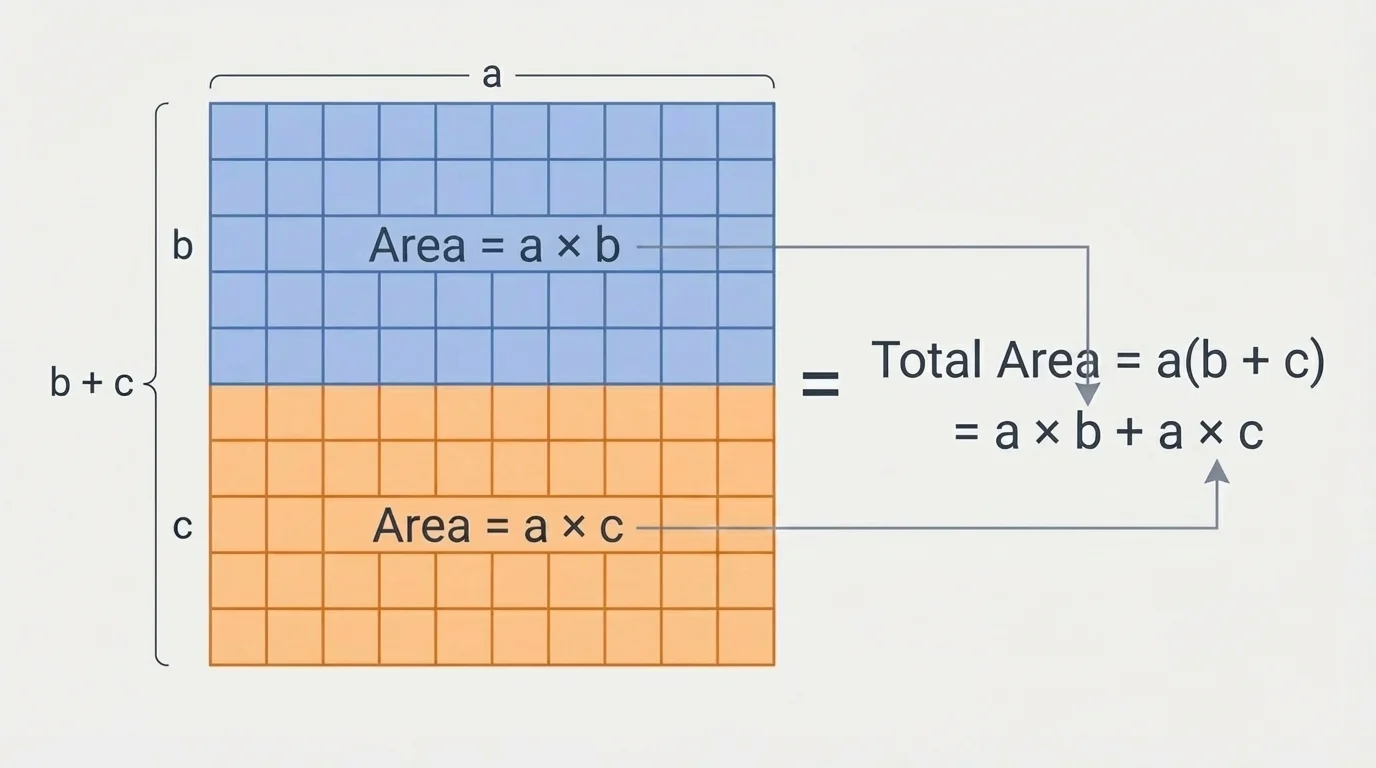
Because multiplication can be turned around for whole numbers, \(a \times b = b \times a\). So whether we think of \(a\) as the height or the width, the area stays the same.
Looking back at the diagram, the direction of the cut changes the picture, but it does not change the total space covered. That is another good check for your reasoning.
Mathematical reasoning means explaining why something is true, not only finding an answer. An area model helps us do that because we can point to the big rectangle, the smaller rectangles, and the tiles inside them.
When you say, "The whole rectangle has side lengths \(a\) and \(b+c\), so its area is \(a \times (b+c)\)," you are using multiplication. When you say, "The rectangle is made of two smaller rectangles with areas \(a \times b\) and \(a \times c\), so the total area is \(a \times b + a \times c\)," you are using addition of areas.
Since both descriptions are about the very same rectangle, we can write:
\[a \times (b+c) = a \times b + a \times c\]
This is more than a rule to memorize. It is a relationship we can see and explain.
Builders and designers often break large spaces into smaller rectangles to measure them. That makes area easier to find and helps them check their work in more than one way.
Area models are useful because they connect words, pictures, and equations. A student can tile, draw, and calculate to prove the same idea.
Suppose a classroom bulletin board is \(2\) units tall and \(5+3\) units wide. You can find the whole area by calculating \(2 \times 8 = 16\), or split it into a \(2 \times 5\) part and a \(2 \times 3\) part. Then \(10 + 6 = 16\). This is useful when one part is already known.
A garden bed might be \(4\) feet wide and \(7+2\) feet long. The area is \(4 \times 9 = 36\) square feet. If the gardener thinks of it as two rectangles, then \(4 \times 7 = 28\) and \(4 \times 2 = 8\). Adding gives \(28 + 8 = 36\).
Floor tiling works the same way. If a hallway floor is one long rectangle, workers may divide it into smaller rectangles to count tiles more easily. Just like in [Figure 2], they can count one part, count the next part, and add the totals.
One mistake is adding all the side lengths and calling that the area. For example, with side lengths \(4\) and \(3+2\), the area is not \(4+3+2\). Area uses multiplication, so the whole area is \(4 \times 5 = 20\).
Another mistake is forgetting that each part must still be multiplied by the shared side length. If a rectangle is \(a\) by \(b+c\), the areas of the parts are \(a \times b\) and \(a \times c\), not just \(b+c\).
A third mistake is thinking the split changes the total area. It does not. As we saw with [Figure 1], partitioning only changes how we count the same space.
| Rectangle | Whole-first method | Part-first method | Same total area |
|---|---|---|---|
| \(4 \times (3+2)\) | \(4 \times 5 = 20\) | \(4 \times 3 + 4 \times 2 = 12 + 8\) | \(20\) |
| \(5 \times (6+1)\) | \(5 \times 7 = 35\) | \(5 \times 6 + 5 \times 1 = 30 + 5\) | \(35\) |
| \(3 \times (4+5)\) | \(3 \times 9 = 27\) | \(3 \times 4 + 3 \times 5 = 12 + 15\) | \(27\) |
Table 1. Examples comparing finding the whole rectangle area first and adding the areas of the parts.
These examples all follow the same pattern. One rectangle can be counted as one whole or as two parts, and both methods must agree.
