Have you ever looked at a floor made of tiles and wondered how many tiles it takes to cover it? That question is really about area. Area helps us measure how much space is inside a flat shape. When we talk about area, we are not measuring around the edge. We are measuring the surface inside.
A plane figure is a flat shape, like a rectangle, square, or an L-shaped design drawn on paper. The area of a plane figure tells how much flat space it covers. One way to measure area is by using small equal squares.
Area is measured by seeing how many equal squares fit inside a shape exactly, as [Figure 1] shows. If a plane figure can be covered without any empty spaces and without any squares lying on top of each other by \(n\) unit squares, then the area of the figure is \(n\) square units.
Area is the amount of surface inside a plane figure.
Square unit is the area of a square that is \(1\) unit long on each side.
If a figure is covered by \(n\) unit squares with no gaps or overlaps, its area is \(n\) square units.
Think of a coloring page. The border of the shape is like the fence around a playground, but the area is the ground inside the fence. Area tells how much of the inside space there is.
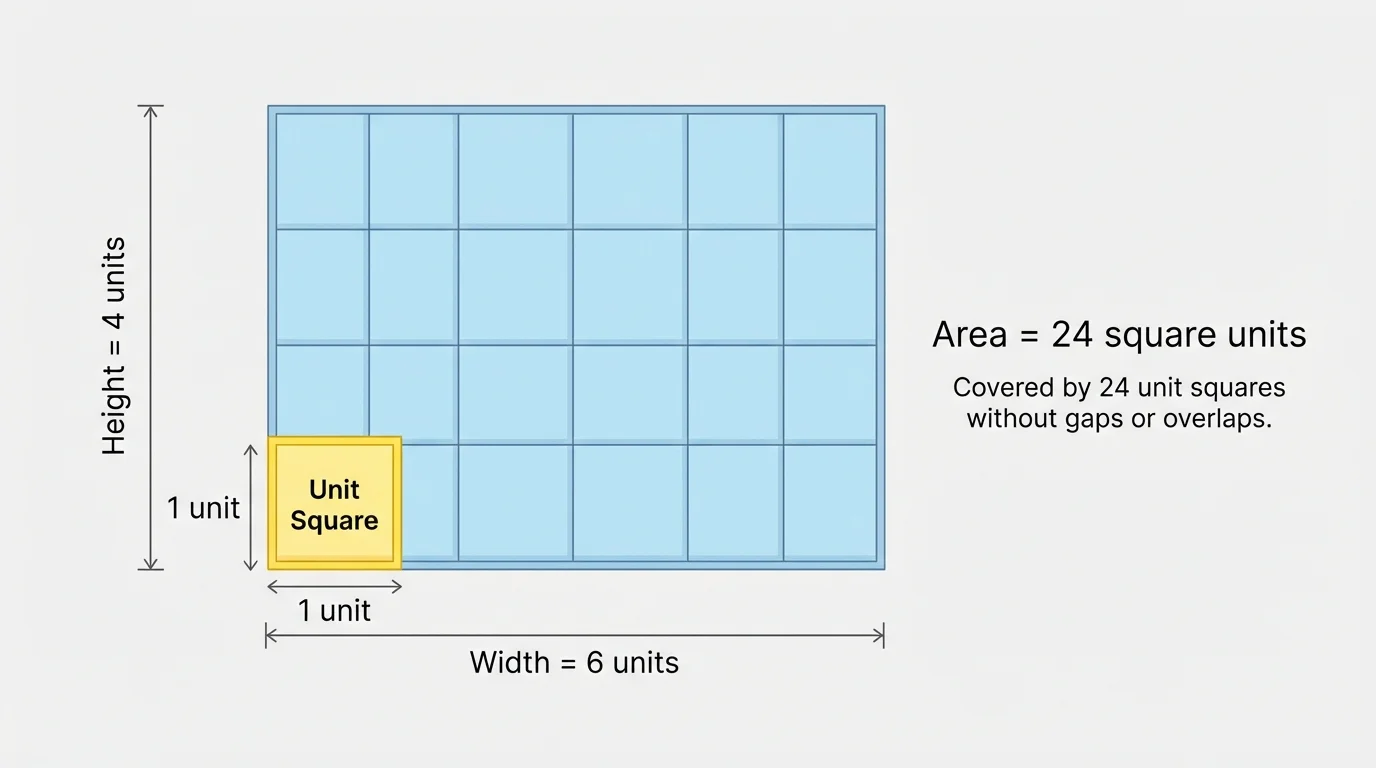
A unit square is a square with side length \(1\) unit. The unit might be \(1\) inch, \(1\) centimeter, or one grid square on grid paper. No matter what the unit is, each small square must be the same size.
When we count these unit squares, we are counting square units. For example, if a shape is covered by \(8\) unit squares, then its area is \(8\) square units. We write that as \(8\) square units, not just \(8\), because the units matter.
You may already know how to count objects in rows and columns. Area uses that same idea, but now the objects are unit squares covering a shape.
Suppose a small rectangle is covered by \(5\) unit squares. Then its area is \(5\) square units. If another shape is covered by \(12\) unit squares, its area is \(12\) square units. The number of squares tells the area.
There is an important rule when we measure area: the unit squares must cover the figure exactly once, as [Figure 2] illustrates. That means there can be no gaps and no overlaps.
A gap is an empty space that is not covered. If there is a gap, then the whole figure is not covered, so the area has not been measured correctly. An overlap is when one square lies partly or fully on top of another square. Then some space gets counted more than once, which is also incorrect.
If you were tiling a tabletop, you would want the tiles to fit side by side. If you leave spaces between tiles, part of the tabletop is uncovered. If you stack one tile on another, the tabletop is not being covered fairly. Area measurement works the same way.
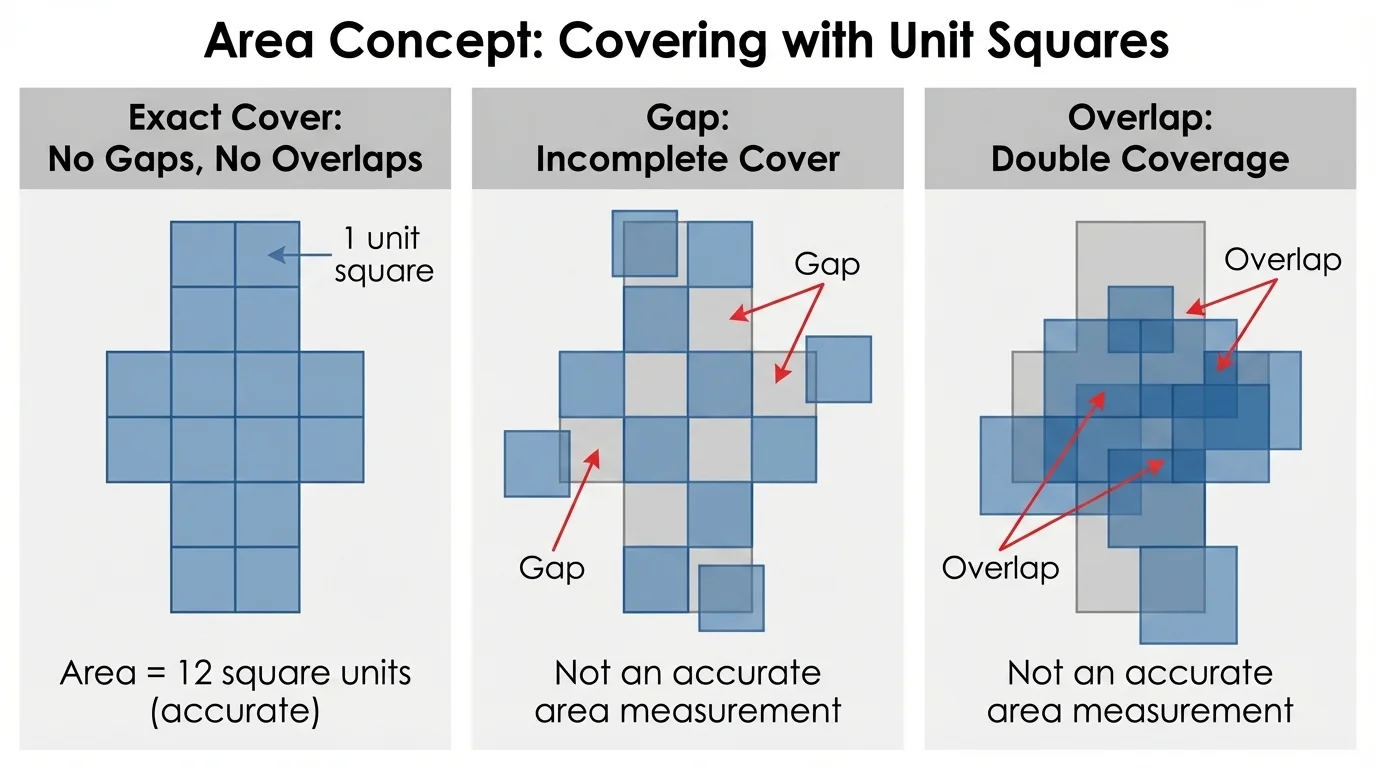
So when we say a figure has area \(n\) square units, we mean it can be covered by exactly \(n\) unit squares with no missing spaces and no double-covered spaces.
One simple way to find area is to count all the unit squares inside a figure. This works especially well on grid paper.
For example, if a shape is made of \(7\) full unit squares, then the area is \(7\) square units. If a rectangle is covered by \(9\) full unit squares, then its area is \(9\) square units.
This idea works for shapes that are not rectangles too. As long as the shape is covered by full unit squares with no gaps or overlaps, you can count the squares to find the area.
Builders, artists, and game designers all use area ideas. Whenever a surface must be covered completely, area helps them know how much material is needed.
Sometimes shapes look unusual, but the same rule still works: count the unit squares that cover the figure exactly.
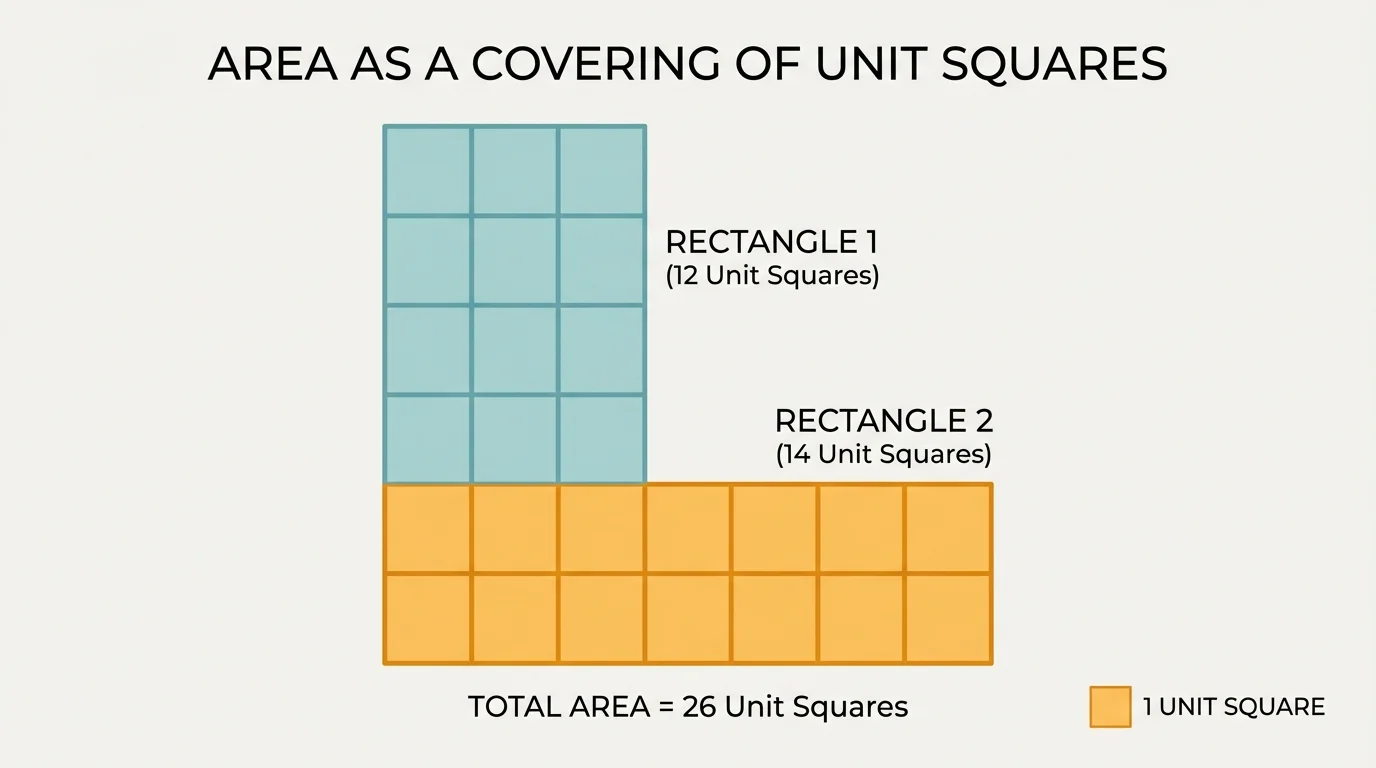
Some figures are easier to understand when you break them into smaller parts, as [Figure 3] shows. If you know the area of each part, you can add the areas to find the total area.
This is helpful for shapes like L-shapes or other figures made from rectangles joined together. If one part has area \(4\) square units and another part has area \(6\) square units, then the whole figure has area
\(4 + 6 = 10\)
square units.
Area can be added because the parts together make the whole shape, and the parts do not overlap. This matches the idea of exact covering: every square is counted once.
Later, you can see that splitting a shape into rectangles makes counting faster and more organized.
Rectangles are special because their unit squares line up in equal rows and columns, as [Figure 4] shows. That means we can find area by multiplication instead of counting one square at a time.
If a rectangle has \(4\) rows with \(6\) unit squares in each row, then the total number of squares is
\[4 \times 6 = 24\]
So the area is \(24\) square units.
Why multiplication helps
Multiplication is a fast way to count equal groups. In a rectangle, each row has the same number of unit squares. Instead of adding \(6 + 6 + 6 + 6\), you can multiply \(4 \times 6\).
You can also think of this as repeated addition. For the rectangle above, repeated addition gives
\[6 + 6 + 6 + 6 = 24\]
and multiplication gives
\[4 \times 6 = 24\]
Both ways show the same area: \(24\) square units.
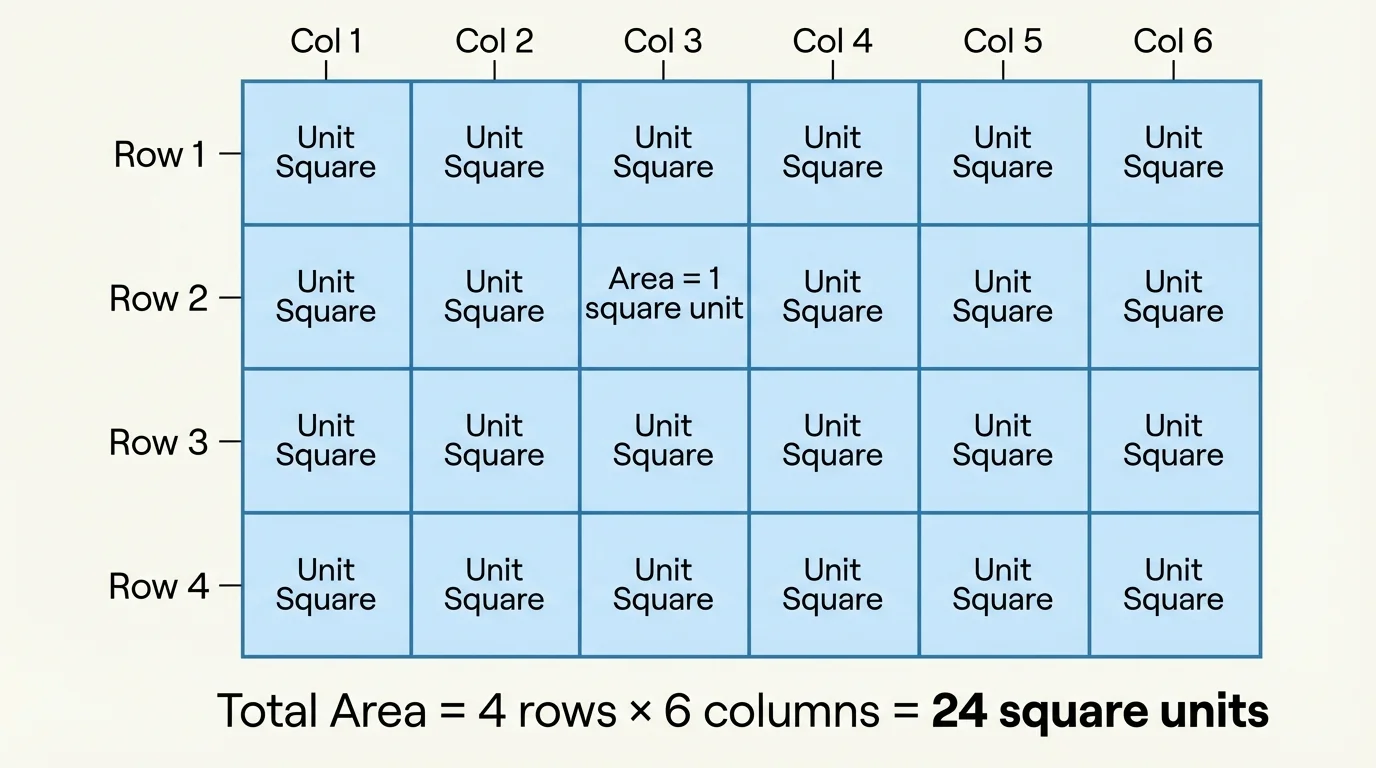
When rectangles get bigger, multiplication saves time. It is much easier to use rows and columns than to count all \(24\) squares one by one.
Worked examples help show how these ideas fit together.
Example 1: Counting unit squares
A small shape is covered by \(8\) unit squares. What is its area?
Step 1: Identify what is being counted.
The figure is covered by \(8\) unit squares.
Step 2: Use the meaning of area.
If a figure can be covered by \(n\) unit squares with no gaps or overlaps, then its area is \(n\) square units.
Step 3: Substitute \(n = 8\).
The area is \(8\) square units.
Answer: \[8 \textrm{ square units}\]
This example shows the basic rule directly: the number of unit squares equals the area in square units.
Example 2: Adding areas of parts
An L-shaped figure is split into two rectangles. One rectangle has area \(5\) square units, and the other has area \(7\) square units. What is the total area?
Step 1: Find the two part areas.
The two areas are \(5\) and \(7\) square units.
Step 2: Add the parts.
\(5 + 7 = 12\)
Step 3: State the unit.
The total area is \(12\) square units.
Answer: \[12 \textrm{ square units}\]
This works because the two parts together make the whole figure and the parts do not overlap.
Example 3: Rectangle with rows and columns
A rectangle has \(3\) rows of unit squares and \(4\) unit squares in each row. What is its area?
Step 1: Write the multiplication expression.
There are \(3\) rows with \(4\) squares in each row, so use \(3 \times 4\).
Step 2: Multiply.
\(3 \times 4 = 12\)
Step 3: Name the unit.
The area is \(12\) square units.
Answer: \[12 \textrm{ square units}\]
This is the same as repeated addition: \(4 + 4 + 4 = 12\).
Example 4: Compare two figures
Figure A is covered by \(10\) unit squares. Figure B is covered by \(13\) unit squares. Which figure has the greater area?
Step 1: Compare the numbers of unit squares.
Figure A has \(10\) square units. Figure B has \(13\) square units.
Step 2: Compare \(10\) and \(13\).
Since \(13 > 10\), Figure B has the greater area.
Answer: Figure B has the greater area, with \(13\) square units.
Comparing areas becomes easier when every figure is measured with the same-sized unit squares.
Area is not just a school idea. It helps in everyday life. If someone wants to cover a kitchen floor with square tiles, they need to know the area of the floor. If a garden bed is shaped like a rectangle, the gardener may want to know its area to decide how many plants can fit.
A piece of paper, a tabletop, a wall for painting, or a blanket spread on a bed all have area. When people cover a surface, area tells how much covering material is needed.
Think about a board game with square spaces. If the board has \(5\) rows and \(5\) columns of equal spaces, then the total number of spaces is
\[5 \times 5 = 25\]
So the board covers \(25\) square units if each space is a unit square.
Area also helps explain why two shapes can look different but still have the same amount of surface. One shape might be long and thin, and another might be almost a square, but if each is covered by \(12\) unit squares, then each has area \(12\) square units.
One common mistake is mixing up area and perimeter. Perimeter is the distance around a shape, but area is the amount of space inside the shape. A fence measures perimeter. Grass inside the fence is about area.
Another mistake is forgetting that the squares must be equal in size. If one square is bigger than another, you cannot count them together as if they were the same unit square.
A third mistake is ignoring gaps or overlaps. As we saw earlier in [Figure 2], even a small gap means the figure is not completely covered, and an overlap means some space is counted twice.
It is also important to state the unit. Saying the area is \(9\) is incomplete. Saying the area is \(9\) square units is clear and correct.
The big idea is simple and powerful: area is measured by counting square units that cover a plane figure exactly once. If a shape can be covered by \(n\) unit squares without gaps or overlaps, then the area is \(n\) square units.
This idea helps with simple counting, with adding areas of parts, and with using multiplication for rectangles. It is the foundation for many later math ideas about measuring space.
"Count the squares, and you measure the space."
Whenever you see a tiled floor, a chessboard, or grid paper, you are looking at the idea of area in action.
