If you wanted to cover a bedroom floor with carpet, how would you know how much carpet to buy? What if the room is not a perfect rectangle? That is where a powerful idea helps: a shape's area can be found by adding the areas of its parts. If we break a shape into smaller rectangles, we can add those smaller areas to find the whole area.
Area tells how much space is covered inside a flat shape. We use area when we measure floors, gardens, posters, tablet screens, tables, and playgrounds. When shapes are made of straight sides and right angles, we can often split them into rectangles and work step by step.
Some shapes are easy to measure because they are already rectangles. Other shapes are more interesting. A hallway attached to a room, a garden with a corner cut out, or a floor shaped like the letter L all use the same idea: split, find, and add.
You already know that a rectangle's area can be found by multiplying its length and width.
\[A = l \times w\]
If a rectangle is \(4\) units long and \(3\) units wide, then its area is \(4 \times 3 = 12\) square units.
We also use square units to name area. If a shape covers \(12\) little \(1 \times 1\) squares, then its area is \(12\) square units. The words "square units" remind us that area is about covering a surface, not just measuring one side.
Area is the amount of surface inside a shape.
Rectilinear figure means a shape made of straight sides that meet at right angles.
Non-overlapping means parts do not cover the same space.
Decompose means to break a shape into smaller parts.
A rectangle is a great place to start. If a rectangle has \(5\) rows with \(4\) unit squares in each row, then the total area is \(5 \times 4 = 20\) square units. Multiplication helps because it is a fast way to add equal groups.
Rectilinear figures are made from straight sides, so they can often be broken apart into rectangles. Once we know the area of each rectangle, we add them to find the total area of the whole figure, as [Figure 1] shows.
The big idea is this: area is additive. That means if a shape is split into smaller parts that do not overlap, then the area of the whole shape equals the sum of the areas of the parts. We are not making new space. We are just measuring the same space in smaller pieces.
Suppose one shape is made from two rectangles. If the first rectangle has area \(12\) square units and the second rectangle has area \(8\) square units, then the total area is \(12 + 8 = 20\) square units.
This works only when the rectangles are non-overlapping. If two parts overlap, then some space is counted twice, and the answer becomes too large. If a piece is left out, then the answer becomes too small.
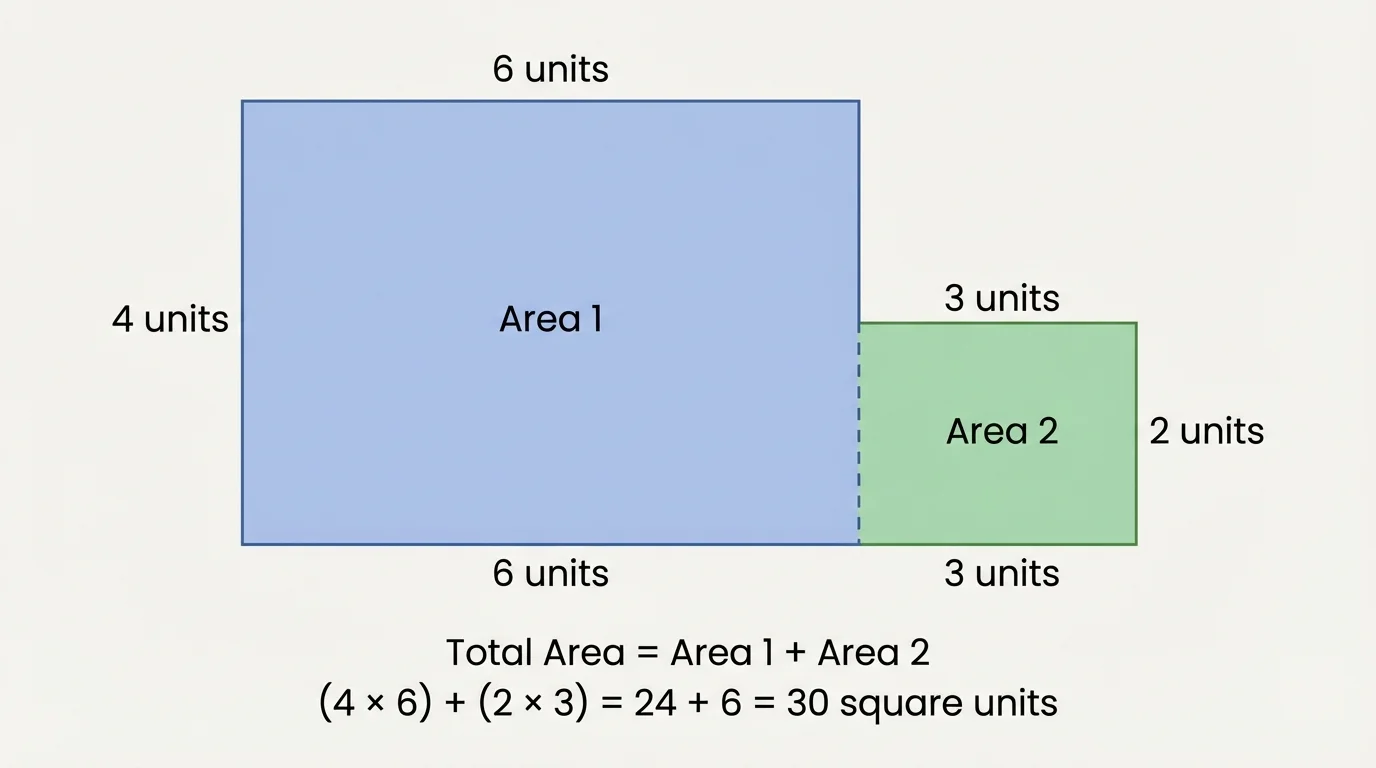
You can think of area like covering a shape with tiles. If the tiles cover every part exactly once, then counting all the tiles gives the correct total. That is why careful decomposition matters.
A large shape can often be split in more than one correct way. Even if the smaller rectangles are different, the total area stays the same when all the space is counted once.
This idea connects addition and multiplication. First, we use multiplication to find each rectangle's area. Then, we use addition to combine the areas of the smaller rectangles.
[Figure 2] To decompose a rectilinear figure, split it into rectangles. There are different correct ways to split the same figure. Your job is to make sure the parts are rectangles and that they do not overlap.
Here is a helpful plan:
Step 1: Look at the whole figure and find straight segments that can help you split it into rectangles.
Step 2: Label the side lengths you know.
Step 3: Find the area of each rectangle using \(A = l \times w\).
Step 4: Add the areas of the rectangles.
Step 5: Write the answer in square units, or in square feet, square inches, and so on.
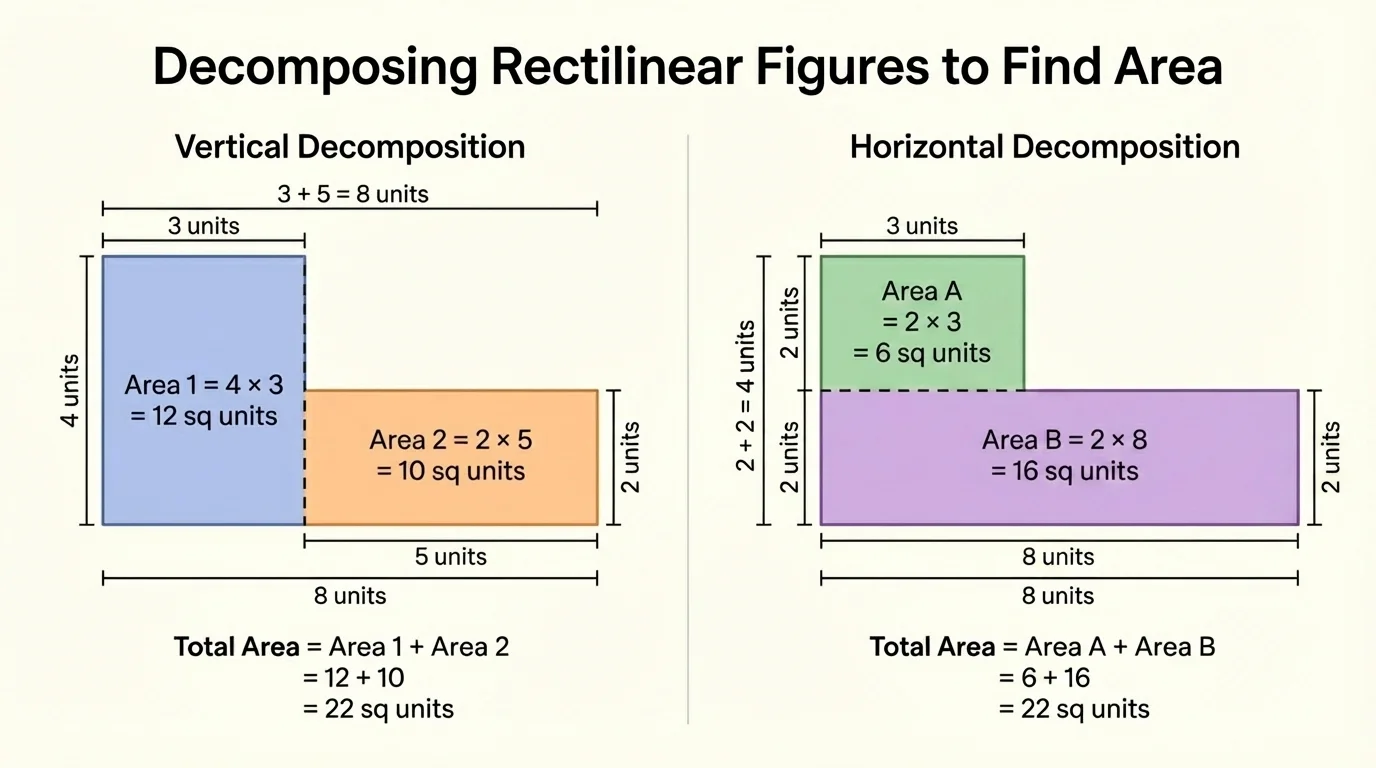
Sometimes all side lengths are given. Sometimes you must look carefully and figure out a missing side length from the shape. For example, if one long side is \(9\) units and part of it is \(4\) units, the remaining part is \(9 - 4 = 5\) units.
That means decomposition is not only about cutting shapes. It is also about understanding how side lengths fit together.
Worked example
An L-shaped figure is split into two rectangles. Rectangle \(1\) is \(6\) units by \(3\) units. Rectangle \(2\) is \(2\) units by \(4\) units. Find the total area.
Step 1: Find the area of Rectangle \(1\).
\[6 \times 3 = 18\]
Rectangle \(1\) has area \(18\) square units.
Step 2: Find the area of Rectangle \(2\).
\[2 \times 4 = 8\]
Rectangle \(2\) has area \(8\) square units.
Step 3: Add the areas.
\(18 + 8 = 26\)
The total area of the L-shaped figure is \(26\) square units.
Notice how the figure is not one rectangle, but it becomes easy once it is broken into rectangles. This is exactly what additive area means.
Worked example
A rectilinear figure can be decomposed into two rectangles. One rectangle measures \(5\) units by \(4\) units. The other measures \(3\) units by \(2\) units. Find the total area.
Step 1: Find the area of the first rectangle.
\[5 \times 4 = 20\]
Step 2: Find the area of the second rectangle.
\[3 \times 2 = 6\]
Step 3: Add the two areas.
\(20 + 6 = 26\)
The total area is \(26\) square units.
This example has the same total as the first one, even though the rectangles are different. Equal totals can come from different decompositions or different shapes.
When you check your answer, ask yourself: Did I count every part once? Did I avoid counting any part twice? Those two questions help catch mistakes.
Area is especially useful in real life. Builders, gardeners, and families all use it. A room or garden may not be a perfect rectangle, but additive area still works.
Worked example
A playroom floor is shaped like an L. One part of the floor is a rectangle measuring \(8\) feet by \(6\) feet. The attached part is a rectangle measuring \(4\) feet by \(3\) feet. What is the total area of the playroom floor?
Step 1: Find the area of the larger rectangle.
\[8 \times 6 = 48\]
The larger part has area \(48\) square feet.
Step 2: Find the area of the smaller rectangle.
\[4 \times 3 = 12\]
The smaller part has area \(12\) square feet.
Step 3: Add the areas.
\[48 + 12 = 60\]
The playroom floor has area \(60\) square feet.
If carpet costs \(\$2\) per square foot, then covering this floor would cost \(60 \times 2 = 120\), so the total cost would be \(\$120\). First, area tells how much surface there is. Then multiplication can help with cost.
Sometimes you can split the same shape in two different ways and still get the same answer. That happens because the whole covered space does not change. We already saw this idea in [Figure 2]. The parts may look different, but together they still cover the exact same shape.
For example, one student might split a figure into a top rectangle and a bottom rectangle. Another student might split it into a left rectangle and a right rectangle. If both decompositions use non-overlapping rectangles and cover the whole figure, both are correct.
| Method | Rectangle Areas | Total Area |
|---|---|---|
| Split A | \(12\) and \(10\) | \(12 + 10 = 22\) |
| Split B | \(14\) and \(8\) | \(14 + 8 = 22\) |
Table 1. Two different decompositions of the same figure can produce the same total area.
This is a strong check on your thinking. If your parts are correct, the total area of the whole figure stays the same.
One common mistake is making rectangles that overlap. Remember the idea from [Figure 1]: parts must fit together without covering the same space twice.
Another mistake is forgetting one part of the figure. If even a small rectangle is missing, the total area will be too small.
A third mistake is mixing up side lengths. Be careful to match each rectangle's length and width. Count or label the correct sides before multiplying.
Finally, do not forget the units. Area is written in square units, square inches, square feet, and so on. If the side lengths are in feet, then the area is in square feet.
Why square units matter
Length measures one direction, but area measures a whole surface. That is why we use square units. A square unit is a tiny \(1 \times 1\) square that covers part of the shape. Counting or multiplying tells how many of those tiny squares fit inside.
Even when you do not draw every little square, you can still imagine the shape as being covered by square units. That helps explain why multiplication and addition both belong in area problems.
[Figure 3] Rectilinear shapes appear everywhere. A classroom rug, a sidewalk made with a turn, a garden bed around a corner, or a wall section around a door can all be treated as smaller rectangles. People use additive area to plan materials, save money, and make good estimates.
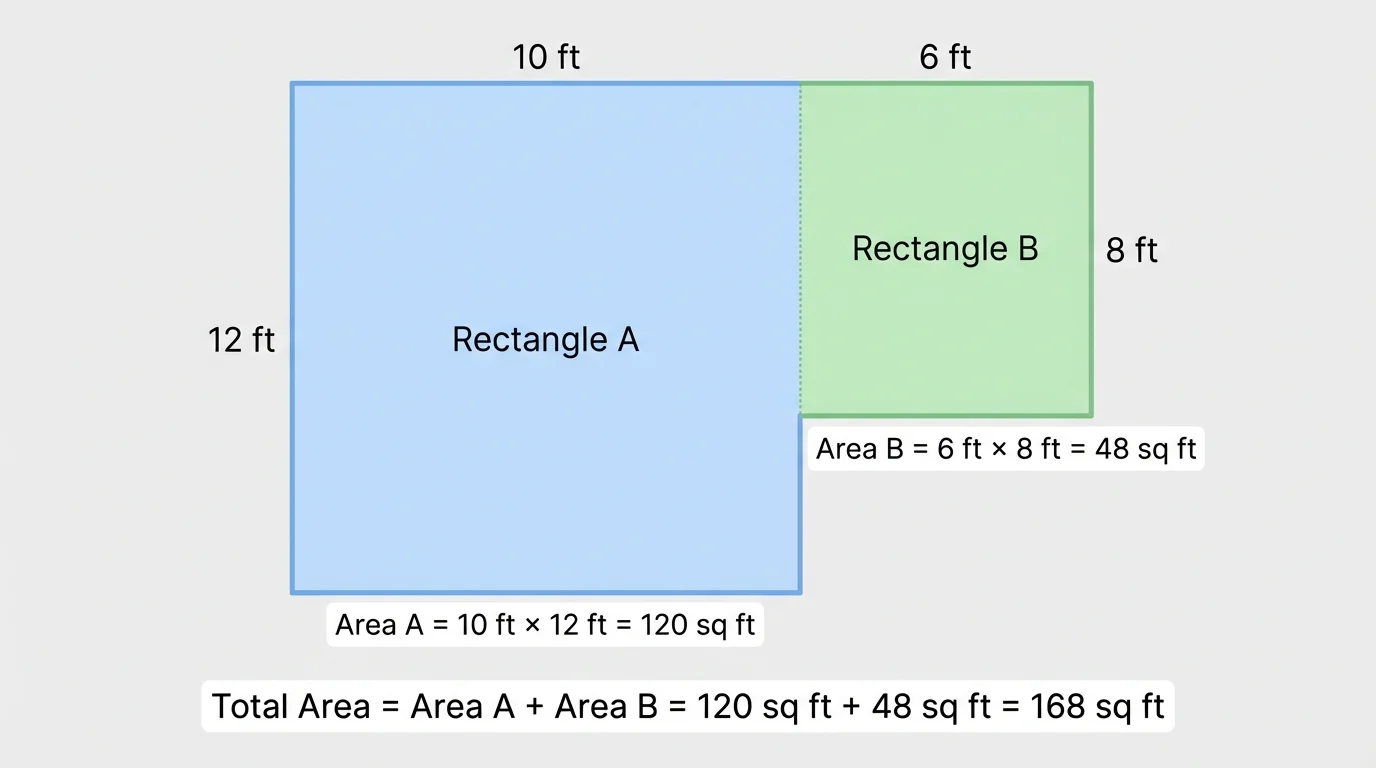
Suppose a gardener has an L-shaped garden. One rectangle is \(7\) feet by \(5\) feet, and another is \(3\) feet by \(4\) feet. The total area is \(7 \times 5 + 3 \times 4 = 35 + 12 = 47\) square feet. That helps the gardener know how much soil or mulch is needed.
Suppose a painter wants to place a large poster board on a wall made from two rectangular spaces together. If one rectangle is \(4\) feet by \(6\) feet and the other is \(2\) feet by \(6\) feet, then the total area is \(24 + 12 = 36\) square feet. That tells how much space the poster board covers.
In building and design, workers often decompose shapes before cutting tile, wood, or carpet. In sports, a practice area might be made from connected rectangles. In everyday life, additive area helps us measure spaces that are not simple rectangles at first glance.
When you see a shape with straight sides and square corners, try looking for hidden rectangles inside it. That is often the key to finding the area.
