[Figure 1] A skateboard trick, a bag of marbles, a team score, or a stack of books can all show the same mathematical idea: one amount can be compared to another by asking how many times as large it is. That is one of the most powerful uses of multiplication. Instead of only showing equal groups, multiplication can also show a comparison, such as saying one amount is \(4\) times as many as another amount.
Multiplicative comparison means comparing two amounts by telling how many times larger one amount is than another. If one child has \(4\) stickers and another child has \(3\) times as many stickers, then the second child has \(3\) groups of \(4\), which is \(12\).
We can write that idea as \(12 = 3 \times 4\). In words, we say: \(12\) is \(3\) times as many as \(4\). Multiplication helps us describe a comparison, not just a group of objects.
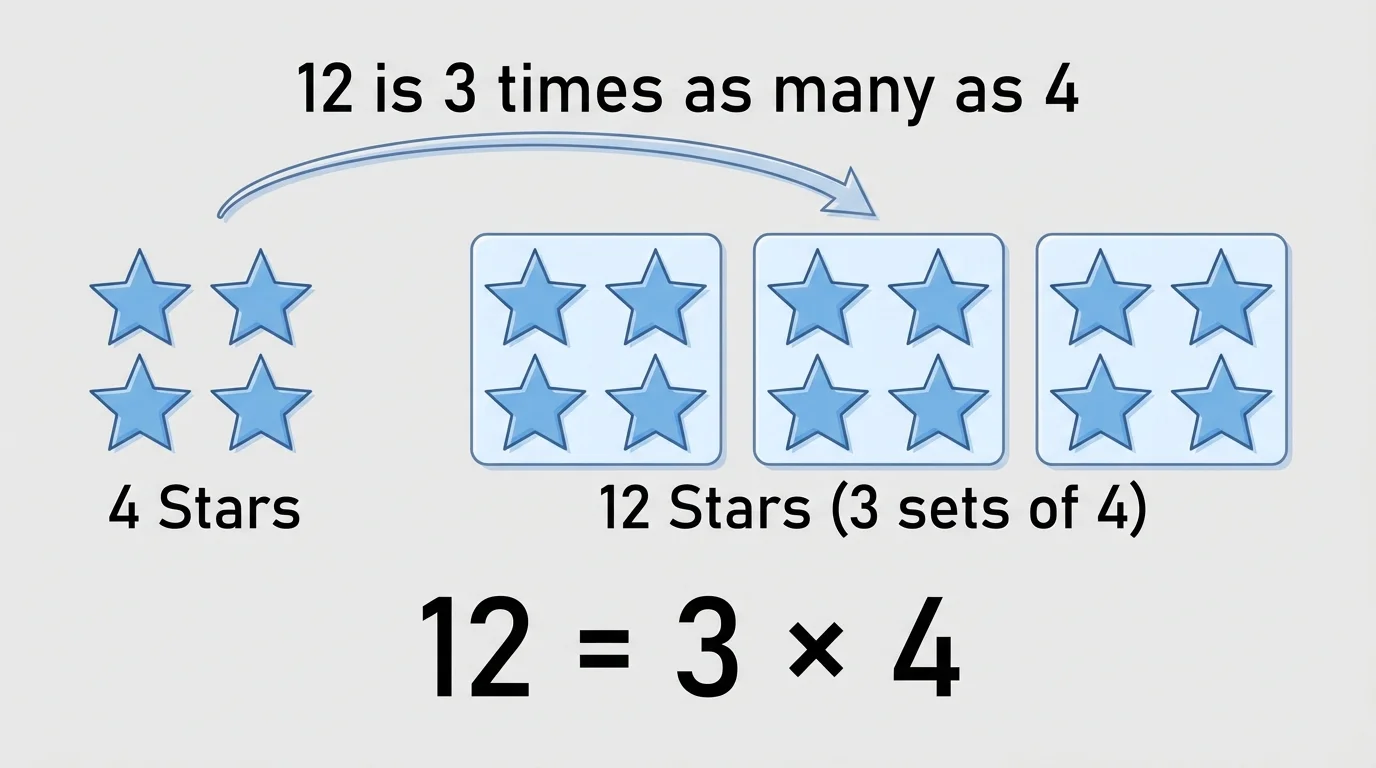
You may already know that multiplication can mean equal groups. For example, \(3 \times 4\) can mean \(3\) groups of \(4\). That same equation can also compare amounts. If one amount is \(4\), then \(3 \times 4 = 12\) tells us that another amount, \(12\), is \(3\) times as many.
This is different from just finding a total by adding. Multiplication as comparison answers a question like, "How many times as many?" That is why the words times as many are so important in this topic.
Times as many means one amount is made by multiplying another amount by a factor. If \(a = b \times c\), then \(a\) is \(b\) times as many as \(c\), and \(a\) is also \(c\) times as many as \(b\).
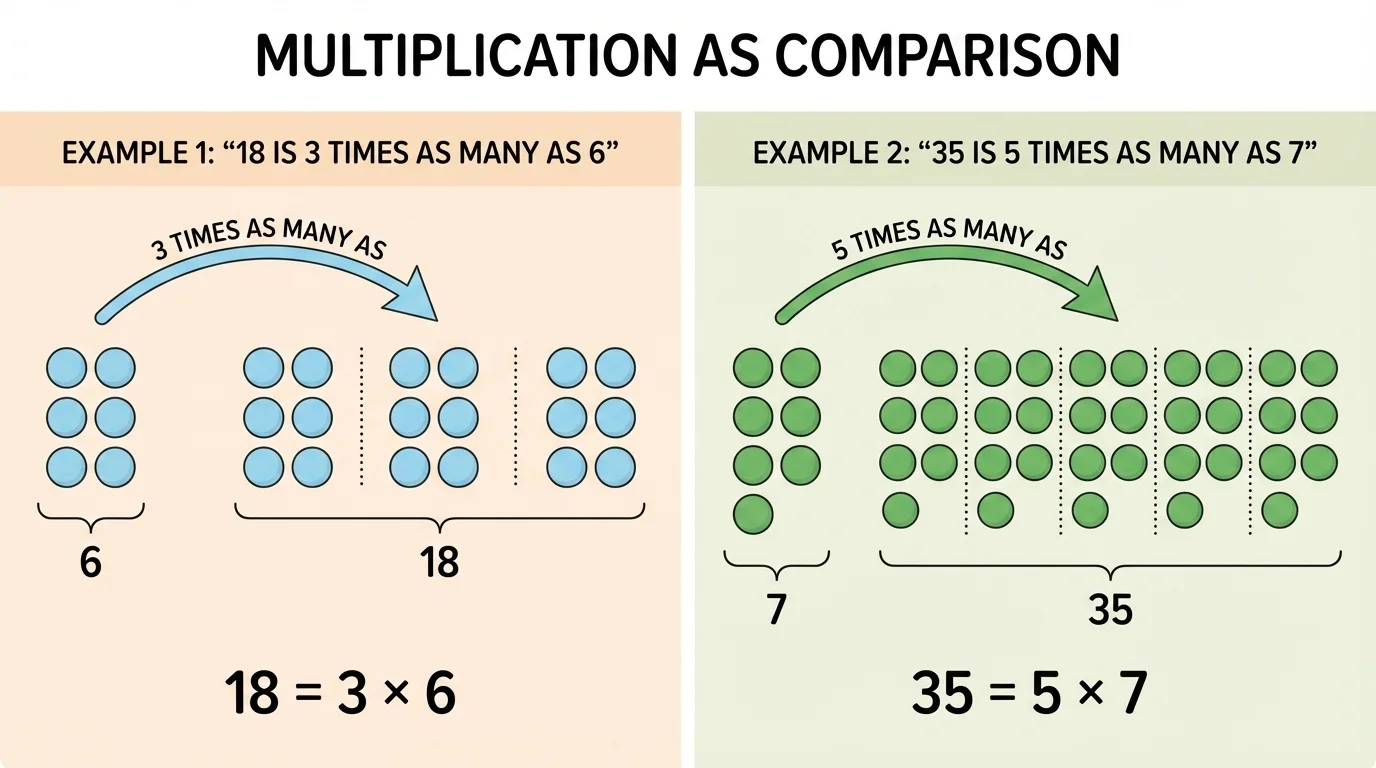
[Figure 2] When we compare with multiplication, we usually think about three parts: the smaller amount, the factor, and the larger amount. For example, in \(18 = 3 \times 6\), the smaller amount can be \(6\), the factor is \(3\), and the larger amount is \(18\).
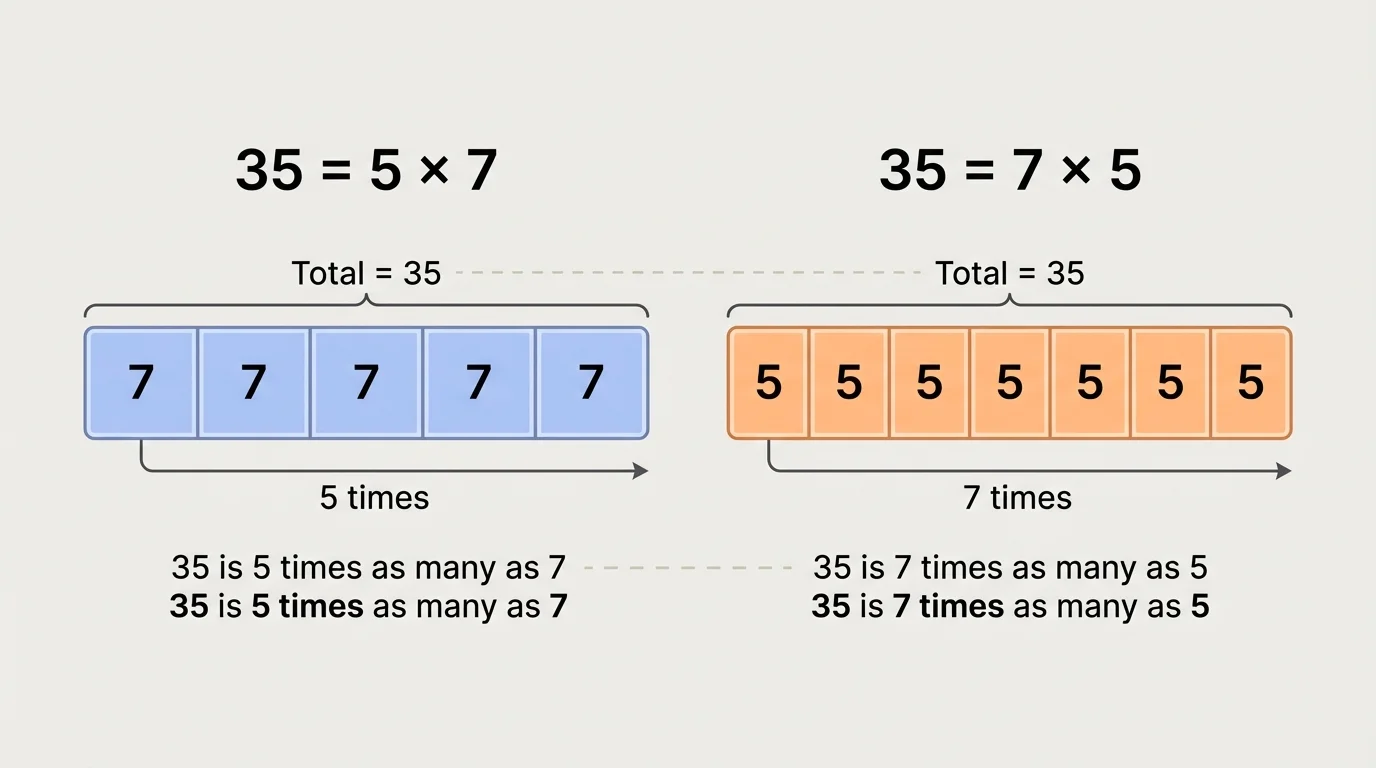
A equation such as \(35 = 5 \times 7\) can be read in two correct comparison ways. We can say \(35\) is \(5\) times as many as \(7\). We can also say \(35\) is \(7\) times as many as \(5\).
This works because multiplication can switch factors: \(5 \times 7 = 7 \times 5\). Both expressions equal \(35\). So the product \(35\) can be compared to \(7\) using the factor \(5\), or compared to \(5\) using the factor \(7\).
Let us read another equation: \(24 = 6 \times 4\). We can say:
Notice what stays the same: the product, \(24\), is the greater number in this comparison. The factors, \(6\) and \(4\), tell us how the comparison is built.
Here is an important point: when you read an equation as a comparison, be careful about which number is being compared to which. In \(24 = 6 \times 4\), it is correct to say \(24\) is \(6\) times as many as \(4\). It is not correct to say \(6\) is \(24\) times as many as \(4\).
One equation, two comparison sentences
If \(a = b \times c\), then the product \(a\) can be described in two ways: \(a\) is \(b\) times as many as \(c\), and \(a\) is \(c\) times as many as \(b\). This happens because the order of the factors can switch without changing the product.
This idea is useful because it shows the same total split in two different but correct ways. Thinking about equal parts helps you read comparison statements correctly.
Words and equations can tell the same comparison story. When you hear a statement with "times as many," look for the factor and the amount being multiplied.
For example, "\(18\) is \(3\) times as many as \(6\)" becomes \(18 = 3 \times 6\). The number \(3\) tells how many times, and the number \(6\) is the amount being multiplied.
[Figure 3] Another example is "A rope that is \(20\) feet long is \(4\) times as long as a rope that is \(5\) feet long." The equation is \(20 = 4 \times 5\).
Sometimes the larger number comes first in the sentence, and sometimes it comes later. Listen carefully. "Mia has \(4\) times as many shells as Ben. Ben has \(3\) shells." This means Mia has \(4 \times 3 = 12\) shells, so the equation is \(12 = 4 \times 3\).
Here are helpful translation patterns:
The words may change a little, but the multiplication idea stays the same.
You already know basic multiplication facts such as \(3 \times 4 = 12\) and \(5 \times 6 = 30\). In this lesson, those same facts are used to compare amounts, not only to count equal groups.
When reading a verbal statement, ask two questions: "What number tells how many times?" and "What amount is being multiplied?" Those two numbers are the factors in the equation.
Worked examples help show how to move between words and equations clearly.
Worked example 1
Interpret \(28 = 4 \times 7\) as a comparison statement.
Step 1: Identify the product and the factors.
The product is \(28\). The factors are \(4\) and \(7\).
Step 2: Read the first comparison.
\(28\) is \(4\) times as many as \(7\).
Step 3: Read the second comparison.
\(28\) is \(7\) times as many as \(4\).
Both statements are correct because \(4 \times 7 = 7 \times 4\).
Notice that the product is the amount being described. The factors tell the comparison relationship.
Worked example 2
Write an equation for the statement: "\(45\) is \(5\) times as many as \(9\)."
Step 1: Find the larger amount.
The larger amount is \(45\).
Step 2: Find the factor.
The phrase "\(5\) times as many" tells us the factor is \(5\).
Step 3: Find the amount being multiplied.
The amount being multiplied is \(9\).
Step 4: Write the equation.
\[45 = 5 \times 9\]
The comparison equation is \(45 = 5 \times 9\).
You can also check by multiplying: \(5 \times 9 = 45\). That matches the statement.
Worked example 3
Sara has \(6\) trading cards. Luis has \(4\) times as many trading cards as Sara. How many cards does Luis have?
Step 1: Identify the known amount.
Sara has \(6\) cards.
Step 2: Identify the comparison.
Luis has \(4\) times as many as Sara.
Step 3: Multiply.
\(4 \times 6 = 24\).
Step 4: Write the comparison equation.
\[24 = 4 \times 6\]
Luis has \(24\) cards.
This is a multiplicative comparison because one person's amount is described using another person's amount and a factor.
Worked example 4
Write a comparison statement for \(32 = 8 \times 4\).
Step 1: Use the first factor.
\(32\) is \(8\) times as many as \(4\).
Step 2: Use the second factor.
\(32\) is \(4\) times as many as \(8\).
Either sentence correctly interprets the equation.
One of the biggest ideas in this topic is that "times as many" does not mean "more than." These phrases sound different because they mean different operations.
If Noah has \(4\) pencils and Ava has \(3\) times as many pencils, then Ava has \(3 \times 4 = 12\) pencils. But if Ava has \(3\) more pencils than Noah, then Ava has only \(4 + 3 = 7\) pencils.
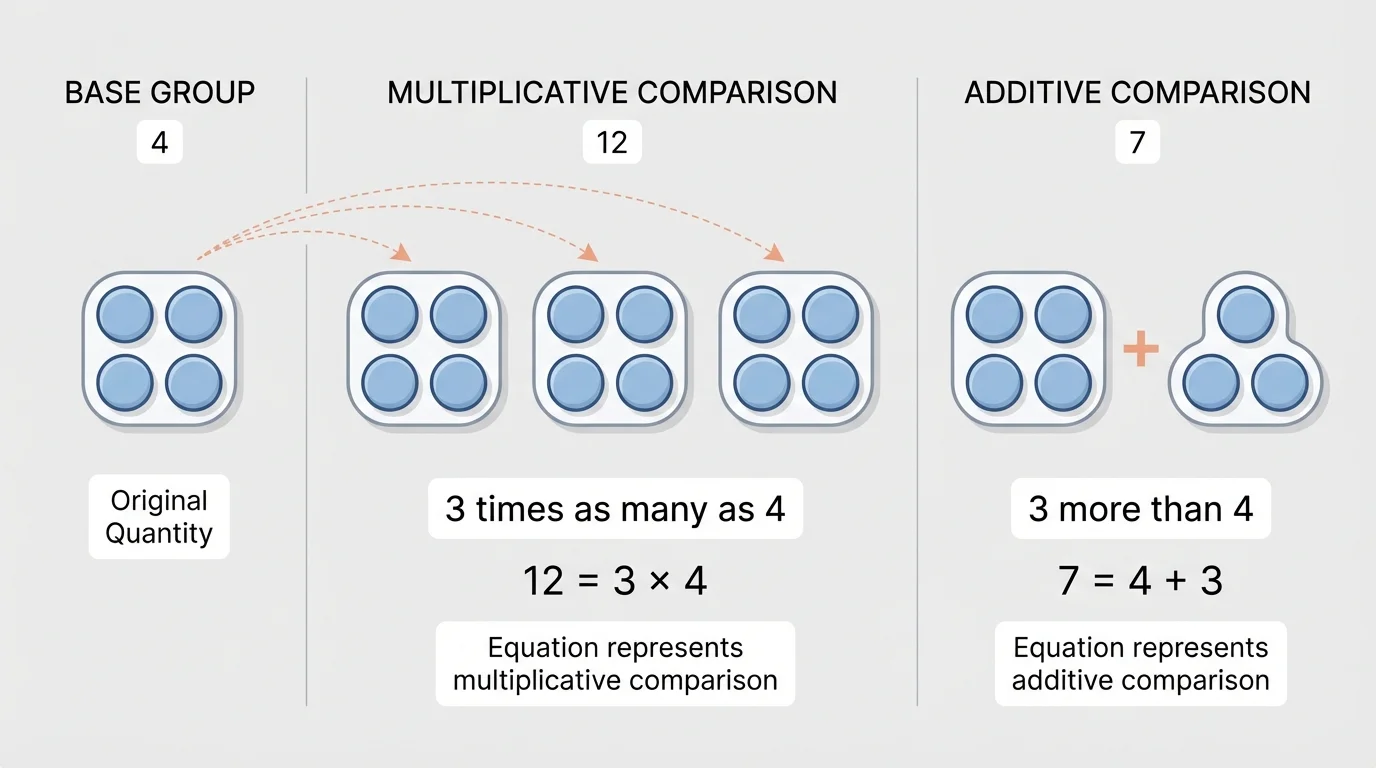
That difference is important: \(12\) and \(7\) are not the same. Multiplication compares by a factor, while addition compares by a difference.
Look at these two sentences:
Using the wrong operation changes the whole meaning. The groups for multiplication grow much faster than the amount in an addition comparison.
| Words in the statement | Operation | Example |
|---|---|---|
| "\(3\) times as many" | Multiply | \(3 \times 4 = 12\) |
| "\(3\) more than" | Add | \(4 + 3 = 7\) |
| "\(2\) times as much" | Multiply | \(2 \times 9 = 18\) |
| "\(2\) less than" | Subtract | \(9 - 2 = 7\) |
Table 1. Comparison of common phrase clues and the operations they signal.
Multiplicative comparison appears in many everyday situations. In sports, one team may score \(3\) times as many points as another team. In a classroom, one shelf may hold \(4\) times as many books as a smaller bin. In cooking, one bowl may contain \(2\) times as much fruit as another bowl.
Suppose one soccer team scores \(6\) goals in a week, and another team scores \(2\) times as many. Then the second team scores \(2 \times 6 = 12\) goals. The equation \(12 = 2 \times 6\) tells the comparison clearly.
At a school fair, one table sells \(8\) cookies, and another sells \(5\) times as many. Then the second table sells \(5 \times 8 = 40\) cookies. Multiplication helps us compare the two tables quickly.
Multiplication comparisons are used in science and technology too. If one machine can process \(4\) times as many items as another machine in one minute, engineers use multiplication to compare their outputs.
Stores also use this kind of thinking. If one pack has \(3\) times as many markers as a smaller pack, you can compare the pack sizes with multiplication before deciding which one fits your needs.
A common mistake is reversing the numbers in the words. For example, "\(18\) is \(3\) times as many as \(6\)" is correct because \(3 \times 6 = 18\). But "\(6\) is \(3\) times as many as \(18\)" is not correct.
Another mistake is using addition instead of multiplication. If one amount is \(4\) times as many as \(5\), the answer is \(20\), not \(9\). The phrase "times as many" always points to multiplication.
A third mistake is forgetting that one equation can be read in two ways. For \(21 = 3 \times 7\), we can say \(21\) is \(3\) times as many as \(7\), and \(21\) is \(7\) times as many as \(3\).
"The words in a math problem matter. A single phrase can tell you which operation to use."
Reading carefully is part of solving math. Watch for clue words such as times as many, times as much, and times as long.
Sometimes the unknown number is the larger amount. For example: "Ben has \(5\) marbles. Maya has \(7\) times as many marbles as Ben." We find Maya's amount with \(7 \times 5 = 35\).
Sometimes the comparison factor is emphasized. "\(42\) is how many times as many as \(6\)?" Since \(42 = 7 \times 6\), the answer is \(7\). This still connects to multiplication as comparison.
Related facts are useful here. If you know \(6 \times 7 = 42\), then you also know that \(42\) is \(7\) times as many as \(6\), and \(42\) is \(6\) times as many as \(7\).
Using multiplication facts to talk about comparisons
Every multiplication fact can be turned into comparison language. If you know a fact such as \(8 \times 3 = 24\), you can say \(24\) is \(8\) times as many as \(3\), or \(24\) is \(3\) times as many as \(8\). This helps connect fact fluency to problem solving.
This shows that multiplication facts are not just for memorizing. They also help you describe relationships between amounts.
