If two friends each eat part of the same pizza, how can you find how much pizza was eaten altogether? Fractions help answer questions like that every day. When the pieces are the same size, fraction word problems become much easier to understand. You can picture the pieces, write an equation, and solve the story step by step.
A fraction names parts of a whole. In \(\dfrac{3}{5}\), the whole is split into \(5\) equal parts, and \(3\) of those parts are being counted.
Unit fraction is a fraction with a numerator of \(1\), such as \(\dfrac{1}{4}\) or \(\dfrac{1}{8}\). A fraction like \(\dfrac{3}{4}\) can be understood as a sum of unit fractions: \(\dfrac{3}{4} = \dfrac{1}{4} + \dfrac{1}{4} + \dfrac{1}{4}\).
Same whole means the fractions refer to parts of one whole object or one whole amount of the same size. This matters because \(\dfrac{1}{2}\) of a small sandwich is not the same amount as \(\dfrac{1}{2}\) of a large sandwich.
When you solve fraction word problems, always ask first: Are these fractions parts of the same whole? If they are, then you can combine or compare them correctly.
The denominator is the bottom number in a fraction. It tells how many equal parts the whole is divided into. Fractions have like denominators when they have the same denominator, such as \(\dfrac{2}{7}\) and \(\dfrac{4}{7}\).
Like denominators are helpful because the pieces are the same size. If you have \(\dfrac{2}{7}\) and add \(\dfrac{3}{7}\), you are adding sevenths to sevenths. You keep the denominator \(7\) and add the numerators:
\[\frac{2}{7} + \frac{3}{7} = \frac{5}{7}\]
If you subtract, you also keep the denominator and subtract the numerators:
\[\frac{6}{8} - \frac{1}{8} = \frac{5}{8}\]
This works because the parts stay the same size. You are only changing how many of those parts you have.
You already know how to add and subtract whole numbers with the same units, such as \(3\) apples \(+\;2\) apples \(= 5\) apples. Fractions with like denominators work in a similar way: \(3\) fourths \(+\;2\) fourths \(= 5\) fourths.
Another important idea is that fractions can be shown as a sum of unit fractions. For example, \(\dfrac{4}{6}\) means \(\dfrac{1}{6} + \dfrac{1}{6} + \dfrac{1}{6} + \dfrac{1}{6}\). That makes addition and subtraction easier to picture.
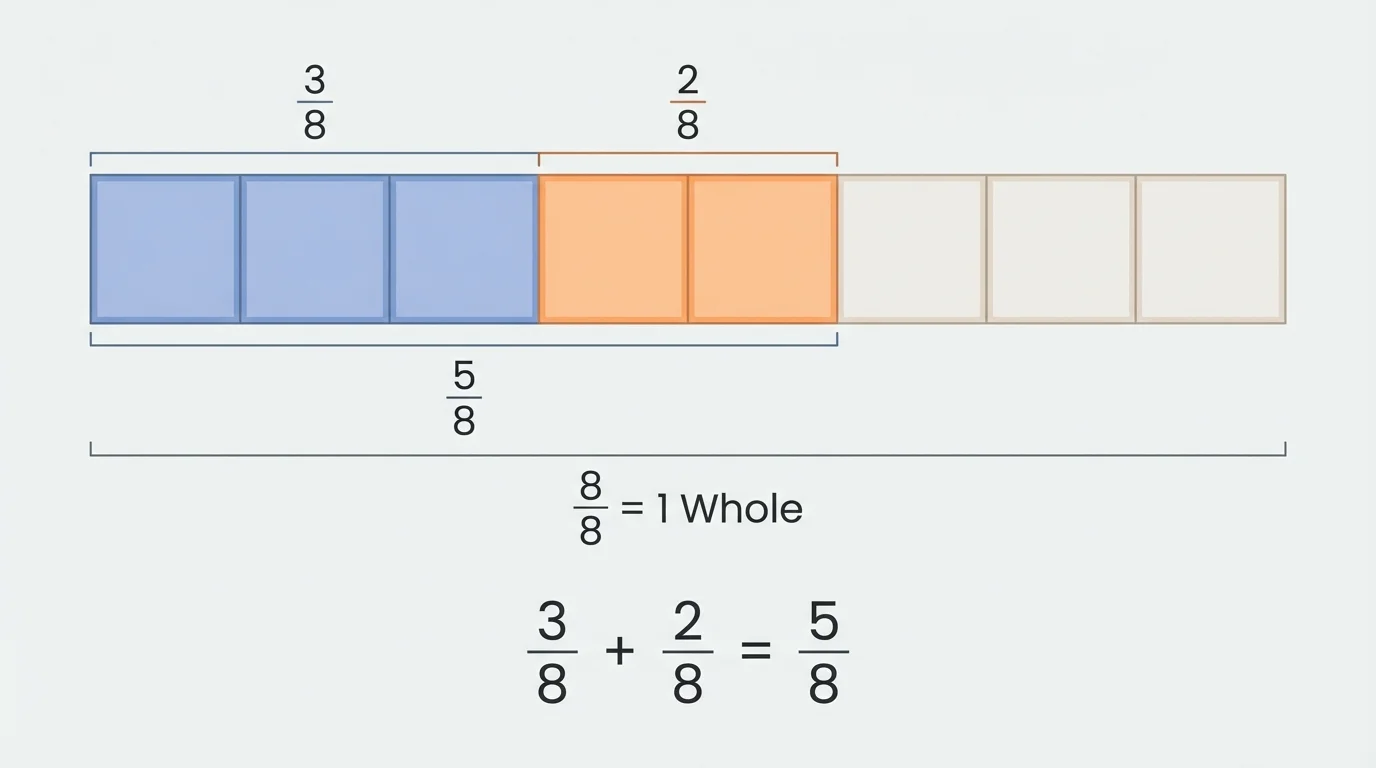
A visual fraction model helps you see the story. As [Figure 1] shows, when one whole is divided into equal parts, you can shade some parts for one amount and more parts to show another amount. Then you count the shaded parts to find the total.
One useful model is a fraction bar. Suppose a whole bar is divided into \(8\) equal pieces. If \(\dfrac{3}{8}\) is shaded blue and \(\dfrac{2}{8}\) is shaded green, then \(5\) of the \(8\) parts are shaded in all. That means the total is \(\dfrac{5}{8}\).
Another useful visual is a circle model, like a pizza cut into equal slices. A number line also works well because it shows how far you move along it when adding or subtracting fractions.
Visual models are especially helpful in word problems because they help you decide what the story means. Are parts being put together? Are parts being taken away? Is the question asking for the amount left or the total amount used?
Later, when you write an equation, the picture and the equation should match. For example, the fraction bar in [Figure 1] matches the equation \(\dfrac{3}{8} + \dfrac{2}{8} = \dfrac{5}{8}\).
An equation is a math sentence that uses an equals sign. In a fraction word problem, the equation shows exactly what is happening in the story.
Words can give clues. If the story says altogether, in all, or total, you often add. If it says left, remain, or how much more, you often subtract.
Turning a story into math
Start by identifying the whole. Next, find the fractions in the story. Then decide whether the action means join, take away, or compare. Last, write an equation with the same denominator and solve.
For example, if Mia drank \(\dfrac{2}{6}\) of a pitcher of juice in the morning and \(\dfrac{1}{6}\) in the afternoon, the equation is \(\dfrac{2}{6} + \dfrac{1}{6} = \dfrac{3}{6}\).
If Leo used \(\dfrac{5}{9}\) of a roll of ribbon and then used \(\dfrac{2}{9}\) more, the equation is \(\dfrac{5}{9} + \dfrac{2}{9} = \dfrac{7}{9}\).
If Sara had \(\dfrac{7}{10}\) of a book left to read and then read \(\dfrac{3}{10}\), the amount left after that is found with \(\dfrac{7}{10} - \dfrac{3}{10} = \dfrac{4}{10}\).
Worked example
A class spent \(\dfrac{2}{8}\) of art time drawing and \(\dfrac{3}{8}\) of art time painting. How much of art time did the class spend drawing and painting altogether?
Step 1: Identify what the problem is asking.
The word altogether tells us to add the fractions.
Step 2: Check the denominators.
The fractions are \(\dfrac{2}{8}\) and \(\dfrac{3}{8}\). They have the same denominator, so the pieces are the same size.
Step 3: Add the numerators and keep the denominator.
\(\dfrac{2}{8} + \dfrac{3}{8} = \dfrac{5}{8}\)
Step 4: Write the answer with words.
The class spent \(\dfrac{5}{8}\) of art time drawing and painting altogether.
Answer: \[\frac{5}{8}\]
You can also think about this example as unit fractions: \(\dfrac{2}{8}\) is two copies of \(\dfrac{1}{8}\), and \(\dfrac{3}{8}\) is three copies of \(\dfrac{1}{8}\). Together that makes five copies of \(\dfrac{1}{8}\), or \(\dfrac{5}{8}\).
Subtraction stories can be shown clearly with a shaded model, as [Figure 2] illustrates for sixths. The picture begins with a starting amount, then some equal parts are removed, and the leftover shaded parts show the answer.
Worked example
Ella filled \(\dfrac{5}{6}\) of a bucket with water. Then she used \(\dfrac{2}{6}\) of the bucket of water to water plants. How much water was left in the bucket?
Step 1: Decide on the operation.
The words was left tell us to subtract.
Step 2: Write the equation.
\(\dfrac{5}{6} - \dfrac{2}{6}\)
Step 3: Subtract the numerators and keep the denominator.
\(\dfrac{5}{6} - \dfrac{2}{6} = \dfrac{3}{6}\)
Step 4: State the answer.
There was \(\dfrac{3}{6}\) of the water left in the bucket.
Answer: \[\frac{3}{6}\]
You may notice that \(\dfrac{3}{6}\) is the same amount as \(\dfrac{1}{2}\), but in this lesson the main focus is solving the story correctly using like denominators.
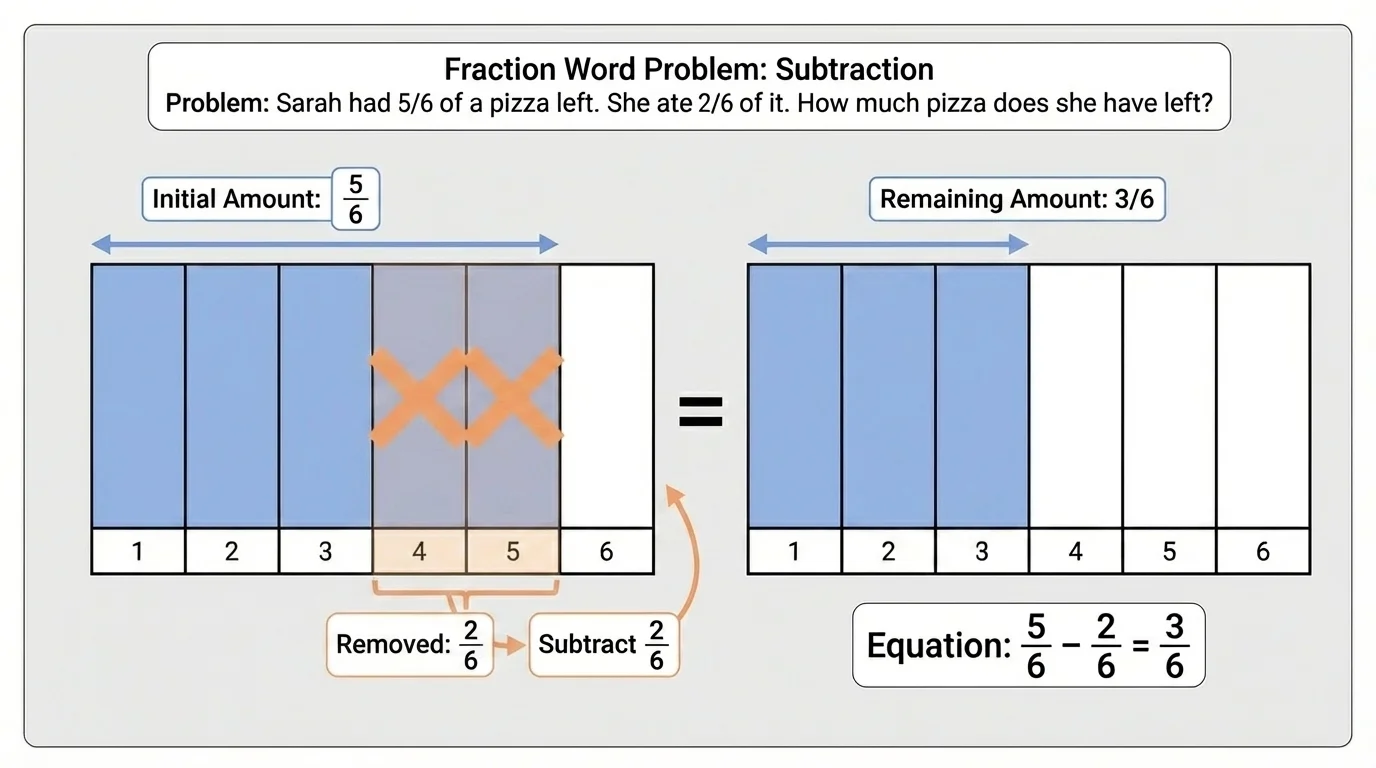
Pictures like the one in [Figure 2] help you see why subtraction works. You start with \(5\) sixths and remove \(2\) sixths, so \(3\) sixths remain.
Worked example
Noah walked \(\dfrac{1}{10}\) of a mile to the park, \(\dfrac{3}{10}\) of a mile around the park, and \(\dfrac{2}{10}\) of a mile home. How far did he walk in all?
Step 1: Find the operation.
The words in all tell us to add all three fractions.
Step 2: Write the equation.
\(\dfrac{1}{10} + \dfrac{3}{10} + \dfrac{2}{10}\)
Step 3: Add the numerators.
\(\dfrac{1}{10} + \dfrac{3}{10} + \dfrac{2}{10} = \dfrac{6}{10}\)
Step 4: Write the answer.
Noah walked \(\dfrac{6}{10}\) of a mile in all.
Answer: \[\frac{6}{10}\]
Word problems can include more than two fractions, as long as the fractions refer to the same whole and use the same denominator. The method stays the same: combine or take away the numerators while keeping the denominator.
Fractions appear in many sports. A coach might describe part of a practice by fractions of an hour, and players may compare how much of a drill or workout has been completed.
Here is a quick comparison of operations and clue words that can help when reading a fraction story.
| Story clue | Likely operation | Example equation |
|---|---|---|
| altogether | addition | \(\dfrac{2}{5} + \dfrac{1}{5} = \dfrac{3}{5}\) |
| in all | addition | \(\dfrac{3}{8} + \dfrac{2}{8} = \dfrac{5}{8}\) |
| left | subtraction | \(\dfrac{7}{9} - \dfrac{4}{9} = \dfrac{3}{9}\) |
| remain | subtraction | \(\dfrac{5}{6} - \dfrac{1}{6} = \dfrac{4}{6}\) |
| how much more | subtraction | \(\dfrac{6}{10} - \dfrac{2}{10} = \dfrac{4}{10}\) |
Table 1. Common clue words and the operations they often suggest in fraction word problems.
A number line helps you compare a fraction answer to one whole and shows how answers can land before \(1\), exactly at \(1\), or beyond \(1\) when the total is greater than one whole.
[Figure 3] For example, \(\dfrac{1}{4} + \dfrac{2}{4} = \dfrac{3}{4}\), which is less than \(1\). But \(\dfrac{2}{4} + \dfrac{2}{4} = \dfrac{4}{4} = 1\). Also, \(\dfrac{3}{4} + \dfrac{2}{4} = \dfrac{5}{4}\), which is more than one whole.
Sometimes a word problem can have an answer greater than \(1\). If Ava drank \(\dfrac{3}{4}\) of a bottle in the morning and \(\dfrac{2}{4}\) of a bottle later, then together she drank \(\dfrac{5}{4}\) bottles, which is \(1\dfrac{1}{4}\) bottles.
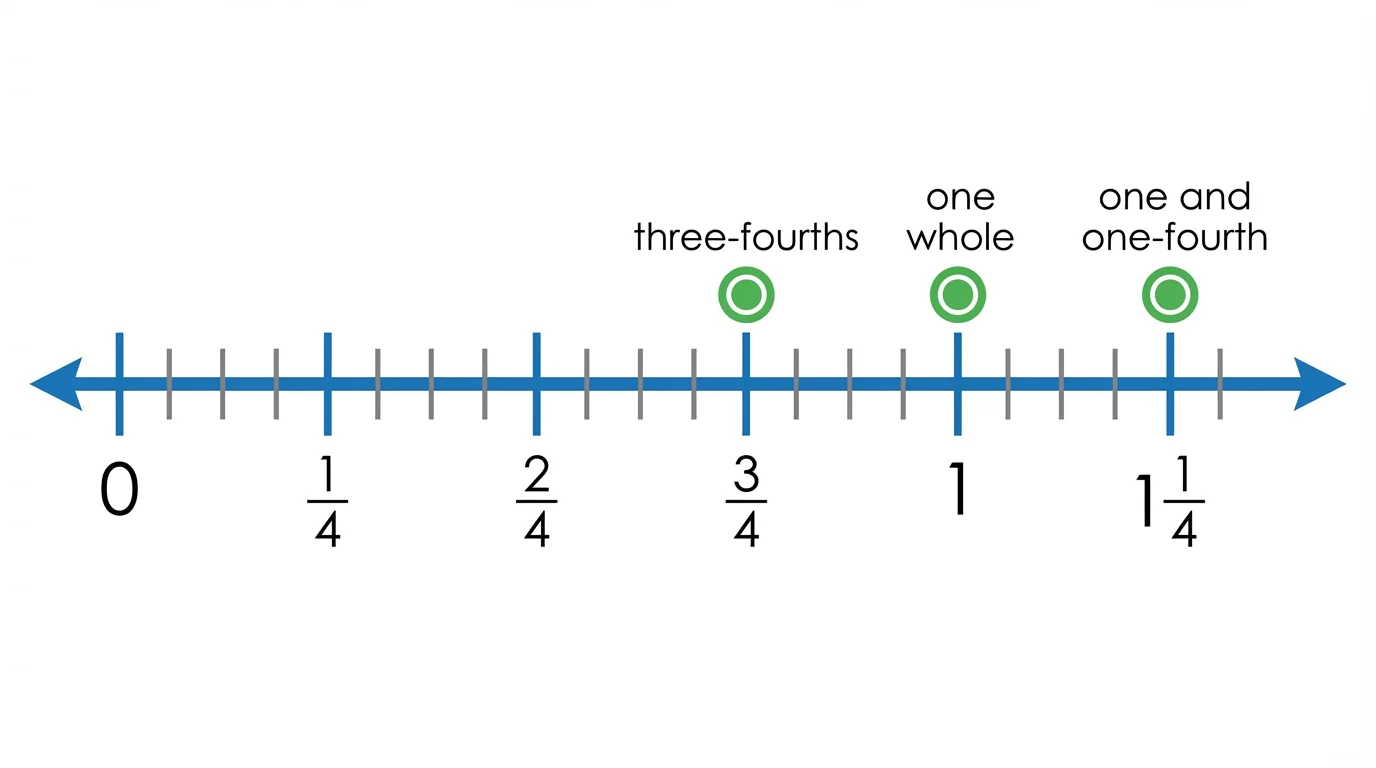
The number line makes it easier to see where \(\dfrac{5}{4}\) belongs. It is one whole and one more fourth beyond \(1\).
Even when an answer is greater than one, the same idea still works: keep the denominator because the part size does not change.
One common mistake is adding both numbers in the fraction. For example, some students may think \(\dfrac{2}{7} + \dfrac{3}{7} = \dfrac{5}{14}\). That is not correct. The denominator stays \(7\), so the correct answer is \(\dfrac{5}{7}\).
Another mistake is forgetting about the whole. If one problem talks about pieces of one pan of brownies and another talks about pieces of a different-size pan, you must be careful. Fractions can only be combined fairly if they refer to the same whole.
Check the story before solving
Ask three questions: What is the whole? Are the parts equal? Am I joining, taking away, or comparing? These questions help you choose the correct equation.
A third mistake is reading clue words too quickly. The word left often means subtract, but you should still read the whole story carefully. Sometimes the problem gives the amount left and asks how much was used, which may change the equation you write.
Fraction word problems are not just school questions. They show up in everyday life. In cooking, you might add \(\dfrac{1}{4}\) cup of one ingredient and \(\dfrac{2}{4}\) cup of another. In crafts, you may use part of a ribbon and then find how much remains. In sports, practice time can be split into equal parts of an hour.
Suppose a baker uses \(\dfrac{3}{12}\) of a tray for blueberry muffins and \(\dfrac{4}{12}\) for chocolate muffins. The baker used \(\dfrac{7}{12}\) of the tray. Or suppose a game lasts \(\dfrac{6}{8}\) of an hour and one break takes \(\dfrac{1}{8}\) of an hour. Then the playing time without that break is \(\dfrac{5}{8}\) of an hour.
"Fractions make equal parts easier to understand, compare, and combine."
Understanding how to solve these stories helps you make sense of measurements, time, food, distance, and many other real situations. The same careful thinking you use with a fraction bar or number line can help you solve everyday problems.
