When you open a door, turn a bicycle, or look at the hands on a clock, you are seeing angles in action. An angle is not just two lines on paper. It tells how much turning has happened. That idea is powerful because it helps us describe shapes, motion, and direction all around us.
To measure length, we use units such as inches or centimeters. To measure time, we use seconds and minutes. To measure an angle, we use degrees. A degree tells us how much turn there is from one ray to another. This lesson explains why a circle helps us measure angles and why a full turn is split into \(360\) equal parts.
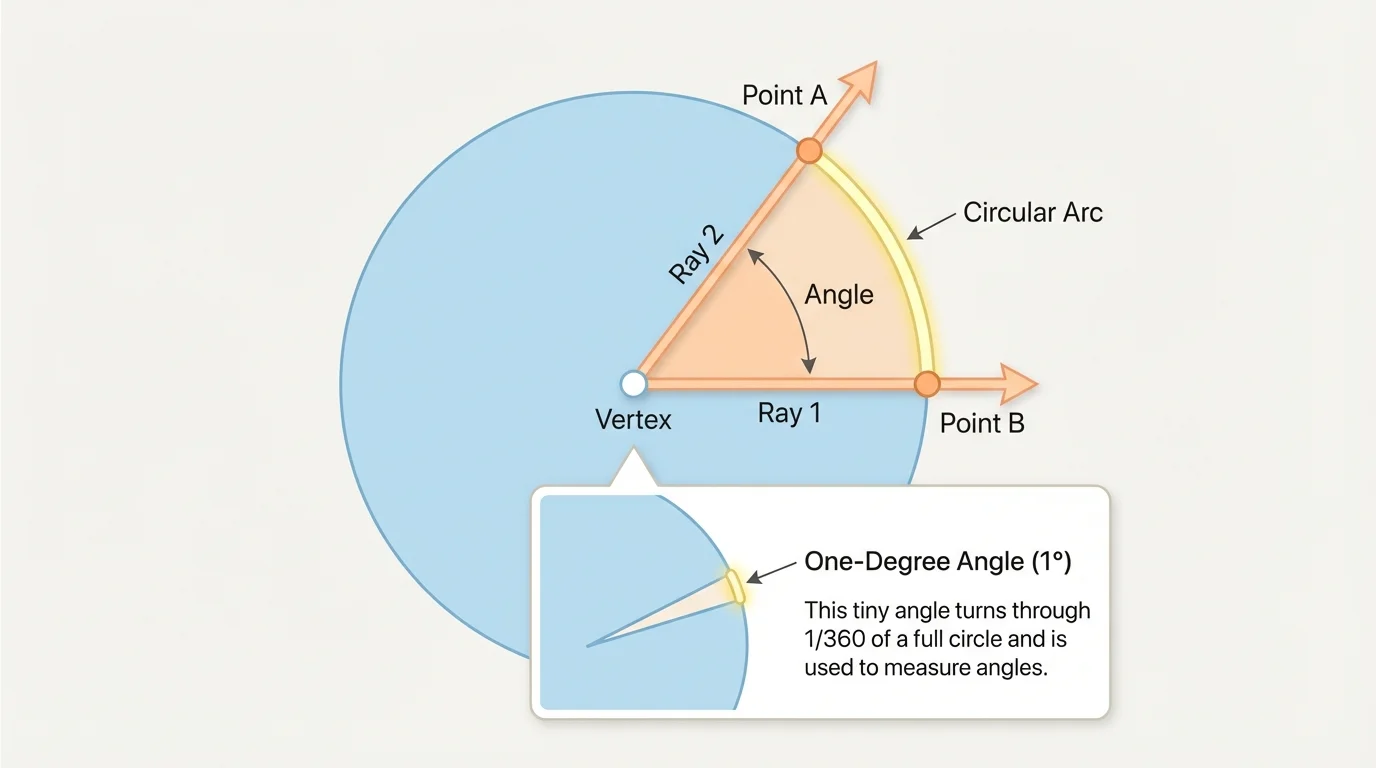
An angle is a shape formed when two rays share the same endpoint, as [Figure 1] shows. The shared point is called the vertex. The rays are like paths that start at the vertex and keep going in different directions.
If the rays point almost the same way, the angle is small. If the rays spread farther apart, the angle is larger. So angle size depends on the amount of opening or turning, not on how long the rays are drawn.
Think of one ray as staying still and the other ray turning. The amount of that turn creates the angle. This is why angles are often connected to movement, such as a swing opening, a steering wheel turning, or a basketball bouncing off the backboard.
It is important to notice that making the rays longer does not change the angle. A short drawing and a long drawing can show the same angle if the opening is the same. The angle is about turning, not the lengths of the rays.
Angle means a shape made by two rays with a common endpoint.
Ray means a part of a line that starts at one point and goes on forever in one direction.
Vertex means the common endpoint where the two rays meet.
Degree means a unit used to measure angles.
Arc means a curved part of a circle.
You can find angles in the corners of shapes, but angles are not only corners. Any time two rays share one endpoint, an angle is formed. That is why arrows on signs, open scissors, and clock hands can all form angles.
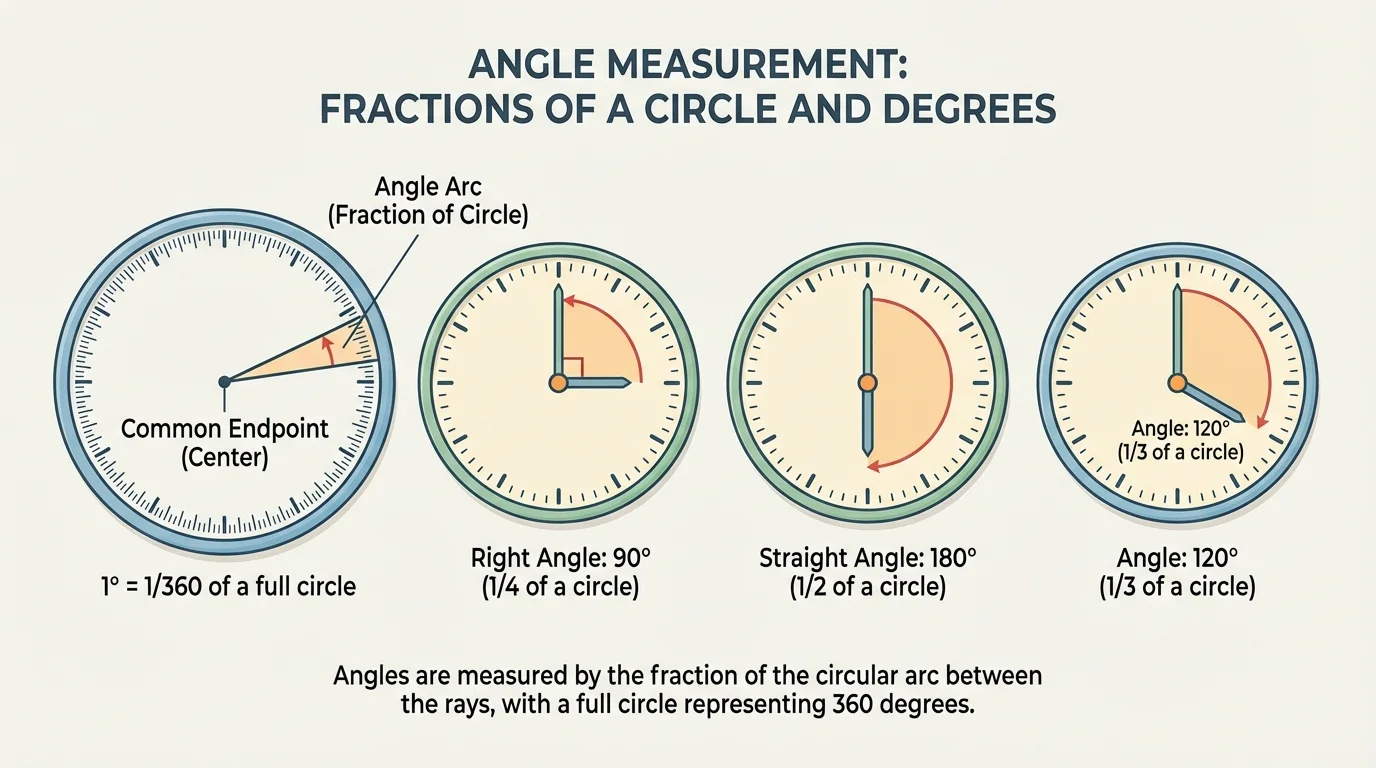
To understand angle measure, mathematicians imagine a circle centered at the vertex, as [Figure 2] illustrates. Each ray crosses the circle at one point. Then we look at the curved part of the circle between those two points. That curved part is the arc.
If the angle is small, the arc between the rays is a small part of the circle. If the angle is large, the arc is a larger part of the circle. So the angle can be measured by thinking about what fraction of the full circle that arc covers.
This idea is very important: angle measure tells what fraction of a full turn has happened. A full turn goes all the way around the circle. A smaller angle is only part of that full turn.
Suppose one angle covers about one quarter of the circle. Then that angle is one quarter of a full turn. If another angle covers half of the circle, then it is half of a full turn. The circle gives us a fair and consistent way to compare all angles.
This is also why angle measure does not depend on the size of the circle. Whether the circle is big or small, the fraction of the circle between the rays stays the same. A quarter of a large circle and a quarter of a small circle both represent the same angle.
Why the circle method works
A full turn is one complete trip around a circle. When an angle is formed, it uses part of that full turn. Measuring the angle means asking, "What part of the whole circle is this?" That is why arc length by itself is not the main idea. The important idea is the fraction of the full circle.
As we saw earlier in [Figure 1], the rays create the angle. Now the circle helps us measure that opening in a precise way.
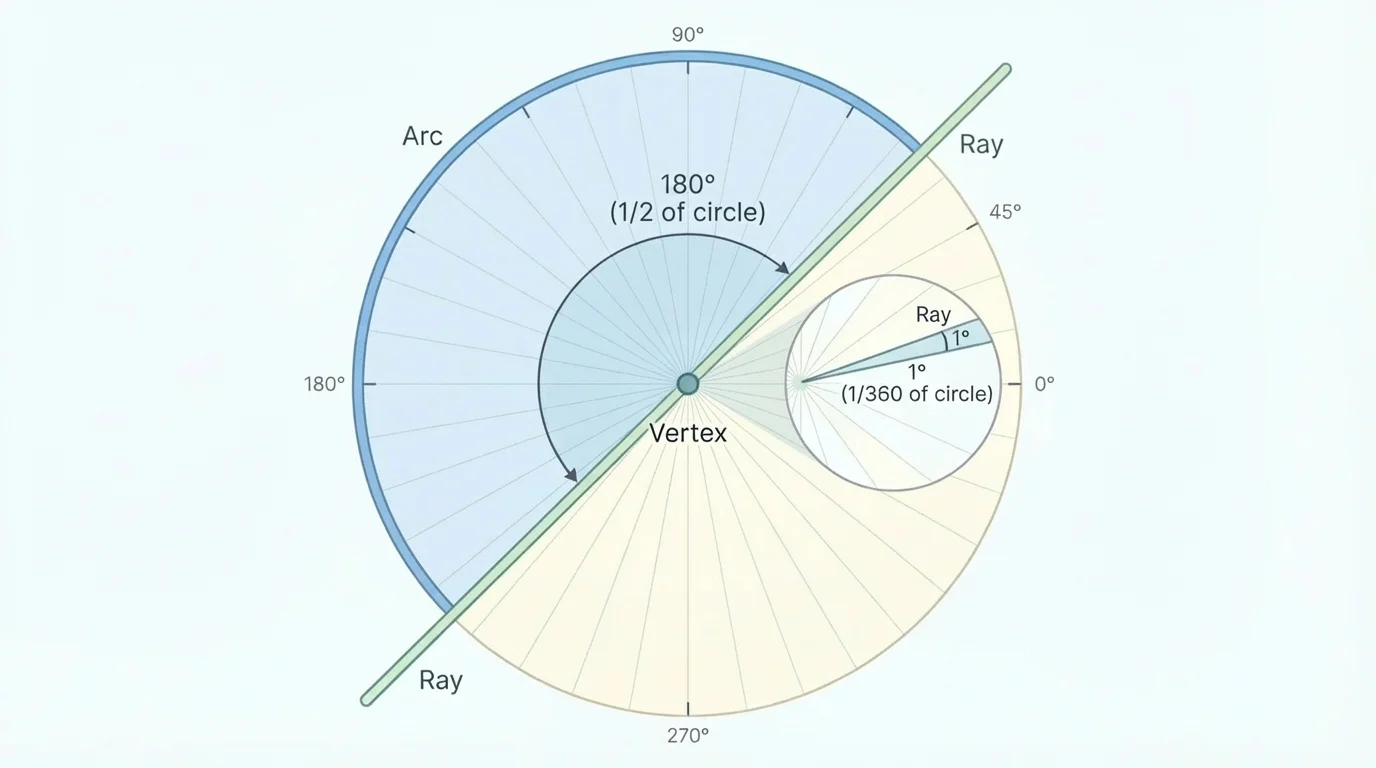
A one-degree angle is an angle that turns through \(\dfrac{1}{360}\) of a full circle, as [Figure 3] shows. A full circle is divided into \(360\) equal parts, and each part is called \(1^\circ\).
This means a complete turn measures \(360^\circ\). If you turn halfway around the circle, that is \(180^\circ\). If you turn one quarter of the way around, that is \(90^\circ\).
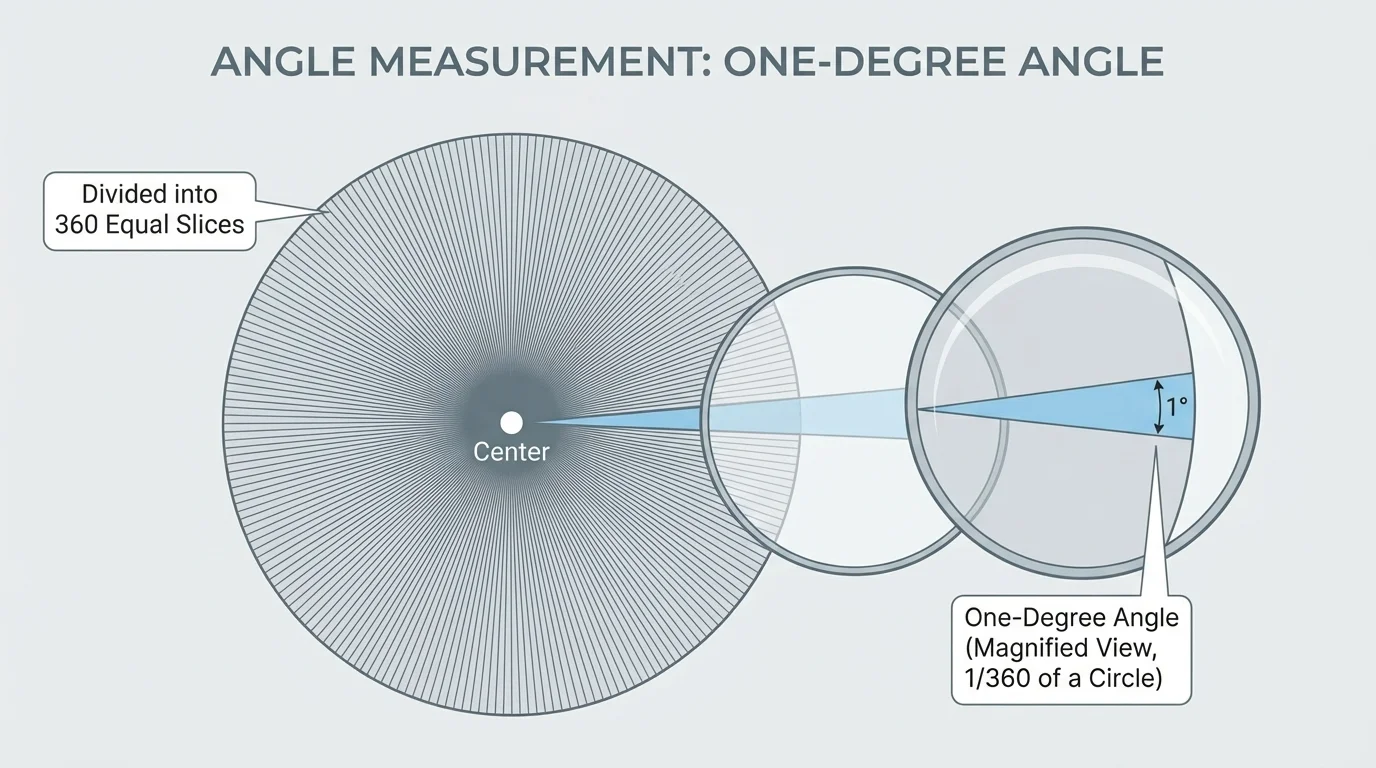
Degrees help us talk about angle size with exact numbers. Instead of saying an angle is "kind of wide," we can say it measures \(45^\circ\) or \(120^\circ\). That makes communication clear in math, science, building, and map reading.
Here are some important benchmark angles:
| Turn | Fraction of circle | Angle measure |
|---|---|---|
| Full turn | \(1\) | \(360^\circ\) |
| Half turn | \(\dfrac{1}{2}\) | \(180^\circ\) |
| Quarter turn | \(\dfrac{1}{4}\) | \(90^\circ\) |
| Eighth turn | \(\dfrac{1}{8}\) | \(45^\circ\) |
Table 1. Common fractions of a circle and their angle measures.
You do not need to see all \(360\) parts drawn to understand degrees. What matters is knowing that the full circle is split equally, and each equal part is \(1^\circ\).
The number \(360\) is very old in mathematics. One reason it is useful is that \(360\) has many factors, so a circle can be divided easily into halves, thirds, fourths, sixths, eighths, and more.
Later, when you measure angles with a protractor, the marks on the protractor are showing degrees around part of a circle.
Some angles are smaller than a quarter-turn, and some are larger. As [Figure 4] shows, the benchmark turns help us compare them. For example, \(30^\circ\) is less than \(90^\circ\), so it is less than a quarter-turn. An angle of \(150^\circ\) is less than \(180^\circ\), so it is less than a half-turn but more than a quarter-turn.
A quarter-turn is \(90^\circ\), a half-turn is \(180^\circ\), and a full turn is \(360^\circ\). These are very useful amounts to remember because many everyday angles are close to them.
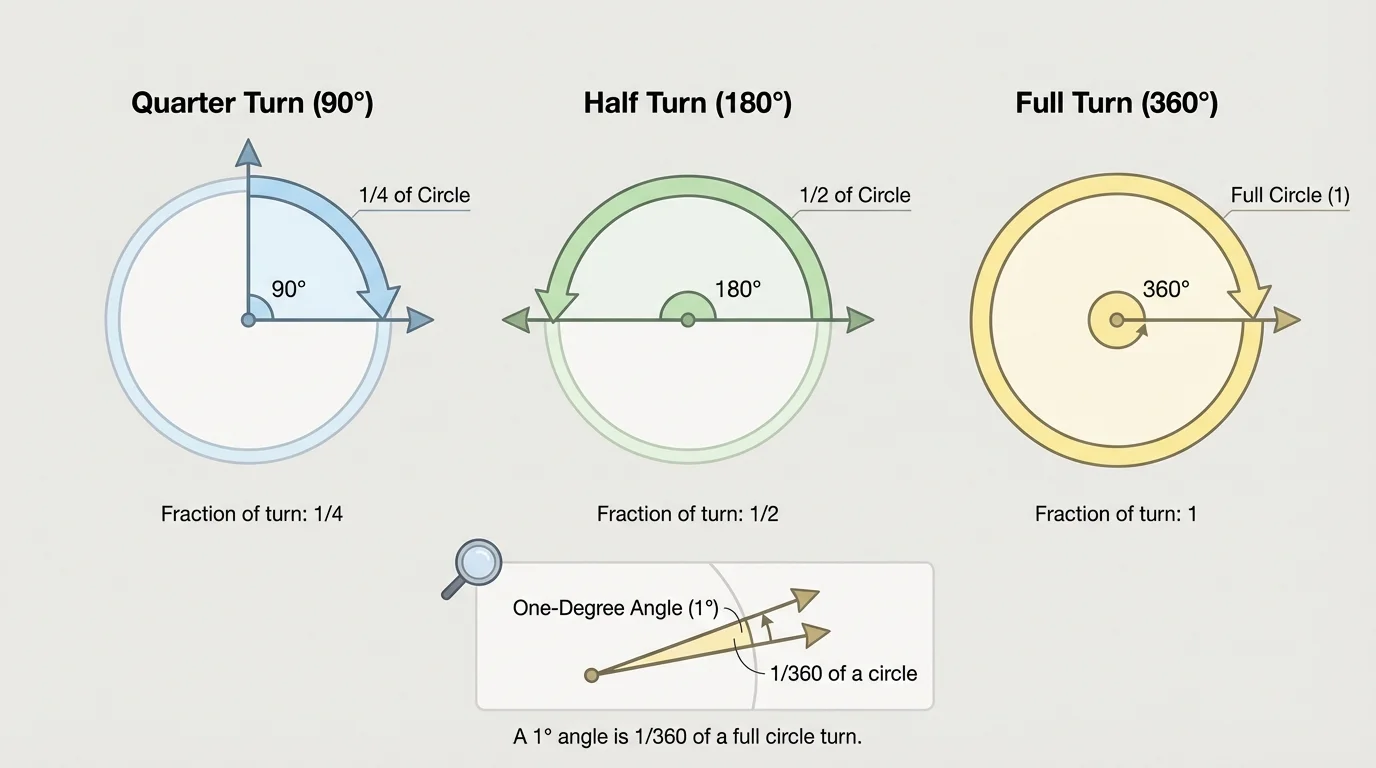
If one angle measures \(70^\circ\) and another measures \(100^\circ\), then \(100^\circ > 70^\circ\). The \(100^\circ\) angle has the greater opening. Comparing angles is just like comparing other measurements: the larger number means the larger measure.
An angle can also be exactly \(180^\circ\). That is called a straight angle because the rays point in opposite directions and form a straight line. An angle of \(360^\circ\) brings the turning ray all the way back to where it started.
When you compare lengths, a longer segment can be drawn anywhere on the page and still have the same length. Angles work in a similar way: the drawing can be bigger or smaller, but the measure stays the same if the opening stays the same.
So when you look at two angles, do not focus on ray length. Focus on the amount of turn from one ray to the other.
Angle measure tells how much turning happens from one ray to the other. It does not tell how long the rays are, how much area is inside the drawing, or how "big" the picture looks overall.
For example, a small sketch of a \(90^\circ\) angle and a giant poster of a \(90^\circ\) angle still show the same angle measure. The opening is the same quarter-turn in both drawings.
Another common mistake is thinking that a wider-looking picture must have a greater angle because its sides are longer. But if the two rays point in the same directions, the angle measure is unchanged. The fraction of the circle between the rays stays the same, which is the main idea we saw with the circle method in [Figure 2].
You can think of angle measure as a turning story. Start on one ray. Turn until you reach the second ray. The amount of turning is the angle measure.
Now let's use these ideas to solve some angle questions step by step.
Worked example 1
An angle is one quarter of a full circle. What is its measure?
Step 1: Recall the measure of a full circle.
A full circle measures \(360^\circ\).
Step 2: Find one quarter of \(360^\circ\).
Compute \(\dfrac{1}{4} \times 360^\circ = 90^\circ\).
The angle measures \(90^\circ\)
A quarter-turn is one of the most important angle benchmarks. You will see it often in squares, rectangles, and clock faces.
Worked example 2
An angle measures half of a full turn. What is its measure in degrees?
Step 1: Start with the full circle.
A full turn is \(360^\circ\).
Step 2: Take half of \(360^\circ\).
Compute \(\dfrac{1}{2} \times 360^\circ = 180^\circ\).
The angle measures \(180^\circ\)
This angle forms a straight line. That is why \(180^\circ\) is called a straight angle.
Worked example 3
Which angle is larger: \(60^\circ\) or \(120^\circ\)?
Step 1: Compare the numbers.
Since \(120 > 60\), the angle with measure \(120^\circ\) is larger.
Step 2: Connect the numbers to turning.
An angle of \(120^\circ\) represents more turning than \(60^\circ\).
The larger angle is \(120^\circ\)
Comparing angle measures works just like comparing distances or weights. The greater number names the greater amount.
Worked example 4
A ray turns through \(\dfrac{1}{8}\) of a circle. How many degrees is that?
Step 1: Use the full-circle measure.
A full circle is \(360^\circ\).
Step 2: Find one eighth of \(360^\circ\).
Compute \(\dfrac{1}{8} \times 360^\circ = 45^\circ\).
The angle measures \(45^\circ\)
This shows how fractions of a circle and degree measures are connected. Once you know the whole is \(360^\circ\), you can find many common angle sizes.
Clocks are one of the easiest places to see angle measure in daily life, as [Figure 5] illustrates. The hands of a clock start at the center and act like rays. The opening between the hands forms an angle.
At \(3{:}00\), the minute hand points to \(12\) and the hour hand points to \(3\). That makes a quarter-turn, or \(90^\circ\). At \(6{:}00\), the hands form a half-turn, or \(180^\circ\).
Sports also use angles. A soccer player changes direction by turning through an angle. A basketball shot can bounce off the backboard at an angle. A skateboard ramp changes the direction of motion by turning the path.
Engineers and builders use angles when making corners, roofs, stairs, and bridges. Drivers use angles when steering around curves. Map readers use angles to describe turns, such as turning \(90^\circ\) right or making a half-turn.
Even a door is a real-world angle model. A closed door may be near \(0^\circ\) from the wall, a partly open door may be around \(45^\circ\), and a wide open door may be close to \(90^\circ\). The exact degree measure tells how far it has turned.
These benchmark turns make real-world situations easier to understand because many motions are close to quarter-turns, half-turns, and full turns.
An angle is a shape made by two rays with the same endpoint. The amount of opening between the rays is the angle's size. To measure that opening, we imagine a circle centered at the vertex and look at the fraction of the circle between the two rays.
A one-degree angle is \(\dfrac{1}{360}\) of a full circle. So a full turn is \(360^\circ\), a half-turn is \(180^\circ\), and a quarter-turn is \(90^\circ\). These benchmarks help you estimate and compare many other angles.
Most of all, remember this: angle measure is about turning. If the amount of turn stays the same, the angle measure stays the same, even when the picture is drawn larger or smaller.
