A concert stadium can hold thousands of people, a factory can make hundreds of items each day, and a video game might count points into the millions. How do people find totals that large quickly and correctly? One powerful method is the standard algorithm for multiplication. It helps us organize our work so that even big numbers become manageable.
When you multiply, you find the total in equal groups. If there are \(36\) rows of chairs with \(24\) chairs in each row, multiplication tells the total number of chairs. Instead of adding \(24 + 24 + 24 + \cdots\) thirty-six times, you can calculate \(36 \times 24\).
As numbers grow larger, mental math alone becomes harder. The standard algorithm gives a reliable way to multiply numbers such as \(487 \times 63\) or \(3{,}245 \times 8\). It is fast, organized, and based on place value.
You already know that multiplication can be understood as repeated addition, equal groups, arrays, and area. You also know basic multiplication facts such as \(6 \times 7 = 42\). The standard algorithm builds on those facts and uses them with larger numbers.
To use the algorithm well, you need to pay close attention to the value of each digit. A digit does not just tell what number it is; it also tells where it is. In \(347\), the \(3\) means \(300\), the \(4\) means \(40\), and the \(7\) means \(7\).
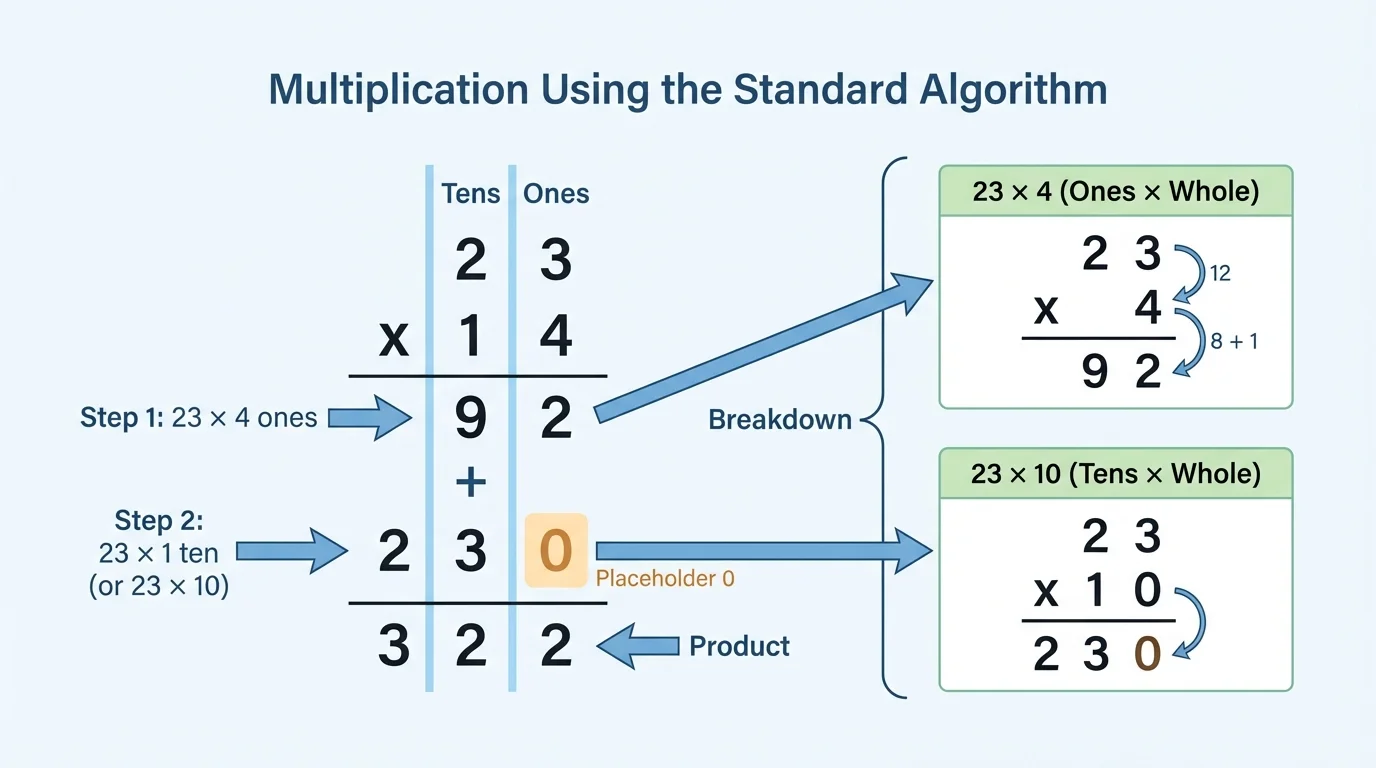
[Figure 1] The word place value means the value of a digit because of its position in a number. This idea is the reason the multiplication algorithm works. When you multiply by a digit in the ones place, your partial product starts in the ones column. When you multiply by a digit in the tens place, each result is worth ten times as much, so that row starts one place to the left.
Suppose you multiply \(23 \times 14\). The \(14\) is really \(10 + 4\). So the product can be broken apart like this:
\[23 \times 14 = 23 \times (10 + 4) = 23 \times 10 + 23 \times 4\]
That means you are really finding two partial products and then adding them. The standard algorithm keeps these partial products lined up by place value so that the final sum is correct.
Factor means a number being multiplied.
Product means the answer to a multiplication problem.
Partial product means the product from multiplying one part of a factor by the other factor or one digit at a time.
Regrouping means writing part of a number in the next place-value column, such as exchanging \(10\) ones for \(1\) ten.
For example, in \(46 \times 32\), the numbers \(46\) and \(32\) are factors. The final answer is the product. The row from multiplying by \(2\) and the row from multiplying by \(30\) are partial products.
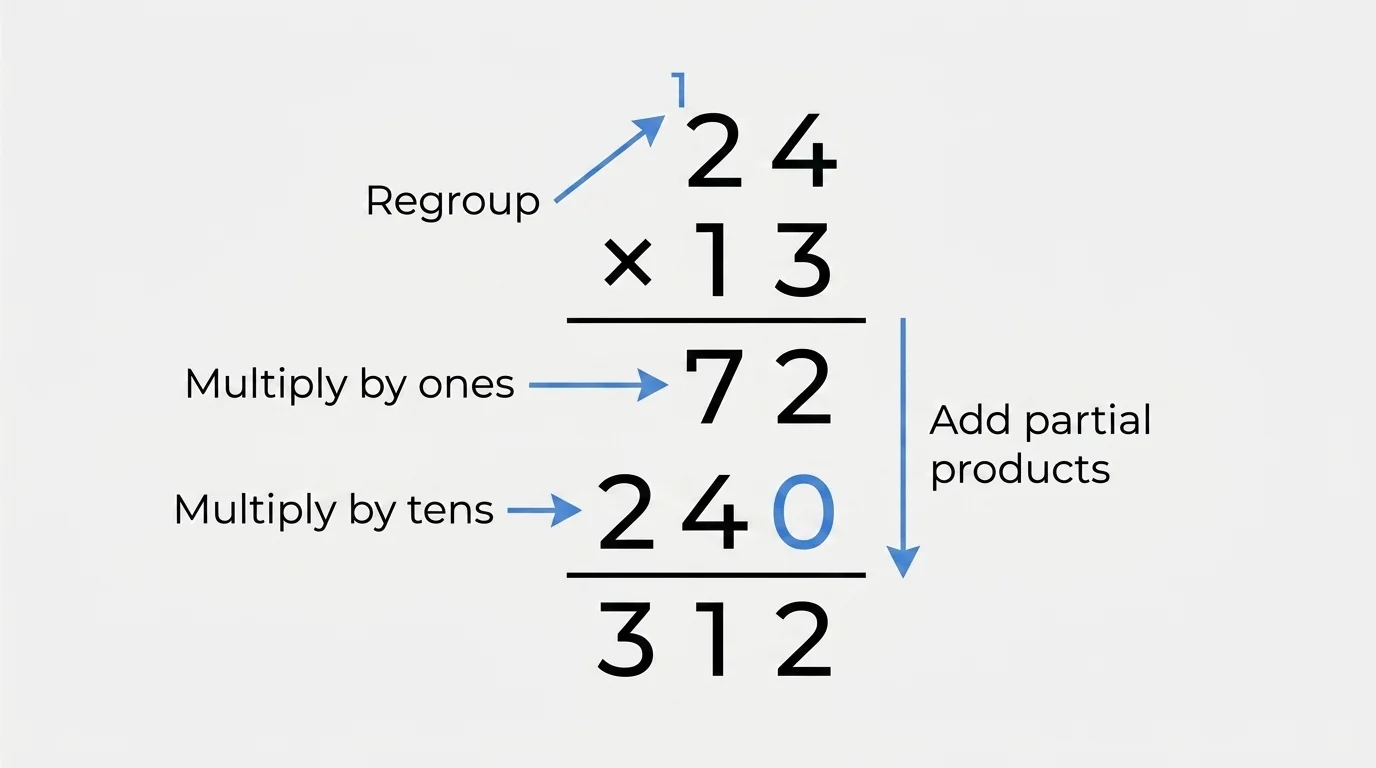
[Figure 2] The algorithm is a step-by-step method for solving a problem. In multiplication, the standard algorithm keeps digits in columns so each place value stays organized. That organization is one reason the method is so useful for large numbers.
Here is the usual process for multiplying multi-digit whole numbers:
Step 1: Write one factor above the other, lining up digits by place value.
Step 2: Multiply the top number by the digit in the ones place of the bottom number. If a product is greater than \(9\), regroup.
Step 3: Move to the next digit in the bottom number. Because that digit has a greater place value, begin the next row one place to the left.
Step 4: Add the partial products.
When people say "carry," the more exact idea is regrouping. If \(8 \times 7 = 56\), you write the \(6\) ones and regroup the \(5\) tens to the next column. This keeps every digit in the correct place.
Let's start with a two-digit by two-digit problem: \(34 \times 27\).
Worked example: \(34 \times 27\)
Step 1: Set up the numbers in columns.
\[\begin{array}{r} 34 \\ \times\;27 \end{array}\]
Step 2: Multiply by the ones digit, \(7\).
First, \(7 \times 4 = 28\). Write \(8\) in the ones place and regroup \(2\) tens.
Next, \(7 \times 3 = 21\). Add the regrouped \(2\): \(21 + 2 = 23\).
So the first partial product is \(238\).
Step 3: Multiply by the tens digit, \(2\), which really means \(20\).
Because you are multiplying by tens, start this row in the tens place.
\(2 \times 4 = 8\), and \(2 \times 3 = 6\), so \(34 \times 20 = 680\).
Step 4: Add the partial products.
\[\begin{array}{r} 34 \\ \times\;27 \\ \hline 238 \\ 680 \\ \hline 918 \end{array}\]
The product is \[34 \times 27 = 918\]
You can also check whether this makes sense by estimating. Since \(34\) is close to \(30\) and \(27\) is close to \(30\), the estimate is \(30 \times 30 = 900\). The exact answer, \(918\), is close to \(900\), so it is reasonable.
Now look at a problem with more digits: \(486 \times 53\). This example shows clearly why partial products matter.
Worked example: \(486 \times 53\)
Step 1: Multiply by the ones digit, \(3\).
\(3 \times 6 = 18\). Write \(8\), regroup \(1\).
\(3 \times 8 = 24\), and \(24 + 1 = 25\). Write \(5\), regroup \(2\).
\(3 \times 4 = 12\), and \(12 + 2 = 14\).
The first partial product is \(1{,}458\).
Step 2: Multiply by the tens digit, \(5\), which really means \(50\).
Start in the tens place.
\(5 \times 6 = 30\). Write \(0\), regroup \(3\).
\(5 \times 8 = 40\), and \(40 + 3 = 43\). Write \(3\), regroup \(4\).
\(5 \times 4 = 20\), and \(20 + 4 = 24\).
The second partial product is \(24{,}300\).
Step 3: Add the partial products.
\[\begin{array}{r} 486 \\ \times\;53 \\ \hline 1458 \\ 24300 \\ \hline 25758 \end{array}\]
The product is \[486 \times 53 = 25{,}758\]
If you look back at [Figure 1], you can see the same place-value idea at work. The second row is not just another copy of the first row. It represents multiplication by tens, so its value is much greater.
Not all multi-digit multiplication problems have two multi-digit factors. Sometimes one factor has many digits and the other has one digit. You still use the same place-value thinking.
Worked example: \(3{,}407 \times 6\)
Step 1: Multiply the ones.
\(6 \times 7 = 42\). Write \(2\), regroup \(4\).
Step 2: Multiply the tens.
\(6 \times 0 = 0\). Add the regrouped \(4\): \(0 + 4 = 4\).
Step 3: Multiply the hundreds.
\(6 \times 4 = 24\). Write \(4\), regroup \(2\).
Step 4: Multiply the thousands.
\(6 \times 3 = 18\). Add the regrouped \(2\): \(18 + 2 = 20\).
Step 5: Write the final answer.
\[\begin{array}{r} 3407 \\ \times\;6 \\ \hline 20442 \end{array}\]
The product is \[3{,}407 \times 6 = 20{,}442\]
This example shows an important idea: a zero in a factor does not mean you skip place value. The zero tens still belong in the tens place, and regrouping still moves into and out of that place correctly.
The standard algorithm is not a trick. It is a shorter way to write expanded-form multiplication. For example:
\[23 \times 14 = 23 \times (10 + 4) = (23 \times 10) + (23 \times 4) = 230 + 92 = 322\]
Here is another example with expanded form:
\[46 \times 32 = (40 + 6)(30 + 2)\]
That means:
\[46 \times 32 = 40 \times 30 + 40 \times 2 + 6 \times 30 + 6 \times 2\]
Now multiply each part:
\[1{,}200 + 80 + 180 + 12 = 1{,}472\]
The standard algorithm combines those same calculations into neat rows. It saves time while still using exactly the same math ideas.
Why rows shift left
Each row in the standard algorithm begins in a different column because the bottom digit may represent ones, tens, hundreds, or more. Multiplying by \(3\) and multiplying by \(30\) are not the same. The second amount is ten times greater, so every digit in that partial product must be placed one column to the left.
That left shift is really a place-value shift. It is one of the most important patterns to notice in multi-digit multiplication.
Even when students understand multiplication, small mistakes can change the final answer a lot. Careful setup helps.
Mistake 1: Not lining up digits correctly. Always write numbers so ones are under ones, tens under tens, and so on.
Mistake 2: Forgetting that a digit in the tens place means tens. In \(27\), the \(2\) means \(20\), not \(2\).
Mistake 3: Losing track of regrouping. If you regroup a digit, make it small and clear above the next column.
Mistake 4: Adding partial products incorrectly. After multiplying carefully, you must still add carefully.
Mistake 5: Ignoring zeros. In a number such as \(205\), the zero still holds the tens place.
A small place-value mistake can make an answer off by tens, hundreds, or even thousands. That is why neat columns are not just about handwriting; they are part of the mathematics.
Looking again at [Figure 2], the arrows and rows help show why staying organized matters. The layout protects the place values from getting mixed up.
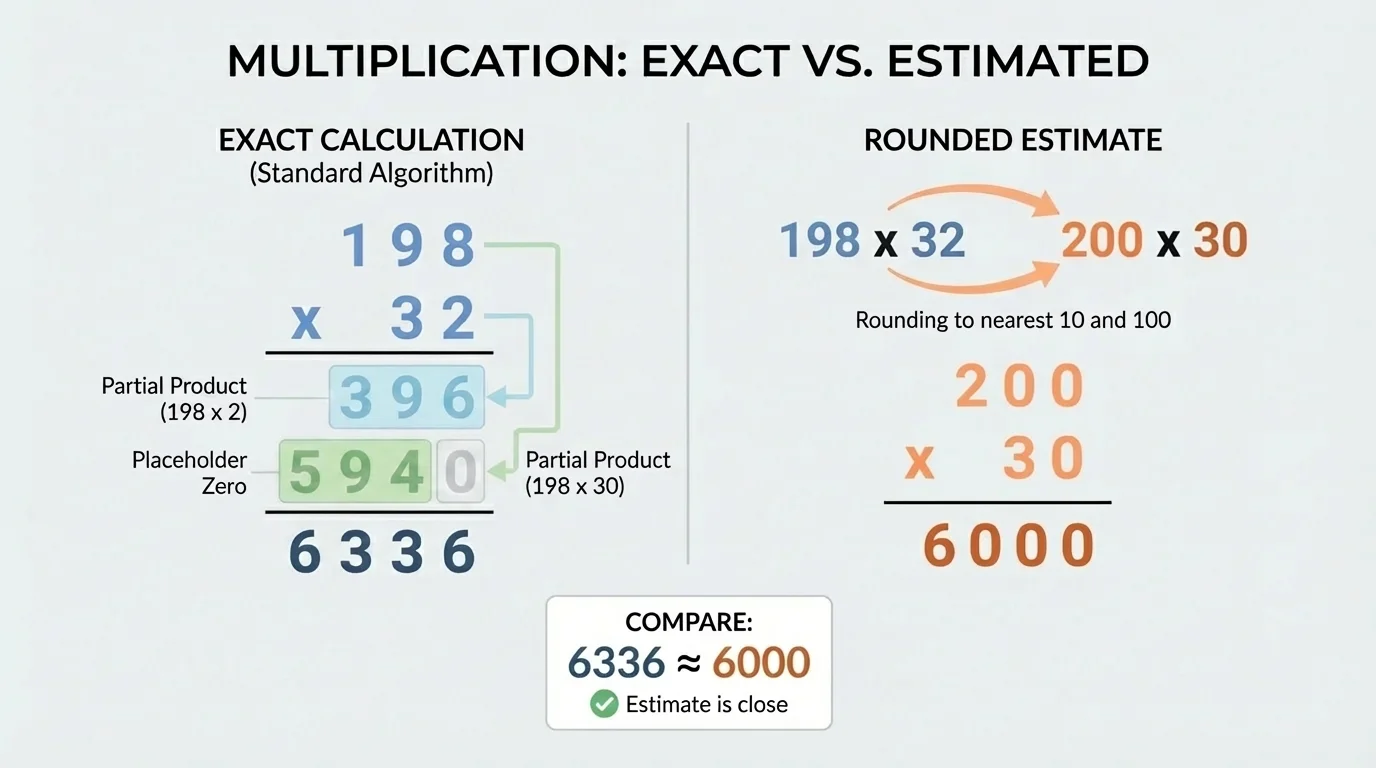
Strong mathematicians do not stop after getting an answer. They also ask, "Does this answer make sense?" One fast way to check is to estimate, which means finding a close answer instead of an exact one. Rounded numbers make that quick check easier, as shown in [Figure 3].
Suppose you found \(198 \times 32\). You might round \(198\) to \(200\) and \(32\) to \(30\). Then \(200 \times 30 = 6{,}000\). The exact product should be near \(6{,}000\).
Now calculate the exact answer:
\[\begin{array}{r} 198 \\ \times\;32 \\ \hline 396 \\ 5940 \\ \hline 6336 \end{array}\]
The exact product is \(6{,}336\), which is close to the estimate of \(6{,}000\). That tells you the answer is reasonable.
Estimation will not tell you the exact answer, but it is excellent for catching major errors. If you got \(63{,}360\) instead, your estimate would warn you that the answer is much too large.
Multi-digit multiplication appears in many real situations. A school might order \(125\) notebooks for each of \(24\) classrooms. The total number of notebooks is \(125 \times 24\).
\[\begin{array}{r} 125 \\ \times\;24 \\ \hline 500 \\ 2500 \\ \hline 3000 \end{array}\]
So the school needs \(3{,}000\) notebooks.
A garden can also use multiplication. If one rectangular garden has \(18\) rows of plants with \(36\) plants in each row, then the total number of plants is \(18 \times 36 = 648\).
Sports use multiplication too. If a stadium has \(42\) sections and each section has \(128\) seats, the total number of seats is found by \(42 \times 128\). Multiplication helps event planners, builders, store owners, and engineers work with large amounts quickly.
Real-world example: stadium seats
Step 1: Multiply the seats in one section by the number of sections.
\[\begin{array}{r} 128 \\ \times\;42 \end{array}\]
Step 2: Find the partial products.
\(128 \times 2 = 256\)
\(128 \times 40 = 5{,}120\)
Step 3: Add them.
\[\begin{array}{r} 128 \\ \times\;42 \\ \hline 256 \\ 5120 \\ \hline 5376 \end{array}\]
The stadium has \(5{,}376\) seats.
Notice how estimation helps here too. Since \(128\) is close to \(130\) and \(42\) is close to \(40\), you can estimate \(130 \times 40 = 5{,}200\). That is close to the exact answer, \(5{,}376\), so the result makes sense.
Fluency means being accurate, efficient, and flexible. It does not mean racing without thinking. A fluent student knows the multiplication facts, understands place value, sets up the algorithm carefully, and checks the result.
Fluency grows when you notice patterns. For example, multiplying by a tens digit shifts a row left. Regrouping follows place-value rules. Estimating gives you a quick check. These are not separate ideas; they work together.
If you understand why the rows are placed where they are, the standard algorithm becomes much easier to remember. Instead of memorizing steps only, you see the structure behind the steps.
"Neat work is mathematical thinking made visible."
That idea is especially true in multiplication. Organized columns, clear regrouping, and careful addition help your thinking stay accurate from beginning to end.
