A stopwatch in a race might show a time like \(9.384\) seconds. A digital scale might show \(2.075\) kilograms. A weather report might list \(0.125\) inches of rain. Those numbers may look small, but each digit matters. In decimals, moving a digit just one place changes its value. Learning to read and write decimals correctly helps you understand measurements, data, and numbers used every day.
Our number system is based on powers of ten. To the left of the decimal point, places get larger: ones, tens, hundreds, and so on. To the right of the decimal point, places get smaller: tenths, hundredths, and thousandths. A decimal is a number that includes a decimal point and may have digits to the right of that point.
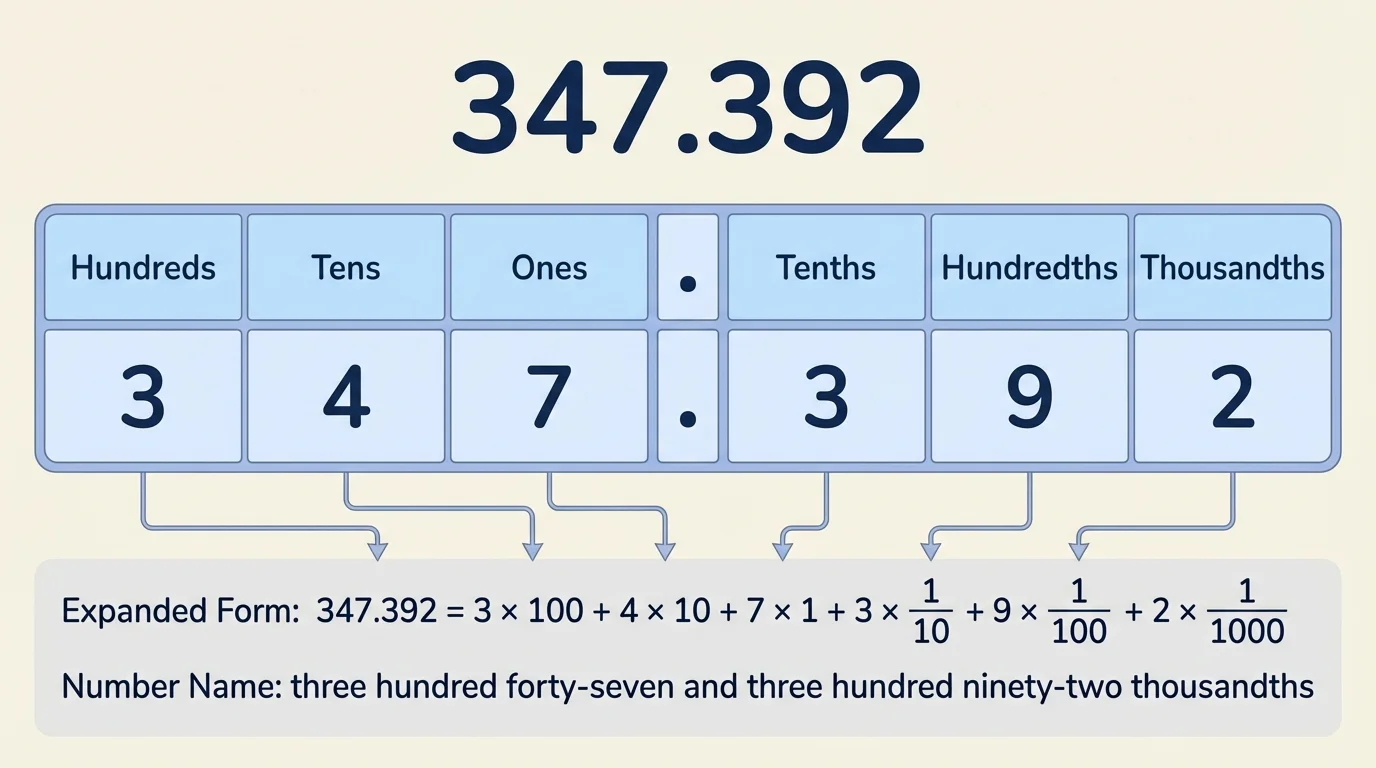
Each digit has a value based on its place, as shown in [Figure 1]. In the number \(347.392\), the \(3\) in the hundreds place means \(300\), the \(4\) in the tens place means \(40\), and the \(7\) in the ones place means \(7\). To the right of the decimal point, the \(3\) means \(3\) tenths, the \(9\) means \(9\) hundredths, and the \(2\) means \(2\) thousandths.
The places to the right of the decimal point are:
This means that \(0.3\) is three tenths, \(0.09\) is nine hundredths, and \(0.002\) is two thousandths.
Notice that moving one place to the right makes the value \(10\) times smaller. Every move one place to the left makes the value \(10\) times larger. That is why \(5\) in the tenths place, \(0.5\), is greater than \(5\) in the hundredths place, \(0.05\).
Place value tells how much a digit is worth based on where it is in a number. In decimals, the places to the right of the decimal point are tenths, hundredths, and thousandths.
You can think of decimals as an extension of whole-number place value. Whole numbers stop at ones, but decimals continue the pattern with smaller and smaller parts. This is why decimals are useful for measurements that are not exact whole numbers.
To read a decimal, first read the whole-number part. Then say "and" for the decimal point. After that, read the decimal part as a whole number, and name the place value of the last digit.
For example, \(347.392\) is read as three hundred forty-seven and three hundred ninety-two thousandths.
Here are more examples:
In \(0.705\), the whole-number part is \(0\), so many people simply say seven hundred five thousandths. The decimal part has three digits, so the last place is thousandths.
A useful rule is this: the name of the decimal part depends on the last place value. If the last digit is in the tenths place, the number is read in tenths. If the last digit is in the hundredths place, the number is read in hundredths. If the last digit is in the thousandths place, the number is read in thousandths.
Fractions can help you understand decimal names. \(0.6 = \dfrac{6}{10}\), so it is six tenths. \(0.47 = \dfrac{47}{100}\), so it is forty-seven hundredths. \(0.392 = \dfrac{392}{1000}\), so it is three hundred ninety-two thousandths.
Be careful with the word and. In reading decimals, "and" tells where the decimal point is. For example, \(6.25\) is six and twenty-five hundredths, not six twenty-five.
Sometimes you are given a number name and must write it as a numeral. Start with the whole-number part. Then place the decimal point where you hear "and." Finally, write the decimal part so that its last digit lands in the correct place.
For example, twenty-one and four tenths is written as \(21.4\). The \(4\) goes in the tenths place.
Eight and thirty-six hundredths is written as \(8.36\). The decimal part, \(36\), ends in the hundredths place, so it has two digits.
Nine and seven thousandths is written as \(9.007\). Since the \(7\) must be in the thousandths place, zeros are needed in the tenths and hundredths places.
Zeros are important placeholders. Without them, the number changes. For example:
These are very different numbers even though each has a \(7\).
In science and engineering, very small decimal differences can matter a lot. A measurement of \(2.5\) centimeters is not the same as \(2.05\) centimeters, and reading the place values correctly is what keeps the measurement accurate.
When writing decimals from words, always ask yourself: what is the place value of the last digit in the decimal part? That question helps you know how many digits to write after the decimal point.
Expanded form shows the value of each digit separately. This helps you understand exactly what each digit is worth. As [Figure 2] illustrates, a decimal can be broken into whole-number parts and fractional parts.
There are two common ways to write expanded form. One way uses addition. Another way uses multiplication with place value units.
For \(347.392\), the expanded form using addition is:
\[347.392 = 300 + 40 + 7 + 0.3 + 0.09 + 0.002\]
The expanded form using multiplication is:
\[347.392 = 3 \times 100 + 4 \times 10 + 7 \times 1 + 3 \times \left(\frac{1}{10}\right) + 9 \times \left(\frac{1}{100}\right) + 2 \times \left(\frac{1}{1000}\right)\]
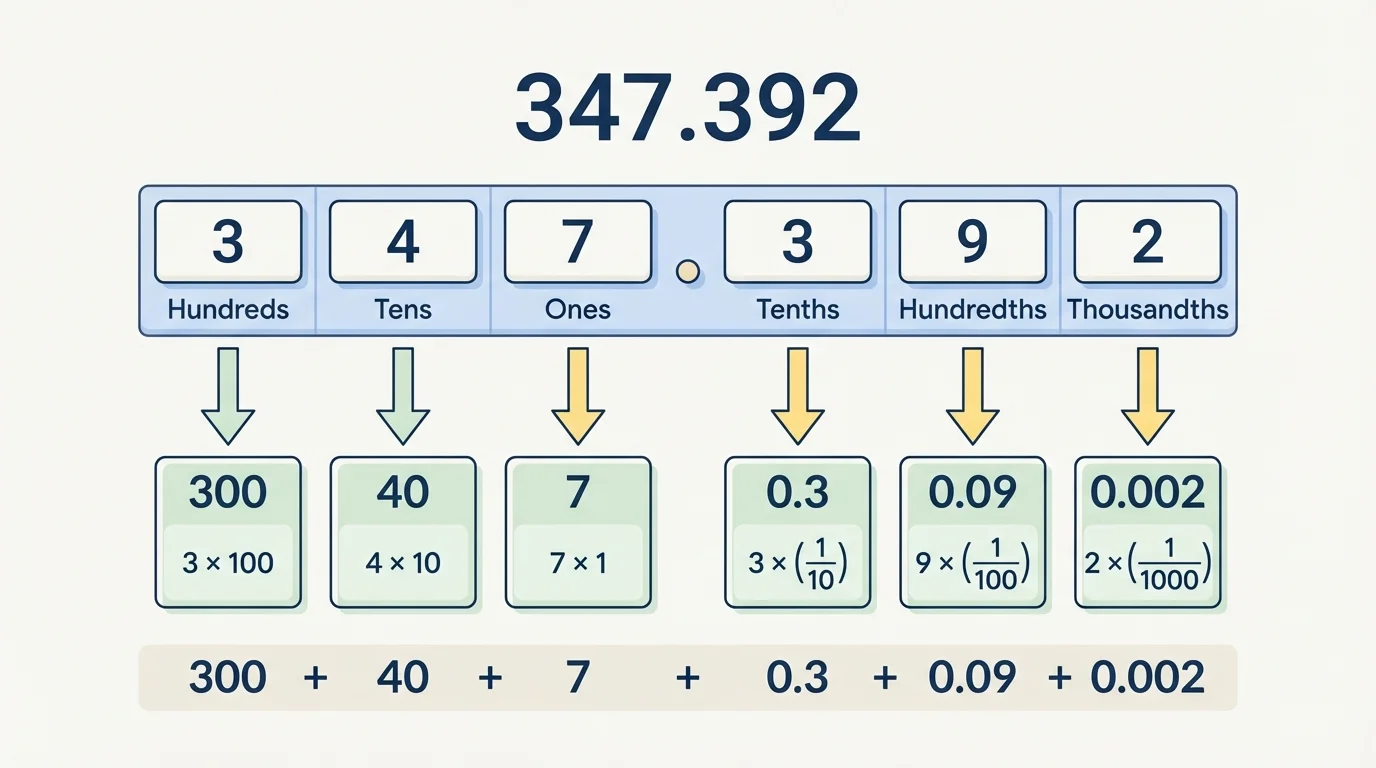
Both forms mean the same thing. They simply show the value of each digit in different ways. The addition form is often easier to read quickly. The multiplication form clearly shows the digit and the place-value unit together.
Here are more examples:
Notice that in \(0.408\), there are no hundredths, so the hundredths part is \(0\). It does not need to appear in the addition form, but it still matters when you identify place values.
Worked example 1
Read \(18.307\) in words.
Step 1: Read the whole-number part.
The whole-number part is \(18\), so read it as eighteen.
Step 2: Say "and" for the decimal point.
So far, the number is eighteen and.
Step 3: Read the digits to the right of the decimal as a whole number and use the last place value.
The decimal part is \(307\). The last digit is in the thousandths place, so read it as three hundred seven thousandths.
The number is eighteen and three hundred seven thousandths.
When reading decimals, naming the last place correctly is the key step. That tells whether to say tenths, hundredths, or thousandths.
Worked example 2
Write forty-two and nine hundred five thousandths as a decimal.
Step 1: Write the whole-number part.
Forty-two is \(42\).
Step 2: Use the word "and" to place the decimal point.
Write \(42.\).
Step 3: Write the decimal part so the last digit is in the thousandths place.
Nine hundred five thousandths is \(905\) thousandths, so write \(905\) to the right of the decimal point.
The decimal is \(42.905\).
Notice that this number does not need extra zeros because \(905\) already has three digits and ends in the thousandths place.
Worked example 3
Write \(5.064\) in expanded form.
Step 1: Identify each digit's place value.
The \(5\) is in the ones place, the \(0\) is in the tenths place, the \(6\) is in the hundredths place, and the \(4\) is in the thousandths place.
Step 2: Write the value of each nonzero digit.
\(5\) ones is \(5\), \(6\) hundredths is \(0.06\), and \(4\) thousandths is \(0.004\).
Step 3: Write the expanded form.
Using addition, \(5.064 = 5 + 0.06 + 0.004\).
Using multiplication, \[5.064 = 5 \times 1 + 6 \times \left(\frac{1}{100}\right) + 4 \times \left(\frac{1}{1000}\right)\]
The zero in the tenths place shows that there are no tenths, but it still helps place the other digits correctly.
Worked example 4
Write the numeral for six and four hundredths, then write it in expanded form.
Step 1: Write the whole-number part and decimal point.
Six and becomes \(6.\)
Step 2: Place the decimal digits correctly.
Four hundredths means \(4\) is in the hundredths place, so the number is \(6.04\).
Step 3: Expand the number.
\(6.04 = 6 + 0.04\).
In multiplication form, \[6.04 = 6 \times 1 + 4 \times \left(\frac{1}{100}\right)\]
Examples like this show why placeholders matter. Without the zero, \(6.04\) would become \(6.4\), which is a very different number.
Moving a digit one place changes its value by a factor of \(10\), and [Figure 3] makes this easy to compare. That is why zeros can be so important in decimals. A zero may show that a place has no value, but it also keeps the other digits in the correct positions.
Compare these three decimals:
These numbers all use the digit \(5\), but they are not equal. In fact, \(0.5 > 0.05 > 0.005\).
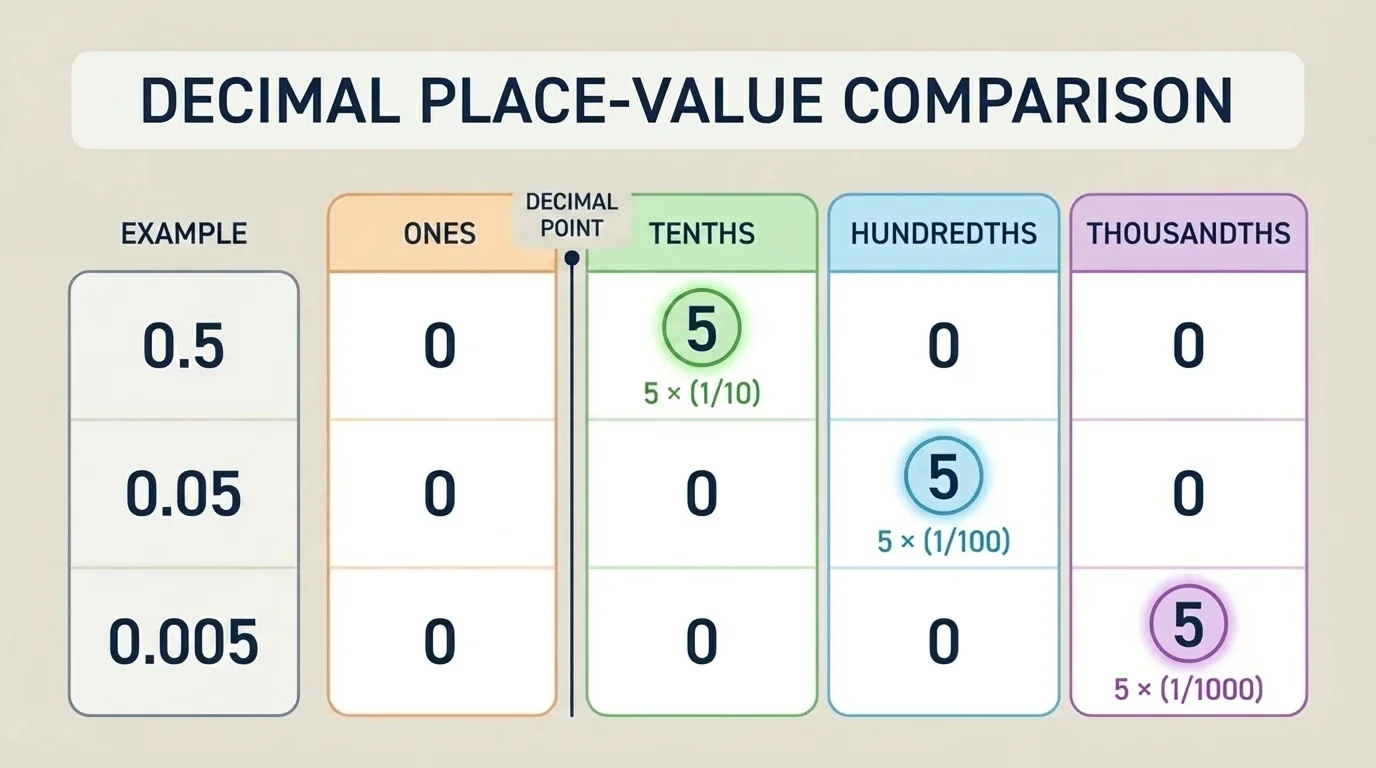
Trailing zeros to the right of a decimal do not change the value. For example, \(2.4 = 2.40 = 2.400\). Each number names the same amount. But zeros between the decimal point and another digit do change the value because they move that digit into a smaller place.
This idea connects back to the place-value chart from [Figure 1]. The chart shows that the position of a digit matters more than the digit alone. A \(7\) in the tenths place is not the same as a \(7\) in the thousandths place.
Why zeros can be important
Zeros are placeholders. In \(3.205\), the \(0\) in the hundredths place shows that there are no hundredths, but it keeps the \(5\) in the thousandths place. Without that zero, the number would be \(3.25\), which is much larger.
When writing decimals from words, always check whether you need zeros to hold places. This is especially important with hundredths and thousandths.
Decimals are everywhere. In sports, race times can be measured to thousandths of a second. A swimmer might finish in \(24.613\) seconds. In science, small changes in temperature or length can be written with decimals. In medicine, doses may need very exact amounts.
Measurements often use decimals because objects are not always exact whole units. A board might be \(1.275\) meters long. A bottle might contain \(0.500\) liters. A rainfall total might be \(2.038\) centimeters.
Expanded form can help you understand what these measurements mean. For example, \(1.275\) meters is:
\[1.275 = 1 + 0.2 + 0.07 + 0.005\]
That means one whole meter, two tenths of a meter, seven hundredths of a meter, and five thousandths of a meter.
Scientists, engineers, and even video game designers rely on exact decimal values. A tiny error in place value can create a big mistake in a result.
"A digit's value depends on its place."
— A central idea of our base-ten system
When you read labels, clocks, scores, and measurements, you are using decimal place value. The better you understand it, the easier it is to work with accurate data.
One common mistake is forgetting to name the last decimal place. For example, \(0.28\) is not twenty-eight tenths. It is twenty-eight hundredths because the last digit is in the hundredths place.
Another mistake is skipping zeros. The number three and six thousandths is \(3.006\), not \(3.6\). The zeros are needed so that the \(6\) lands in the thousandths place.
A third mistake is reading the decimal point incorrectly. In decimal names, "and" marks the decimal point. So \(14.09\) is fourteen and nine hundredths.
Expanded form also requires care. For example, \(2.304\) is not \(2 + 0.3 + 0.4\). The digit \(4\) is in the thousandths place, so the correct form is \(2 + 0.3 + 0.004\). This is easier to see when you think of place values, just as in [Figure 2], where each digit is matched to its exact value.
If you slow down and identify each place before writing or reading, you will make far fewer mistakes.
