What happens if you take part of a number that is already a whole amount, or even part of another fraction? That is exactly what fraction multiplication does. It helps answer questions like, "What is \(2/3\) of \(4\)?" or "What is \(2/3\) of \(4/5\) of a cup?" These questions come up in cooking, building, and sharing, and the answers can be surprising. For example, taking \(2/3\) of \(4\) does not give a smaller whole number. It gives \(8/3\), which is more than \(2\) but less than \(3\).
To understand this well, we need to think of fractions as parts. A fraction tells how many equal parts we are talking about. When we multiply by a fraction, we are finding a part of something. Sometimes that something is a whole number, and sometimes it is another fraction.
Suppose a ribbon is \(4\) meters long, and you need \(2/3\) of it. Or suppose a recipe calls for \(4/5\) cup of milk, but you only want \(2/3\) of the recipe. Fraction multiplication helps you find those amounts exactly. It is a way of scaling or resizing quantities.
Multiplying a whole number by a fraction and multiplying a fraction by a fraction are closely connected. In both cases, you are finding part of an amount. That is the big idea of this lesson.
You already know that a fraction such as \(3/5\) means \(3\) equal parts out of \(5\) equal parts in one whole. You also know that multiplication can mean repeated groups or finding part of a quantity. Here, those ideas work together.
A useful way to read \((a/b) \times q\) is "\(a/b\) of \(q\)." Another useful way is to think of it as a two-step process:
\[\frac{a}{b} \times q = a \times q \div b\]
This means you can multiply by \(a\) and then divide by \(b\). It also means you can imagine splitting \(q\) into \(b\) equal parts and then taking \(a\) of those parts.
When you find a fraction of a quantity, you first divide the quantity into the number of parts named by the denominator. Then you take the number of parts named by the numerator. In \(\dfrac{2}{3} \times 4\), the denominator \(3\) tells us to split \(4\) into \(3\) equal parts. The numerator \(2\) tells us to take \(2\) of those parts.
This idea is easier to see than to memorize. If \(4\) is divided into \(3\) equal parts, each part is \(4/3\). Taking \(2\) parts gives \(2 \times 4/3 = 8/3\).
Numerator is the top number in a fraction. It tells how many parts are being taken.
Denominator is the bottom number in a fraction. It tells how many equal parts make one whole.
Equivalent fractions are fractions that name the same amount even though they look different, such as \(2/3\) and \(4/6\).
You can also connect this to the sequence of operations. Since \(\dfrac{2}{3} \times 4\) means take \(2\) of the \(3\) equal parts of \(4\), we can write:
\[\frac{2}{3} \times 4 = 2 \times 4 \div 3 = 8 \div 3 = \frac{8}{3}\]
The answer \(8/3\) is an improper fraction because the numerator is greater than the denominator. It can also be written as the mixed number \(2\dfrac{2}{3}\). Both names describe the same amount.
A visual fraction model makes the meaning clear, as [Figure 1] shows. Draw \(4\) whole bars. Then split each whole bar into \(3\) equal parts because the denominator is \(3\). Shade \(2\) of the \(3\) parts in each bar because the numerator is \(2\).
Now count all the shaded pieces. There are \(4\) bars, and each bar has \(2\) shaded thirds. That makes \(8\) shaded thirds total, or \(8/3\). The model shows why the answer is not just \(2/3\) or \(8\). It is \(8\) pieces, and each piece is a third.
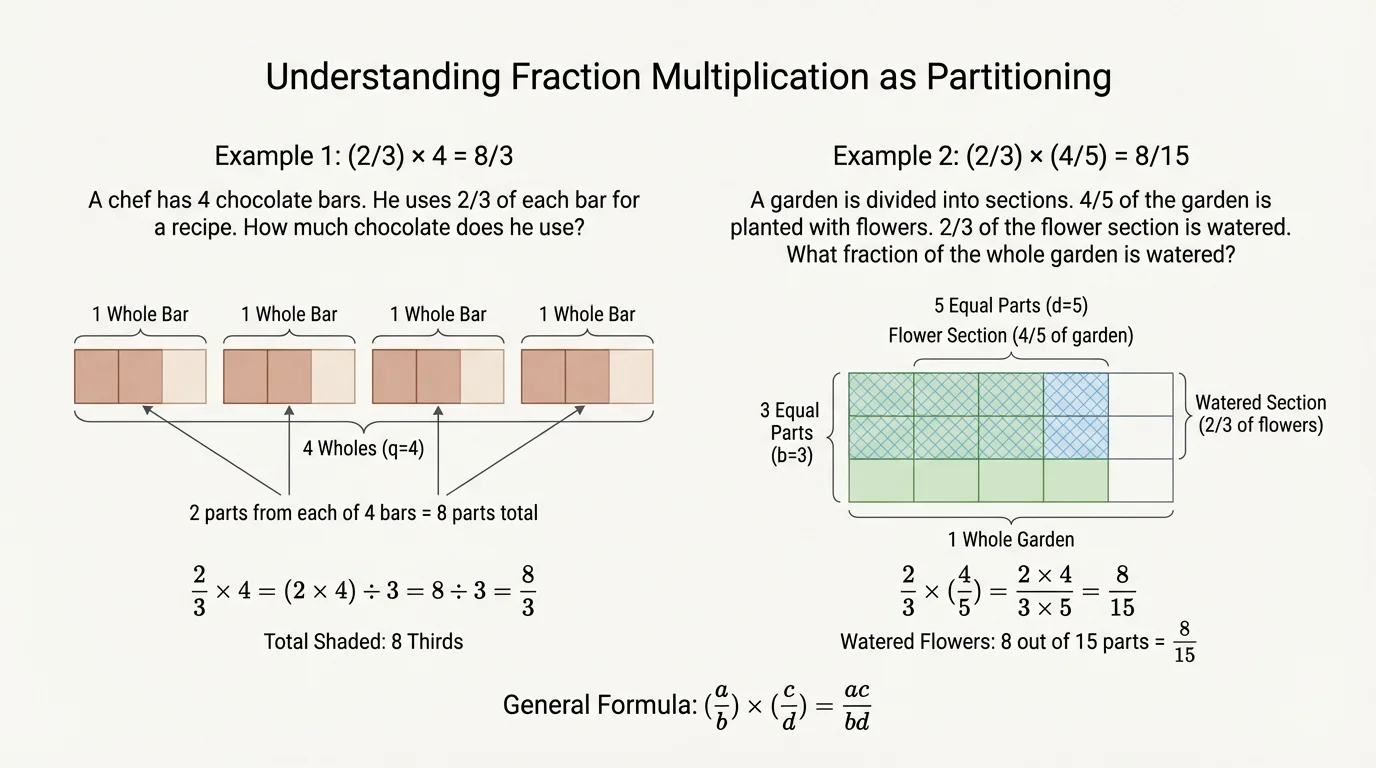
We can say the same idea another way. Start with \(4\) wholes. If each whole is cut into thirds, then \(4\) wholes become \(12\) thirds. Taking \(2/3\) of each whole means taking \(8\) of those thirds. That gives \(8/3\).
Worked example 1
Find \(\dfrac{2}{3} \times 4\).
Step 1: Interpret the fraction.
\(\dfrac{2}{3} \times 4\) means split \(4\) into \(3\) equal parts and take \(2\) of those parts.
Step 2: Find one part.
One of the \(3\) equal parts is \(4 \div 3 = 4/3\).
Step 3: Take two parts.
\(2 \times \dfrac{4}{3} = \dfrac{8}{3}\).
\[\frac{2}{3} \times 4 = \frac{8}{3} = 2\frac{2}{3}\]
This example also matches the shortcut of multiplying across when one factor is a whole number written as a fraction. Since \(4 = 4/1\), we get \((2/3) \times (4/1) = 8/3\). Later, this same idea helps with any two fractions.
Suppose Mia has \(4\) meters of ribbon. She uses \(2/3\) of the ribbon for a project. How much ribbon does she use?
Split the \(4\) meters into \(3\) equal parts. Each part is \(4/3\) meter. Mia uses \(2\) of those parts:
\[\frac{2}{3} \times 4 = \frac{8}{3}\]
So Mia uses \(8/3\) meters of ribbon, or \(2\dfrac{2}{3}\) meters. This story helps us remember that multiplying by a fraction can mean taking part of a real quantity.
Multiplying by a fraction does not always make a number smaller in a simple way. For example, \(\dfrac{2}{3} \times 4 = \dfrac{8}{3}\), which is less than \(4\) but still greater than \(2\). The result depends on the starting amount.
The bar model from [Figure 1] is especially helpful because it shows both the equal partitioning and the total number of pieces at the same time. That is why visual models are so powerful when learning fraction multiplication.
Now let's take part of a quantity that is already a fraction. In \(\dfrac{2}{3} \times \dfrac{4}{5}\), we are finding \(2/3\) of \(4/5\). This means we start with \(4/5\) of a whole and then take \(2/3\) of that amount.
This problem involves fraction multiplication and represents a part of a part. A very useful model for this is an area model. We use one fraction in one direction and the other fraction in the other direction.
An area model, as [Figure 2] illustrates, starts with one whole rectangle. Divide it into \(3\) equal rows and \(5\) equal columns. That creates \(15\) equal small rectangles in all.
Shade \(4/5\) of the whole in one direction by shading \(4\) of the \(5\) columns. Then show \(2/3\) in the other direction by shading \(2\) of the \(3\) rows in a different pattern. The overlapping part represents \(2/3\) of \(4/5\).
Count the overlap. There are \(8\) small rectangles in the overlap, and there are \(15\) equal small rectangles in the whole. So the product is \(8/15\).
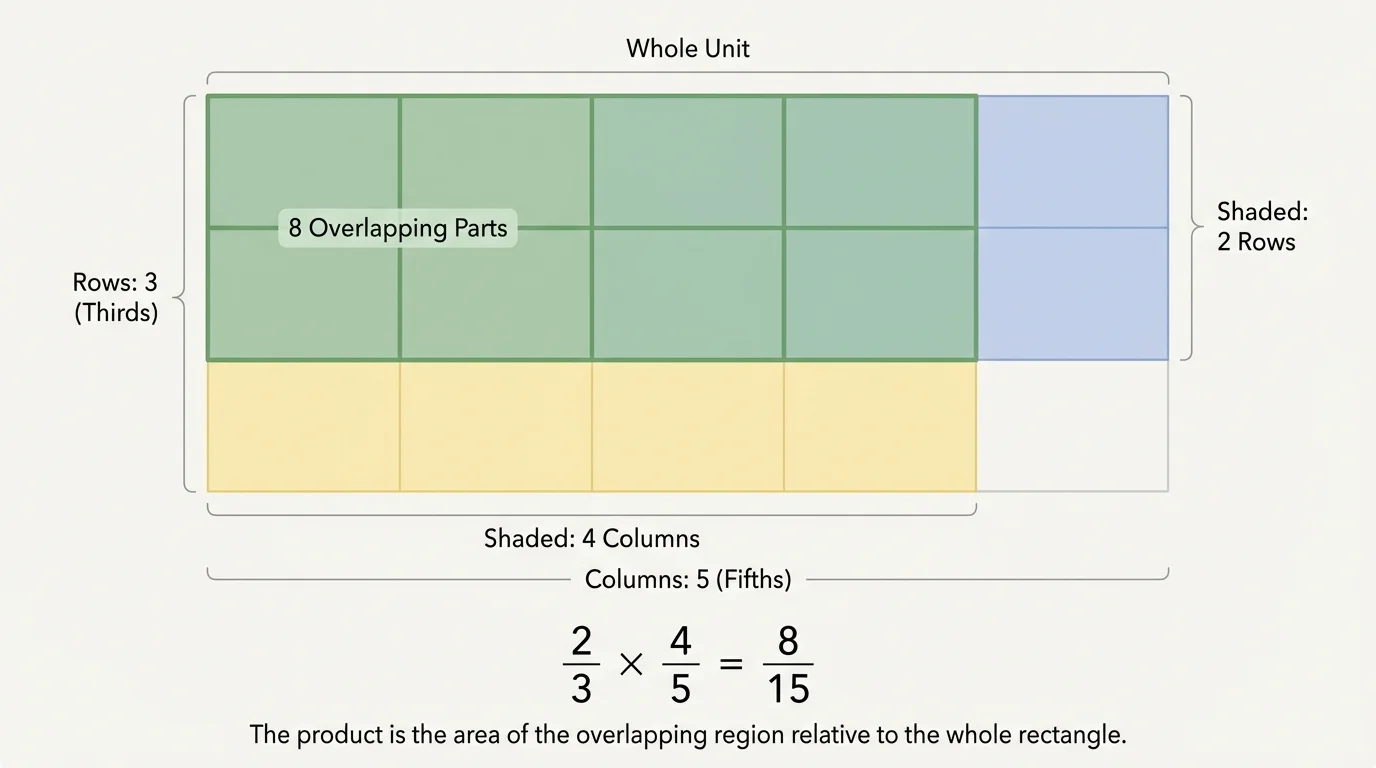
This model is important because it shows where the numbers come from. The denominator \(15\) comes from \(3 \times 5\), the total number of equal parts in the whole. The numerator \(8\) comes from \(2 \times 4\), the number of overlapping parts.
Worked example 2
Find \(\dfrac{2}{3} \times \dfrac{4}{5}\).
Step 1: Multiply the numerators.
\(2 \times 4 = 8\).
Step 2: Multiply the denominators.
\(3 \times 5 = 15\).
Step 3: Write the product.
\(\dfrac{2}{3} \times \dfrac{4}{5} = \dfrac{8}{15}\).
\[\frac{2}{3} \times \frac{4}{5} = \frac{8}{15}\]
A story context can help here too. Suppose a container holds \(4/5\) liter of juice. Leo drinks \(2/3\) of what is in the container. How much juice does he drink? He drinks \(2/3\) of \(4/5\) liter, which is \(8/15\) liter.
When multiplying two fractions, we multiply the numerators and multiply the denominators:
\[\frac{a}{b} \times \frac{c}{d} = \frac{ac}{bd}\]
This rule is not magic. It grows naturally from the area model in [Figure 2]. If one fraction divides the whole into \(b\) parts and the other divides it into \(d\) parts, then the whole gets split into \(bd\) equal small parts. If \(a\) parts are chosen one way and \(c\) parts the other way, then \(ac\) small parts overlap.
So the product is \(ac/bd\). This works for many cases, including whole numbers written as fractions with denominator \(1\).
Why multiplying fractions works
Multiplication by a fraction means taking part of an amount. For whole numbers, multiplication can mean repeated groups. For fractions, multiplication can also mean resizing. When you multiply by \(1/2\), you are taking half. When you multiply by \(3/2\), you are making the amount larger by one and a half times.
This is why multiplying by a fraction less than \(1\) often gives a smaller result, and multiplying by a fraction greater than \(1\) gives a larger result. The fraction tells how the amount changes.
Let's look at a few more examples so the pattern becomes familiar.
Worked example 3
Find \(\dfrac{3}{4} \times 8\).
Step 1: Split \(8\) into \(4\) equal parts.
\(8 \div 4 = 2\).
Step 2: Take \(3\) of those parts.
\(3 \times 2 = 6\).
\[\frac{3}{4} \times 8 = 6\]
Here the answer is a whole number because \(8\) divides evenly into \(4\) equal parts. Not every problem gives a mixed number or a fraction in the end.
Worked example 4
Find \(\dfrac{5}{6} \times \dfrac{3}{10}\).
Step 1: Multiply the numerators.
\(5 \times 3 = 15\).
Step 2: Multiply the denominators.
\(6 \times 10 = 60\).
Step 3: Simplify.
\(\dfrac{15}{60} = \dfrac{1}{4}\).
\[\frac{5}{6} \times \frac{3}{10} = \frac{1}{4}\]
Simplifying is important because fractions should be written in simplest form when possible.
Worked example 5
Find \(\dfrac{7}{3} \times \dfrac{1}{2}\).
Step 1: Multiply the numerators.
\(7 \times 1 = 7\).
Step 2: Multiply the denominators.
\(3 \times 2 = 6\).
Step 3: Write as a mixed number if desired.
\(\dfrac{7}{6} = 1\dfrac{1}{6}\).
\[\frac{7}{3} \times \frac{1}{2} = \frac{7}{6} = 1\frac{1}{6}\]
This example shows that multiplying fractions can also start with an improper fraction. The same rule still works.
One common mistake is to add numerators and denominators when multiplying. For example, some students incorrectly think \((2/3) \times (4/5) = 6/8\). That is not how multiplication of fractions works. We multiply across: numerators with numerators and denominators with denominators.
Another mistake is forgetting what the denominator means. In \(8/3\), the denominator \(3\) tells the size of each part: thirds. The numerator \(8\) tells how many of those thirds there are.
Sometimes students think multiplication must always make numbers bigger. But when you multiply by a fraction less than \(1\), you are taking only part of the amount. That is why \((2/3) \times 4\) is less than \(4\), and \((2/3) \times (4/5)\) is even smaller than \(4/5\).
| Expression | Meaning | Product |
|---|---|---|
| \(\dfrac{2}{3} \times 4\) | Two thirds of four wholes | \(\dfrac{8}{3}\) |
| \(\dfrac{2}{3} \times \dfrac{4}{5}\) | Two thirds of four fifths | \(\dfrac{8}{15}\) |
| \(\dfrac{3}{4} \times 8\) | Three fourths of eight | \(6\) |
| \(\dfrac{5}{6} \times \dfrac{3}{10}\) | Five sixths of three tenths | \(\dfrac{1}{4}\) |
Table 1. Examples showing the meaning and product of fraction multiplication expressions.
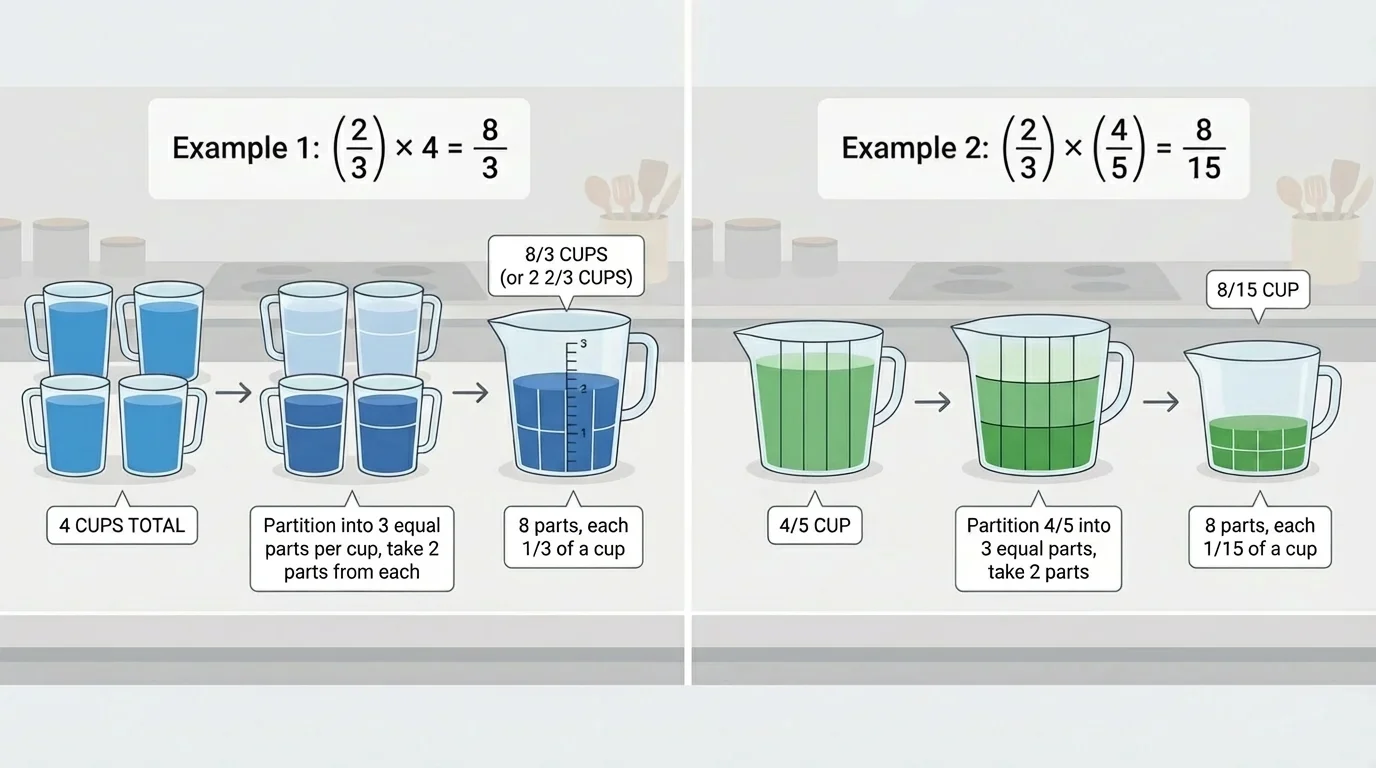
[Figure 3] Fraction multiplication appears in everyday measuring in a cooking setting. If a recipe needs \(4\) cups of fruit and you make only \(2/3\) of the recipe, you need \((2/3) \times 4 = 8/3\) cups, or \(2\dfrac{2}{3}\) cups. If a recipe calls for \(4/5\) cup of yogurt and you make \(2/3\) of the recipe, you need \((2/3) \times (4/5) = 8/15\) cup.
Fraction multiplication is also used to calculate distances. If a hiking trail is \(4\) miles long and you walk \(3/4\) of it, you walk \((3/4) \times 4 = 3\) miles. Builders use it when measuring boards, artists use it when scaling drawings, and scientists use it when working with parts of measured amounts.
Whenever you hear "of" in a problem, there is a good chance multiplication is involved. In fraction problems, "of" often means finding part of a quantity.
The cooking picture connects both types of multiplication from this lesson: a fraction of a whole number amount and a fraction of a fractional amount. That is why recipes are such a useful real-world example.
"A fraction of a quantity means a part of that quantity, not a separate new rule to memorize."
As you work with more problems, try to ask yourself two questions: "What is being divided into equal parts?" and "How many of those parts are being taken?" Those questions help make sense of every fraction multiplication problem.
