A window, a floor tile, a road sign, and a sheet of paper may look different, but many of them are built from the same shape families. Geometry becomes powerful when we notice that shapes are not just separate objects. They can be organized into groups inside bigger groups, almost like a family tree. When you understand that a square is also a rectangle and also a rhombus, you begin to see how mathematicians classify figures by their properties instead of only by their names.
In geometry, a shape is classified by its properties. Properties are features that can be true about a figure, such as how many sides it has, whether sides are equal in length, whether angles are right angles, or whether sides are parallel.
A two-dimensional figure is a flat shape. It has length and width, but not thickness. Squares, triangles, pentagons, and circles are all two-dimensional figures. In this lesson, we will focus mainly on figures made of straight sides.
When shapes share properties, they can be placed in the same category. Then, if one group has even more special properties, it can become a smaller group inside the larger one. This kind of arrangement is called a hierarchy.
You already know some useful ideas from earlier geometry work: a right angle measures \(90^\circ\), parallel lines stay the same distance apart and never meet, and perpendicular lines cross to make right angles.
To classify figures well, we look carefully at their sides and angles. For example, a shape with exactly four sides is in one large group, but if those sides also form opposite parallel pairs, the shape belongs to a smaller, more special group.
A polygon is a closed figure made of straight line segments. The word closed matters. If the sides do not connect all the way around, the figure is not a polygon.
Quadrilateral means a polygon with exactly four sides.
Parallel lines are lines in the same plane that never meet.
Perpendicular lines are lines that meet to form right angles.
A quadrilateral is one of the most important polygon groups in Grade \(5\) geometry. Many special shapes you already know are quadrilaterals: rectangles, squares, rhombuses, parallelograms, and trapezoids.
Another useful word is property. A property is a fact that describes a figure. For instance, "has four sides" is a property. "Has two pairs of parallel sides" is another property. "Has four right angles" is another.
Geometry groups can fit inside other groups, as [Figure 1] shows. A broad group contains many figures, and a smaller group contains only the figures with extra special properties. This is what makes a hierarchy useful.
For example, all quadrilaterals are polygons because every quadrilateral is a closed figure with straight sides. But not all polygons are quadrilaterals, because some polygons have \(3\), \(5\), \(6\), or more sides. So we can write this relationship in words as: quadrilaterals are a type of polygon.
[Figure 2] Inside the group of quadrilaterals, there are smaller groups. Some quadrilaterals have one pair of parallel sides. Some have two pairs of parallel sides. Some have four equal sides. Some have four right angles. The more properties a figure has, the more specific its category can become.
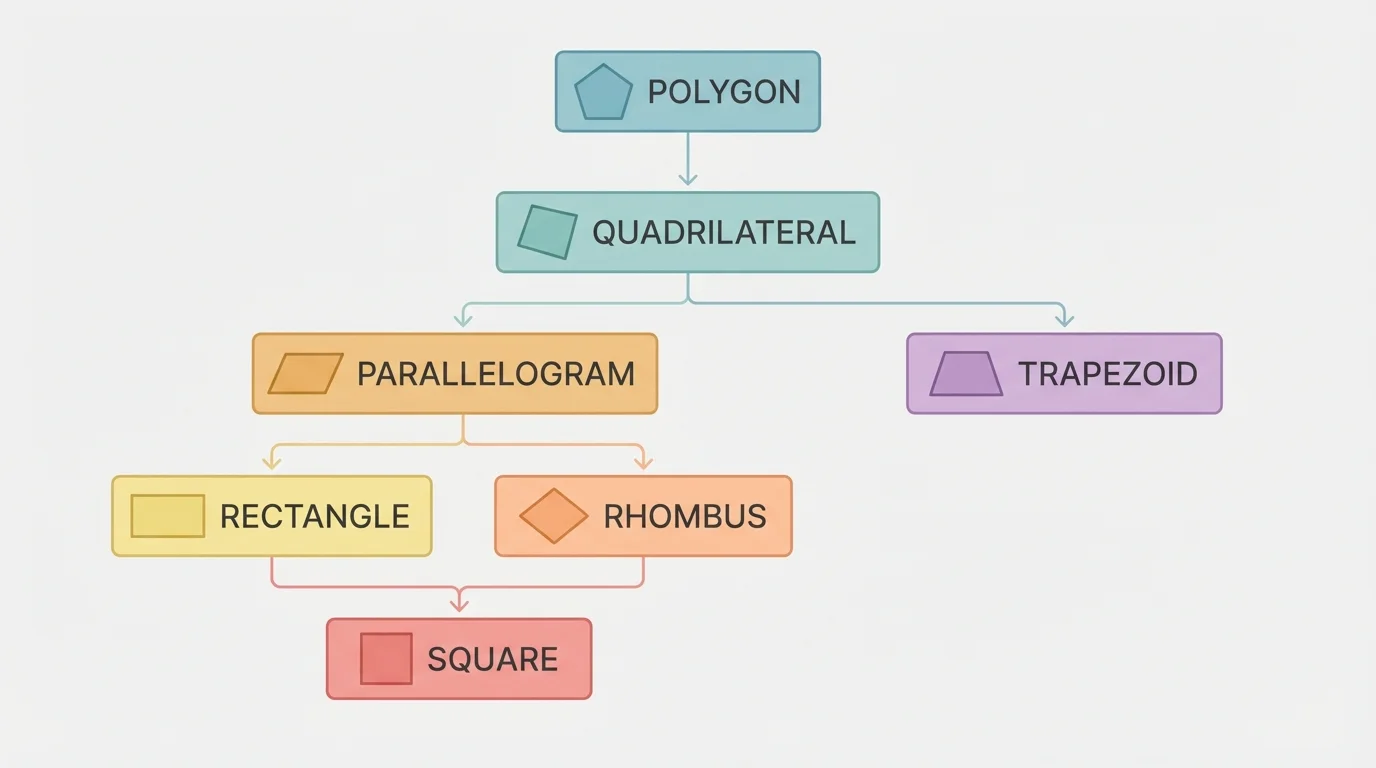
You can think of a hierarchy as moving from general to specific. "Polygon" is more general than "quadrilateral." "Quadrilateral" is more general than "rectangle." "Rectangle" is more general than "square."
This helps us say true statements such as: every square is a quadrilateral, and every square is also a polygon. These statements are true because a square belongs inside those larger groups.
Quadrilaterals form a whole family of shapes, and each family member has a special combination of properties. Looking closely at parallel sides, side lengths, and angle measures helps us tell them apart.
A trapezoid is a quadrilateral with exactly one pair of parallel sides. A parallelogram is a quadrilateral with two pairs of parallel sides.
A rectangle is a parallelogram with four right angles. A rhombus is a parallelogram with four equal sides. A square has both of these sets of properties: it has four equal sides and four right angles.
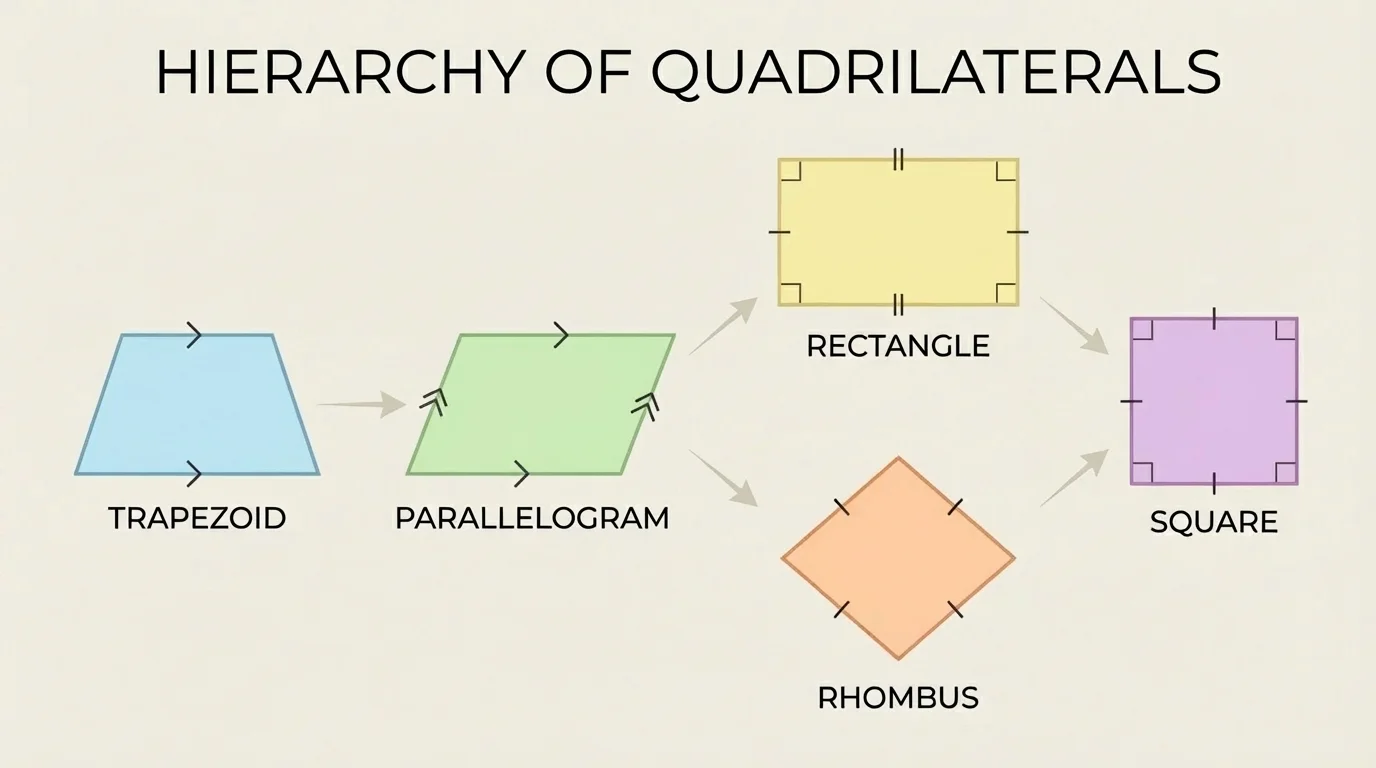
Because a square has so many special properties, it belongs to several groups at once. It is a square, a rectangle, a rhombus, a parallelogram, a quadrilateral, and a polygon.
| Figure | Four sides | Parallel sides | Equal sides | Right angles |
|---|---|---|---|---|
| Trapezoid | Yes | Exactly one pair | Not always | Not always |
| Parallelogram | Yes | Two pairs | Opposite sides equal | Not always |
| Rectangle | Yes | Two pairs | Opposite sides equal | Four |
| Rhombus | Yes | Two pairs | All four equal | Not always |
| Square | Yes | Two pairs | All four equal | Four |
Notice how one row can build on another. A rectangle and a rhombus are both special kinds of parallelograms. A square is even more special because it fits both of those descriptions at the same time.
Inclusive definitions in geometry
In everyday language, people sometimes treat shape names as completely separate. In geometry, names are often inclusive. That means a more specific figure can still belong to a more general group. A square does not stop being a rectangle just because it has all sides equal. It still has four right angles, so it keeps the rectangle property.
When we classify shapes, we do not ask, "What is the one name for this shape?" We ask, "Which categories does this shape belong to?" That is a more mathematical way to think.
One of the most important ideas in this topic is that one shape can fit more than one category, as [Figure 3] makes clear. This happens because categories in geometry are nested.
Take a square. It has four sides, so it is a quadrilateral. It has two pairs of parallel sides, so it is a parallelogram. It has four right angles, so it is a rectangle. It has four equal sides, so it is a rhombus. Since all of those statements are true, the square belongs in all of those groups.
This may feel surprising at first because people often think a rectangle must have two long sides and two short sides. But that is not part of the mathematical definition. The definition only requires four right angles. A square meets that rule perfectly.
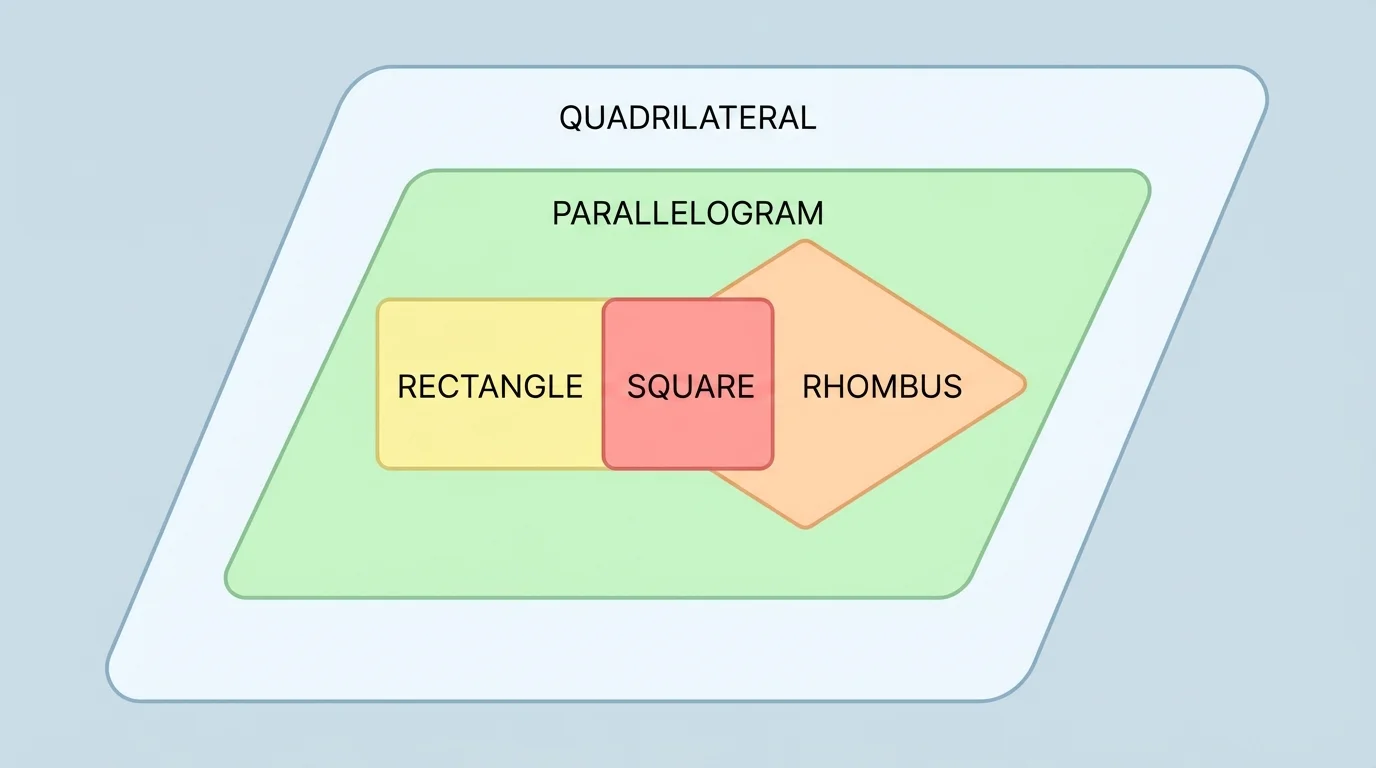
The same idea works in other directions. Every rectangle is a parallelogram because opposite sides are parallel. But not every parallelogram is a rectangle, because some parallelograms do not have four right angles.
Likewise, every rhombus is a parallelogram, but not every parallelogram is a rhombus. A rhombus needs all four sides equal, and many parallelograms do not have that property.
Some geometry facts seem backward at first. For many students, the most surprising one is that a square is not just like a rectangle — it actually is a rectangle because it satisfies the definition exactly.
Using definitions carefully helps avoid arguments based only on how shapes look. A slanted figure can still be a parallelogram. A square can still be a rectangle. The properties decide the category.
Let us practice classifying figures by using their properties, not just by appearance. As we saw earlier in [Figure 1], the goal is to place each figure into the correct part of the hierarchy.
Worked Example 1
A figure has \(4\) sides. Both pairs of opposite sides are parallel, and all \(4\) angles are right angles. Classify the figure.
Step 1: Start with the broadest category.
The figure has \(4\) sides, so it is a quadrilateral.
Step 2: Use the parallel-side property.
Both pairs of opposite sides are parallel, so it is a parallelogram.
Step 3: Use the angle property.
All \(4\) angles are right angles, so it is a rectangle.
The most specific classification we can guarantee is rectangle. It is also a parallelogram, quadrilateral, and polygon.
Notice that this example did not say all sides were equal, so we cannot call it a square.
Worked Example 2
A figure has \(4\) equal sides and \(4\) right angles. Classify the figure in as many categories as possible.
Step 1: Count the sides.
With \(4\) sides, the figure is a quadrilateral.
Step 2: Look at parallel sides.
A figure with \(4\) right angles has opposite sides parallel, so it is a parallelogram.
Step 3: Use the right-angle property.
Since it has \(4\) right angles, it is a rectangle.
Step 4: Use the equal-side property.
Since all \(4\) sides are equal, it is a rhombus.
Step 5: Name the most specific figure.
A figure with \(4\) equal sides and \(4\) right angles is a square.
The figure is a square, and it also belongs to the categories of rectangle, rhombus, parallelogram, quadrilateral, and polygon.
This example shows why a square sits deep in the hierarchy.
Worked Example 3
A quadrilateral has exactly one pair of parallel sides. It does not have two pairs of parallel sides. What is the best classification?
Step 1: Identify the broad category.
It is already called a quadrilateral, so it has \(4\) sides.
Step 2: Use the parallel-side information.
It has exactly one pair of parallel sides.
Step 3: Match the property to a figure name.
A quadrilateral with one pair of parallel sides is a trapezoid.
The best classification is trapezoid.
Because the figure does not have two pairs of parallel sides, it is not a parallelogram, rectangle, rhombus, or square.
Worked Example 4
A figure is a rectangle, but its side lengths are \(8\) units and \(3\) units. Is it also a square?
Step 1: Recall the definition of square.
A square must have \(4\) equal sides and \(4\) right angles.
Step 2: Compare the side lengths.
The side lengths are \(8\) and \(3\). Since \(8 \neq 3\), all four sides are not equal.
Step 3: Decide the classification.
The figure has the right-angle property of a rectangle, but not the equal-side property of a square.
No, it is not a square. It is a rectangle and a parallelogram.
[Figure 4] These examples show that the most specific name depends on all the given properties together, not on a single clue.
Shape classification is not just for math class. Designers, builders, artists, and engineers use shape properties all the time in everyday objects. Knowing which sides are parallel or which angles are right angles helps people make strong, useful, and attractive designs.
Windows and doors are often rectangles because right angles fit neatly into walls. Floor tiles are often squares because equal sides help them line up in regular patterns. Some bridges and support frames use parallelogram-like sections, and some signs or decorative panels are special quadrilaterals.
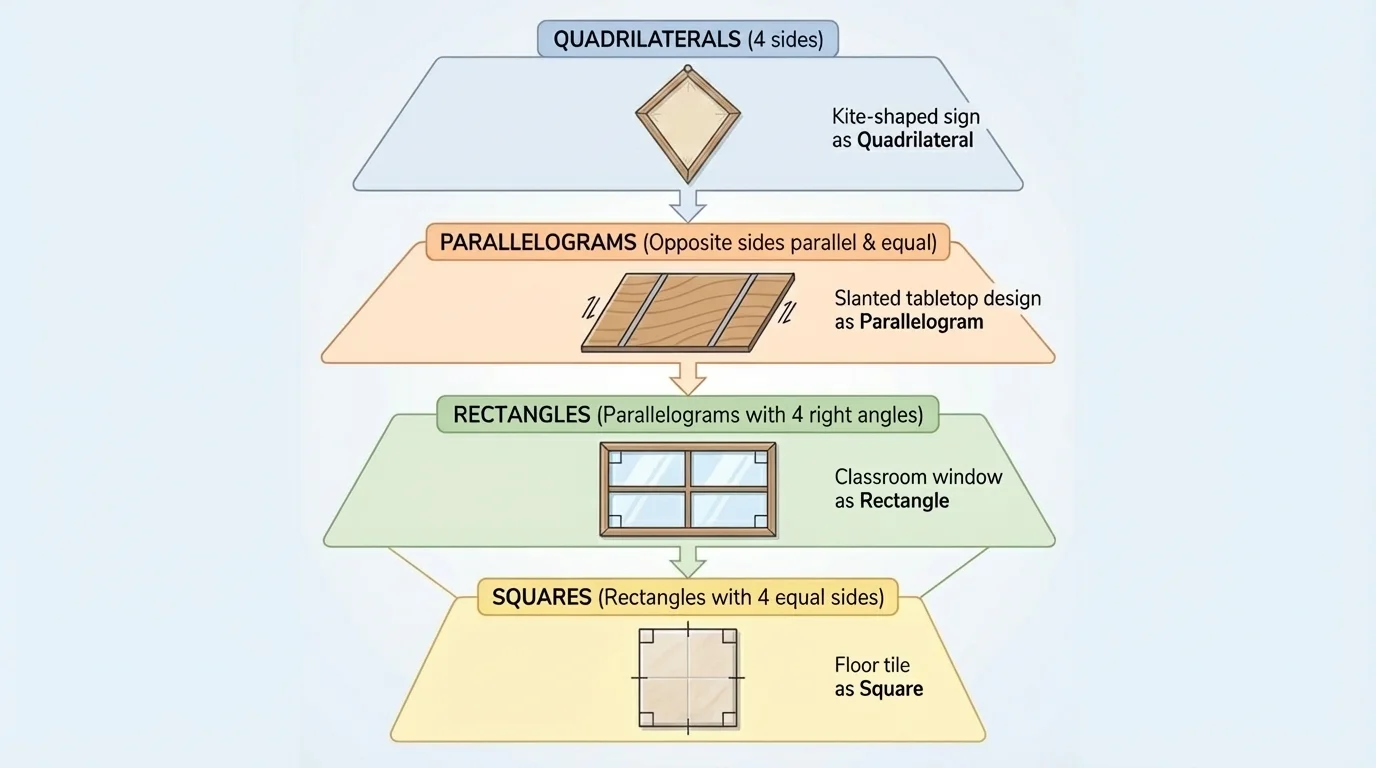
In computer graphics and video games, programmers also sort shapes by properties. A drawing tool may need to know whether a shape has \(4\) equal sides or whether opposite sides are parallel. That helps the program name, rotate, or resize the figure correctly.
When workers cut materials, exact shape classification matters. A square tile and a rectangular tile do not always fit the same space. A builder has to know whether all side lengths match or whether only opposite sides match.
One common mistake is thinking that shape categories are separate boxes that never overlap. In geometry, categories often overlap because one figure can satisfy several definitions at once.
Another mistake is deciding by appearance only. A shape may look "tilted," but if both pairs of opposite sides are parallel, it is still a parallelogram. Geometry depends on properties, not on whether the figure looks upright.
A third mistake is forgetting the exact wording of a definition. For example, if a figure has \(4\) right angles, that is enough to make it a rectangle. It does not matter whether the sides look long or short.
"In geometry, definitions decide the category."
That idea is powerful because it gives us a fair and accurate way to classify all figures. The hierarchy of shapes becomes clearer when we trust properties and definitions every time.
