Every day, people use positions with numbers, even when they do not call them number lines or coordinate planes. A temperature of \(-3\) degrees, a basement on level \(-2\), or a game character at location \((4,-1)\) all depend on knowing exactly where a number belongs. Math gives us a clear way to show these locations: on a number line or on a coordinate plane.
A rational number is any number that can be written as a fraction of two integers, as long as the denominator is not \(0\). That means integers such as \(-4\) and \(7\), fractions such as \(\dfrac{3}{5}\), and decimals such as \(1.2\) and \(-0.75\) are all rational numbers. One big idea of this lesson is that every rational number has one exact place on a number line. When we use two number lines that cross, we can also place pairs of numbers on a coordinate plane.
A number line is a straight line where numbers are placed in order. The center point is usually \(0\). Numbers greater than \(0\) are to the right on a horizontal line, and numbers less than \(0\) are to the left. On a vertical number line, numbers increase upward and decrease downward.
Integer means a whole number and its opposite, including \(0\), such as \(-3\), \(0\), and \(8\).
Opposites are numbers the same distance from \(0\) but on opposite sides, such as \(-2\) and \(2\).
Absolute value is the distance a number is from \(0\) on a number line. For example, the absolute value of \(-5\) is \(5\).
The most important rule for a number line is equal spacing. If the distance from \(0\) to \(1\) is one step, then the distance from \(1\) to \(2\) must be the same size step. This is true for negative numbers too. Without equal spacing, the diagram does not correctly represent the numbers.
On a horizontal number line, as shown in [Figure 1], values increase as you move right. This means \(3\) is to the right of \(1\), and \(-4\) is to the left of \(-2\). Even though \(-4\) and \(-2\) are both negative, \(-4\) is farther left, so it is the smaller number.
To place a number, start by finding the labeled marks. Then count equal spaces from \(0\) or from another known number. If a point is halfway between \(0\) and \(1\), it represents \(\dfrac{1}{2}\), which is also \(0.5\). If a point is halfway between \(-1\) and \(0\), it represents \(-\dfrac{1}{2}\), or \(-0.5\).
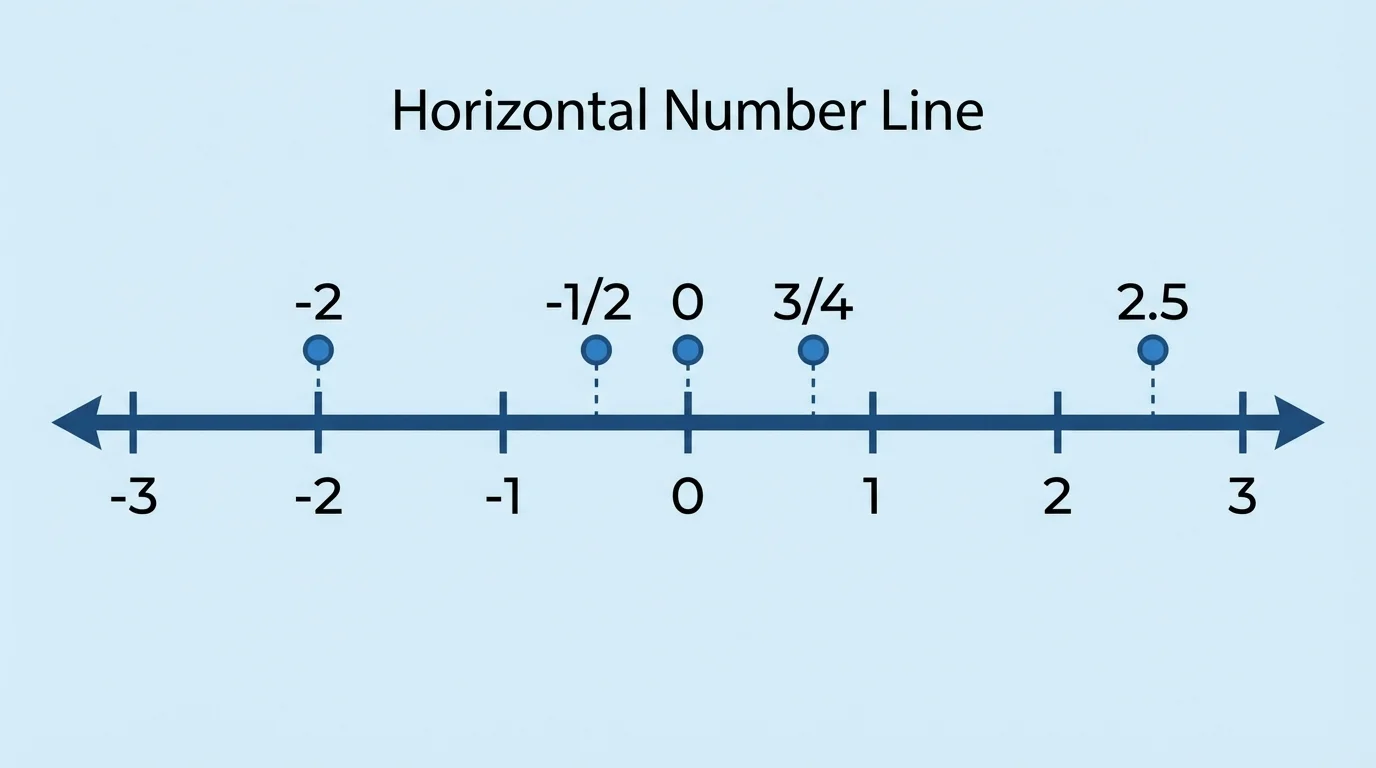
Notice that the number line does not only show whole numbers. It also shows numbers between whole numbers. In fact, there are infinitely many rational numbers between \(0\) and \(1\). For example, \(\dfrac{1}{2}\), \(\dfrac{1}{4}\), \(\dfrac{3}{4}\), \(0.2\), and \(0.99\) all fit between them.
When comparing numbers, position matters. A number farther right is always greater on a horizontal number line. So \(-1\) is greater than \(-3\), even though \(3\) is a larger absolute value than \(1\). This is one reason number lines are so helpful: they make order easy to see.
As shown in [Figure 2], a vertical number line works the same way, except the direction changes. Values increase as you move up and decrease as you move down. A point at \(4\) is above \(0\), while a point at \(-3\) is below \(0\).
Vertical number lines are useful for situations such as elevation, floors in a building, and temperature. A diver at \(-8\) meters is below sea level. A hilltop at \(12\) meters is above sea level. The numbers still follow the same order: higher on the line means greater value.
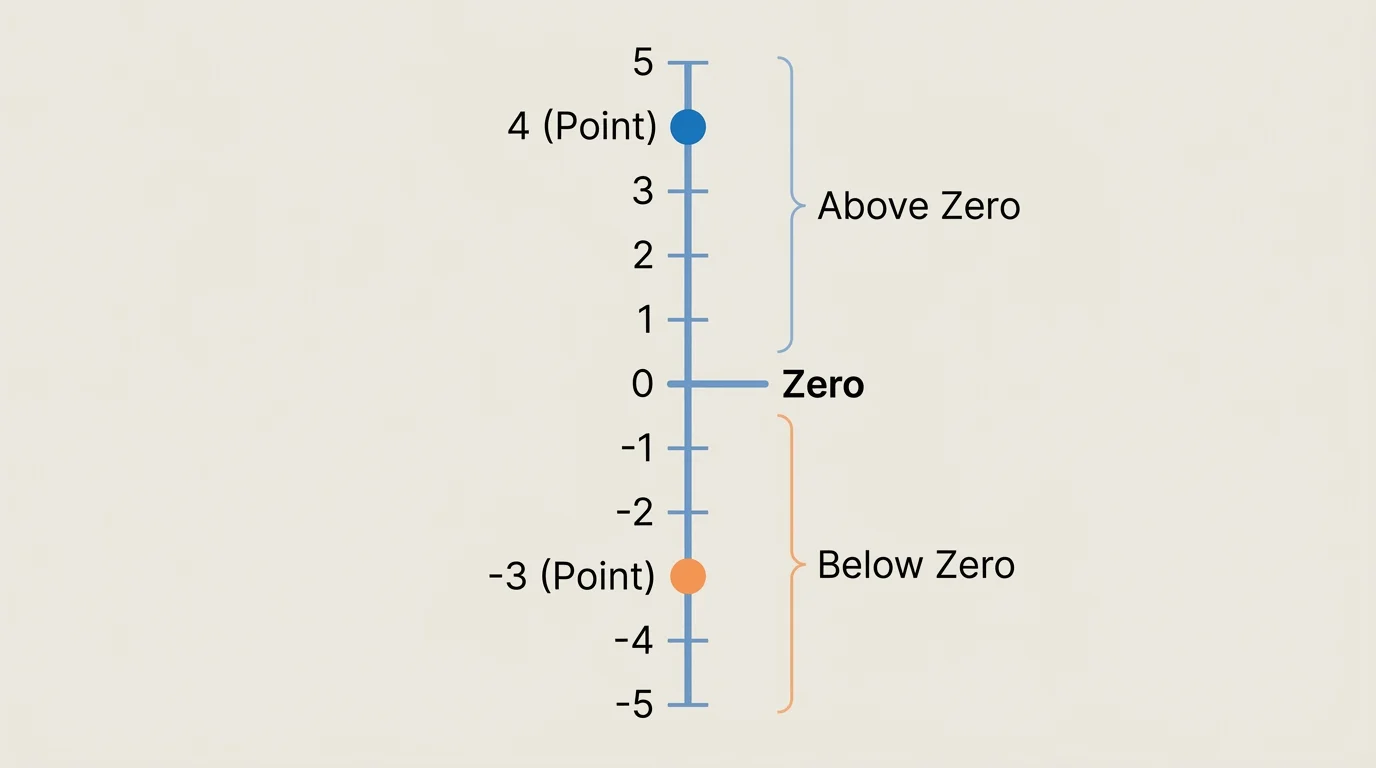
This means you can read a vertical number line just as carefully as a horizontal one. The only difference is the picture. The math idea is unchanged: numbers have exact positions, and equal intervals matter.
You already know that fractions and decimals can name the same value. For example, \(\dfrac{1}{2} = 0.5\) and \(\dfrac{3}{4} = 0.75\). That idea helps when placing rational numbers on a line.
As illustrated in [Figure 3], fractions and decimals are placed by dividing each unit into equal parts. If you want to plot fourths, then each unit from one integer to the next must be split into \(4\) equal pieces. If you want to plot tenths, each unit is split into \(10\) equal pieces.
For example, to place \(\dfrac{3}{4}\), start at \(0\) and move three of the four equal parts toward \(1\). To place \(1.5\), start at \(1\) and move halfway to \(2\). To place \(-1.25\), start at \(-1\) and move one-fourth of the way toward \(-2\).
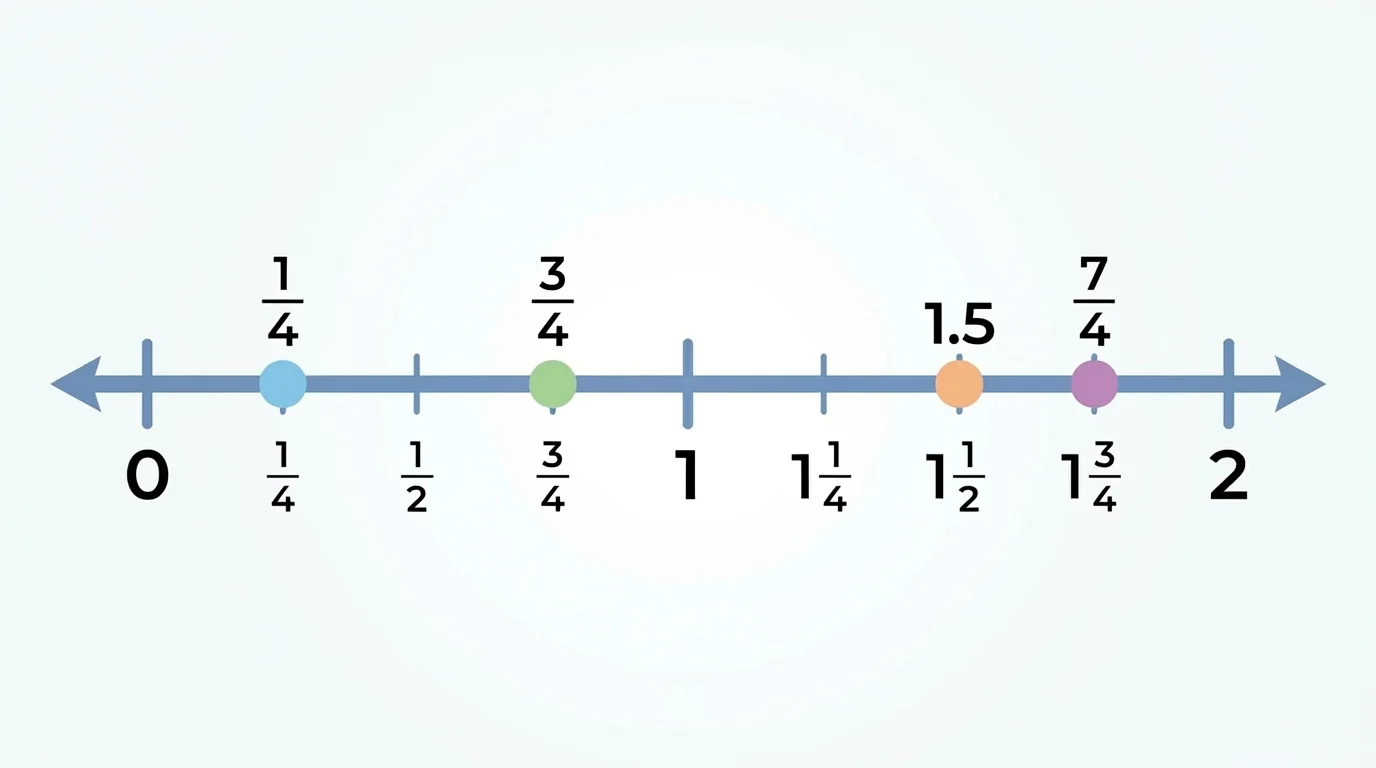
Equivalent numbers go in the same place. For example, \(\dfrac{1}{2}\), \(0.5\), and \(\dfrac{2}{4}\) all name the same point. This is a powerful idea because it connects fractions, decimals, and percents later on.
| Number | Equivalent Form | Location Idea |
|---|---|---|
| \(\dfrac{1}{2}\) | \(0.5\) | Halfway between \(0\) and \(1\) |
| \(\dfrac{3}{2}\) | \(1.5\) | Halfway between \(1\) and \(2\) |
| \(-\dfrac{3}{4}\) | \(-0.75\) | Three-fourths of the way from \(0\) to \(-1\) |
| \(\dfrac{7}{4}\) | \(1.75\) | Three-fourths of the way from \(1\) to \(2\) |
Table 1. Examples of rational numbers written in equivalent forms and described by location on a number line.
Worked examples help show how to turn a number into a position. Pay attention to the direction, the whole number part, and the size of the pieces between integers.
Worked example 1
Plot \(-3\) on a horizontal number line.
Step 1: Find \(0\) and identify the direction of negative numbers.
Negative numbers are to the left of \(0\).
Step 2: Count equal spaces.
Move \(1\) unit left to \(-1\), another to \(-2\), and one more to \(-3\).
Step 3: Mark the point.
The point is exactly three units left of \(0\).
The correct location is \(-3\).
This example is simple, but it shows an important fact: an integer lands exactly on a tick mark if the line is labeled by ones.
Worked example 2
Plot \(\dfrac{5}{4}\) on a number line.
Step 1: Rewrite the number in a useful form.
\(\dfrac{5}{4} = 1\dfrac{1}{4} = 1.25\).
Step 2: Find the interval.
Since \(1.25\) is greater than \(1\) and less than \(2\), the point lies between \(1\) and \(2\).
Step 3: Divide the unit into fourths.
Split the distance from \(1\) to \(2\) into \(4\) equal parts.
Step 4: Move one fourth past \(1\).
The point is at the first fourth mark after \(1\).
The correct location is \(1\dfrac{1}{4}\), or \(1.25\).
Whenever the denominator is \(4\), thinking in fourths makes the placement easier. The same idea works with thirds, fifths, tenths, and other equal partitions.
Worked example 3
Plot \(-0.6\) on a vertical number line.
Step 1: Locate \(0\) and \(-1\).
The number \(-0.6\) is between \(0\) and \(-1\).
Step 2: Divide the interval into tenths.
Because \(0.6\) means six tenths, split the space from \(0\) to \(-1\) into \(10\) equal parts.
Step 3: Count downward.
Move down \(6\) tenths from \(0\).
The point is \(-0.6\), slightly more than halfway from \(0\) to \(-1\).
Because it is negative, the point must be below \(0\). That quick sign check helps catch mistakes.
As shown in [Figure 4], a coordinate plane is made from two number lines that cross at \(0\). The horizontal line is the x-axis, and the vertical line is the y-axis. Their intersection point is the origin, written as \((0,0)\).
Every point on the coordinate plane is named by an ordered pair. An ordered pair has two numbers written in a specific order: \((x,y)\). The first number tells how far to move left or right from the origin. The second number tells how far to move up or down.
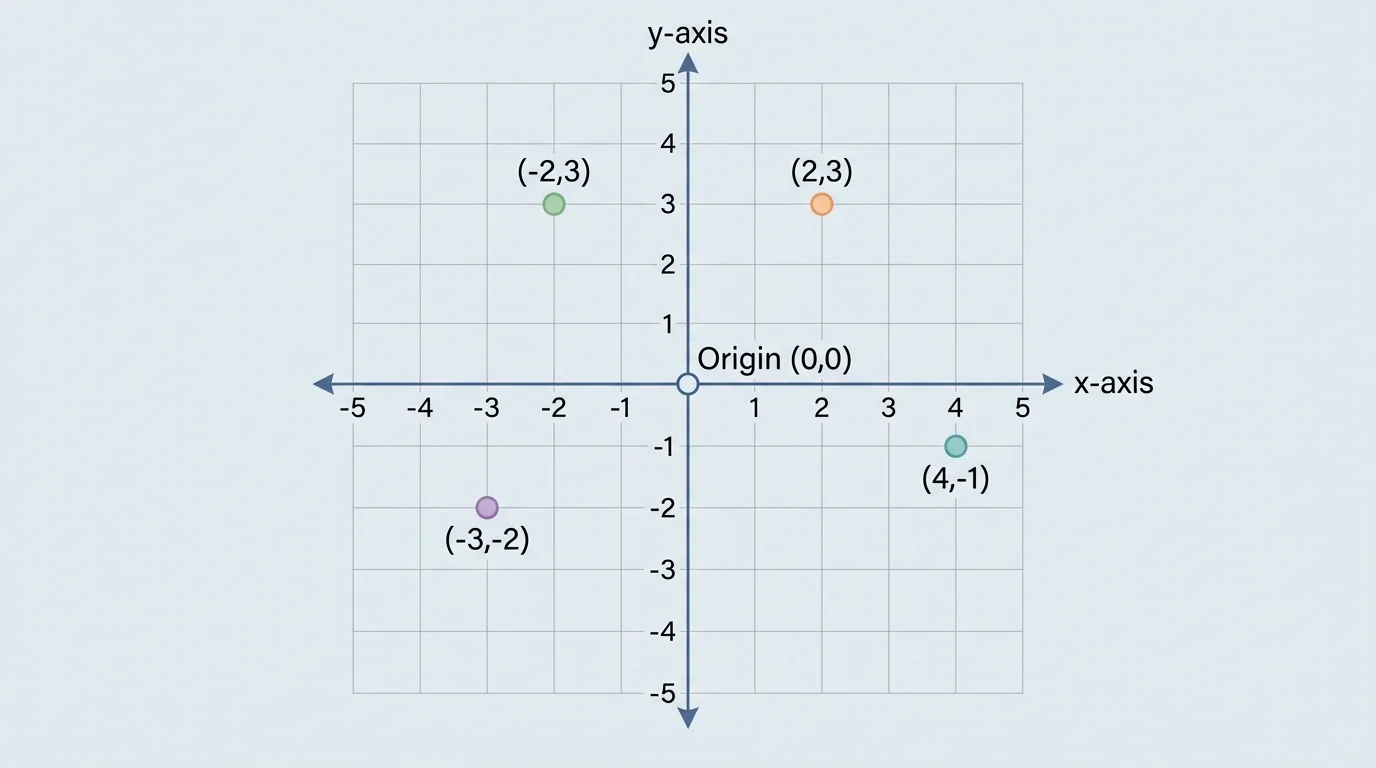
For example, the point \((3,2)\) means move \(3\) units right and \(2\) units up. The point \((-4,1)\) means move \(4\) units left and \(1\) unit up. The order matters a lot. The point \((3,2)\) is not the same point as \((2,3)\).
How the coordinate plane combines two number lines
You can think of the coordinate plane as a horizontal number line and a vertical number line working together. First read the horizontal position, then read the vertical position. This gives one exact location in the plane.
Points can lie in different parts of the plane depending on the signs of the coordinates. If both numbers are positive, the point is right and up from the origin. If the first is negative and the second is positive, the point is left and up. If both are negative, the point is left and down. If the first is positive and the second is negative, the point is right and down.
Negative coordinates are often the trickiest part at first, but they follow the same direction rules as number lines. A negative \(x\)-coordinate means move left. A negative \(y\)-coordinate means move down. Keeping the signs connected to direction helps you plot correctly.
Suppose you need to plot \((-2,-3)\). Start at the origin. Move \(2\) units left because the \(x\)-value is \(-2\). Then move \(3\) units down because the \(y\)-value is \(-3\). Mark the point there.
Points with different sign patterns end up in different regions of the plane. That is why it is useful to pause and predict the general area before plotting the exact point.
Worked example 4
Plot the point \((4,-2)\).
Step 1: Read the first coordinate.
The \(x\)-coordinate is \(4\), so move \(4\) units to the right.
Step 2: Read the second coordinate.
The \(y\)-coordinate is \(-2\), so move \(2\) units down.
Step 3: Mark the point.
The point is right of the origin and below it.
The plotted point is \((4,-2)\).
This point has one positive coordinate and one negative coordinate, so it lies to the right and below the origin.
Worked example 5
A point is \((-3,5)\). Describe where it is and plot it.
Step 1: Read the \(x\)-coordinate.
\(-3\) means move \(3\) units left.
Step 2: Read the \(y\)-coordinate.
\(5\) means move \(5\) units up.
Step 3: Combine the moves.
From the origin, go left \(3\) and up \(5\).
The point is left of the origin and above it.
A good habit is to say the moves out loud: "left \(3\), up \(5\)." That keeps the order clear.
Worked example 6
Which point is farther right: \((-1,4)\) or \((2,4)\)?
Step 1: Compare the \(x\)-coordinates.
The first point has \(x = -1\). The second point has \(x = 2\).
Step 2: Decide which \(x\)-value is greater.
Since \(2 > -1\), the point with \(x = 2\) is farther right.
Step 3: Check the \(y\)-coordinates.
Both points have \(y = 4\), so they are on the same horizontal level.
The point farther right is \((2,4)\).
This example shows that sometimes you compare only one coordinate. If you want to know which point is higher, compare the \(y\)-coordinates instead.
One common mistake is using unequal spacing on a number line. If the marks are not evenly spaced, then numbers are not shown correctly. Another mistake is putting a negative number on the wrong side of \(0\), or above instead of below on a vertical line.
On the coordinate plane, students often switch the order of the coordinates. Remember: \((x,y)\) means horizontal first, vertical second. If you plot \((2,-3)\) as left \(2\), down \(3\), you accidentally used \((-2,-3)\) instead.
Here are a few quick checks: if a number is negative, it must be left of \(0\) on a horizontal line or below \(0\) on a vertical line. If a point has a positive \(x\)-coordinate, it must be right of the origin. If a point has a negative \(y\)-coordinate, it must be below the origin. Small checks like these can save a lot of trouble.
Game designers, pilots, sailors, and map makers all use systems based on coordinates. The same idea that helps you plot \((3,-2)\) in math also helps people describe real locations accurately.
Number lines and coordinate planes are not just classroom pictures. They model real situations. A horizontal number line can represent gains and losses of money. A vertical number line can represent temperatures above and below \(0\), or floors in a building above and below ground level.
A coordinate plane can represent a city map with east-west and north-south streets, a seat map in a stadium, or positions in a video game. If a robot starts at the origin and moves to \((5,-1)\), that tells exactly where it ends up. The same precision helps in science, engineering, and computer graphics.
Even weather maps use ideas related to coordinates. A place can be identified by two measurements, one for east-west position and one for north-south position. That is another reason this topic matters: it turns location into something that can be described with numbers.
"A number line shows where one number lives. A coordinate plane shows where two numbers meet."
Once you understand how one rational number is placed on a line, the coordinate plane becomes much easier. It is really the same idea, used twice at once.
