Suppose someone says, "I am thinking of a number. When I add \(4\), I get \(8\)." That is really a question in disguise: which number works? Algebra is full of questions like that. Sometimes there is one answer, sometimes there are many, and sometimes there are none at all. Learning to solve equations and inequalities means learning how to answer that question clearly and correctly.
An equation says that two expressions are equal. For example, \(x + 4 = 8\) is an equation. The variable \(x\) stands for a number we do not know yet. To solve the equation means to find which value of \(x\) makes the equation true.
An inequality compares two expressions that are not necessarily equal. It might use symbols such as \(<\), \(>\), \(\le\), or \(\ge\). For example, \(x + 2 > 7\) is an inequality. Solving it means finding all values of \(x\) that make the statement true.
Equation means a math statement showing that two expressions are equal.
Inequality means a math statement comparing two expressions using symbols such as \(<\), \(>\), \(\le\), or \(\ge\).
Solution means a value that makes an equation or inequality true.
Sometimes you are not allowed to use just any number. The problem may give a specified set, which is the list or group of values you are supposed to check. For example, if the set is \(\{1, 2, 3, 4, 5\}\), then only those numbers are possible answers. Even if another number works, it does not count unless it is in the set.
This idea is important because solving is not only about doing steps. It is about answering a question: Which values from this set, if any, make the statement true?
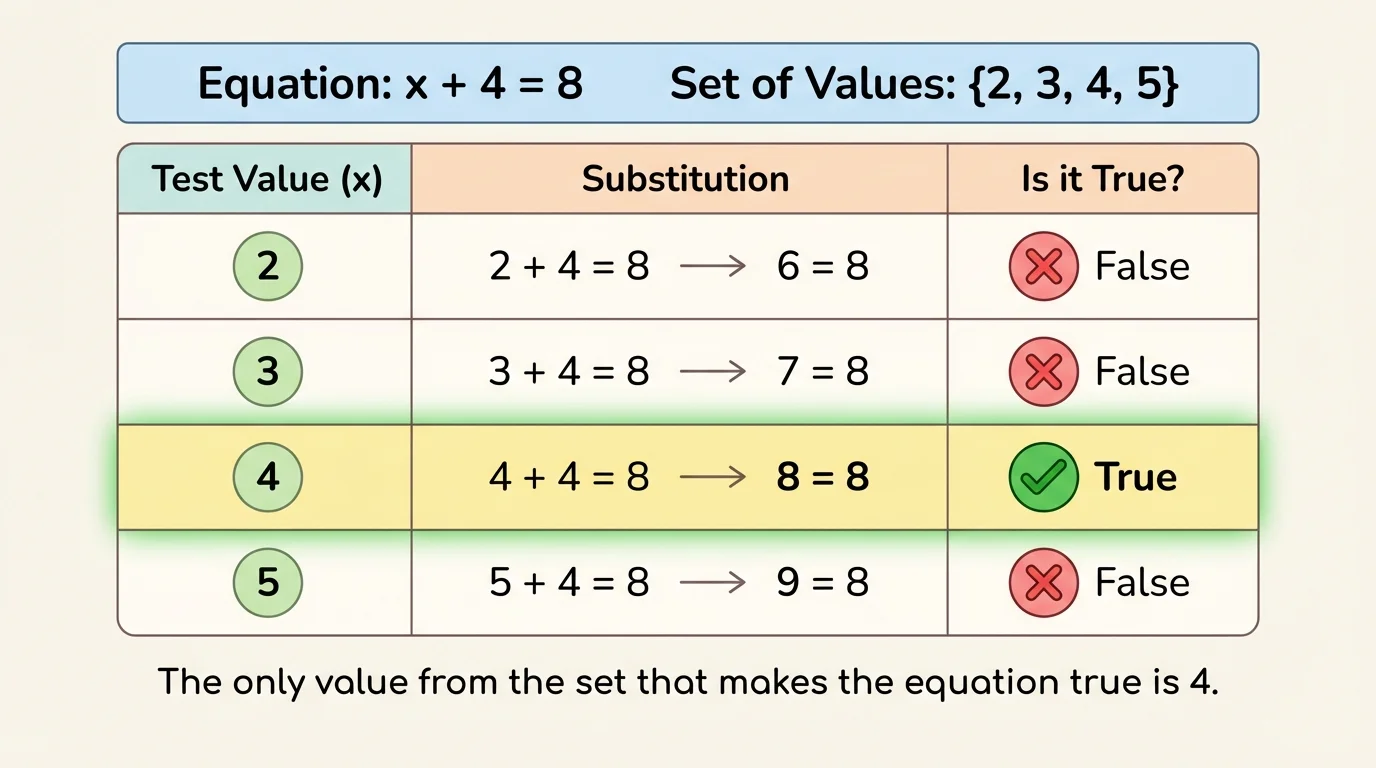
One of the quickest ways to test a number is substitution. That means replacing the variable with the number and seeing whether the statement becomes true, as [Figure 1] shows when several values are tested from one set.
For example, test whether \(x = 4\) makes \(x + 4 = 8\) true. Replace \(x\) with \(4\): \(4 + 4 = 8\). Since \(8 = 8\), the statement is true. So \(4\) is a solution.
Now test whether \(x = 3\) works in the same equation. Substitute \(3\): \(3 + 4 = 8\). This gives \(7 = 8\), which is false. So \(3\) is not a solution.
Substitution works for inequalities too. To test whether \(x = 6\) makes \(x - 1 > 3\) true, replace \(x\) with \(6\): \(6 - 1 > 3\). Then \(5 > 3\), which is true, so \(6\) is a solution.
If you test \(x = 4\) in \(x - 1 > 3\), you get \(4 - 1 > 3\), or \(3 > 3\). That is false, because \(3\) is not greater than \(3\). It is equal. So \(4\) is not a solution.
Worked example 1
From the set \(\{2, 5, 7, 9\}\), determine which values make \(x + 1 = 8\) true.
Step 1: Test \(x = 2\).
Substitute: \(2 + 1 = 8\), so \(3 = 8\). This is false.
Step 2: Test \(x = 5\).
Substitute: \(5 + 1 = 8\), so \(6 = 8\). This is false.
Step 3: Test \(x = 7\).
Substitute: \(7 + 1 = 8\), so \(8 = 8\). This is true.
Step 4: Test \(x = 9\).
Substitute: \(9 + 1 = 8\), so \(10 = 8\). This is false.
The only solution from the set is \(\boxed{7}\).
Notice something useful: substitution does not change the equation or inequality. It simply checks whether a value works. This is especially helpful when a problem gives you a short set of possible answers.
Sometimes instead of testing every number in a set, you can solve the equation directly. This means using what you know about operations to find the value of the variable.
For example, in \(x + 6 = 10\), the question is "What number plus \(6\) equals \(10\)?" Since \(4 + 6 = 10\), the solution is \(x = 4\).
You can also think of undoing the operation. Addition can be undone by subtraction. So subtract \(6\) from both sides: \(x + 6 - 6 = 10 - 6\). This gives \(x = 4\).
Addition and subtraction undo each other, and multiplication and division undo each other. These inverse operations help you isolate the variable and solve equations.
Here are some common one-step equations:
| Equation | Question to Ask | Solution |
|---|---|---|
| \(x + 3 = 11\) | What number plus \(3\) equals \(11\)? | \(x = 8\) |
| \(x - 5 = 2\) | What number minus \(5\) equals \(2\)? | \(x = 7\) |
| \(3x = 12\) | What number times \(3\) equals \(12\)? | \(x = 4\) |
| \(\dfrac{x}{2} = 6\) | What number divided by \(2\) equals \(6\)? | \(x = 12\) |
Table 1. Examples of one-step equations and the questions they represent.
After solving, it is smart to check your answer by substitution. If you solve \(3x = 12\) and get \(x = 4\), substitute: \(3(4) = 12\). Since \(12 = 12\), the answer is correct.
Worked example 2
Solve \(x - 9 = 5\), and check the answer.
Step 1: Undo subtraction.
Add \(9\) to both sides: \(x - 9 + 9 = 5 + 9\).
Step 2: Simplify.
This gives \(x = 14\).
Step 3: Check by substitution.
Substitute \(14\) into the original equation: \(14 - 9 = 5\).
Step 4: Decide whether it is true.
Since \(5 = 5\), the equation is true.
The solution is \(\boxed{14}\).
When an equation has one solution, that solution is the value that makes the statement true. If a specified set is given, the solution must also belong to that set.
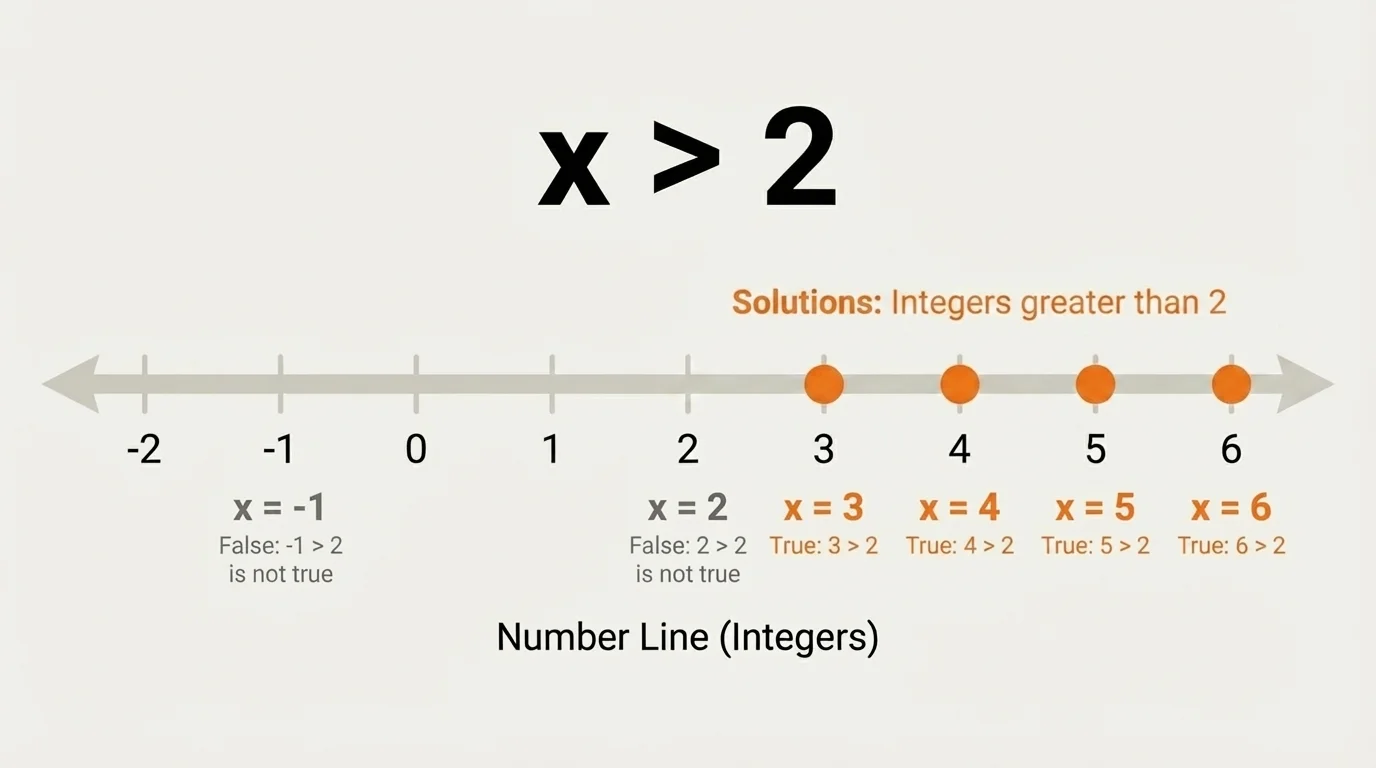
An inequality is different from an equation because it often has more than one solution. In fact, it may have many solutions, as [Figure 2] illustrates on a number line where several values make the statement true.
Take \(x + 3 > 7\). We want all values of \(x\) that make the inequality true. Subtract \(3\) from both sides: \(x > 4\). This means any number greater than \(4\) is a solution.
If the specified set is \(\{2, 3, 4, 5, 6, 7\}\), then only the numbers in that set that are greater than \(4\) count. So the solutions are \(\{5, 6, 7\}\).
Inequalities can use different symbols:
| Symbol | Meaning | Example |
|---|---|---|
| \(>\) | greater than | \(x > 3\) |
| \(<\) | less than | \(x < 3\) |
| \(\ge\) | greater than or equal to | \(x \ge 3\) |
| \(\le\) | less than or equal to | \(x \le 3\) |
Table 2. Common inequality symbols and what they mean.
The words or equal to matter a lot. For example, \(x \ge 5\) includes \(5\), but \(x > 5\) does not. That single line under the symbol changes the answer.
Worked example 3
From the set \(\{1, 2, 3, 4, 5, 6\}\), find all values that make \(x - 2 \le 2\) true.
Step 1: Solve the inequality.
Add \(2\) to both sides: \(x - 2 + 2 \le 2 + 2\), so \(x \le 4\).
Step 2: Use the specified set.
We need numbers from \(\{1, 2, 3, 4, 5, 6\}\) that are less than or equal to \(4\).
Step 3: List the solutions.
The solutions are \(\{1, 2, 3, 4\}\).
Step 4: Check one boundary value.
Test \(x = 4\): \(4 - 2 \le 2\), so \(2 \le 2\). This is true, so \(4\) belongs in the solution set.
The solution set is \(\boxed{\{1, 2, 3, 4\}}\).
As with equations, substitution is a powerful way to check whether a particular value belongs in the solution set. The number line view from [Figure 2] helps you see why several different numbers can all work at once.
Sometimes students solve correctly but forget to use the given set. That changes the answer. The specified set controls which values are allowed, and the same inequality can lead to different listed solutions depending on the allowed numbers.
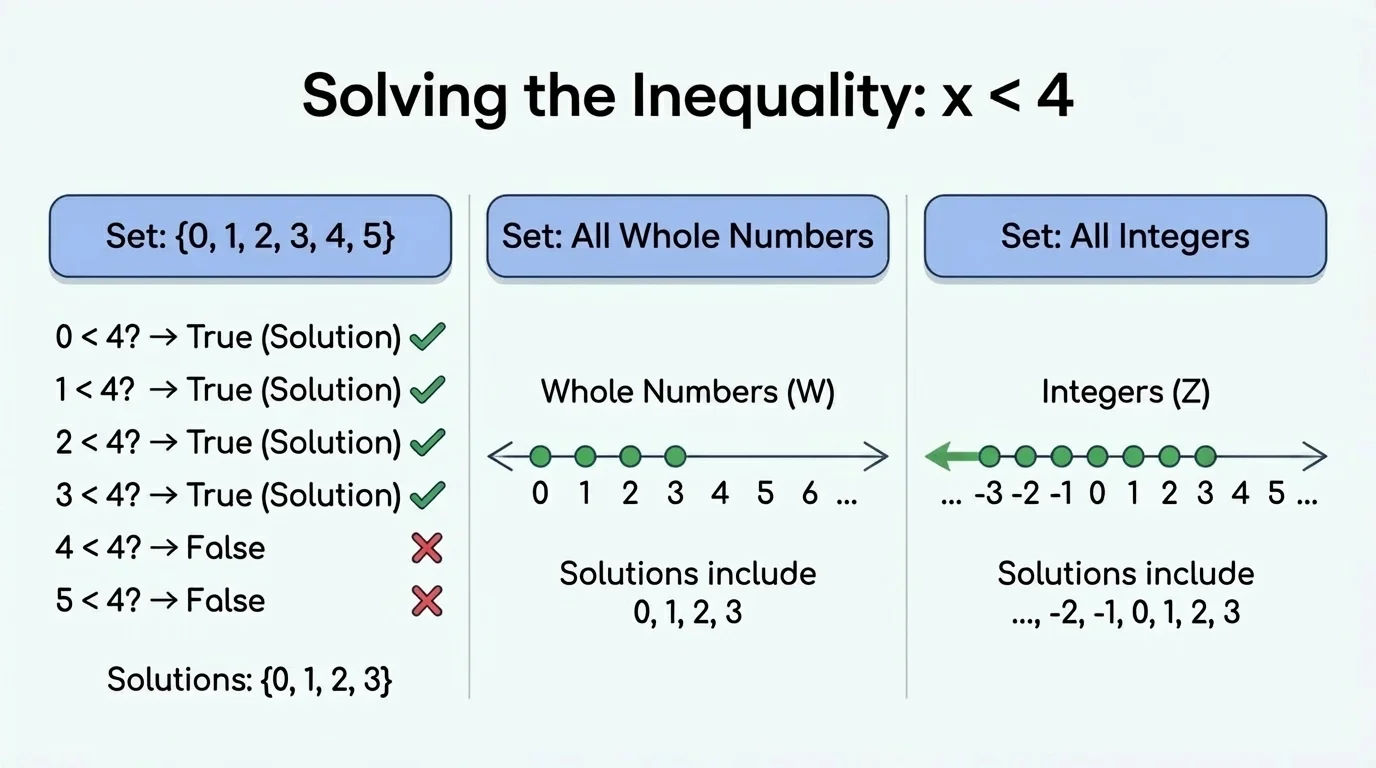
[Figure 3] Consider \(x < 4\). If the specified set is \(\{0, 1, 2, 3, 4, 5\}\), then the solutions are \(\{0, 1, 2, 3\}\). If the specified set is all whole numbers, then the solutions are \(0, 1, 2, 3, ...\). If the specified set is all integers, then the solutions are \(..., -3, -2, -1, 0, 1, 2, 3\).
The rule is simple: first understand the equation or inequality, then limit your answer to the given set if there is one.
This also means some problems can have no solution from the given set. For example, from the set \(\{1, 2, 3\}\), the equation \(x + 5 = 10\) has no solution, because the value that works is \(5\), and \(5\) is not in the set.
Why sets change the answer
An equation or inequality asks about truth, but the specified set tells you where to look for that truth. If you are only allowed to search in a small group of numbers, you may find one answer, many answers, or none. The math statement stays the same, but the allowed numbers change what counts as a solution.
This idea shows up often in puzzles, games, and coding. A rule may be true for many numbers, but only a few are allowed because of the situation.
One common mistake is forgetting to substitute correctly. If the equation is \(2x + 1 = 9\) and you test \(x = 4\), you must replace \(x\) everywhere: \(2(4) + 1 = 9\). Then \(8 + 1 = 9\), so it is true.
Another mistake is mixing up equation and inequality answers. An equation such as \(x + 2 = 5\) usually has one solution, here \(x = 3\). But an inequality such as \(x + 2 < 5\) has many solutions, all values less than \(3\).
A third mistake is forgetting that equality matters. In \(x \le 6\), the number \(6\) is included. In \(x < 6\), it is not.
A tiny symbol can completely change the answer set. The difference between \(>\) and \(\ge\) is only one short line, but it decides whether the boundary number belongs in the solution set.
Students also sometimes stop too soon. If you solve \(x > 2\) but the specified set is \(\{0, 1, 2, 3, 4\}\), the final answer is not just "\(x > 2\)." The final answer from the set is \(\{3, 4\}\).
Equations and inequalities appear in everyday situations more often than you might think. If you save the same amount of money each week, you can write an equation to find how many weeks it takes to reach a goal. If you want to spend no more than a certain amount, you can write an inequality.
Suppose a game gives \(3\) points for each goal, and a player wants exactly \(12\) points. The equation is \(3g = 12\), where \(g\) is the number of goals. Solving gives \(g = 4\). If the player wants at least \(12\) points, the inequality is \(3g \ge 12\), so \(g \ge 4\).
In measurement, a plant that grows \(2\) centimeters each week may follow a rule such as \(h = 10 + 2w\), where \(h\) is height and \(w\) is weeks. If you want to know when the plant reaches more than \(18\) centimeters, solve \(10 + 2w > 18\). Then \(2w > 8\), so \(w > 4\). After more than \(4\) weeks, the plant is taller than \(18\) centimeters.
Worked example 4
A movie ticket costs $6. Let \(t\) be the number of tickets. You have $24. How many tickets can you buy?
Step 1: Write an equation.
The total cost is \(6t\), and you have exactly $24, so \(6t = 24\).
Step 2: Solve.
Divide both sides by \(6\): \(t = 4\).
Step 3: Check.
Substitute \(t = 4\): \(6(4) = 24\), so \(24 = 24\). This is true.
You can buy \(\boxed{4}\) tickets.
Now change the question slightly: you want to spend no more than $24. Then the inequality is \(6t \le 24\), so \(t \le 4\). If \(t\) must be a whole number of tickets, the possible values are \(0, 1, 2, 3, 4\). This is another example of how the specified set matters.
When you solve equations and inequalities, you are really deciding which numbers make a mathematical statement true. Whether you test a value by substitution, solve directly, or list answers from a set, the goal stays the same: identify the values that work.
